

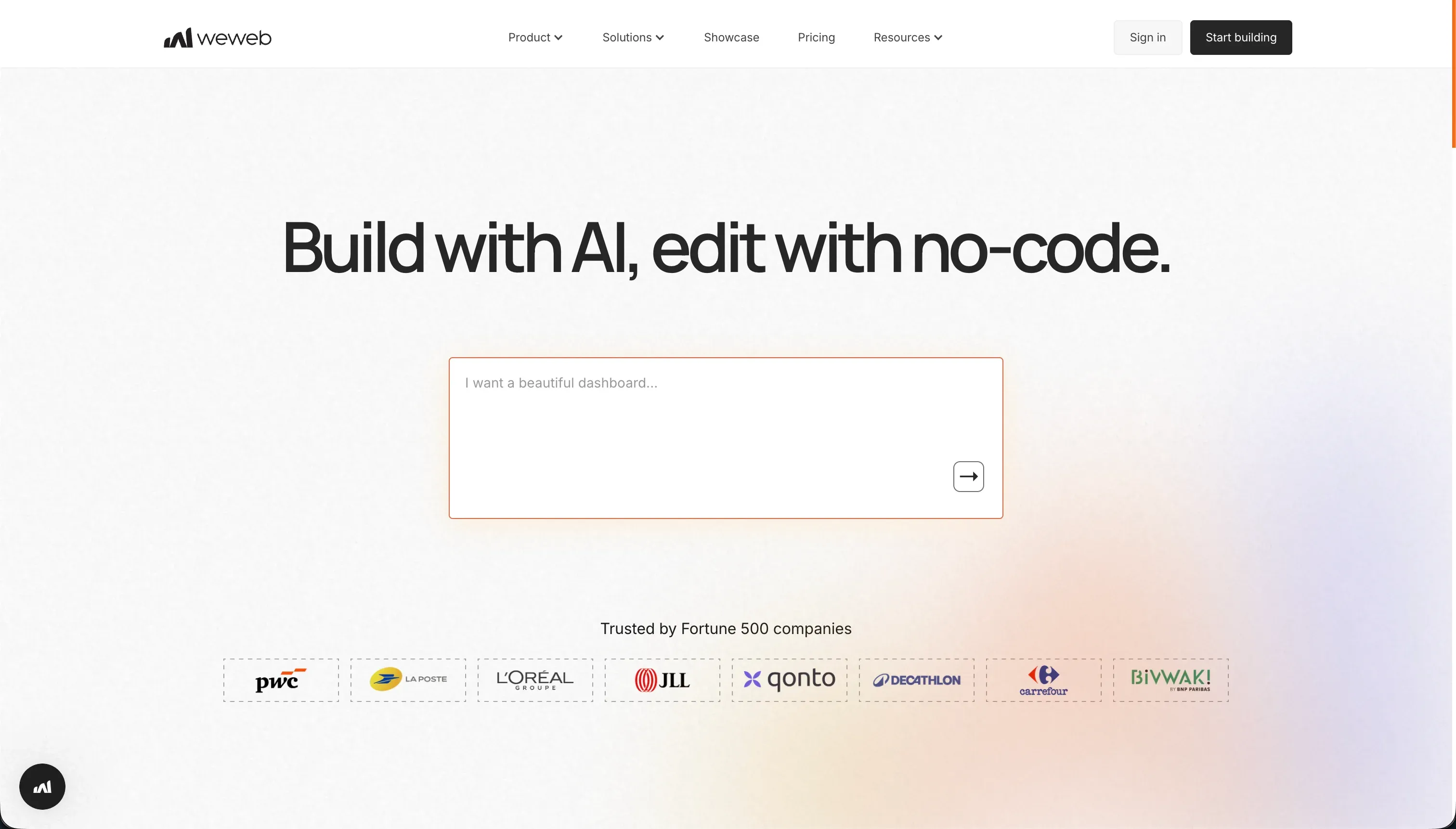
The decision between WeWeb and Adalo represents a classic architectural divide in software procurement. Buyers choosing WeWeb are opting for a decoupled front-end builder that requires separate data hosting, designed to compile high-performing single-page applications.
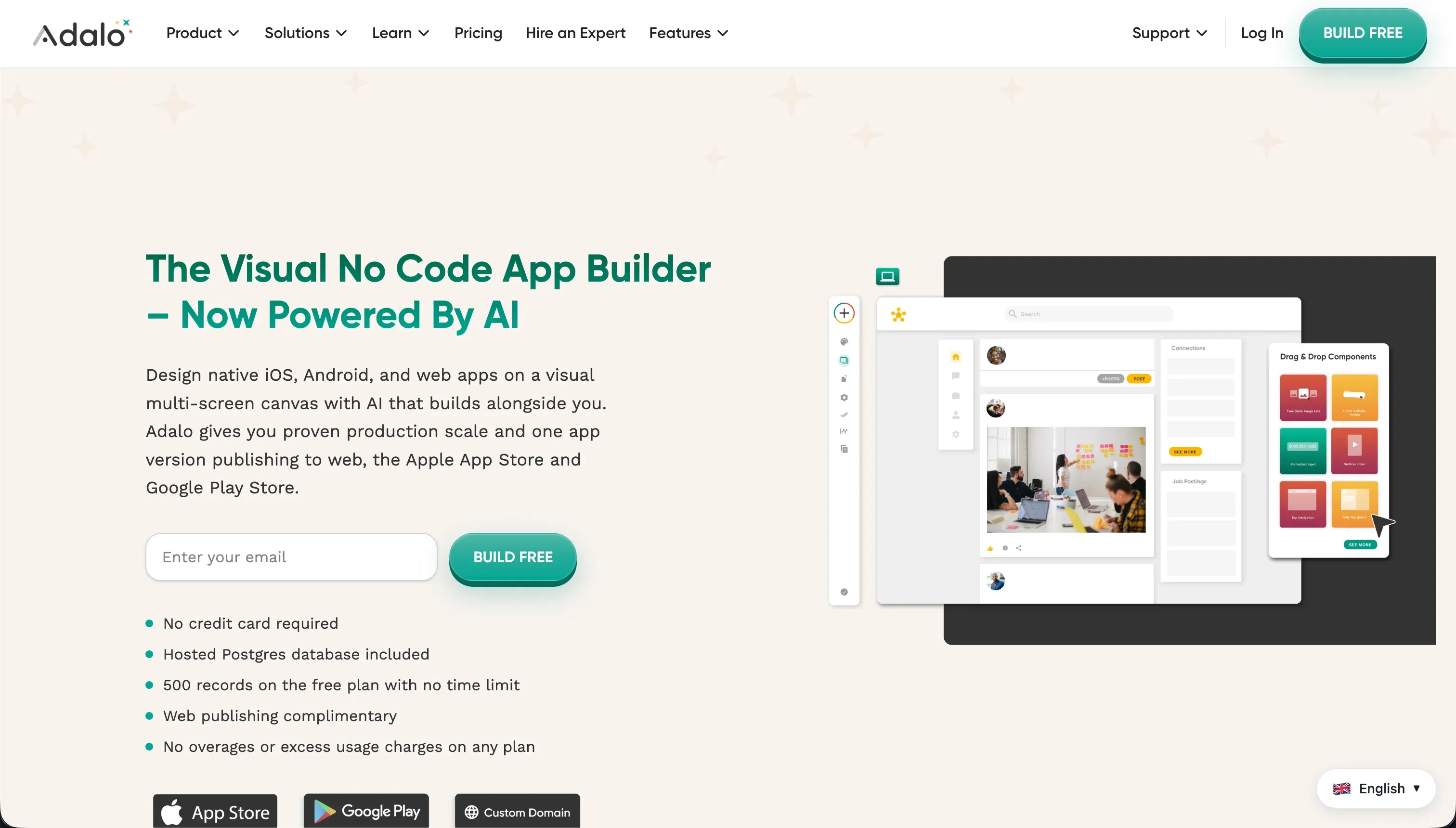
Buyers choosing Adalo are selecting an all-in-one mobile-first visual builder with an integrated database, designed for rapid layout and direct publishing to native mobile app stores.
WeWeb wins the general decision on scored criteria, securing an aggregate 6.2/10 over Adalo’s 4.6/10. Because Adalo’s build model focuses on a fixed-width screen canvas while WeWeb leverages a responsive CSS engine, WeWeb delivers superior durability for mainstream business software. This aggregate result only flips to Adalo if you must run native mobile applications on a budget and have a developer handoff planned.
The decision in 30 seconds
| If your priority is… | Pick | Why |
|---|---|---|
| Custom layouts and responsive desktop web components | WeWeb | An 8.5 design flexibility score with CSS flexbox and grids |
| Fast setup and a simple built-in database | Adalo | Scores 6.0 on ease of build with a drag-and-drop relational canvas |
| Reliable data storage and error-free production scaling | Neither | Adalo has database reliability issues and WeWeb has no native data storage |
| Secure client portals with row-level permissions | WeWeb | Token-based external-auth integration is far more secure than visual filters |
| Direct app store packaging and publishing | Adalo | Built-in mobile compiler handles app store submissions out of the box |
What each platform is
What is WeWeb?
WeWeb is a visual compiler for the front-end that operates on a decoupled architecture. Instead of managing your data locally, it requires you to build layouts that connect dynamically to external databases or APIs via structured token-based authentication.
This design is highly favored by technical agencies and front-end developers who demand pixel-level interface control but want to keep their back-end completely separate.
Concrete features in WeWeb include a visual layout engine configured around CSS flexbox, grids, and absolute positioning, alongside an integrated AI assistant that generates raw JavaScript code snippets to power custom components.
Since WeWeb has no built-in database, it is genuinely built for developers and teams utilizing dedicated back-ends like Supabase, Xano, or Airtable who want to publish fast, SEO-friendly single-page web applications.
What is Adalo?
Adalo is an all-in-one visual app builder that relies on a free-positioning drag-and-drop canvas. It stores app data in its own integrated relational database while providing basic visual actions to handle navigation, record updates, and push notifications. It is built to serve creators, startup founders, and non-technical business builders looking to launch simple mobile app MVPs.
Key features of Adalo are its visual canvas editor, a component marketplace for third-party add-ons, and a native mobile compiler designed to package your projects for submission to the Apple and Google Play app stores. The interface is optimized to manage basic user profiles and directories, although complex multi-step automations and dynamic data relationships require extensive workarounds to configure manually.
The core difference
The primary dividing line between these platforms is the choice between a decoupled front-end architecture and an all-in-one visual silo.
- WeWeb operates on a fully decoupled model, separating layout construction from your data layer and requiring custom-wired API payloads.
- Adalo bundles database storage, interface layout, and packaging in a single visual editor with a fixed-width mobile canvas.
Where the scores diverge
Design flexibility: WeWeb 8.5, Adalo 5.0. WeWeb secures an 8.5 here, which is its highest score, against Adalo’s 5.0. WeWeb offers a visual layout engine modeled on CSS standards, plus an AI assistant that facilitates custom JavaScript components.
Adalo uses a free-floating canvas based on a fixed-width mobile frame, which results in desktop web layouts that look like stretched phone interfaces instead of responsive designs.
Production readiness: WeWeb 6.0, Adalo 3.5. WeWeb scores 6.0 against Adalo’s low 3.5. WeWeb compiles single-page applications that render reliably on desktop and handle search optimization natively. However, its score is limited by reports of trailing performance on mobile browsers relative to desktop.
Adalo’s score reflects user reviews citing daily internal server errors hit by paying customers, unacceptably slow native Android load times, and documented instances of database data loss, making it suitable and safe for mockups and validation only.
Ease of build: WeWeb 4.0, Adalo 6.0. Adalo wins this segment with a 6.0 score, while WeWeb drops to 4.0. Adalo uses an intuitive drag-and-drop canvas and a built-in database, which shortens the learning curve.
WeWeb has no native database, which means you cannot build a functional app without first purchasing, configuring, and connecting an external service such as Xano, Supabase, or Airtable. Managing routing, token-based auth, and API payloads in WeWeb also requires a solid grasp of web development concepts.
Maintainability: WeWeb 6.0, Adalo 4.0. WeWeb takes this 6.0 to 4.0. WeWeb uses a centralized visual state editor to manage variables and triggers, though the decoupled setup means updates often require matching modifications on both WeWeb and your external database.
Adalo’s automation engine is difficult to manage on day two; multi-step logic easily becomes fragile, and users report that changes to external API setups require building API configurations again from scratch instead of modifying existing parameters.
Data & integrations: WeWeb 7.0, Adalo 5.0. WeWeb leads this category 7.0 to 5.0. WeWeb natively connects to SQL databases and REST APIs, serving as a flexible front-end client, though its deduction reflects weak headless-CMS sync.
Adalo relies mainly on its internal database, which becomes a bottleneck at scale, lacks two-way live sync with external databases, and relies on integration pipelines that scale poorly.
Security & access control: WeWeb 5.5, Adalo 4.0. WeWeb scores 5.5, while Adalo scores 4.0. WeWeb relies on configured tokens and row-level rules built inside your external database; its security is strong, but only as reliable as the third-party backend you build.
Adalo provides only basic user login roles, requiring you to construct custom visibility filters manually on every screen element to build a multi-role app, which frequently risks exposing data in shared environments.
Cost comparison
WeWeb uses a subscription model that breaks down into the Starter tier at $59/month billed monthly and the Scale plan at $249/month. Staging environments and code download features are kept behind the higher plans, which raises the upfront investment for professional workflows.
Adalo offers a Starter tier at $45/month billed monthly and a Professional plan at $65/month, scaling up to the Team tier at $200/month based on database record limits and native publishing features.
The real cost of ownership diverges on the development stack. WeWeb demands that you pay separate database fees for Supabase, Xano, or Airtable starting on day one. Adalo includes database storage in its pricing, but you must factor in the cost of expensive marketplace plugins to accomplish basic utility tasks, plus the developer hours spent rebuild-testing features that break during platform upgrades.
Lock-in and the exit path
WeWeb features a relatively clean exit path, providing full Vue.js and Nuxt.js code downloads on Scale and Enterprise plans, preserving your interface logic so long as you continue to host your external database.
Adalo has high lock-in; it does not support code exports of any type, and its internal database relies on binary file transfers that make a complete app migration require building the entire platform again from scratch on a new service.
- Full Vue.js and Nuxt.js code download
- Scale and Enterprise plans only
- Interface logic is preserved
- You keep hosting your external database
- No code exports of any type
- Internal database moves by binary file transfer
- Complete migration means rebuilding from scratch
Who should pick WeWeb
Pick WeWeb if:
- Frontend designers who need pixel-perfect responsive layouts on top of custom databases
- Agencies building secure, client-facing responsive web applications with separate Xano or Supabase backends
- Enterprise teams requiring staging environments and a clean path to export code
Do not pick WeWeb if your team lacks intermediate web development knowledge or has no budget to manage a separate backend hosting service.
Who should pick Adalo
Pick Adalo if:
- Startup founders looking to validate initial mobile mockups and launch simple MVPs on a tight timeline
- Non-technical creators who need to package basic mobile directories for app store submissions
- Builders looking for a visual layout canvas with a built-in database and short onboarding
Do not pick Adalo if you are building an enterprise-grade web application, an operational back-office CRM, or any secure portal that requires strict, record-level access permissions.
What neither platform answers
Both WeWeb and Adalo assume you are either attempting to master visual state machines or deploying separate databases to build custom software. If your objective is to launch a secure, operational portal, a client directory, or an internal tracker, WeWeb forces you to buy and maintain a three-piece tech stack, while Adalo locks your business statistics inside a slow, fragile database.
For operational business tools and secure portals, Softr represents a much stronger procurement choice.
Softr scores 8.5 on production readiness and 9.0 on maintainability on our scorecard because it supplies native user login controls, role permissions, responsive blocks, and its own database out of the box, while retaining two-way sync with Airtable or HubSpot.
If you are building a custom mobile utility, look instead at FlutterFlow, which delivers stable code generation and real offline performance.
Analyst verdict
WeWeb wins the head-to-head comparison on scores, finishing with an aggregate 6.2/10 against Adalo’s 4.6/10. WeWeb takes production readiness, maintainability, security, data handling, and design flexibility. Adalo keeps ease of build but fails to match the robustness required for production-level tools.
Our recommendation is conditional: if you have front-end design resources and are hosting data on a structured backend like Supabase, WeWeb is the superior frontend client. If you require simple mobile-first app store delivery on a limited budget, Adalo is the eligible shortlist candidate despite its reliability limits.
Related reading: the WeWeb scorecard, the Adalo scorecard, and our scoring methodology.