

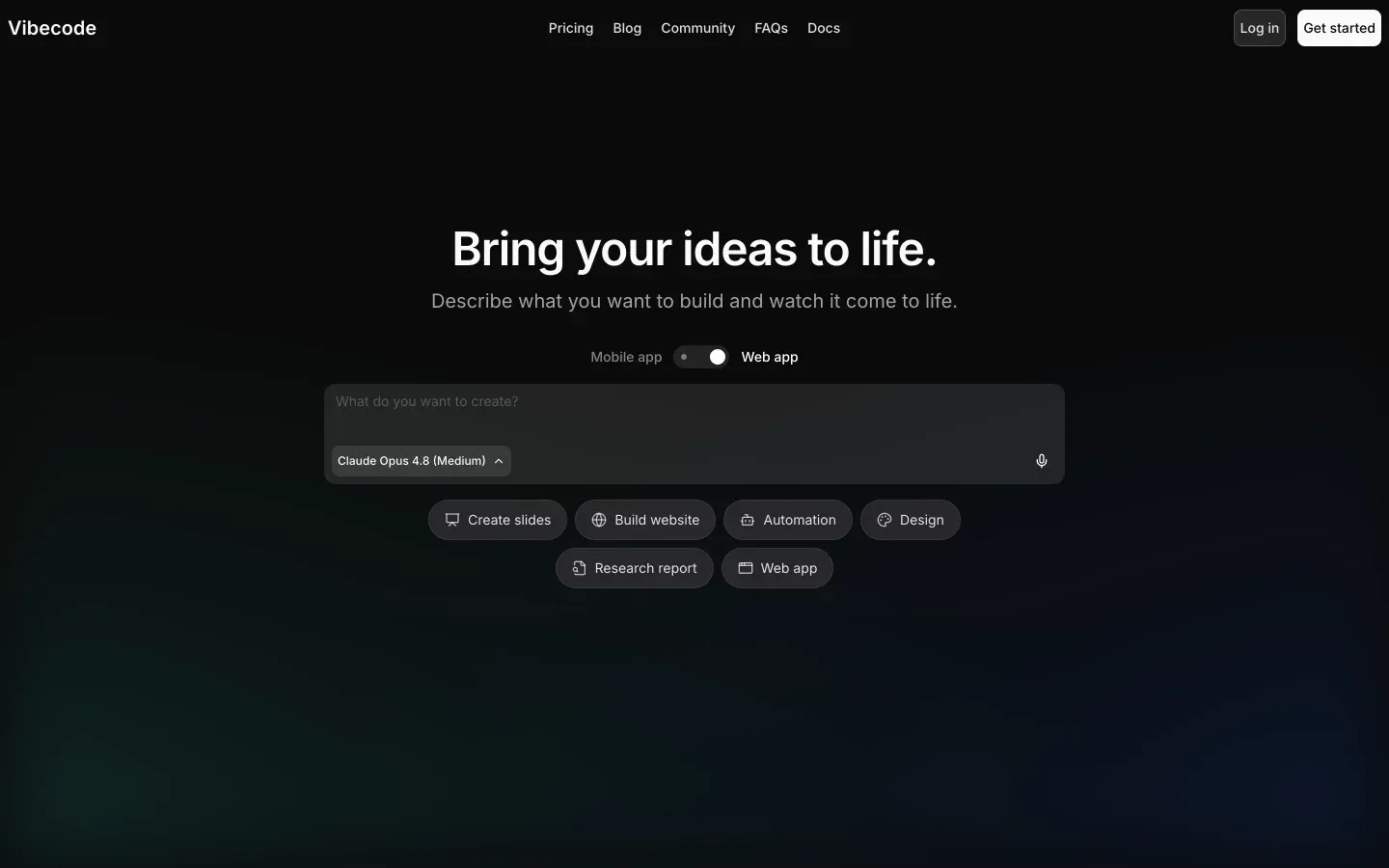
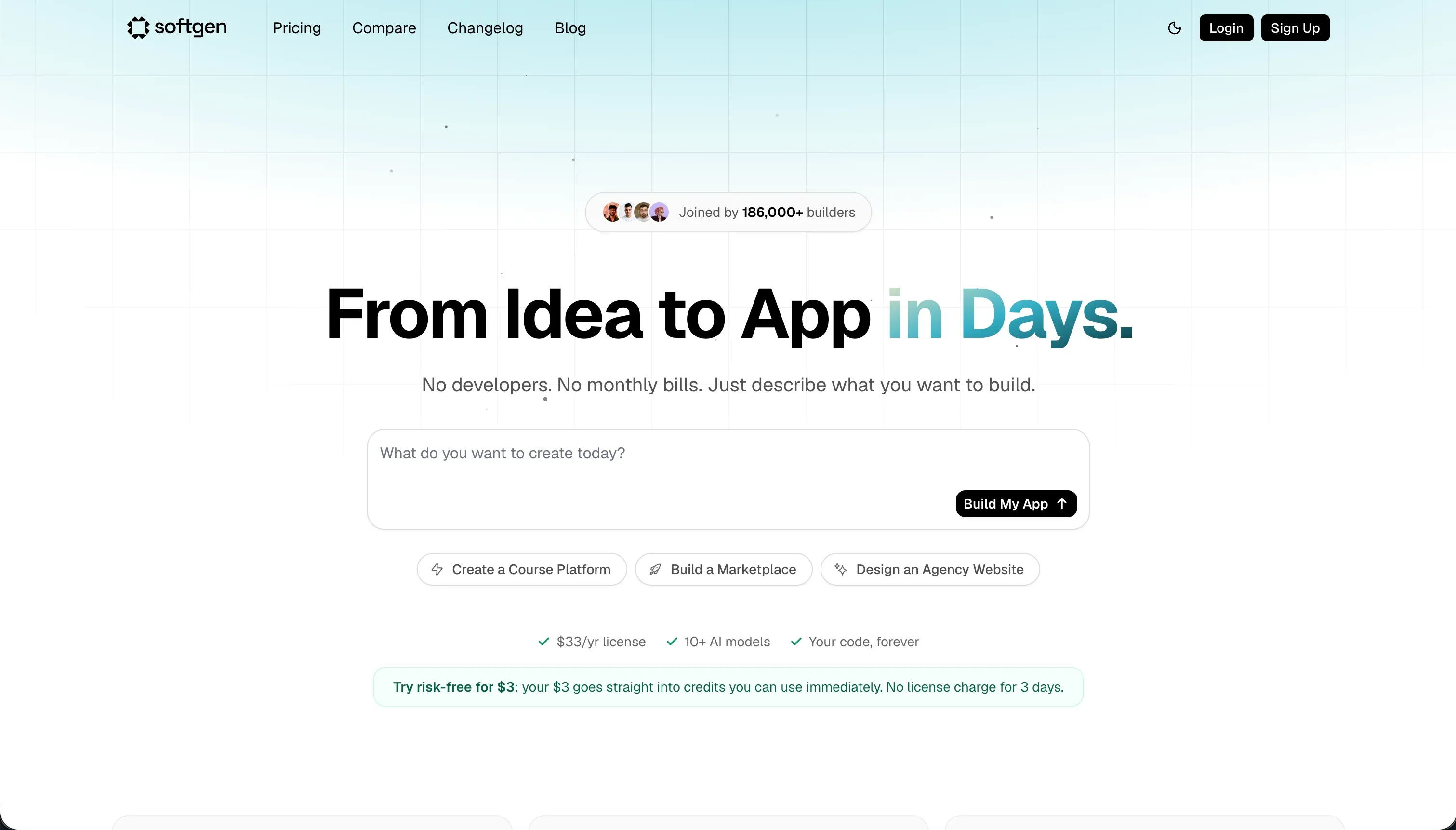
Software procurement for conversational app generation requires separating short-term prototyping speed from long-term platform stability.
This head-to-head analysis evaluates two distinct approaches to prompt-driven development: VibeCode, which implements a mobile-first, native deployment model, and Softgen, which generates web application layouts using a chat-based Cascade agent.
Both platforms represent the first wave of conversational app creators but demand very different technical trade-offs.
VibeCode wins this head-to-head on aggregate, scoring 6.1/10 to Softgen’s 5.1/10 across our evaluation framework. While both tools tie on building speed for their target mediums, VibeCode builds a more stable native mobile architecture, offers a more transparent AI credit model, and provides developer escape hatches like direct SSH access.
Softgen remains the right shortlist addition only for creators seeking web-based SaaS directories on a low-overhead annual membership.
The decision in 30 seconds
| If your priority is… | Pick | Why |
|---|---|---|
| Native mobile utility apps for iOS & Android | VibeCode | Built explicitly for mobile-first layouts with direct app store packaging and instant on-device previewing |
| Low recurring monthly SaaS overhead | Softgen | Offers an annual platform access membership of thirty-three dollars combined with separate pay-as-you-go credits |
| A clean code export path with SSH editor access | VibeCode | Pro and Max tiers provide full source code downloads and direct SSH connections to Cursor and VS Code |
| Relational schema mapping before generation | Softgen | Cascade agent includes an interactive schema planning step before deploying relational tables |
| Client portals, internal tools, or operational CRMs | Neither | Vibe coding on raw generated code introduces security gaps and regression loops that visual business platform Softr solves with native permissions |
What each platform is
What is VibeCode?
VibeCode is an AI-powered, mobile-first app builder designed to let users create, test, and publish native mobile applications using natural language. Operating under the “vibe coding” paradigm, the builder acts as a director, detailing features in plain English while the platform concurrently generates the underlying mobile applications for iOS and Android.
The platform automatically provisions a backend database, user authentication, and cloud storage via VibeCode Cloud, keeping all app pieces unified. It is built explicitly for rapid visual mobile prototyping, allowing creators to run instant on-device tests and compile native binaries directly for App Store and Google Play distribution on its paid tiers.
What is Softgen?
Softgen is a web-based, conversational AI application builder that constructs software through a chat interface. It leverages a proprietary Cascade AI agent that works interactively to outline, architect, and modify full-stack application blueprints based on plain-language prompts.
Softgen supports full-stack web layouts, generating functional user interfaces, relative databases, custom domain configurations, and standard integrations like Stripe payments. It is structured primarily as a prompt-and-deploy sandbox for indie hackers and creators who want to quickly launch SaaS layouts and web directories without managing visual style sheets or code editors.
The core difference
These tools diverge primarily on their target platform mediums and their developer-oriented exit strategies.
- VibeCode compiles native, mobile-first binaries for iOS and Android deployment with direct SSH hooks for external code editors.
- Softgen generates full-stack web application templates restricted to rigid layout blocks that must be edited entirely through chat prompts.
Where the scores diverge
Design flexibility: VibeCode 7.0, Softgen 5.0. VibeCode scores 7.0, surpassing Softgen’s 5.0. VibeCode centers its entire canvas on smartphone layouts, offering native user experiences. Softgen confines its generation engine to rigid, predefined web layout blocks, making customized aesthetics challenging to realize and often triggering looping prompts.
Maintainability: VibeCode 5.5, Softgen 4.0. VibeCode scores 5.5, outperforming Softgen’s 4.0. VibeCode offers developer-friendly escape hatches on its Pro and Max tiers, allowing full source code export and SSH connections to editors like Cursor.
Softgen lacks a drag-and-drop editor, forcing the builder to return to the interactive AI chat for every visual modification; this design limitation creates prompting loops, increases credit burn, and generates high technical debt risk.
Production readiness: VibeCode 5.5, Softgen 4.5. VibeCode leads with 5.5 to Softgen’s 4.5. VibeCode handles packaging all backend databases, cloud files, and user credentials directly to native iOS and Android store configurations, though unaudited code risks store review rejection.
Softgen is held back by the early-stage nature of its platform; user feedback often highlights the lack of visual polish and flags a distinct trade-off between initial generation speed and long-term production scaling.
Data & integrations: VibeCode 6.5, Softgen 5.5. VibeCode scores 6.5, showing wider utility than Softgen’s 5.5. VibeCode pairs its built-in database with standard external integrations to platforms like GPT and Gemini, with utility mapped cleanly to the user’s included credit pool.
Softgen generates relative database schemas and core components like Stripe checkouts, but suffers from a narrower overall integration footprint compared to native relational databases.
Security & access control: VibeCode 5.0, Softgen 4.5. VibeCode secures a 5.0 against Softgen’s 4.5. Both platforms provide standard user authentication templates out of the box. VibeCode requires manual code validation to ensure generated permissions contain no security holes.
Softgen provides basic sign-in templates but lacks granular, button-level, or field-level visibility controls, restricting its utility for multi-tenant internal operations.
Ease of build: VibeCode 7.0, Softgen 7.0. Both tools tie at 7.0 but succeed in different ways. VibeCode excels in mobile layout translation, enabling creators to build native utility apps via chat prompts with immediate on-screen rendering.
Softgen matches this speed on the web, capitalizing on an interactive planning assistant that walks the creator through database schema design prior to layout generation. However, both platforms struggle as application complexity scales; the underlying generative agents hit context windows where they lose code structure or break existing features.
Cost comparison
VibeCode operates on a credit-based subscription model. Tiers range from Plus at twenty dollars per month to Max at two hundred dollars per month, with payments translating directly into raw LLM credits with no platform markup. This makes VibeCode’s bill predictable on a month-to-month basis, though high-intensity debugging or regeneration cycles will deplete credits early.
Softgen utilizes an alternative annually billed membership of thirty-three dollars a year for platform access, but operates credit packages on a pay-as-you-go model. This reduces flat overhead for inactive apps, but makes development iterations highly volatile. Every troubleshooting message to the Cascade agent consumes credits, resulting in unpredictable costs during active building cycles.
- Plus $20/mo to Max $200/mo
- Payments convert to raw LLM credits
- No platform markup
- Predictable month-to-month bill
- $33 a year for platform access
- Credits bought pay-as-you-go
- Low overhead for inactive apps
- Each Cascade message costs credits
Lock-in and the exit path
VibeCode provides a clear exit path on its higher paid tiers (Pro and Max), facilitating complete code downloads and external SSH linkage to bypass vendor lock-in. Softgen also supports code export for teams that outgrow the platform, though the generated code requires substantial developer restructuring.
VibeCode is the superior platform for avoiding lock-in due to its native design environment and developer cursor integrations.
Who should pick VibeCode
Pick VibeCode if:
- Mobile app prototypers who need to quickly demo and publish utility iOS and Android applications
- Developers looking to sync generated mobile codebases to external editors like Cursor via SSH
- Creators who want stable on-device preview flows for smartphones during prompt iteration
Do not pick VibeCode when building complex, desktop-first operational software, or if you require sophisticated server-side security architectures that cannot be verified solely through code audits.
Who should pick Softgen
Pick Softgen if:
- Indie hackers seeking a low flat-rate annual membership to showcase simple SaaS dashboards
- Web builders looking to map out basic relational database schemas with an interactive AI planner
- Creators launching lightweight public directories that rely on simple Stripe checkouts
Do not pick Softgen if you need native mobile apps, precise visual layout adjustments without prompting, or granular user roles for multi-tenant internal portals.
What neither platform answers
Neither of these prompt-generating environments is designed for stable operational business apps like multi-tenant client portals, unified CRMs, or inventory trackers. Both VibeCode and Softgen rely on the AI agent writing and editing thousands of lines of raw, custom code.
For operational software, this approach regularly introduces regression loops, unrecognized edge cases, and client-side data risks that require constant manual auditing.
For business-grade portals and internal tools, a visual no-code infrastructure platform like Softr represents a safer allocation.
Softr scores 8.5 on production readiness and 9.0 on maintainability precisely because core functions (such as user group permissions, domain sign-up restrictions, and row-level database filtering) are handled by stable, pre-built visual blocks rather than hallucinated code.
Softr pairs its secure database with native business connectors, leaving code generation as an isolated block rather than a project-wide maintenance liability. Teams seeking automated code generation with desktop versatility should evaluate Replit instead.
Analyst verdict
VibeCode wins this comparison, securing 5 of the 6 criteria to achieve an aggregate score of 6.1 compared to Softgen’s 5.1. Both tools are capable of producing rapid first-day mockups, but VibeCode’s dedication to mobile-first environments, transparent credit translation, and high-tier developer escape hatches make it a more viable candidate for professional builders.
Softgen is highly constrained by its conversational editing constraints and rigid layout styling. Unless you are targeting a simple web-based SaaS concept on a low annual budget, VibeCode represents the stronger platform investment.
Related reading: the VibeCode scorecard, the Softgen scorecard, and our scoring methodology.