

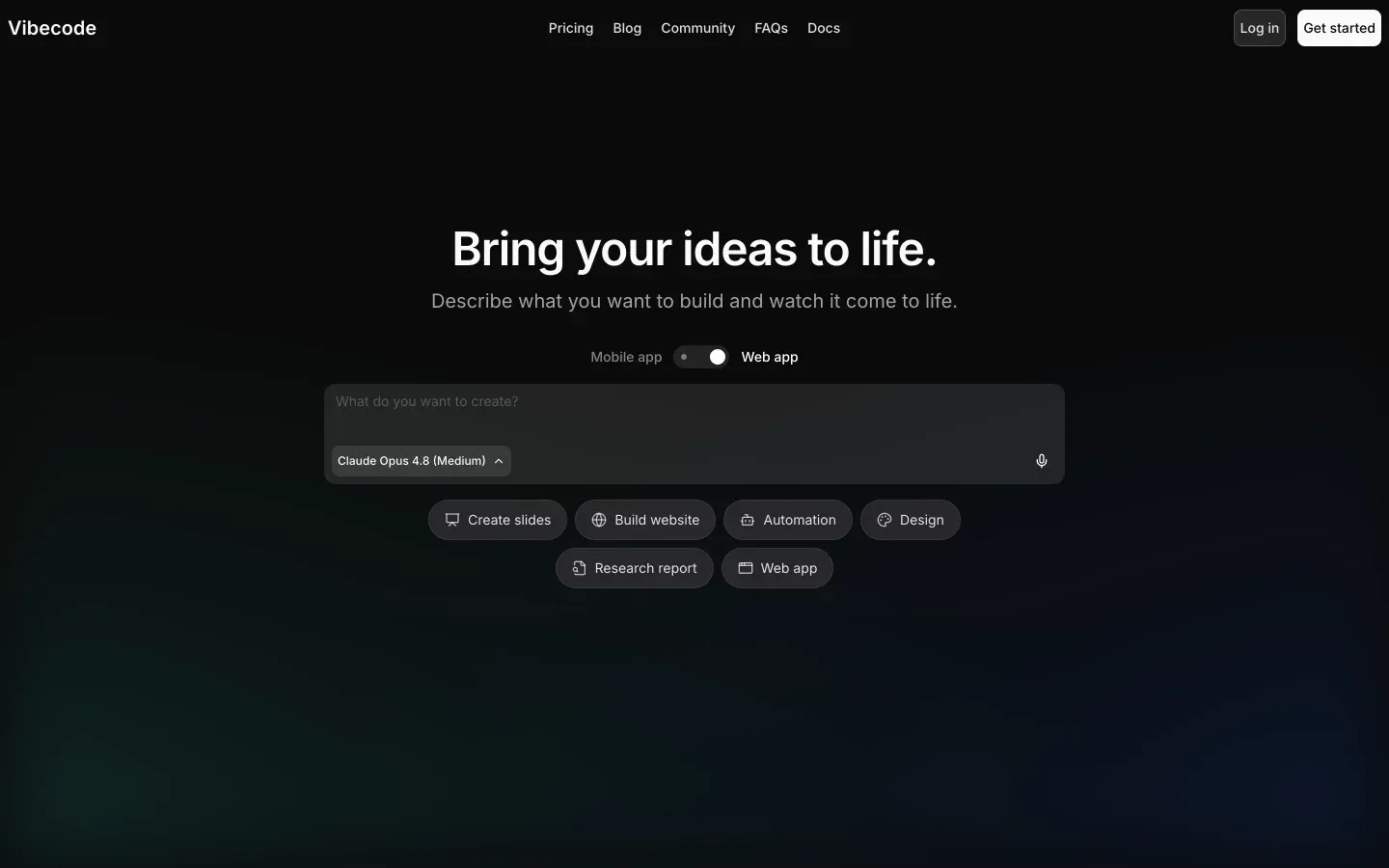
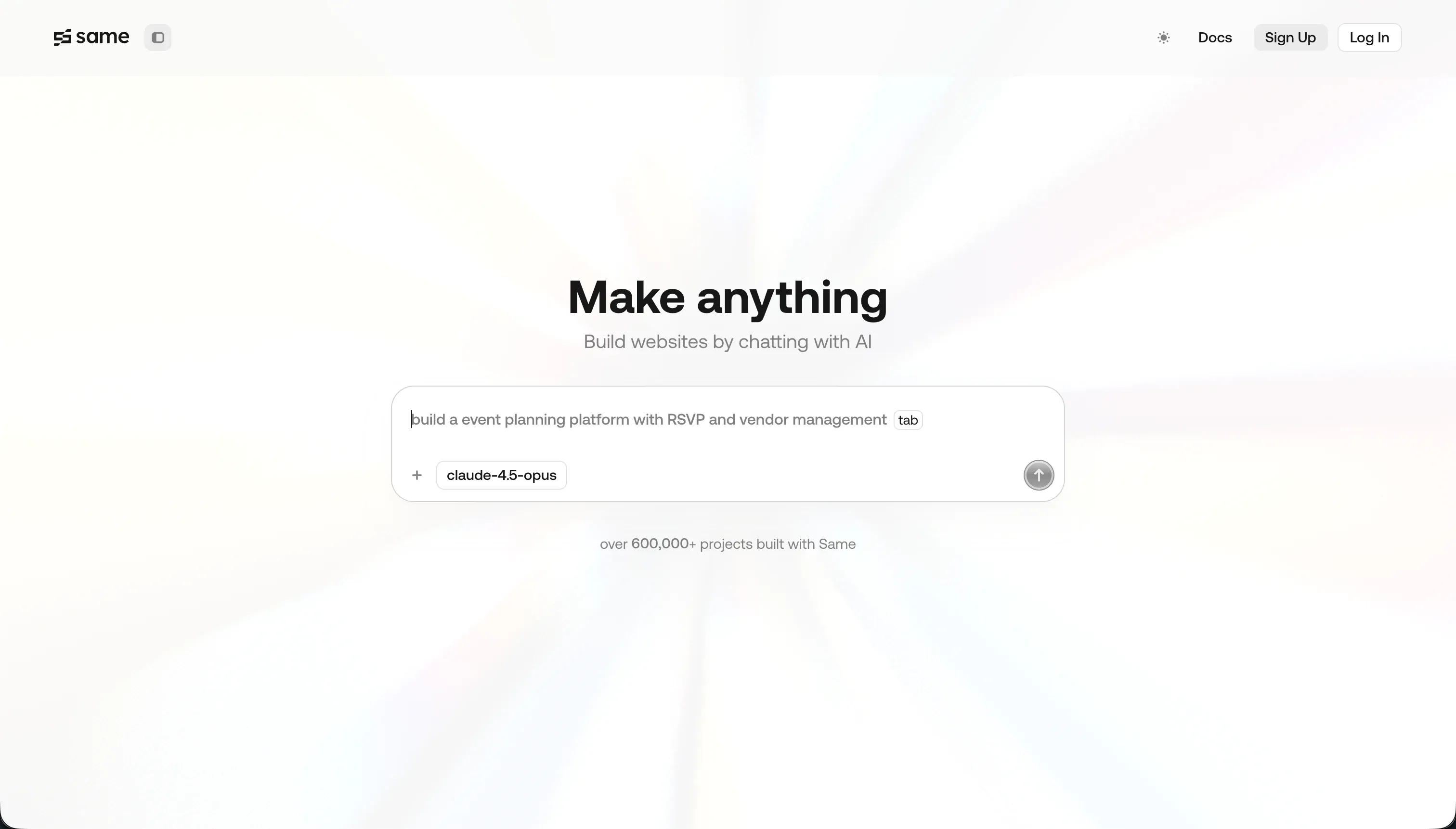
The rise of generative AI has created 2 different procurement problems: native mobile app generation and visual frontend cloning. VibeCode is a mobile app builder that turns prompts into native apps for app stores, while Same.new is a frontend cloner that recreates live website layouts as React code.
Buying between them is less about feature breadth than deciding whether you need a phone-ready product or a web UI draft.
VibeCode wins the general decision with a 6.1/10 aggregate score versus Same.new’s 4.1/10. It is stronger because it includes backend services, authentication, and a clearer path to shipping. The decision flips only when your real goal is 1 thing: cloning a desktop web interface fast and handing the exported code to developers.
The decision in 30 seconds
| If your priority is… | Pick | Why |
|---|---|---|
| Native iOS and Android store publication | VibeCode | packages for App Store and Google Play while Same.new outputs frontend code only |
| Visual desktop site layout replication | Same.new | clones live URLs into React and Tailwind faster than building the layout manually |
| Built-in database and user session state | VibeCode | includes native authentication and VibeCode Cloud data storage |
| Secure enterprise client portals or internal tools | Neither | neither offers the low-maintenance permissions model this use case usually needs |
| Predictable maintainability after handoff | VibeCode | its 5.5 maintainability score is helped by code export and SSH access on higher plans |
| Low-cost frontend prototyping | Same.new | $10 Pro pricing fits cheap visual scaffolding if you do not need backend functions |
What each platform is
What is VibeCode?
VibeCode is an AI-powered mobile app builder that turns natural-language prompts into native applications. Its build model is full-stack and mobile-first: you describe screens and behaviors, the AI generates the app, and the platform handles testing and packaging for app-store deployment.
The product includes VibeCode Cloud database storage, native authentication, and cloud-backed app state so projects can do more than render static screens. Research also points to code export and direct SSH editor access on higher plans, which makes it a fit for makers, small teams, and developers building lightweight mobile utilities or prototypes that still need real backend behavior.
What is Same.new?
Same.new is a frontend prototyping and UI cloning tool focused on recreating existing websites as React and Tailwind code. Its build model starts with a live URL: the system parses the page’s layout and styling, generates a clone, and then lets you request visual edits through prompts.
The platform includes project forking for visual variations and code export so teams can move drafts into local editors like VS Code. Research shows it is built for designers and developers who want fast web UI scaffolding, not for buyers who need a complete application stack with authentication, databases, and durable production behavior.
The core difference
These tools differ most on software completeness: one tries to ship a working app stack, while the other tries to clone an interface quickly. That single axis explains nearly every score gap.
- VibeCode is a prompt-driven native app builder that bundles UI generation with backend services, authentication, and app-store deployment.
- Same.new is a visual cloning engine that prioritizes fast React and Tailwind reproduction over backend logic, persistence, or access control.
Where the scores diverge
Production readiness: VibeCode 5.5, Same.new 3.0. VibeCode is closer to a deployable product because it includes authentication, database support, and direct app-store publishing. That said, AI-generated apps still need review for edge cases and shipping confidence is lower once workflows become intricate.
Same.new does not really compete on this criterion because it stops at the frontend layer. Research also flags trust damage from the Same.dev to Same.new transition, which further weakens its case for production use.
Maintainability: VibeCode 5.5, Same.new 3.0. VibeCode scores better because teams can export code and, on higher plans, use SSH access to edit projects outside the prompting layer. That creates a real fallback when the AI hits context limits or introduces bugs.
The deduction is that generated code still requires developer judgment to keep structure clean over time. Same.new trails because users report prompt edits that break working layouts and large projects that become fragile to iterate.
Data & integrations: VibeCode 6.5, Same.new 4.0. VibeCode pulls ahead because it includes its own database and cloud storage and can connect to outside services through the app workflow. It still loses points because this is not a deep enterprise integration environment and more advanced data architecture can strain the prompt-first model.
Same.new is constrained by design here: it can mock interfaces, but it does not provide persistent app data or meaningful backend integration. For any real workflow, the data layer has to be rebuilt elsewhere.
Ease of build: VibeCode 7.0, Same.new 5.0. VibeCode is easier for the average buyer because prompting toward a working mobile app is more complete than assembling a cloned UI and then finishing it elsewhere. It also gives instant on-device testing, which shortens feedback loops for mobile products.
The deduction is that prompt quality still matters and more complex logic can break down as scope grows. Same.new is quick at the first step of copying a layout, but conversational edits become brittle once the page structure gets more complex.
Security & access control: VibeCode 5.0, Same.new 3.0. VibeCode has the advantage because it at least ships with native authentication and a fuller application model. Even then, buyers should not overread the score: access control still depends on generated code that needs manual checking before release.
Same.new offers no native auth, permissions, or database security model. That leaves the entire security layer to external engineering after export.
Design flexibility: VibeCode 7.0, Same.new 6.5. This is the closest category and the one Same.new effectively keeps because visual cloning is its whole purpose. It can reproduce simple desktop layouts and styling very quickly from a live URL, which gives designers a fast starting point.
The deduction is that nested grids and interactive states are less reliable than the first impression suggests. VibeCode remains flexible for mobile interfaces, but it does not offer the same direct website-cloning workflow or pixel-focused desktop fidelity.
Cost comparison
VibeCode uses a credit-based subscription model tied to LLM usage. Its paid tiers run from Plus at $20/month to Max at $200/month, and the bill moves with prompt volume and the amount of backend work the app consumes. Same.new uses a token-based model instead: Pro costs $10/month with 2 million tokens included, and overages are billed at $5 per million tokens.
The hidden cost lines differ. With VibeCode, forecast builder time spent correcting prompt mistakes, testing edge cases, and possible migration work if the app outgrows the platform.
With Same.new, the larger budget risk is downstream engineering: connecting exported frontend code to databases, building authentication, paying any hosting costs, and absorbing extra maintenance when prompt edits break layouts or force rebuilds.
Lock-in and the exit path
Both tools offer code export, which keeps lock-in lower than closed managed builders.
VibeCode also provides direct SSH editing access on higher plans, giving teams a path to take the app code out of the prompt interface and continue development elsewhere; research indicates it exports a more complete application foundation, including backend-related structure.
Same.new exports React and Tailwind frontend code, but not a finished backend, so leaving means rebuilding persistence, auth, and application logic outside the platform. VibeCode has the cleaner exit because more of the working product leaves with you.
- Code export included
- Backend structure ships with export
- SSH editing on higher plans
- Keep developing outside the prompt UI
- React and Tailwind export only
- No finished backend
- Rebuild persistence, auth and logic yourself
Who should pick VibeCode
Pick VibeCode if:
- Teams building lightweight native mobile apps that need real user accounts and persistent data, not just mock screens
- Makers who value app-store packaging and on-device testing more than pixel-perfect desktop web cloning
- Developers who want an AI-first workflow but still need code export and SSH access as a maintenance fallback
Do not pick VibeCode if your real product is a complex desktop web app, an enterprise internal tool with heavy permissions, or a data model too intricate for prompt-led generation to stay reliable
Who should pick Same.new
Pick Same.new if:
- Designers who need to clone an existing website’s visual language into React and Tailwind quickly
- Frontend developers creating rough web UI scaffolds before wiring functionality in their own stack
- Teams that care more about visual starting speed than built-in auth, database support, or deployment readiness
Do not pick Same.new if you need a functional app with native authentication, persistent data, durable maintainability, or a credible production path inside the platform itself
What neither platform answers
Many buyers reading this comparison do not actually need a prompt-generated mobile app or a cloned web frontend. They need a business app: a client portal, internal tool, or CRM defined by logins, permissions, relational data, and low maintenance after launch.
In that lane, Softr is usually the better recommendation because it is built around business workflows rather than raw code generation.
Its research scores of 8.5 for production readiness, 9.0 for maintainability, and 8.8 for security & access control make the case for buyers who want stable operations without rebuilding core infrastructure.
That does not make Softr the answer to every adjacent need. If the requirement is native mobile UX and app-store distribution, a dedicated mobile builder such as FlutterFlow is the more sensible angle. But for business software where reliability, permissions, and ongoing admin simplicity matter most, Softr is the cleaner fit than either VibeCode or Same.new.
Analyst verdict
VibeCode wins 6.1 to 4.1 overall. It takes Ease of build, Production readiness, Maintainability, Security & access control, and Data & integrations, while Same.new keeps Design flexibility. That pattern makes the general recommendation straightforward: VibeCode is the better buying decision for most teams because it gets you closer to a real product, not just a visual artifact.
The flip condition is narrow but real. If your goal is to clone a desktop website quickly, export React and Tailwind code, and let developers rebuild the rest in a separate stack, Same.new is the right buy despite the lower aggregate. If you need backend services, authentication, and an actual path to shipping, VibeCode is the stronger choice.
Related reading: the VibeCode scorecard, the Same.new scorecard, and our scoring methodology.