

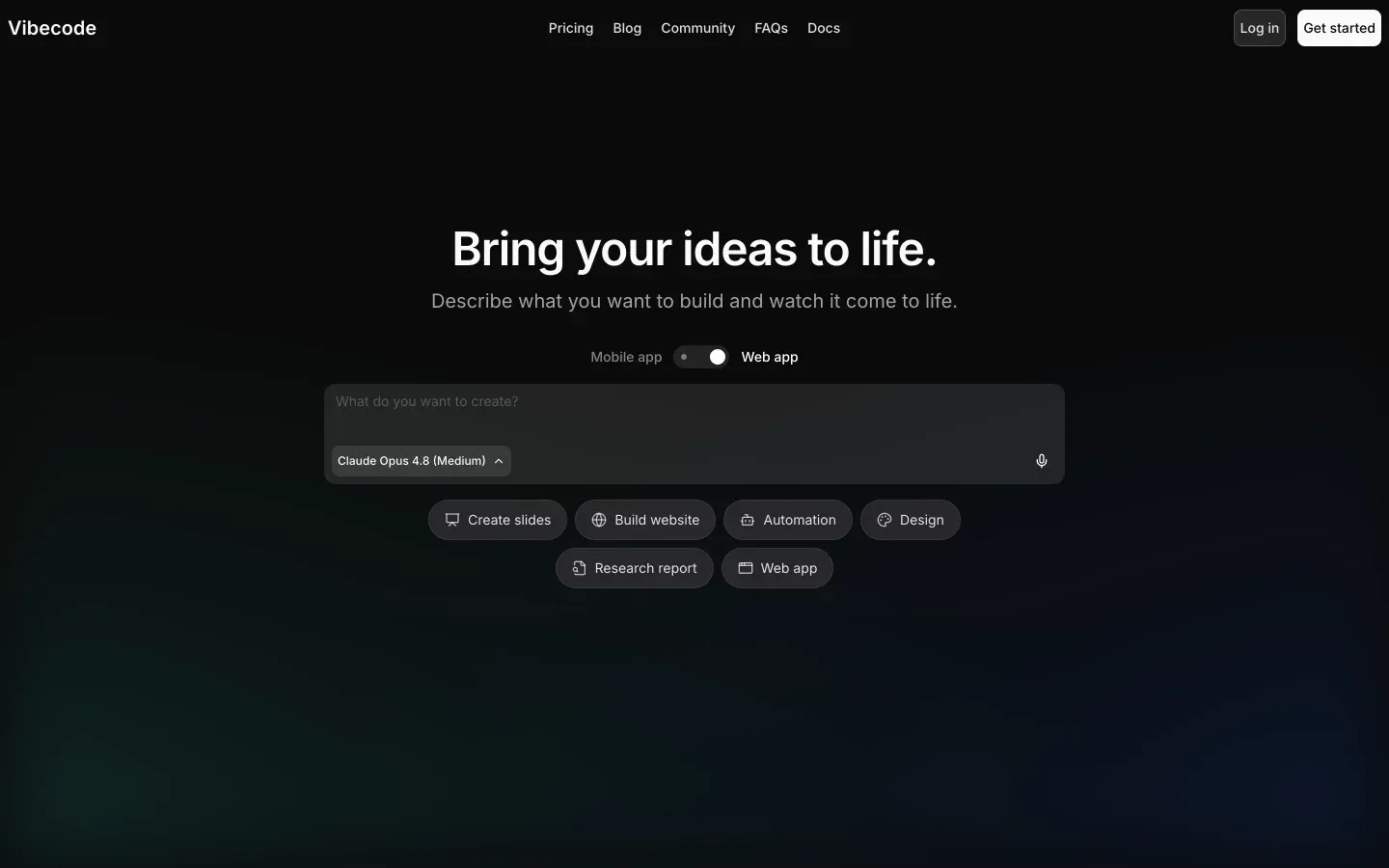
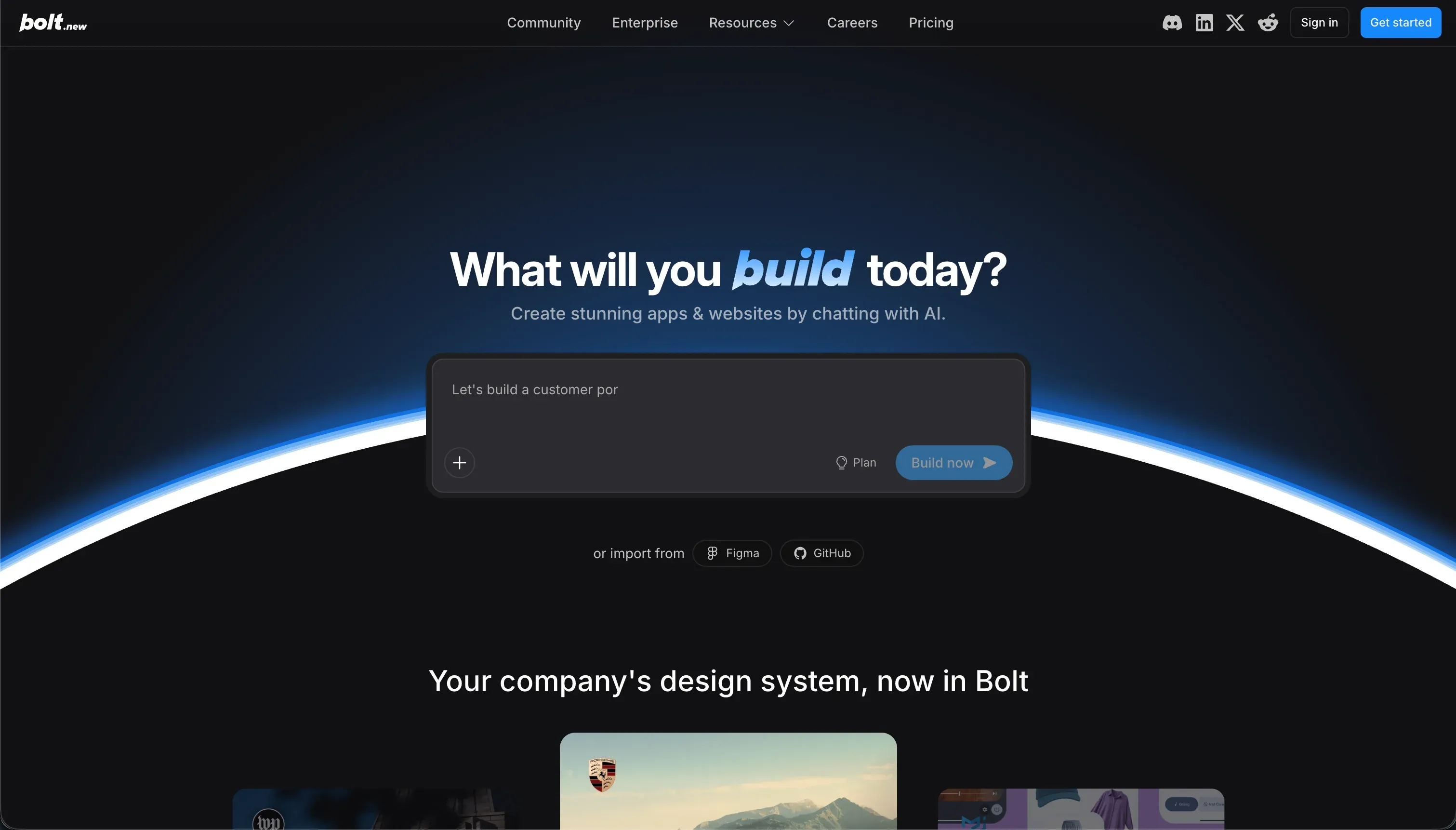
The modern mobile-first builder and the browser-native development environment represent a significant paradigm split in the generative AI landscape. Non-technical creators trying to launch smartphone apps will look to VibeCode for its plain-English prompting and instant on-device layout previews.
Developers seeking granular architectural control over frontend frameworks often pivot to Bolt to generate standard React code inside a zero-setup browser IDE.
VibeCode wins this direct head-to-head with an aggregate score of 6.1/10 against Bolt’s 5.1/10. VibeCode takes the lead in four out of six key evaluation criteria, primarily because it manages backend services, user authentication, and mobile app store packaging out of the box.
The decision flips to Bolt only when your project demands pixel-level frontend layout freedom and a framework-free environment where you can freely install npm packages.
The decision in 30 seconds
| If your priority is… | Pick | Why |
|---|---|---|
| Native iOS and Android app store packaging | VibeCode | VibeCode packages compiled code directly to the Apple App Store and Google Play, whereas Bolt is Web-first |
| Browser-native Node.js WebContainers workspace | Bolt | Bolt runs full React, Vite, and Node.js environments directly inside the browser window |
| Pixel-level design freedom with Figma and npm | Bolt | Bolt carries an 8.0 design score with no template ceilings, importing Storybook components easily |
| Built-in database and user authentication with zero setup | VibeCode | VibeCode provisions an integrated cloud database, user auth, and storage automatically |
| Secure client portals, internal tools, or operational CRMs | Neither | A dedicated business-grade platform like Softr secures CRUD APIs on the server side with flat pricing |
What each platform is
What is VibeCode?
VibeCode is an AI-powered, mobile-first application builder designed to let users create, test, and publish native mobile applications using natural language. Operating under a conversational “vibe coding” paradigm, the platform translates plain-English descriptions into functional mobile software with layouts styled specifically for smartphone screens.
By auto-provisioning the underlying database, authentication mechanics, and cloud storage on its native infrastructure, it bypasses the typical manual setup.
The platform is primarily engineered for mobile app prototypers who need to spin up rapid MVPs and non-technical creators aiming to launch simple games or utility apps on Android and iOS. Pro and Max plans allow teams to download their full source code or pull it directly into external code editors via SSH access.
VibeCode’s direct publishing pathways to the Apple App Store and Google Play make it a highly targeted tool for consumer-facing mobile deployment.
What is Bolt?
Bolt is a browser-based, full-stack AI development environment that operates as an automated workspace rather than a visual template editor.
Using StackBlitz WebContainers technology, Bolt executes a complete Node.js environment directly in your browser, enabling users to run terminal commands, install npm packages, and edit code client-side with real-time feedback.
When prompted, Bolt generates React components, Node backend services, routing assets, and PostgreSQL schemas under a conversational diff-based approach.
The platform target audience consists of builders, experienced operations teams, and web developers who want rapid initial scaffolding but intend to keep their hands on the architectural steering wheel. It includes default cloud hosting, automated Netlify deployment options, and full codebase exports to standard React and Vite structures.
While Bolt can generate the elements of a visual application, it acts primarily as an automated coder translating requirements into standard, unmanaged web repositories.
The core difference
The core divergence between these two developer agents lies in their execution context and distribution focus.
- VibeCode targets native mobile deployment, generating a mobile-first UI with built-in app store compilation from prompts.
- Bolt provides an unmanaged browser-based IDE, generating React codebases where the developer holds final code responsibility.
Where the scores diverge
Maintainability: VibeCode 5.5, Bolt 3.5. VibeCode’s 5.5 score is preserved by offering code export and SSH access on its higher tiers, though the AI can lose structural context and write messy logic as the app expands.
Bolt scores a low 3.5, driven heavily by user documentation of aggressive edit loops where the AI deletes or overhauls working logic and reverts looks during simple prompts. This behavior causes massive token drain on minor iterations without a developer supervising the code.
Ease of build: VibeCode 7.0, Bolt 5.5. VibeCode’s 7.0 score reflects its highly targeted focus on building smartphone apps from plain English with instant on-device testing.
Bolt’s 5.5 score is lower because the browser-based IDE assumes actual web development knowledge: you are expected to understand terminal outputs, debug silent container crashes, and manually read build errors inside a browser IDE workspace, which can quickly alienate non-technical builders.
Production readiness: VibeCode 5.5, Bolt 4.0. VibeCode scores 5.5 by auto-provisioning the backend, user authentication, and cloud storage, alongside direct App Store and Google Play deployment options.
Bolt’s 4.0 score represents a major pain point: builders routinely encounter container crashes, out-of-memory errors, and a ‘Project too large’ wall that halts all prompting. Furthermore, Bolt outputs web app code that does not package natively for mobile app stores.
Security & access control: VibeCode 5.0, Bolt 3.5. VibeCode scores 5.0 thanks to its pre-integrated user authentication, but its schema-level security still relies on manual code audits.
Bolt’s 3.5 score indicates the total absence of a visual permission layer; configuring user authentication or row-level security (RLS) rules requires prompting the AI to write raw database logic, leaving the verification of system permissions completely hidden inside generated code.
Design flexibility: VibeCode 7.0, Bolt 8.0. Bolt secures its lone win here at 8.0/10, showing the lack of layout ceilings in Vite and React. Developers can import Figma styles, NPM packages, and Storybook components to build bespoke web frontends. VibeCode’s 7.0 design score is limited by its native smartphone viewport focus, providing less direct visual editing than classic widget-tree frameworks.
Data & integrations: VibeCode 6.5, Bolt 6.0. VibeCode scores 6.5 by providing a native cloud database, user storage, and quick integration with external model APIs processed via your platform plans.
Bolt’s 6.0 score reflects its ability to map PostgreSQL schemas and NPM integrations, but it lacks any visual database administration dashboard, forcing teams to install external platforms like Supabase to manage user information.
Cost comparison
VibeCode operates on a clean, credit-based structure where subscriber payments transfer directly to raw LLM API consumption with no platform markup. Plans start with the Free tier before stepping up to Plus at $20/mo, Pro at $50/mo, and Max at $200/mo, with Pro and Max plans providing SSH tunnels and raw code export.
This model means costs map directly to active development velocity, allowing buyers to easily predict their recurring spend when the app enters a passive maintenance phase.
Bolt.new couples a subscription model with a token-consumption framework that has drawn criticism for burning through quotas during failed debugging cycles. The Pro plan begins at $25/mo for 10 million tokens and can scale option-by-option to $2,000/mo for 1.2 billion monthly tokens.
Because Bolt forces developers to re-prompt the AI for every minor code fix, even small styling revisions can deplete multi-million token pools quickly, making Bolt much costlier for continuous iteration.
Lock-in and the exit path
VibeCode provides a clear exit path on its Pro and Max tiers, allowing full native code exports and developer-centric SSH connections to tools like Cursor. Bolt delivers excellent raw code ownership from day one, exporting standard React and Vite codebases that carry zero proprietary constraints.
Escaping either tool is entirely possible, but Bolt has the cleaner initial exit since it requires no premium subscription tier to download files.
Who should pick VibeCode
Pick VibeCode if:
- Builders creating mobile-first utilities or simple games specifically destined for the Apple App Store and Google Play
- Prototypers who need instant mobile previews on physical devices without managing environment variables
- Creators looking for a secure database, cloud storage, and user login pre-configured instantly from a single prompt
Do not pick VibeCode seeking a custom desktop-native web dashboard, complex workflow software, or multi-tenant database systems where raw vibe coding risks logic failure.
Who should pick Bolt
Pick Bolt if:
- Experienced React developers seeking an automated AI agent to scaffold custom frontend code rapidly
- Teams using Figma design systems and Storybook who intend to export and self-host custom React web applications
- Technical users comfortable utilizing browser-based Node.js runtimes and custom database integrations like Supabase
Do not pick Bolt as a non-technical builder, as maintaining the app past week one will force you to read generated code, configure database RLS rules from scratch, and manage container memory crashes.
What neither platform answers
Both VibeCode and Bolt assume the developer is building a bespoke consumer utility where code is the primary asset. Many software requirements, however, center on business operations: client portals, secure vendor coordination tools, project trackers, internal directories, and department CRMs.
For these scenarios, VibeCode hands you mobile-only layouts that fail on desktop web browsers, while Bolt forces you to manage database setups, host raw repositories on Netlify, and debug silent container failures.
For operational business software, Softr scores massively higher at 5.5/10 for VibeCode and 4.0/10 for Bolt on production readiness, alongside an 9.0/10 in maintainability.
Softr builds on secure, visual infrastructure out of the box: user authentication, granular user groups, global data restrictions, and dynamic visual blocks (like kanbans and charts) are native components rather than code written by an AI.
When custom layouts are required, the Vibe Coding block in Softr generates specific React components that instantly inherit the app’s secure server-side CRUD database, preventing the security risks and container crashes of pure prompt-only platforms.
Analyst verdict
VibeCode wins this head-to-head comparison with an aggregate score of 6.1/10 to Bolt’s 5.1/10. VibeCode wins on ease of build (7.0), production readiness (5.5), security (5.0), and maintainability (5.5). Bolt takes the design flexibility category outright with an 8.0, showcasing standard React and Vite structures with zero visual restrictions.
The final purchasing decision is determined by form factor and technical capability. Choose VibeCode if you are building smartphone apps that require immediate app store compilation, direct push notifications, and built-in user data tables.
Choose Bolt only if you are a web developer seeking a fast prompting tool to kickstart custom frontend layouts and are fully prepared to self-host and manage your own database infrastructure.
Related reading: the VibeCode scorecard, the Bolt scorecard, and our scoring methodology.