

Developing custom smartphone applications presents businesses with a difficult procurement choice: commit to the unpredictability of AI code generation or struggle with the performance limitations of legacy visual builders.
VibeCode represents the mobile-first “vibe coding” category, driving development via plain-English prompting and instant on-device previewing. Adalo represents the traditional visual no-code movement, relying on a free-positioning drag-and-drop canvas to build interface layouts.
VibeCode wins this comparison with an aggregate score of 6.1/10 against Adalo’s 4.6/10. VibeCode takes four of the six evaluation criteria, leaving Adalo ahead only on visual-canvas design flexibility, which is a minor victory considering Adalo’s documented production-readiness challenges. For anything beyond a simple visual mockup, VibeCode is the more viable starting point.
The decision in 30 seconds
| If your priority is… | Pick | Why |
|---|---|---|
| Speeding from a plain-text prompt to a working mobile setup | VibeCode | Generates complete native smartphone layouts and provisions backends instantly from instructions |
| Placing visual components freely on a drag-and-drop canvas | Adalo | Provides a free-form spatial editor, though restricted to a fixed-width screen model |
| Client portals, secure CRM, or business-grade internal tools | Neither | Both struggle with complex enterprise permissions, making Softr the higher-scoring purchase |
| Database reliability with real production traffic | VibeCode | Adalo has documented cases of catastrophic data loss where significant database rows vanished |
| Preventing absolute platform lock-in | VibeCode | Paid plans support full source code downloads and direct SSH access to external IDEs |
What each platform is
What is VibeCode?
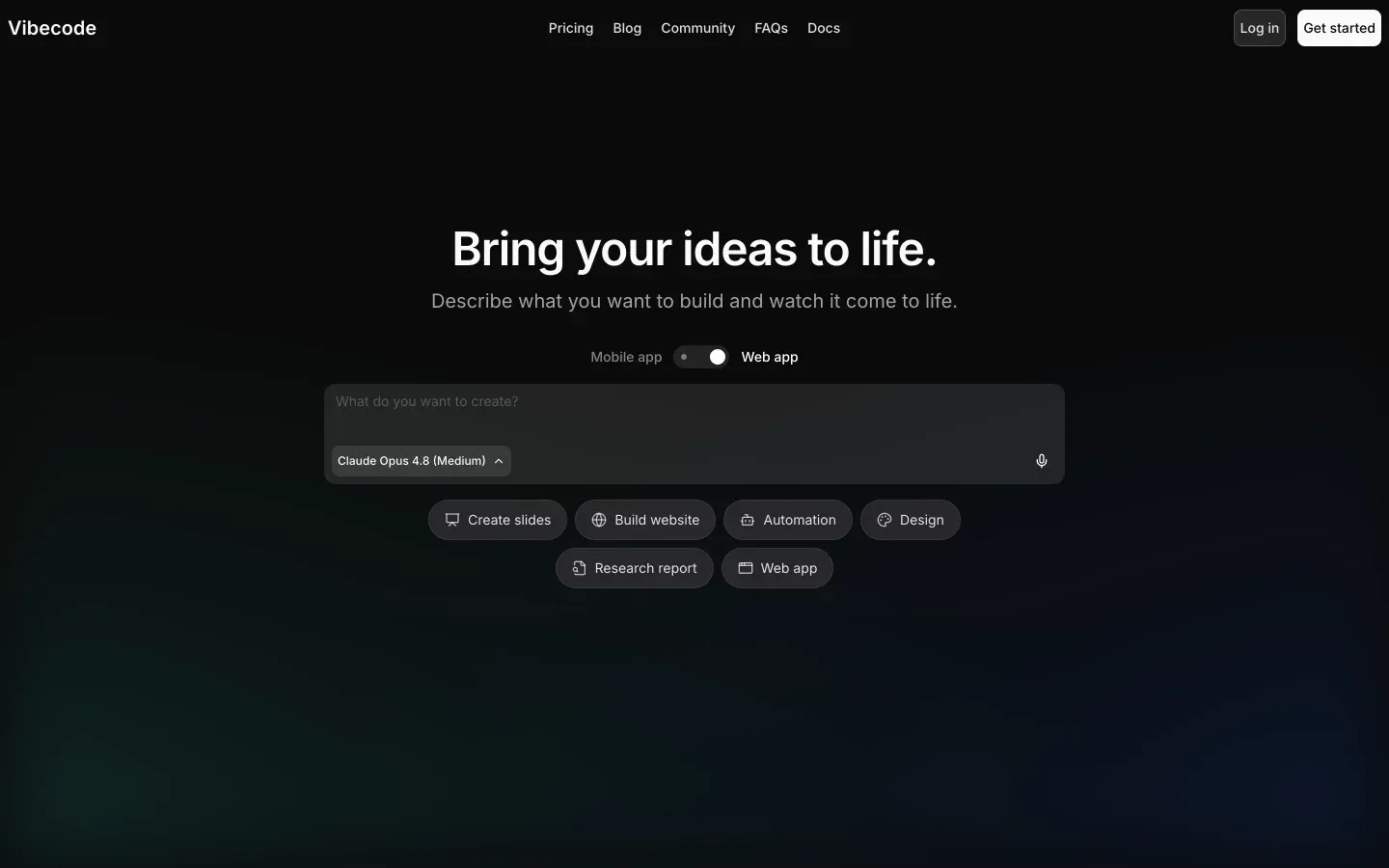
VibeCode is an AI-powered, mobile-first app creation platform that compiles native iOS and Android experiences from conversational instructions.
The build model is prompt-driven: builders describe their desired features, logic, and look in plain English, and the platform’s AI engines interpret these sentences to construct the underlying frontend layout, provision databases, and generate API interfaces on its cloud hosting.
Built for mobile prototypers and non-technical mobile creators, VibeCode automatically handles the typical infrastructure headaches of mobile publishing. It provisions user authentication, establishes cloud storage via VibeCode Cloud, and packages application files for direct deployment to the Apple App Store and Google Play Store on Pro and Max tiers.
For developers looking to escape prompt limits, it offers a direct connection to external editors via SSH.
What is Adalo?
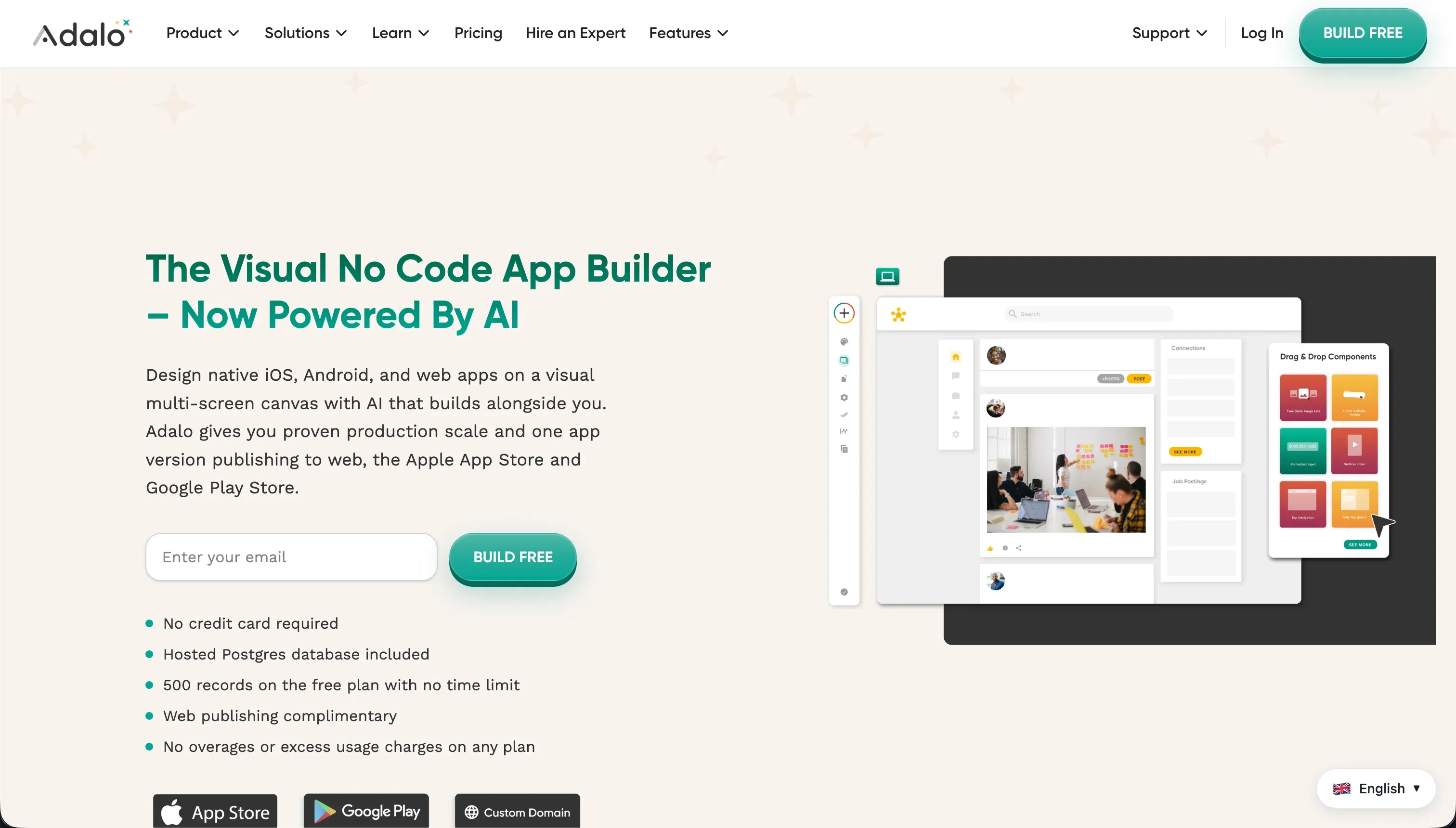
Adalo is a visual drag-and-drop builder designed to help creators and startup founders assemble mobile and web applications visually. The platform utilizes a spatial canvas editor where elements like buttons, cards, forms, and text components are positioned manually. These frontend components bind to a built-in relational database to display and manipulate dynamic application records.
The visual interface is built for simple mobile MVPs, directories, and customer mockups. Out of the box, it provides action workflows to link page navigation, trigger push notifications, and send basic database updates. Adalo also provides an internal component store to buy plugins, connecting to external REST APIs and Airtable for secondary data storage.
The core difference
These two utilities differ completely on their fundamental build paradigm and rendering engine.
- VibeCode compiles real application code dynamically from natural language prompting, requiring the builder to act as a logic director.
- Adalo forces the user to manually position components onto a strict, fixed-width visual workspace with no AI assistance.
Where the scores diverge
Production readiness: VibeCode 5.5, Adalo 3.5. This is the widest divergence in the matchup. VibeCode scores a modest 5.5/10 because it provisions real databases, auth systems, and cloud storage reliably, though generating complex workflows entirely by prompt introduces the risk of edge-case loops that fail store review. Adalo scores a critical 3.5/10.
Paying users report daily internal server errors, unacceptable native Android rendering performance, and a recorded case of roughly 70 percent of an application database vanishing instantly, making it viable for rough mockups but highly risky for live operations.
Design flexibility: VibeCode 7.0, Adalo 5.0. Adalo scores 5.0/10, offering a free-positioning visual editor that gives builders direct control over where cards and buttons sit. However, because it relies on a fixed-width screen model, its desktop screens display as stretched phone layouts, lacking responsive scaling.
VibeCode scores 7.0/10 by generating responsive, optimized smartphone layouts directly from text, though it loses a point because builders cannot directly drag widgets to precise pixel locations without prompting.
Maintainability: VibeCode 5.5, Adalo 4.0. VibeCode scores 5.5/10 due to its code-export capability and direct SSH access on Pro and Max tiers, opening a clear escape path if the AI hits a logic wall. However, the AI can lose structural context in larger codebases, generating unoptimized files over time.
Adalo scores 4.0/10 because its basic navigation actions are easy to manage, but any complex, multi-step business logic, approval rules, or conditional loops must be built manually from scratch, while its external REST API connectors are fragile and break easily when schemas shift.
Data & integrations: VibeCode 6.5, Adalo 5.0. VibeCode scores 6.5/10, establishing its own native database and VibeCode Cloud storage out of the box, with API connections to external AI models and maps paid for cleanly through its native credit allotment. Adalo scores 5.0/10.
While it contains a built-in relational database and hooks to Airtable, the internal database becomes a performance bottleneck quickly as records scale, there is no automatic two-way synchronization, and API configurations are clunky.
Ease of build: VibeCode 7.0, Adalo 6.0. VibeCode scores 7.0/10 by allowing builders to generate complete, functional mobile layouts and system logic within minutes using raw prompts, accompanied by instant on-device previews. Adalo scores a lower 6.0/10.
While its drag-and-drop canvas provides a gentle initial learning curve, reviewers report that implementing standard utility logic - like a secure forgot-password route or multiple-image uploads - requires incredibly tedious workarounds, eroding the value of its visual start.
Security & access control: VibeCode 5.0, Adalo 4.0. VibeCode scores 5.0/10, providing built-in user login flows off the shelf, though securing specific data paths depends on AI-generated instructions that require a developer’s eyes to audit for leaks. Adalo scores a low 4.0/10.
It lacks centralized, role-based access control out of the box, forcing builders to attach custom visibility filters manually to every screen asset to build a multi-role app, a pattern highly vulnerable to silent data leaks.
Cost comparison
VibeCode utilizes a transparent consumption-pricing framework with plans starting at $20/mo (Plus) and scaling to $50/mo (Pro) and $200/mo (Max). Each plan delivers a matching volume of direct dollar-value credits processed directly for LLM application building (Anthropic, OpenAI, etc.) with no platform markup.
The primary variable for a VibeCode budget is how many conversational prompt sequences the team executes during development and how heavily external AI features are queried.
Adalo charges flat subscription fees starting at $36/mo (Starter) and climbing through $52/mo (Professional) to $160/mo (Team) and $200/mo (Business). However, these plans enforce restrictive caps on database records (ranging from 10,000 to 100,000 items) and charge steep premium pricing for marketplace add-ons.
Buyers should forecast substantial hidden costs with Adalo, specifically developer time spent rebuilding fragile API configurations, upgrading tiers to access basic native capabilities, and pay-to-play plugins.
Lock-in and the exit path
The exit pathways differ dramatically between these two tools, which represents a decisive point for long-term planning. Adalo keeps builders locked into its ecosystem; it does not export application code or relational database architectures, meaning any transition require rebuilding the entire frontend and backend from scratch.
Conversely, VibeCode supports direct source-code export and raw SSH access to external IDEs on its Pro ($50/mo) and Max ($200/mo) tiers. While the generated code can require refactoring to clean up AI-engineered bloat, the presence of a real physical codebase means VibeCode provides a soft landing and a viable escape route.
- App code export: none
- App code export: full source
- Database export: none
- Database access: raw SSH (Pro $50/mo, Max $200/mo)
- Frontend rebuild from scratch
- Frontend: refactor AI bloat
- Backend rebuild from scratch
- Backend: refactor, no rebuild
Who should pick VibeCode
Pick VibeCode if:
- Creators building mobile-first MVPs who want to speed from plain-text instructions to functional smartphone screens.
- Teams demanding an exportable codebase to avoid absolute framework lock-in.
- Prototypers who need to package native application files for iOS and Android directly to testing platforms.
Do not pick VibeCode if your system requires custom, pixel-refined enterprise web portals or complex database connections that require manual modeling.
Who should pick Adalo
Pick Adalo if:
- Makers who want to sketch static visual layouts on a spatial canvas without writing prompts.
- Designers building early validation wireframes for mobile targets that will not hold live customer data.
- Teams seeking basic smartphone app mockups with minimal data scalability needs.
Do not pick Adalo if your application needs to operate as a reliable, production-ready business system, manage thousands of database records, or survive without server errors.
What neither platform answers
Both options are designed to solve the mobile-app model, where the terminal product is packageable for app stores. However, the vast majority of operations teams do not need a native App Store submission; they require highly secure internal utilities, search directories, customer-facing hubs, or robust CRM components.
For this class of operational software, VibeCode forces you to babysit a fragile code-gen repository, while Adalo presents unacceptable latency, security risks, and database instability.
A business-grade platform like Softr solves this lane completely. Softr scores 8.5 on production readiness, 9.0 on maintainability, and 8.5 on security & access control.
It achieves this by composing battle-tested, native visual blocks tied directly to a zero-maintenance Softr Database, or syncing instantly with business platforms like HubSpot and Airtable.
You get the speed of AI co-building paired with visual editing precision, secure user groups, clear row-level security, and responsive Progressive Web Apps (PWAs) that teams install instantly without App Store review hurdles.
Analyst verdict
VibeCode is the superior platform, defeating Adalo with an aggregate score of 6.1/10 to 4.6/10. VibeCode dominates across production readiness (5.5 vs 3.5), maintainability (5.5 vs 4.0), data integrations (6.5 vs 5.0), and ease of build (7.0 vs 6.0).
While Adalo’s visual canvas allows for easy components mocking, its actual production performance is crippled by latency, lack of central access controls, and catastrophic database row disappearances. VibeCode’s prompt-driven generation introduces standard, secure backend scaffolding from the start and offers code export to cleanly escape the platform.
Unless your project is a simple visual blueprint, VibeCode is the only rational placement of resources in this head-to-head.
Related reading: the VibeCode scorecard, the Adalo scorecard, and our scoring methodology.