


The choice between v0 and softgen represents a classic procurement dilemma in AI-assisted application building: whether to buy a design-first interface generator that stops at the frontend or a full-stack, chat-based database-and-workflow generator. v0, built by Vercel, excels as a developer-aligned frontend engine that scaffolds React code from natural language.
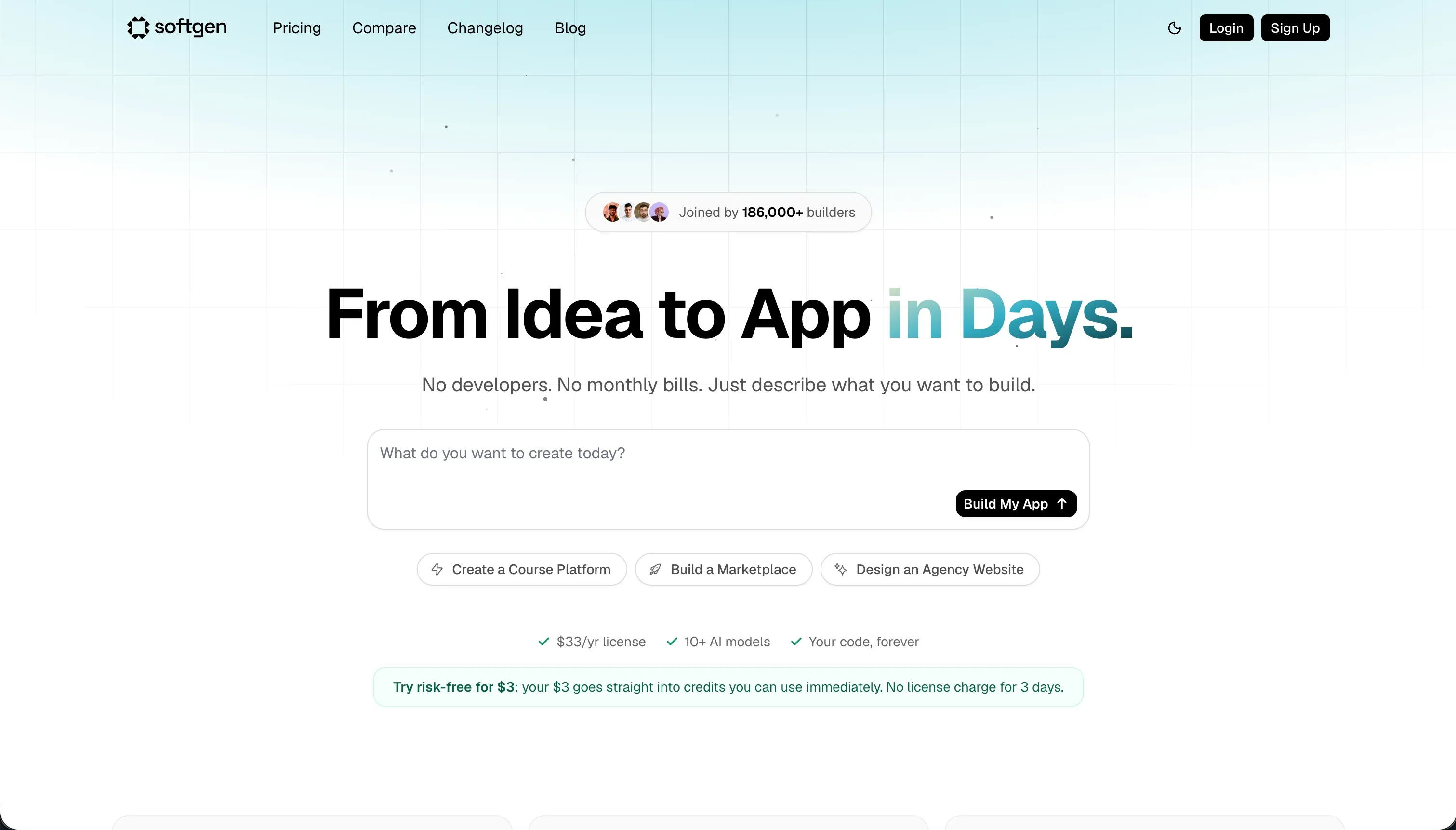
Softgen, operating as a conversational agent, focuses on generating lightweight full-stack MVPs with basic backend infrastructure included from day one.
Aggregate scores place v0 ahead at 5.8/10, with Softgen trailing at 5.1/10. Because v0 generates highly polished, framework-compatible React code, it holds a decisive edge in design quality and code ownership.
This performance gap is conditional, however: teams looking to run a complete database-driven app in an evening will favor Softgen’s all-in-one assistant, while teams with developer resources who want high-fidelity React interfaces will land firmly with v0.
The decision in 30 seconds
| If your priority is… | Pick | Why |
|---|---|---|
| Highly polished, modern React/Tailwind code | v0 | scores 8.5 on design flexibility, outputting clean, modern shadcn/ui components |
| Pre-configured relational databases and user auth | Softgen | includes out-of-the-box user templates and schema mapping |
| Robust client portals and secure internal tools | Neither | neither platform provides role-based user management or granular permissions out of the box |
| Zero-maintenance infrastructure without servers to manage | Softgen | manages backend deployments directly in its dedicated hosting sandbox |
| Full code ownership and inspectable TypeScript assets | v0 | exports clean, vanilla React code directly to standard local frameworks |
What each platform is
What is v0?
v0 is an AI-powered design and frontend generation assistant built by Vercel. It allows users to write natural language prompts, upload hand-drawn sketches, or provide visual screenshots to scaffold responsive, consumer-grade user interfaces.
The system coordinates the output using React, Tailwind CSS, and shadcn/ui layouts, allowing builders to instantly inspect and deploy the code to Vercel’s global CDN or sync it directly to a local development environment via GitHub.
This platform is explicitly designed as an interface layer rather than a full-stack application creator. Concrete features include a visual ‘Design Mode’ for color and styling modifications alongside a command-line interface helper that pulls components directly into local IDEs.
It serves non-technical founders seeking rapid UI prototyping and professional developers who want to bypass the repetitive overhead of building standard layout frameworks from scratch.
What is Softgen?
Softgen is a conversational, full-stack AI application builder. It utilizes a conversational workspace partner known as the ‘Cascade agent’ to outline, architect, deploy, and modify functional web applications using natural language.
Builders collaborate with the Cascade agent during an interactive schema-planning flow, which maps out database models and authentication interfaces before generating any structural UI layouts.
Key features in the Softgen package include standard relational database templates, integrated sign-in forms, and payment checkouts like Stripe. Softgen is built for creators, indie hackers, and non-technical builders who need to get a complete MVP with a functional database and payment layer to market in a matter of hours without touching terminal windows or configuring external APIs.
The core difference
The primary dividing line between these platforms comes down to design depth versus stack completeness.
- v0 acts as a designer’s dynamic scratchpad, delivering clean, inspectable React code while leaving all databases, state management, and hosting setups entirely to the local developer.
- Softgen acts as an all-in-one assembler, trading away custom design layout options to package database tables, backend logic, and hosting under a unified conversational interface.
Where the scores diverge
Design flexibility: v0 8.5, Softgen 5.0. v0 dominates this category with an 8.5, generating visually striking interfaces that align perfectly with the modern shadcn/ui framework. Builders can refine layouts using design mode inputs or adjust code directly.
Softgen scores a 5.0 as the conversational assistant is locked into a rigid grid of pre-configured layout modules, making custom aesthetics hard to implement without burning through prompt credits in repetitive loops.
Maintainability: v0 5.5, Softgen 4.0. v0 secures a 5.5, benefiting from its fully inspectable, non-proprietary code output that can be synced to GitHub and refined in any local IDE. However, it loses points because code quality drops past 5 to 10 chat iterations, leading to bloated CSS styles.
Softgen scores a 4.0 because it has no visual drag-and-drop editor; every small design adjustment must go back to the chat assistant, raising the risk of custom layouts falling into looping prompt errors and building up technical debt.
Ease of build: v0 7.5, Softgen 7.0. v0 scores a 7.5 on ease of build because it instantly generates a highly polished, responsive interface from a single sketch or text prompt.
This model is exceptionally fast for creating mockups, but a half-point is deducted because the output is just code; to turn it into a working product, you must wire up databases and backend APIs manually. Softgen scores a 7.0; its Cascade assistant holds the user’s hand to map database tables before generating of structural components.
While this makes building complete, basic apps straightforward for non-technical creators, visual adjustments must be done entirely through conversational prompt iterations which can stall.
Security & access control: v0 4.0, Softgen 4.5.
Softgen takes a slight lead with 4.5 by shipping pre-built authentication widgets and sign-in forms out of the box, though it lacks robust permission tiers or button-level conditional logic. v0 receives a 4.0 as it contains no logic to parse user roles, manage passwords, or govern API endpoints; any access control system must be designed from scratch by the developer who takes over the output.
Data & integrations: v0 5.0, Softgen 5.5. Softgen scores a 5.5 because of its schema generator that sets up basic relational models and links them directly to simple mock data and payment services like Stripe. v0 drops to a 5.0; while its Vercel deploy button and GitHub sync work perfectly, it lacks a relational database engine and requires manual configuration for any outside database integration.
Production readiness: v0 4.5, Softgen 4.5. Both options score a low 4.5 on production readiness, but for opposing reasons. v0 provides a gorgeous front door with absolute zero built-in infrastructure; it ships no database, no state storage, and block auth, so a developer must deploy and maintain the backend.
Softgen, while generating a functional database and Stripe checkout, is described by reviewers as an early-stage ecosystem where visual templates can be rigid and apps struggle to scale natively.
Cost comparison
The financial cost of these two systems is built on entirely different consumption metrics. v0 utilizes a credit-based model layered over monthly subscription tiers: a Free tier with a basic allowance, a $30/month Team plan, and a $100/month Business plan. Token fees are based on the complexity of the chosen developer model (Mini, Pro, Max).
Softgen bypasses traditional monthly platform subscriptions by offering a $33/year membership fee for platform access and hosting, and requiring pay-as-you-go credit bundles to fund design changes or schema adjustments.
Buyers must calculate the operational costs of maintaining these apps over time. With v0, the cost is front-loaded into developer hours; because you have to build the database and coordinate auth, you are paying for professional engineering cycles.
With Softgen, the hidden cost lies in iteration loop and credit overruns; because there is no visual drag-and-drop builder, correcting visual alignment, styling bugs, and minor database changes via chat prompts can drain token packages rapidly.
Lock-in and the exit path
v0 offers an exceptional exit path with zero platform lock-in: you can sync your generated React and TypeScript files directly to GitHub, download the clean assets, and host them on any server completely independent of Vercel.
Softgen provides a code-export option to assist teams that outgrow their infrastructure, though transitioning their generated full-stack template into standard code environments is more complex than v0’s modular shadcn/ui outputs. v0 remains the clear winner for teams looking for an uncompromised escape hatch.
Who should pick v0
Pick v0 if:
- Teams of frontend developers who want to bypass the tedious drafting of shadcn/ui layout structures.
- Founders who need to build and export a beautifully designed visual prototype to investors this week.
- Organizations with a clear developer handoff planned, where v0 builds the visual frontend and engineers construct the backend.
Do not pick v0 if you are a non-technical creator who needs a running database, payment integrations, and working user login pages without writing code yourself.
Who should pick Softgen
Pick Softgen if:
- Indie hackers looking to build and deploy a basic, single-functional MVP or directory in a single afternoon.
- Non-technical founders looking to test structured user sign-up sheets and Stripe test checkout screens quickly.
- Makers who favor a low-cost, pay-as-you-go annual plan over expensive monthly subscriptions.
Do not pick Softgen if you require polished visual branding, customized pixel-level grids, or a robust visual drag-and-drop editor.
What neither platform answers
Both v0 and Softgen assume you are either willing to build backends from scratch or run your business on basic, early-stage AI-generated software. If your goal is to build an internal tool, a vendor directory, an operations dashboard, or a secure client portal, neither platform is the right benchmark.
In this business software category, you are looking for functional logins, secure data storage, and role-based permissions that do not break when an AI updates its baseline model.
For these applications, Softr is the higher-scoring baseline. Softr scores an 8.5 on production readiness and a 9.0 on maintainability precisely because its platform features - such as Google login, custom SSO, stripe connectors, and secure user directories - are built visually using native blocks instead of code prompts.
Building with Softr connects a robust visual editor directly to secure local data via Softr Databases or external partners like Airtable, keeping data transactions server-side. For teams that want code logic instead, Bubble remains a robust alternative.
Analyst verdict
v0 wins this head-to-head match with an aggregate score of 5.8/10 against Softgen’s 5.1/10 limit. v0 claims its victory by securing a decisive 8.5/10 in design flexibility and offering clean, non-proprietary React code that can be deployed anywhere.
Softgen struggles with visual customization, earning a 5.0/10 limit because its conversational interface acts as a visual cage, forcing users into tedious chat loops to change simple visual alignments.
The final purchasing decision is simple: if you have developer resources to write backends, v0 is a magnificent design accelerator that sets up frontends in seconds. If you are non-technical and want to run a prototype full-stack directory by tonight, Softgen’s pay-as-you-go MVP model is the strategic path, provided you do not plan to scale past its basic custom limits.
Related reading: the v0 scorecard, the Softgen scorecard, and our scoring methodology.