
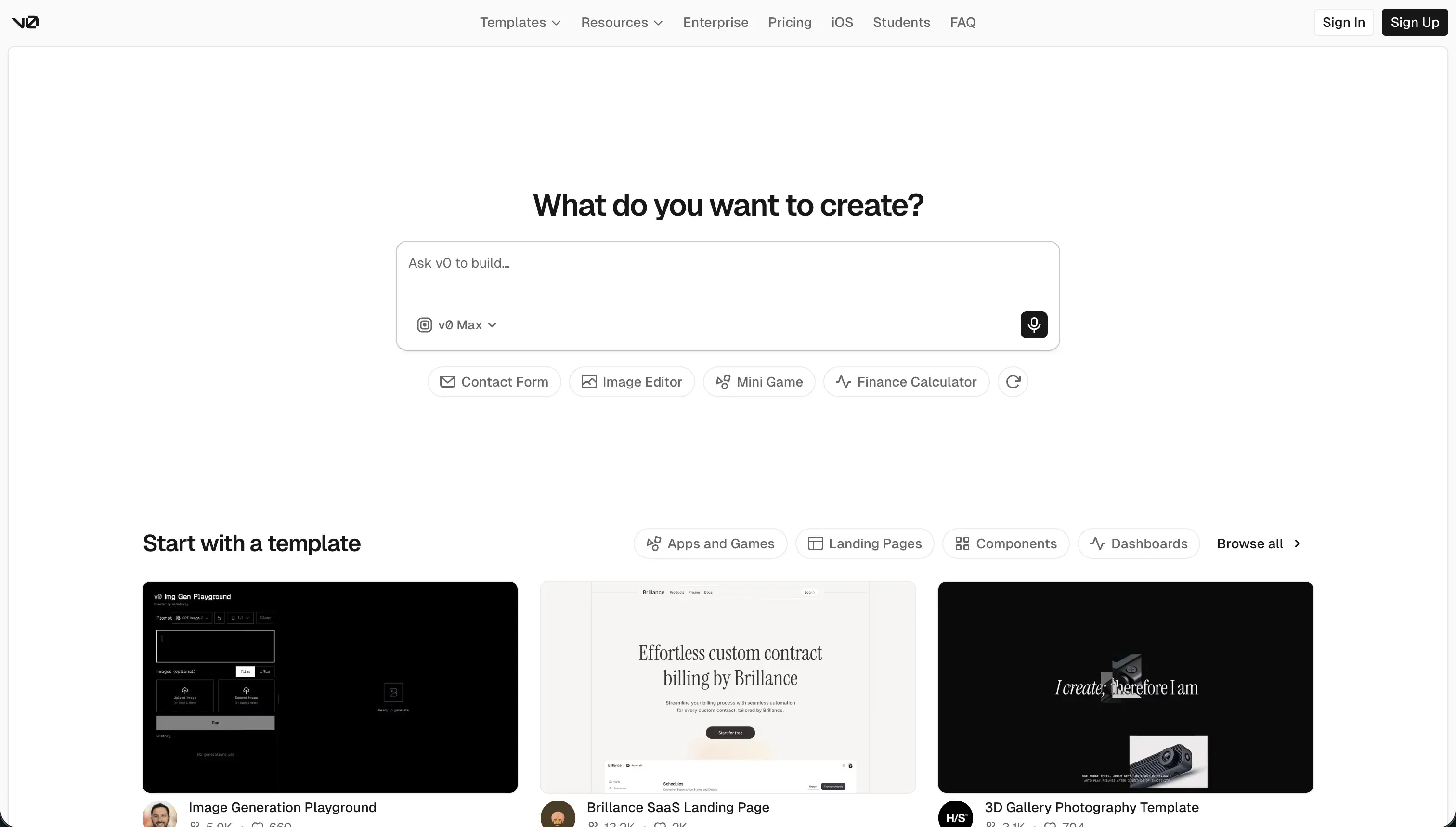
What v0 is
v0 by Vercel is an AI-powered frontend generation assistant that translates natural language prompts, sketches, or screenshots into responsive user interfaces. It outputs clean, standard React code styled with Tailwind CSS and the modern shadcn/ui library, ready to be deployed instantly on Vercel’s global CDN or synced directly to your own repositories via GitHub.
The build model is strictly designed for UI prototyping rather than full-stack visual composition. Unlike classic template-based no-code platforms or visual drag-and-drop database tools, v0 operates as an intelligent designer’s scratchpad; you converse with the AI or feed it design inputs, and it continuously refines the generated React and TypeScript code in real time inside its preview canvas.
The core tradeoff is frontend speed versus application infrastructure. While you gain absolute freedom to create modern, bespoke web layouts without structural templates, you receive no built-in host infrastructure such as user authentication, databases, or backend business logic. Every transactional query, data table, and user routing mechanism must be constructed manually after the interface code is exported.
Where the scores come from
The scorecard for v0 reveals a highly concentrated strength in interface creation balanced against the heavy engineering responsibilities of building a functioning application, showing a platform that excels at visual scaffolding but demands external technical ownership for day-two operations.
Ease of build: 7.5/10
v0 scores 7.5 in ease of build because it dramatically shortens the path from a visual concept or sketch to fully styled frontend React code. For developers and interface designers, the conversational editor allows you to write natural language prompts and instantly see interactive components come together with standard design systems.
However, the platform falls short of a complete build experience because its outputs are strictly limited to frontend mockups. Because you need to manually connect these interfaces to a backend, database, and authentication provider, non-technical builders face a hard engineering cliff immediately after generating their screen layouts.
Production readiness: 4.5/10
Production readiness scores 4.5 due to the complete lack of built-in hosting utilities, runtime servers, or persistence layers. v0 does not provide production infrastructure; once the visual component is generated, the developer must stand up the companion API servers, secure variables, and deploy databases entirely on their own.
Furthermore, developers report reliability friction during real project iterations. Chat sessions extending past 5 to 10 messages often suffer from drastic context drift, which introduces bloated layouts, outdated Tailwind version errors, or buggy component logic that requires offline fixing.
Maintainability: 5.5/10
Maintainability scores 5.5, reflecting a dual reality where owning standard framework code is highly beneficial, but the code quality itself can degrade. On the positive side, because the output is standard React and TypeScript, it can be seamlessly synced through GitHub and debugged inside clean local files with no proprietary runtime lock-in.
On the negative side, reviewers note that v0 frequently generates repetitive or bloated Tailwind class piles and attempts to reconstruct complex components from scratch instead of referencing native import libraries. Over time, these generated components can create a legacy maintenance burden for technical teams to reflow.
Security & access control: 4.0/10
Security and access control scores 4.0 because the platform carries no native data protection or permission architecture. Since v0 generates layout codes exclusively on the client side, there are no built-in password recovery flows, Multi-Factor Authentication modules, or database security protocols.
Any access control schemes, server-side data validations, or row-level permissions must be coded and managed entirely by developers on an external backend. v0’s canvas cannot confirm who is logged in or isolate restricted data files.
Data & integrations: 5.0/10
Data and integrations scores 5.0, anchored by its direct Git integrations and one-click Vercel deployments. The platform easily moves source files into standard developer ecosystems and pulls from remote GitHub branches.
However, there is no native data layer or visually mapped API connectors. The database schema, relational tables, and live API endpoints do not exist natively on the platform; v0 generates hardcoded data templates that require manual integration before showing live production records.
Design flexibility: 8.5/10
Design flexibility scores 8.5, representing the strongest attribute on the v0 scorecard. Because v0 generates standard Tailwind classes and shadcn/ui blocks, it operates with virtually limitless visual freedom, avoiding the rigid grid constraints seen in layout-limited no-code builders.
One functional limit noted by visual designers is that conversational adjustments typically focus to CSS and Tailwind color variables. Moving beyond color palette updates to achieve pixel-perfect layout alignment still rewards a developer’s visual eye and CSS intuition rather than relying solely on automated prompt updates.
What types of apps you can build with v0
v0 is built to construct the frontend presentation tier of modern web structures. It works best when used to accelerate UI layout mockups, interactive component experiments, brand design validations, or responsive web layouts that will eventually be supported by a dedicated technical engineering team.
Good-fit application types include frontend prototypes, marketing landing pages, visual dashboards, and custom interface designs built from static design assets or rough sketches.
Conversely, if your goal is to build secure, business-facing applications like client portals, secure internal tools, or transactional CRMs that manage sensitive user permissions, a platform like Softr offers a safer alternative.
Whereas v0 requires you to manually write server-side logic and databases to secure a dashboard, Softr delivers out-of-the-box user permissions and server-side data isolation, meaning your business tables are protected by default without writing backend code.
- Best for prototypes, landing pages, visual dashboards
- You write server-side logic and databases yourself
- Securing a dashboard is manual work
- UI layer only, backed by an engineering team
- Built for client portals, internal tools, transactional CRMs
- Out-of-the-box user permissions
- Server-side data isolation included
- Business tables protected by default, no backend code
- Secure app classes without writing backend
Who should not use v0?
Do not use v0 if you are a non-engineer who needs a complete, running business application with live databases and hosting. Without developer resources to wire up APIs and server frameworks, v0’s outputs remain non-functional visual shells.
Do not use v0 if your project requires built-in features like ready-made authentication, database schemas, or row-level access control as part of its core build. v0 provides zero backend environment configurations, leaving all secure access architectural work to you.
Do not use v0 if your engineering team requires highly predictable fixed monthly tooling costs. The usage-based consumption pricing means credit pools burn down quickly during complex debug cycles, costing teams unexpected premium credit fees even for failed AI generations.
Analyst verdict
With an average score of 5.8, v0 is a highly effective, specialized generator for developers who need to produce mockups, scaffold modern UI screens, and export raw code without locking themselves into proprietary platforms. It provides high frontend design freedom but relies entirely on external developers to compile, host, secure, and maintain the systems that make an application function on day two.
If your project requires self-hosting or you already carry backend systems, v0 is a strong fit. If you are instead building secure portals, internal CRMs, or operational programs, shortlist platforms like Softr, Retool, or Bubble. Read more about our scoring indicators in the methodology.