

Choosing between Bubble and v0 is really choosing between 2 different procurement problems. Bubble is a no-code application platform with its own managed runtime, database, and workflow engine. v0 is an AI frontend generation tool that produces React and Tailwind code for teams already building in code.
Bubble wins the general decision, 6.8/10 to v0’s 5.8/10. It takes the categories that matter most for a live app: production readiness, maintainability, security, and data handling. v0 only flips the decision when your team already has engineers ready to wire generated UI into a custom backend. In that case, its faster frontend generation becomes the more valuable advantage.
The decision in 30 seconds
| If your priority is… | Pick | Why |
|---|---|---|
| Full-stack web app without writing code | Bubble | Scores 8.0 on data & integrations with a built-in database and visual workflows |
| Generate React and Tailwind UI from a prompt | v0 | Wins ease of build at 7.5 because it creates frontend code in seconds |
| Built-in auth, permissions, and managed backend logic | Bubble | Scores 6.5 on security & access control with server-side privacy rules |
| Portable codebase with a cleaner exit path | v0 | Exports standard React code to GitHub instead of locking logic into a proprietary runtime |
| Client portal or internal tool with low maintenance | Neither | Both are a poor fit versus a business-app platform built for logins, permissions, and ops workflows |
What each platform is
What is Bubble?
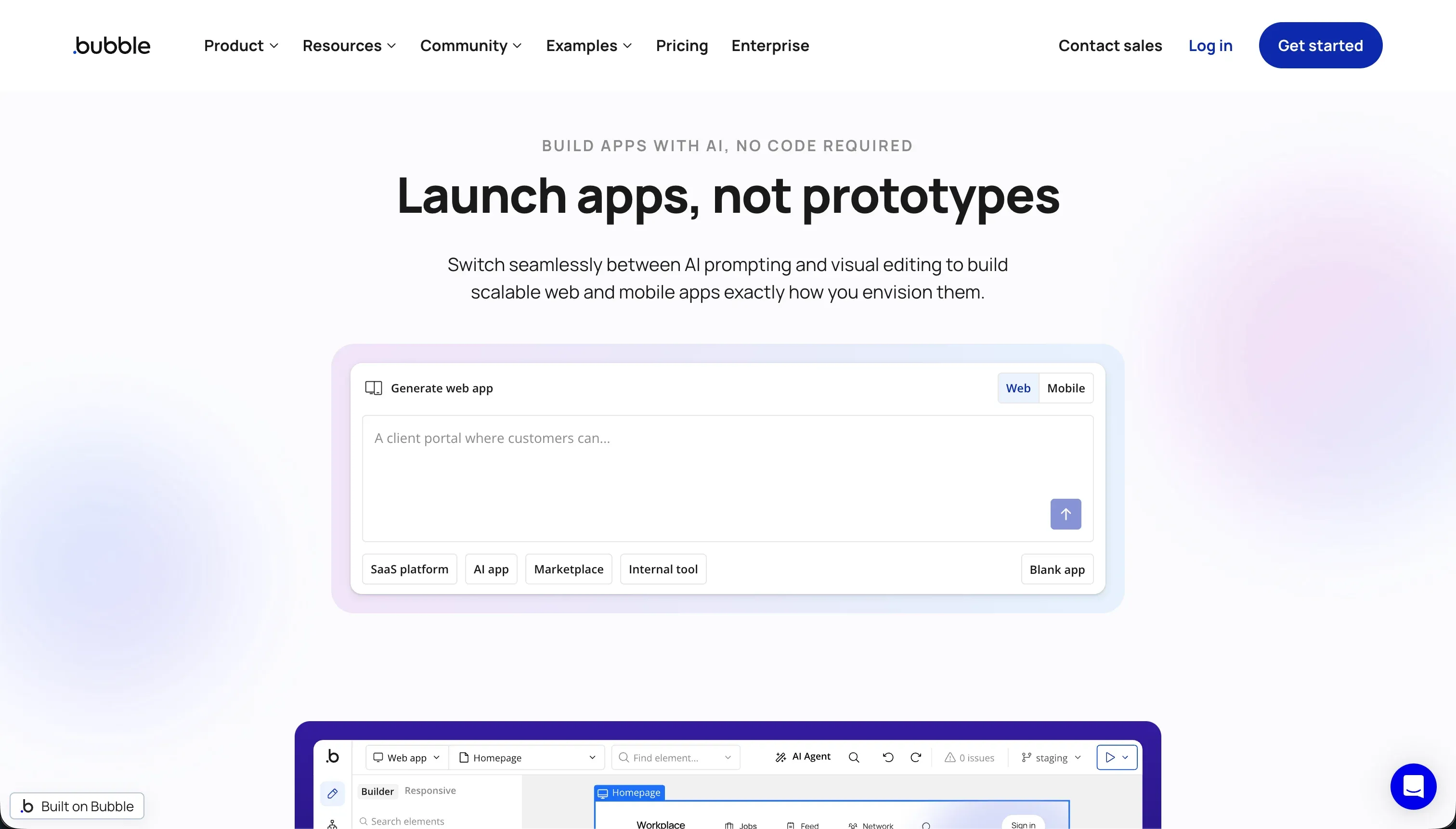
Bubble is a visual full-stack app builder that lets you design pages, model data, and create backend logic without writing code. The build model is a proprietary managed runtime: you assemble UI in a drag-and-drop editor, define workflows visually, and run the finished app on Bubble’s own hosting and database layer.
Bubble includes concrete platform features such as built-in user authentication, server-side privacy rules, a native database with custom data types, and an API Connector for external services. It is genuinely built for founders, operators, and agencies who need custom business logic or customer-facing web apps without staffing a traditional engineering team.
What is v0?
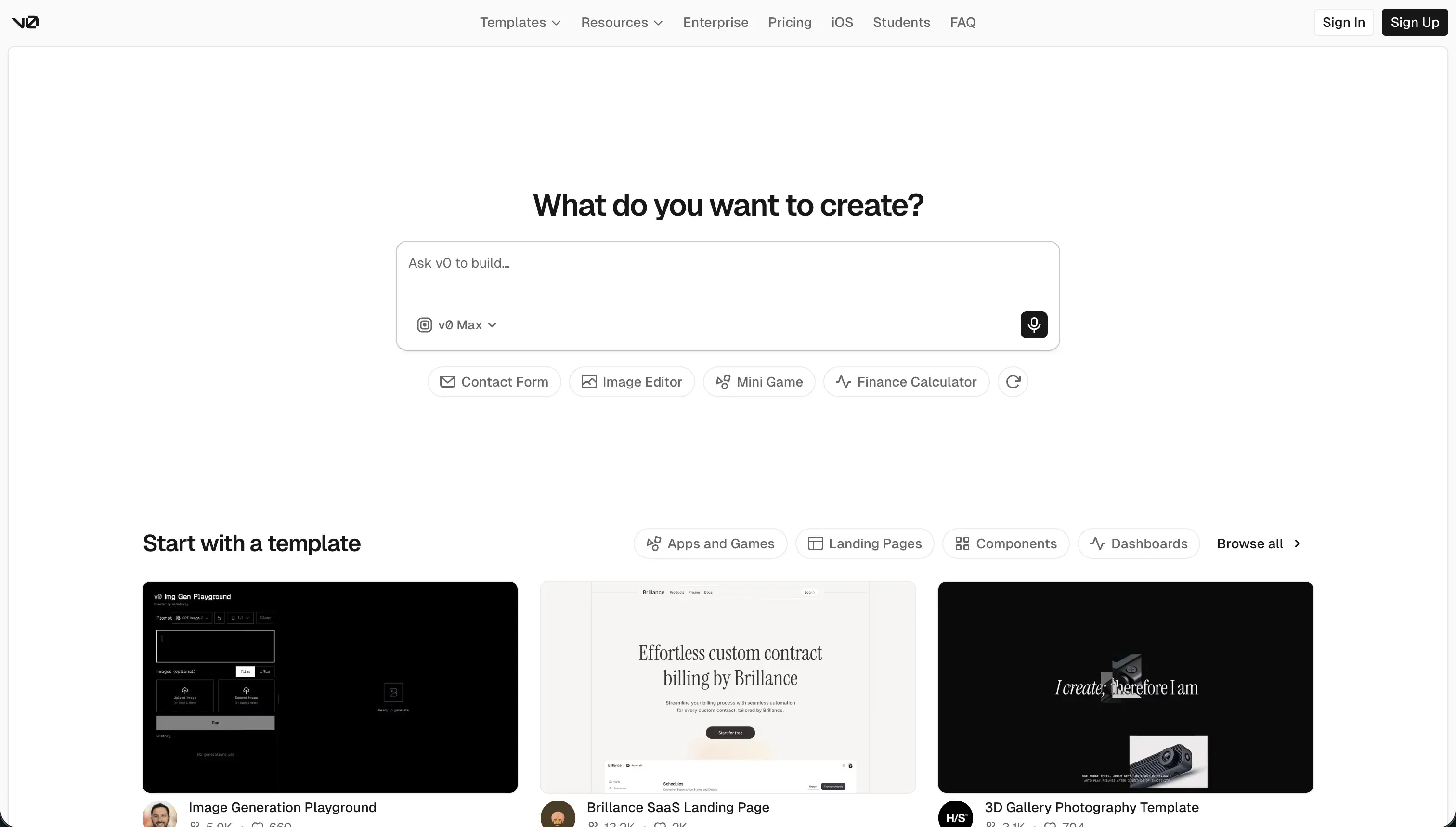
v0 is Vercel’s AI UI generation tool for producing React interfaces from prompts, screenshots, and iterative chat edits. The build model is code generation rather than managed runtime: v0 creates frontend components and layouts, then your team takes that code into a normal developer workflow.
v0 generates Tailwind-styled interfaces, uses shadcn/ui patterns, and can sync output to GitHub for downstream development. It is genuinely built for designers, product teams, and developers who want to move quickly on polished frontend screens, not for non-technical buyers expecting a complete database-backed application out of the box.
- Drag-and-drop UI editor
- Visual workflows, no code
- Managed hosting and database
- Built-in auth and privacy rules
- API Connector for external services
- Generates React from prompts
- Tailwind and shadcn/ui output
- Syncs code to GitHub
- Team owns the dev workflow
- Frontend only, no backend
The core difference
These tools diverge most on one axis: managed application runtime versus generated frontend code. Bubble gives you a place to run the whole app; v0 gives you code that still needs a real app stack around it.
- Bubble packages UI, database, workflows, hosting, and access rules inside one proprietary no-code runtime.
- v0 generates production-style React frontend code but leaves backend architecture, data, auth, and deployment decisions to your team.
Where the scores diverge
Data & integrations: Bubble 8.0, v0 5.0. Bubble leads because it has a managed database model, custom data types, and an API Connector that lets non-developers hook workflows into external services.
It still loses points because advanced integration patterns can push teams into plugin dependence or more brittle configurations over time. v0 does not really compete on native data capabilities since it generates frontend code rather than managing records or backend logic. Any real data layer has to be designed and implemented outside the tool.
Ease of build: Bubble 5.0, v0 7.5. v0 is easier because the first output arrives almost instantly from a prompt or screenshot, which is a much lighter start than learning a visual programming system.
That speed does not make it effortless forever, though: once you need the generated UI to behave like real software, a developer still has to wire state, APIs, and backend logic. Bubble loses here because its editor, data modeling, and workflow concepts take real ramp time. The payoff comes later, but the initial learning curve is materially steeper.
Production readiness: Bubble 7.0, v0 4.5. Bubble scores higher because it is already structured to run a real web app with auth, database, hosting, and backend workflows in one managed environment.
Its deduction comes from the known limits of that environment, including performance strain on larger builds and operational quirks that advanced teams may outgrow. v0 starts behind because generated UI is not the same thing as a deployable product.
Teams still need to supply the backend, infrastructure, secrets management, and runtime behavior before users can rely on it.
Security & access control: Bubble 6.5, v0 4.0. Bubble has a meaningful advantage because it includes native user accounts and server-side privacy rules at the platform layer.
The deduction is that these controls still need to be configured correctly by the builder, so the platform does not remove security responsibility entirely. v0 scores low not because its code is inherently unsafe, but because it provides no built-in access-control system to evaluate.
Authentication, authorization, and secure data handling all depend on what your engineers build around the generated frontend.
Maintainability: Bubble 6.0, v0 5.5. Bubble wins because the same visual system that creates the app also keeps the logic, data structure, and permissions in one place for ongoing edits.
It is not a perfect score because large Bubble apps can become messy, with sprawling workflows and debugging overhead inside the editor. v0 falls behind when repeated prompting creates inconsistent patterns, extra cleanup, and code that still needs a developer to normalize.
That can be fine for fast prototyping, but it is a weaker maintenance story for long-lived systems.
Design flexibility: Bubble 8.5, v0 8.5. This is close, which is why it does not decide the matchup on its own. v0 is strong because it produces modern React and Tailwind interfaces quickly and gives code-oriented teams room to refine the result directly.
Bubble stays competitive because its visual editor allows deep layout control for a no-code platform, including responsive behavior and custom page composition. The difference is mostly about medium: v0 is more natural for code teams, while Bubble is more natural for no-code teams.
Cost comparison
Bubble uses subscription tiers with workload-based economics underneath, while v0 uses seats plus usage credits. On Bubble, plan price and Workload Units both matter, so bills move when backend workflows, database queries, and app activity become heavier. On v0, the bill moves with seats and model usage, so more generations, retries, and debugging loops consume more credits.
The hidden costs are different.
Bubble buyers should forecast builder ramp time, workflow optimization work, plugin spend, and the cost of reworking apps that hit workload inefficiencies. v0 buyers should forecast developer time to connect the frontend to real systems, cleanup of generated code, extra credit consumption during iteration, and migration work if the generated UI becomes only the first step toward a custom app.
Lock-in and the exit path
Bubble has the heavier lock-in because you can export data rows, but not the actual application logic, workflows, or full visual structure that make the app run.
Leaving Bubble means rebuilding the product in another stack. v0 has the cleaner exit because its main output is standard frontend code that can live in GitHub and continue outside the product, though your team still has to supply and maintain the backend architecture separately.
Who should pick Bubble
Pick Bubble if:
- Non-technical teams that need a real web app, not just screens, and value Bubble’s stronger production readiness and 8.0 data & integrations score
- Founders or agencies building workflow-heavy software with auth, database records, and user roles inside one managed platform
- Buyers who care more about shipping a functioning product than owning exportable code, especially where security rules and backend logic matter
Do not pick Bubble if your top requirement is exportable code, a standard developer stack, or a billing model that avoids workload-driven surprises.
Who should pick v0
Pick v0 if:
- Developer-led teams that want to generate polished React UI fast and can connect it to their own backend systems
- Design and product teams that need rapid mockups or coded frontend concepts for review, demos, or handoff
- Buyers who prioritize a cleaner exit path because v0 outputs standard code instead of trapping the product in a proprietary runtime
Do not pick v0 if you need a complete live application with built-in database, authentication, permissions, and backend workflows handled for you.
What neither platform answers
Many buyers reading this comparison do not actually need either a visual full-stack app builder or an AI frontend generator. They need a business app: a client portal, internal tool, CRM, or vendor workspace defined by logins, permissions, records, and low ongoing maintenance.
In that lane, Softr is often the better answer because it is built around business app deployment and scores strongly on production readiness, maintainability, and security & access control for that use case.
If your priority is the lowest-friction business application for operational teams, shortlist Softr for its stronger business-app posture and simpler management model.
If your priority is a more engineering-led internal tool environment with direct data connectivity and custom workflows, another sensible angle is Retool.
That split is the honest exclusion: many people comparing Bubble and v0 are actually choosing between an ops app platform and a developer-centric toolchain, not between these 2 products alone.
Analyst verdict
Bubble wins 6.8 to 5.8 on aggregate. It takes production readiness, maintainability, security & access control, and data & integrations, while v0 keeps ease of build and stays competitive on design flexibility. That makes Bubble the better general recommendation for buyers who need software that actually runs as one managed product.
The decision flips in 1 specific case: when you already have engineers who want generated React UI, code ownership, and a custom backend. In that setup, v0’s 7.5 score on ease of build matters more than Bubble’s managed runtime advantages. If you do not have that engineering capacity, Bubble is the safer buy.
Related reading: the Bubble scorecard, the v0 scorecard, and our scoring methodology.