

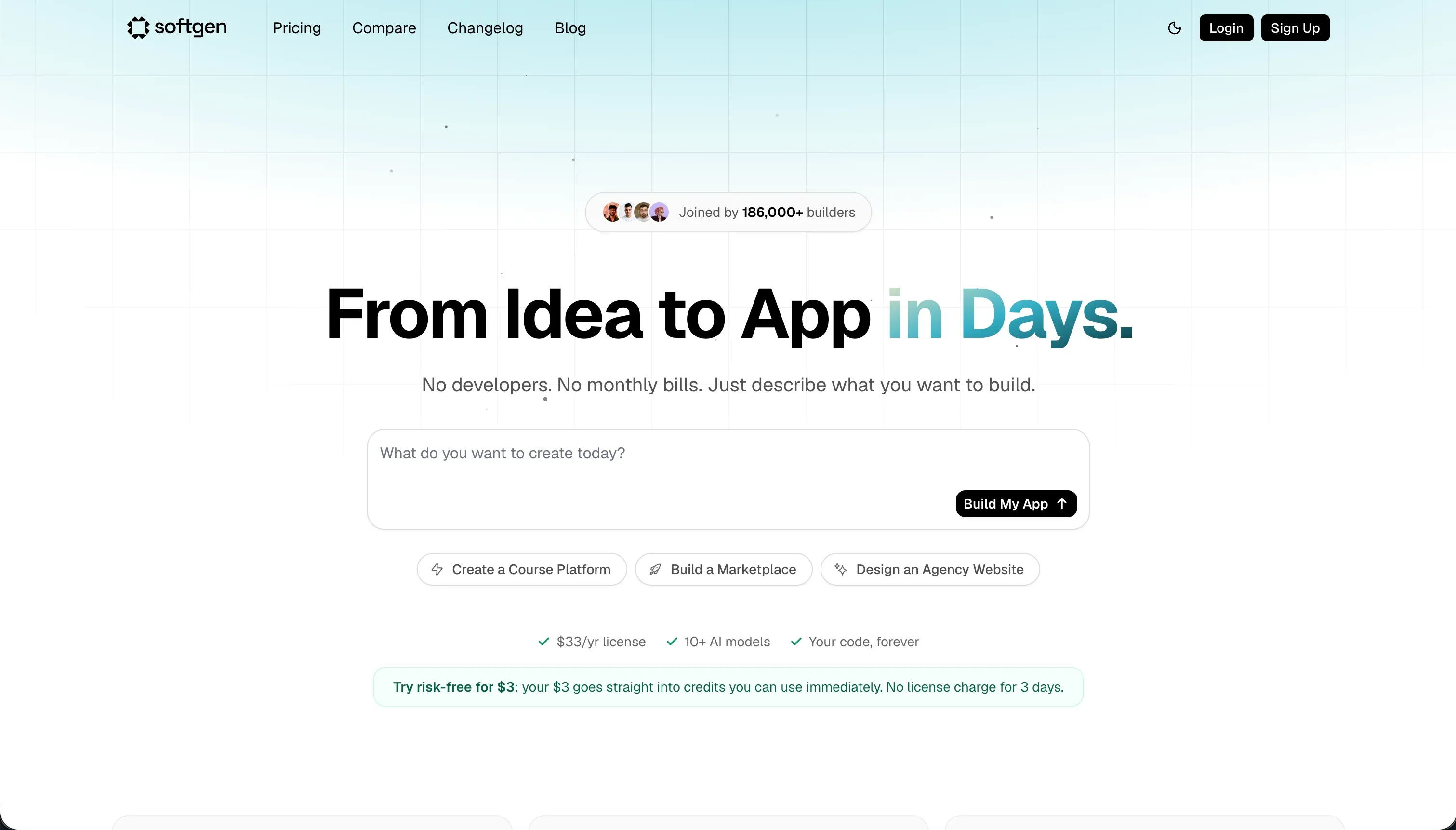
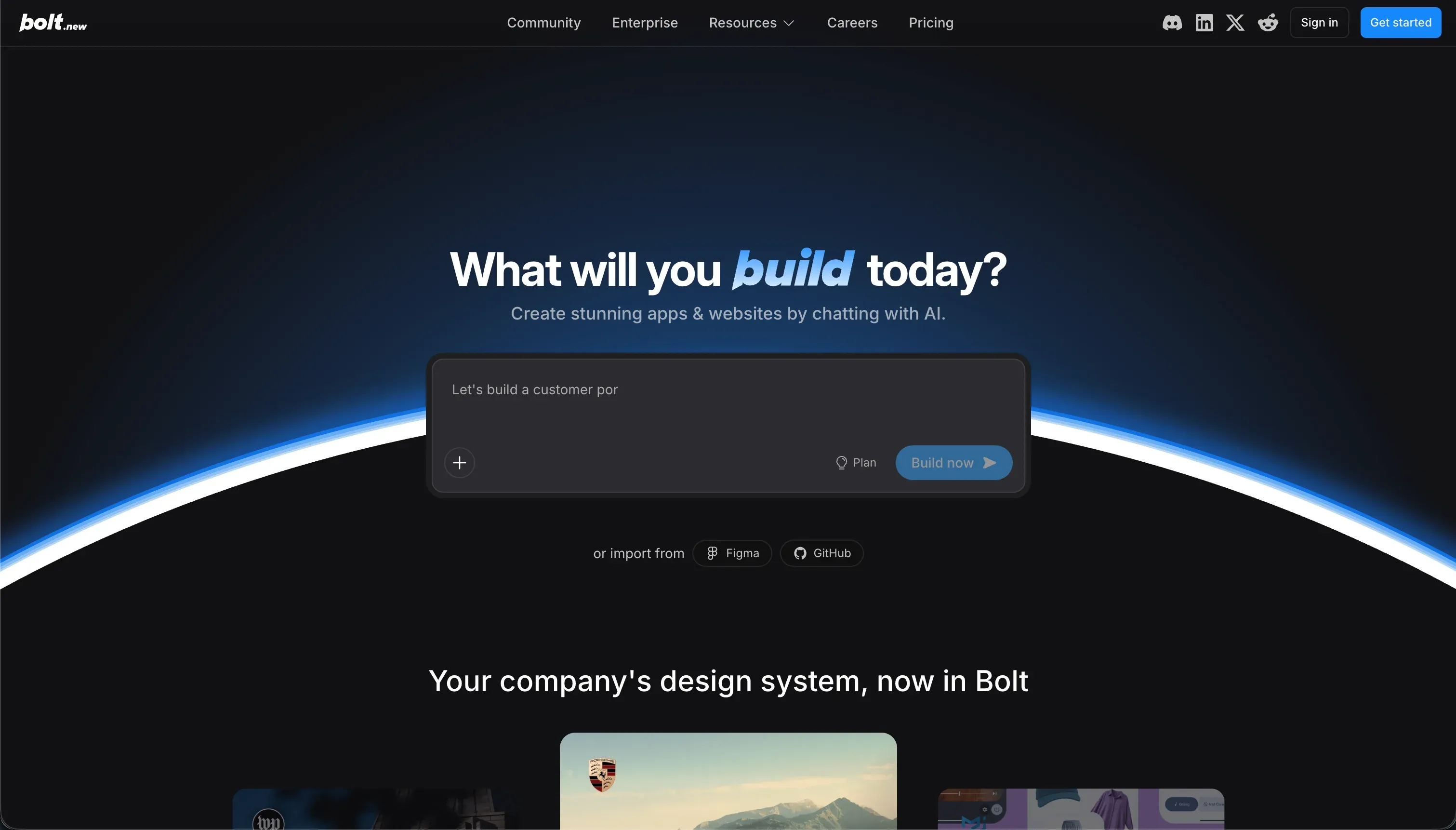
Choosing between conversational AI application builders requires evaluating the technical depth of the output and the daily operational overhead. Softgen targets creators and indie hackers looking to build and test MVPs with predefined layouts, whereas Bolt serves as a browser-native workspace for developers who want direct repository ownership and deep front-end flexibility.
While both platforms land on an aggregate score of 5.1/10, Softgen wins the comparison by securing the advantage in ease of build, maintainability, production readiness, and security of authentication. Select Bolt only if you possess the web development background needed to manage an active browser-based coding container.
The decision in 30 seconds
| If your priority is… | Pick | Why |
|---|---|---|
| Fastest MVP without coding knowledge | Softgen | scores 7.0 on ease of build with a guided schema planner and natural-language Cascade agent |
| Pixel-level front-end design and custom CSS | Bolt | scores 8.0 on design flexibility, allowing standard React code adjustments without template ceilings |
| A completely pre-built database and auth layer | Neither | both code-gen tools leave security policies and database hosting to manual configuration or external setups |
| Clean, independent codebase ownership | Bolt | exports standard React/Vite codebases and features native GitHub sync |
| Guarding against repetitive code-gen loops | Softgen | the interactive planning flow maps out schemas before generation, reducing initial prompt waste |
What each platform is
What is Softgen?
Softgen is a chat-based conversational application builder. The platform uses its proprietary Cascade AI workspace agent to outline, architect, and modify application features in plain language, creating user interfaces, relational schemas, and integrations like Stripe.
Softgen works within predefined layout modules, meaning you do not have a visual drag-and-drop editor. Instead, developers and non-technical founders use an interactive conversational flow to map out database schemas before deploying generated applications to Softgen’s hosting environment.
What is Bolt?
Bolt is a browser-native development environment designed for rapid full-stack application prototyping. It generates complete React front-ends, Node.js backends, configurations, and PostgreSQL schemas within browser-native WebContainers.
More than a prompt-to-app generator, Bolt functions as a live browser IDE. Builders with web development knowledge can install npm packages directly in the client, run terminal commands, and sync codebases to GitHub repositories, deploying to Bolt Cloud or Netlify.
The core difference
The primary axis of divergence is the balance between visual layout constraints and raw developer control.
- Softgen limits visual customization to predefined structural modules in exchange for a simpler, chat-guided setup.
- Bolt provides an open-ended browser IDE generating complete raw React and Vite codebases.
Where the scores diverge
Design flexibility: Softgen 5.0, Bolt 8.0. Bolt wins this criterion cleanly with an 8.0, utilizing generated React and Vite structures that remove any template constraints while offering Figma import and npm integration.
Softgen scores a 5.0; its AI is structurally confined to set layout modules, meaning granular visual edits through chat often spark repetitive prompting loops that yield visual frustration and consume pay-as-you-go credits.
Ease of build: Softgen 7.0, Bolt 5.5. Softgen scores 7.0, leveraging its Cascade agent and an interactive planning helper that models app schemas before writing code. This structure guides non-technical users safely through early architecture.
Bolt scores only 5.5 because it operates as a full browser IDE; although it generates previews in minutes, successfully debugging deployment failures, configuring backend variables, and resolving container issues assumes basic web development knowledge.
Security & access control: Softgen 4.5, Bolt 3.5. Softgen scores 4.5 by shipping pre-configured authentication templates and login forms out of the box, although its permission logic is basic. Bolt scores a 3.5, as it features no visual layer for access settings.
Builders must prompt the AI to write database Row-Level Security rules from scratch, making security audits virtually impossible for a non-technical manager who cannot read code.
Production readiness: Softgen 4.5, Bolt 4.0. Softgen scores 4.5 here, which is low but remains ahead of Bolt’s 4.0. Softgen provides straightforward one-click deployments and custom domains, though reviewers describe the visual tuning as early-days with polish still needed.
Bolt suffers from severe developer-level stability issues; users report frequent browser WebContainer crashes, out-of-memory errors on large projects, and a strict project size limit that blocks further prompting.
Maintainability: Softgen 4.0, Bolt 3.5. Softgen’s score of 4.0 reflects the lack of a drag-and-drop visual builder, meaning all iterations require re-prompting the AI chat, creating long-term maintainability trade-offs. However, it provides a code export path.
Bolt scores a lower 3.5; its edit loops frequently trigger severe code regressions where the AI overwrites working files or reverts progress, causing builders to burn huge sums of credits simply trying to stop the AI from breaking its own code.
Data & integrations: Softgen 5.5, Bolt 6.0. Bolt scores 6.0, generating open PostgreSQL schemas and incorporating anything reached via code, though it has no native database admin interface. Softgen scores slightly lower at 5.5; it generates solid working relational databases and essential business integrations like Stripe, but its general integration ecosystem remains narrower.
Cost comparison
The financial cost of these platforms is driven by entirely different usage variables. Softgen bypasses monthly recurring platform subscriptions with an annual membership of $33 to access the editor, funding updates through pay-as-you-go credits.
Bolt utilizes a hybrid subscription model, scaling from a $25/mo Pro plan (with 10 million tokens) up to high-capacity developer tiers, charging monthly fees while forcing users to maintain active subscriptions to prevent loose tokens from expiring.
For cost forecasting, buyers must calculate development time and credits wasted in debugging. Softgen buyers risk burning credits in visual prompting loops trying to align layout blocks. Bolt buyers face high token depletion during automated error-handling cycles, where the browser container actively consumes millions of tokens troubleshooting build errors or trying to correct repetitive code-gen regressions.
- $33 annual membership, no monthly subscription
- Pay-as-you-go credits fund updates
- Credits burn in visual prompting loops aligning layout blocks
- $25/mo Pro tier with 10M tokens, scales up
- Monthly fees must stay active or tokens expire
- Tokens deplete in error-handling cycles and code-gen regressions
Lock-in and the exit path
Both platforms offer code export as an exit path, which is a major advantage over proprietary runtimes. Softgen allows full raw codebase downloads when your application outgrows its basic structure. Bolt features direct React and Vite standard codebase downloads alongside integrated GitHub repository synchronization.
Bolt provides the cleaner developer exit due to its standard Vite repository structures, though in both cases, moving to alternative platforms means onboarding a professional engineer to manage the exported codebase.
Who should pick Softgen
Pick Softgen if:
- Creators looking to launch a fast database MVP or searchable business directory without managing complex IDE parameters.
- Non-technical founders who value a structured questionnaire process to map schemas before entering a code-generation workspace.
- Teams seeking a low-cost, low-subscription platform backup with flat yearly membership access.
Do not pick Softgen if you need highly customized web aesthetics or pixel-precise control over custom layout containers.
Who should pick Bolt
Pick Bolt if:
- Developers looking to quickly scaffold clean React and Vite codebases to skip the tedious initial environment setup.
- Builders who require complete control over custom design systems, storybooks, and third-party node packages.
- Indie hackers who intend to execute standard Git commits and directly export applications for external hosting.
Do not pick Bolt if you lack web programming knowledge to resolve local WebContainer browser crashes, node dependencies, or database configuration errors.
What neither platform answers
Both Softgen and Bolt are developer-paradigm tools where iteration is heavily dependent on AI prompting or manual coding. If you are a business operator trying to launch a secure, low-maintenance business app like a client portal, a modern CRM, or an internal operations hub, both of these platforms introduce structural risks.
You will either get caught in repetitive prompt-debugging loops or be forced to manage server deployments, APIs, and raw codebases.
For the operational lane of business software, Softr represents a much more reliable alternative. It scores 8.5 on production readiness, 9.0 on maintainability, and 8.5 on security and access control.
Because Softr structures your application with secure, native, responsive components connected directly to a high-performance native database, you get visual certainty. You can configure granular user permissions, authentication states, and client-facing dashboards visually without risking code corruption.
For teams needing custom code on occasion, Replit offers a more comprehensive programming workspace than browser-based IDEs.
Analyst verdict
Softgen wins this comparison on points, scoring 5.1/10 to Bolt’s 5.1/10 aggregate, breaking the scoring tie by securing the advantage in 4 of the 6 key criteria. Softgen is highly accessible to non-technical users because its planning workflow and layout constraints prevent builders from accidentally compiling a broken, insecure codebase.
Bolt excels at design flexibility, but its operational reality involves regular container crashes and token-consuming edit loops that demand solid programming literacy to make the platform maintainable outside of basic prototypes. Choose Softgen for low-code database MVPs with a guided setup, or pivot to alternative no-code options for stable, production-ready operational business systems.
Related reading: the Softgen scorecard, the Bolt scorecard, and our scoring methodology.