

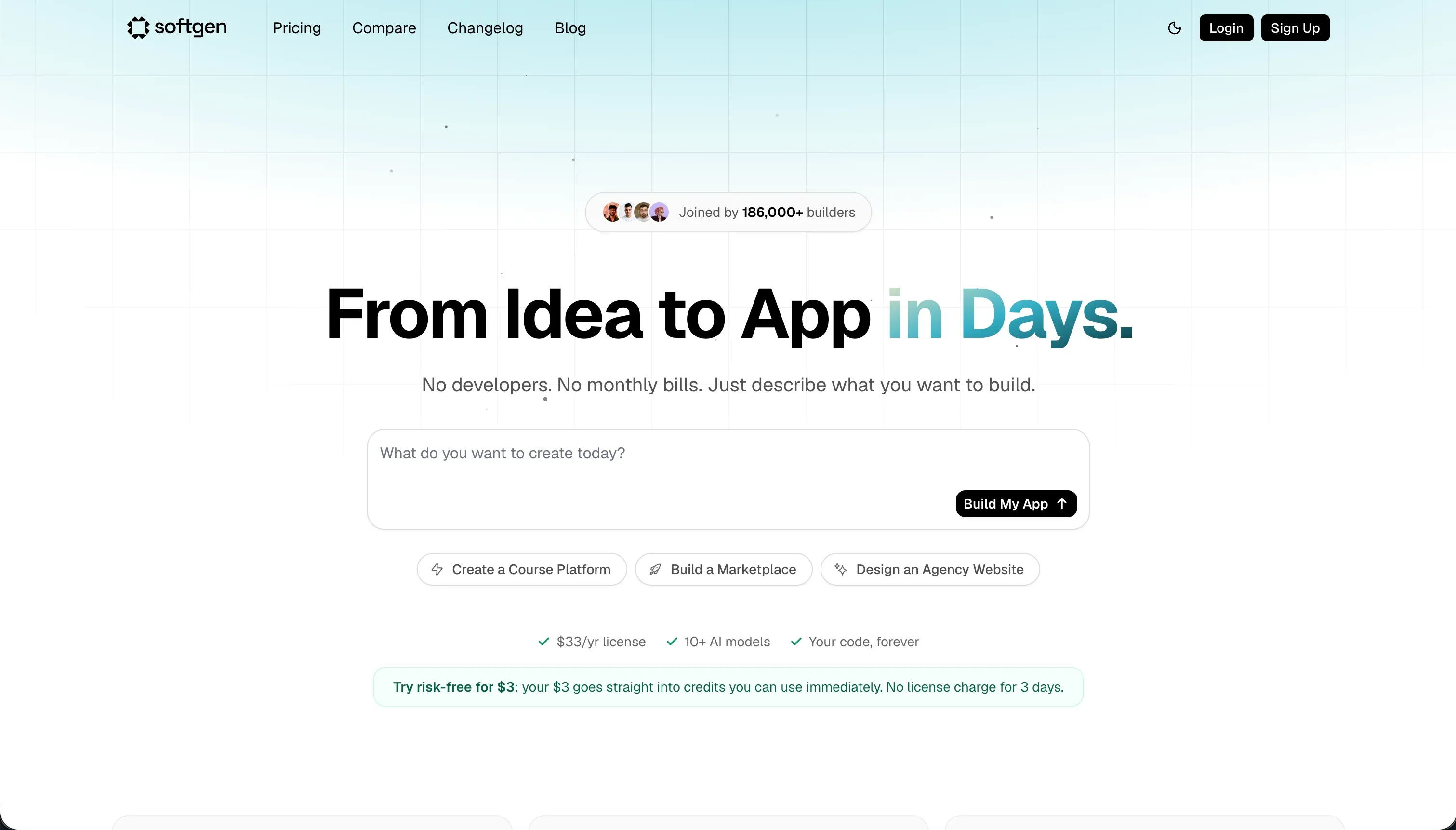
When sourcing an application builder, procurement teams must separate tools by their primary interface model and deployment mechanics. Softgen sits in the conversational AI application category, using chat-driven generation to shape web layouts and database schemas.
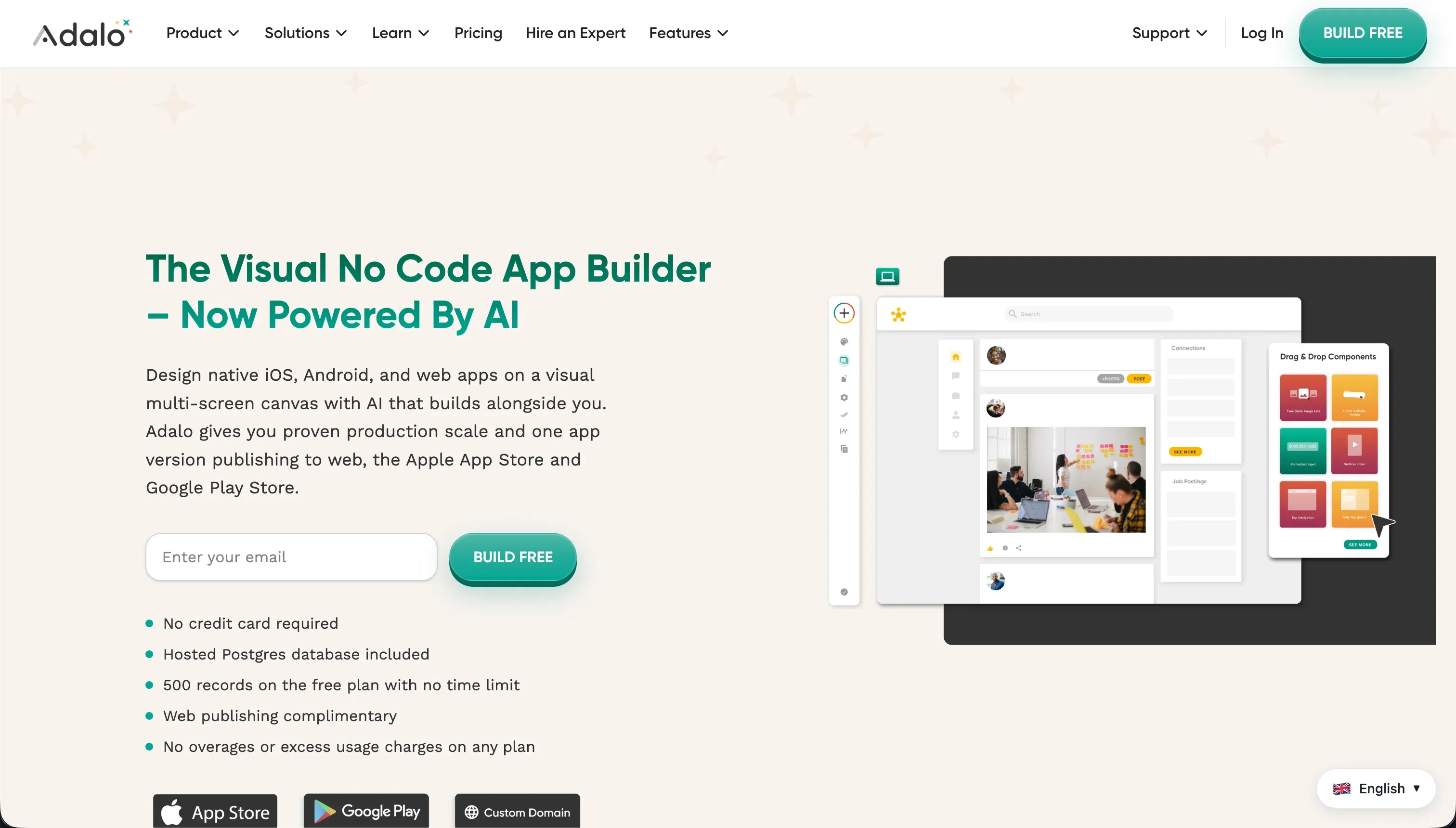
Adalo belongs to the mobile-first drag-and-drop no-code category, positioning visual elements on a freeform canvas to produce native mobile packages.
Softgen wins the aggregate decision with a score of 5.1/10 against Adalo’s 4.6/10. The score separation comes down to basic platform stability and ease of setting up initial schemas, whereas Adalo’s visual gentleness is undermined by systemic performance and database latency reports. The recommendation flips only when a native iOS or Android app store submission is a non-negotiable project constraint.
The decision in 30 seconds
| If your priority is… | Pick | Why |
|---|---|---|
| Rapid web MVP generation | Softgen | conversational planning flow and schema mapped before generating scores 7.0 |
| Native iOS and Android packaging | Adalo | built-in app packaging services submit directly to app stores |
| Securing data at the record level | Neither | both tools lack robust, centralized role-based access control and field visibility controls |
| Avoiding prompt-dependent layout edits | Adalo | free-positioning canvas lets you drag elements visually with zero chat loops |
| A secure, scalable corporate portal | Neither | Softgen has basic access rules and Adalo suffers from cataloged internal server errors and data loss risks |
What each platform is
What is Softgen?
Softgen is a conversational web application builder that maps natural language requests directly into functional screens. Instead of utilizing visual editors with drag-and-drop elements, builders interact with the Cascade AI agent to outline, structure, and modify app layouts.
The builder describes the desired functionality in plain English, and the underlying compiler constructs the user interfaces, relational schemas, and sign-in structures.
Built primarily for indie hackers, creators, and teams looking to quickly validate ideas, Softgen includes interactive visual tweaking through chat prompts.
Key features include an interactive planning helper that models tables before generation, relational database generation, standard authentication sign-in forms, and one-click hosting deployments on custom domains. If developers outgrow the platform, Softgen provides a code-export tool as an exit path.
What is Adalo?
Adalo is a visual no-code builder focused on creating mobile-first and web applications. It uses a drag-and-drop visual canvas that allows non-engineers to position buttons, texts, forms, and images freely on fixed-width screens, mimicking presentation software.
Logic is governed by basic action workflows triggered by clicks, such as sending navigation commands or initiating simple updates to its built-in relational database.
Built for early-stage startup innovators and visual designers who want to launch lightweight mobile directories or simple MVPs, Adalo includes a component marketplace to hook up Stripe and audio players. Crucially, the platform manages the packaging and submission pipeline for building files compatible with Apple and Google app stores.
However, the platform relies heavily on its internal database, and users consistently cite scaling limitations and high latency when loading images or large record sets.
- Chat prompts drive layout and edits
- Cascade AI agent maps plain English to screens
- Generates schemas, auth, hosting on custom domains
- Code export as an exit path
- Drag-and-drop canvas on fixed-width screens
- Click-triggered action workflows on a built-in database
- Component marketplace for Stripe and audio
- Handles Apple and Google app store packaging
The core difference
The core conflict in this matchup is between conversational generation and manual visual positioning.
- Softgen abstracts the visual editor away entirely, using AI chat prompts to generate, edit, and modify relational database web applications within rigid layout containers.
- Adalo requires manual drag-and-drop visual composition on a fixed canvas, offering structural autonomy but requiring you to configure every workflow step by hand.
Where the scores diverge
Ease of build: Softgen 7.0, Adalo 6.0. Softgen scores 7.0/10 while Adalo scores 6.0/10. Softgen’s Cascade conversational agent and schema-planning flow allow non-technical builders to describe their app in plain language and see a working MVP quickly.
Adalo’s visual canvas is simple to start with, but Capterra reviewers report that even standard utilities like forgot-password links or multi-image upload fields are surprisingly tedious to implement manually, degrading the initially gentle learning curve.
Production readiness: Softgen 4.5, Adalo 3.5. Softgen scores 4.5/10, whereas Adalo drops to 3.5/10. Softgen is early in its development and lacks scale validation, but it provides basic stable hosting.
Adalo’s production readiness is heavily penalized in user reviews; paying customers catalog daily internal server errors, slow native Android performance, and documented cases of critical data loss where major portions of databases disappeared. Reviews overwhelmingly state Adalo is built for mockups and validation, not stable production applications.
Security & access control: Softgen 4.5, Adalo 4.0. Softgen scores 4.5/10, leading Adalo’s 4.0/10. Softgen delivers pre-built authentication templates and default sign-in logic, though its internal visibility rules are rudimentary.
Adalo offers basic user roles but completely lacks centralized role-based access control; building multi-role applications requires manually applying individual custom visibility rules to every single screen element, which is highly prone to human error and data exposure.
Data & integrations: Softgen 5.5, Adalo 5.0. Softgen scores 5.5/10 while Adalo scores 5.0/10. Softgen automatically configures the relational link mapping on generation and covers standard MVP requirements like Stripe integration. Adalo utilizes its built-in database alongside external connections like Airtable and REST APIs.
However, the internal database becomes a performance bottleneck at scale, external integrations lack native two-way sync, and reviewers evaluate the API integration setup as clunky and easily broken.
Maintainability: Softgen 4.0, Adalo 4.0. Both platforms tie with a low score of 4.0/10, but they suffer from opposite maintenance bottlenecks. Softgen lacks a drag-and-drop builder, meaning all layout edits require chat prompting, which can trigger circular prompting loops and introduce technical debt at scale.
Adalo has a visual editor, but complex workflows, nested automation logic, and approval states become highly fragile and difficult to maintain; additionally, external API integrations cannot be updated sequentially and must often be rebuilt from scratch upon modification.
Design flexibility: Softgen 5.0, Adalo 5.0. Both tools are tied at 5.0/10. Softgen’s conversational engine is visually rigid, constraining layouts to predefined modular templates where highly customized visual styling is difficult to achieve. Adalo features a completely free-positioning visual editor, but strictly designs on a fixed-width screen model.
Consequently, Adalo apps viewed on desktop screens do not adapt responsively and feel like stretched mobile layouts.
Cost comparison
The two platforms operate under entirely different purchasing structures. Softgen bypasses monthly recurring platform subscriptions in favor of a low-cost $33/year membership plan paired with pay-as-you-go AI usage credit packages to fund design generations and in-editor updates.
Adalo relies on standard monthly recurring subscriptions, starting with a Free tier that limits databases to 200 items, and scaling to a $45/mo Starter, $65/mo Professional, and up to $250/mo Business, with plans enforcing strict scaling caps on total database records.
The long-term cost for both platforms can rise in unexpected areas. For Softgen, making minor layout updates, debugging sections, or executing repetitive visual iterations through chat prompts quickly burns pay-as-you-go credit packages.
For Adalo, high-volume apps must pay steep premium subscription upgrades solely to unlock larger record allowances, and buyers frequently report needing expensive marketplace add-ons to unlock basic app functionalities.
Lock-in and the exit path
Softgen offers a cleaner exit path than Adalo by allowing builders to export the underlying generated application code if their team outgrows the platform. With Adalo, there is no code export path, nor is there a structured way to export database schemas; while you can extract raw records, file links do not bundle together correctly.
Migrating away from Adalo requires a developer to build the frontend and schema architecture completely from scratch.
- No code export path
- Export the generated app code
- No structured schema export
- Take your schema with you
- Raw records only, file links break
- Rebuild frontend from scratch
- Frontend already built
- Rebuild schema from scratch
- Schema architecture intact
Who should pick Softgen
Pick Softgen if:
- Builders wanting a plain-language generator to build a web-based MVP or directory within hours.
- Teams seeking code export optionality to ensure they are not permanently locked into a single hosting provider.
- Non-technical users who prefer having an AI co-builder architect relational databases on a low annual budget.
Do not pick Softgen if your application requires pixel-level layout precision, custom drag-and-drop visuals, or native mobile app store delivery.
Who should pick Adalo
Pick Adalo if:
- Makers who need to quickly package and submit a basic native application to the iOS or Android app stores.
- Designers who want a freeform visual canvas to freely position buttons and layouts without prompt iterations.
- Product teams seeking to build static, low-data mobile mockups and validate consumer concept interest.
Do not pick Adalo if you are deploying secure, data-intensive internal business tools like a portal or CRM where database reliability, performance, and permission security are mandatory.
What neither platform answers
When evaluated from a business procurement perspective, both Softgen and Adalo struggle to support operational business software like client portals, internal dashboards, and CRMs. Softgen hands builders a visually rigid app with basic role permissions, while Adalo suffers from critical performance latency and database stability issues.
Operational platforms do not require novel logical engines or fragile mobile-first canvas positioning; they demand robust authentication, granular data access, and reliable web loading.
For business-grade portals and internal databases, Softr offers a secure web platform. Softr scores 8.5 on production readiness, 9.0 on maintainability, and 8.5 on security & access control on our evaluation scorecard. It delivers secure user groups, instant preview impersonation, and native server-side row-level security out of the box.
Teams looking to build operational apps can combine Softr with its high-performance native database, or sync two-way data with tools like Airtable or SQL, side-stepping both the prompting loop exhaustion of code-gen platforms and the infrastructure instability of Adalo.
For highly technical code-first platforms, teams should instead consider Replit.
Analyst verdict
Softgen wins the aggregate comparison with a 5.1/10 score compared to Adalo’s 4.6/10. Softgen’s relational planning flow, code export capabilities, and straightforward conversational onboarding make it a superior choice for rapid web-based MVP prototyping where team members do not want to design every coordinate manually.
Adalo’s gentle visual start is undermined by severe, documented production latency and database failures that make it unsuitable for transactional production use.
However, the selection is highly conditional. If your project mandates a native app store listing for iOS or Android users, Adalo is the only system in this head-to-head capable of packaging those native deployment files. Choose Adalo strictly for lightweight, low-data mobile validation.
For all web platforms and scalable directories, Softgen is the structurally safer and lower-cost prototype route. For critical business portals, both fail to provide the standard security and database durability needed, and you should select Softr instead.
Related reading: the Softgen scorecard, the Adalo scorecard, and our scoring methodology.