


Choosing between Retool and VibeCode requires comparing two fundamentally different visual paradigms. Retool is a developer-centric, web-first visual builder built to aggregate internal database resources into unified operations panels.
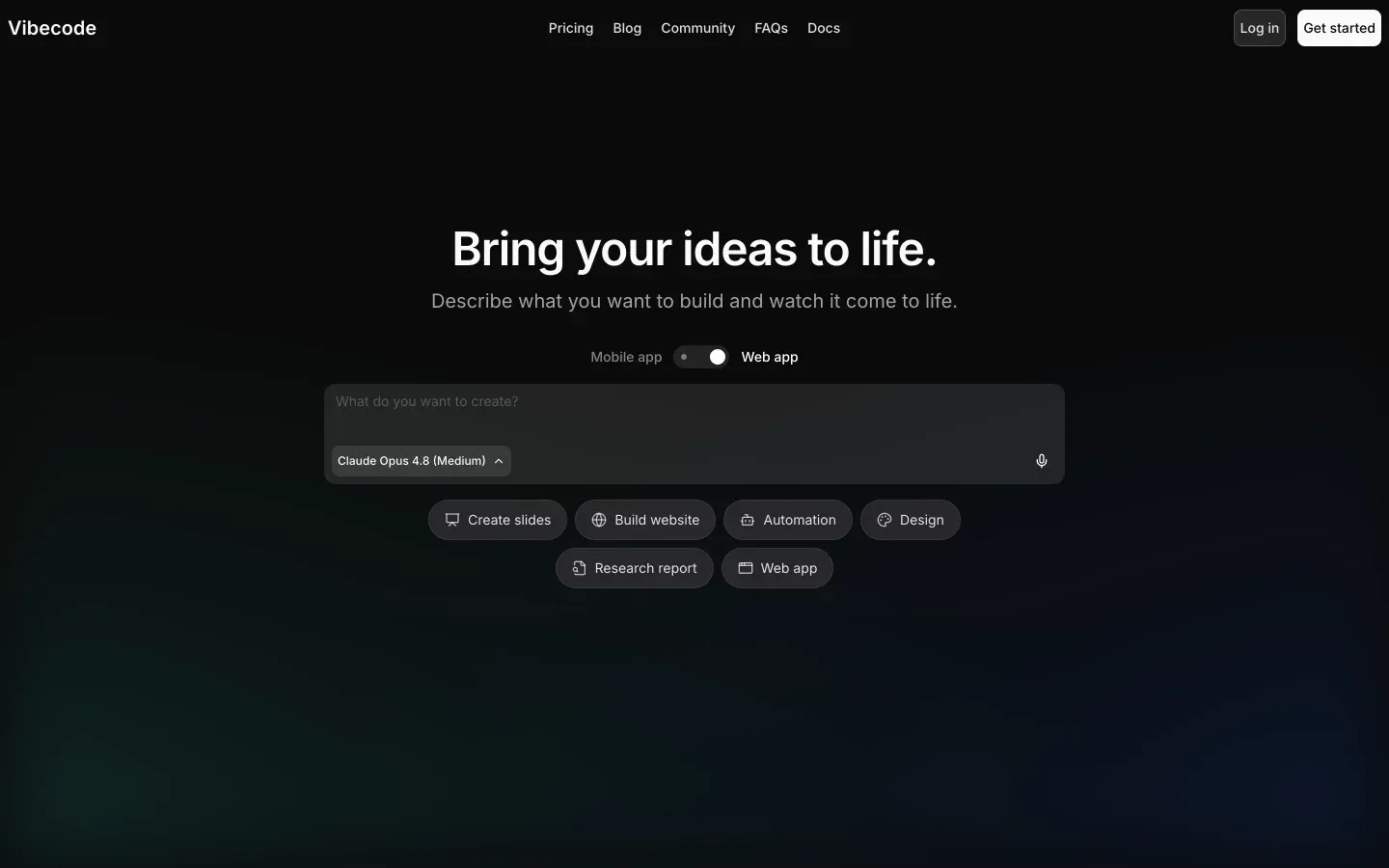
VibeCode is an AI-native, mobile-first app builder designed to generate native smartphone layouts from human-language prompts and package them directly to public app stores.
Retool wins the general matchup with an aggregate score of 6.8/10 against VibeCode’s 6.1/10, making it the more structurally stable choice for business environments. However, VibeCode flips the decision for teams that do not write code and need to publish directly to the iOS and Android app stores.
The decision in 30 seconds
| If your priority is… | Pick | Why |
|---|---|---|
| Internal administrative panels and database CRUD boards | Retool | Its pre-built 100-plus component library is specifically tuned for dense data presentation |
| Self-hosting on internal servers or virtual private clouds (VPC) | Retool | Its Enterprise plan supports complete self-hosting, whereas VibeCode is primary cloud-hosted |
| Native mobile utility apps published directly to iOS and Android stores | VibeCode | It compiles native smartphone packages and assists with App Store and Google Play submissions |
| Building business systems without any visual or logical code dependencies | Neither | Retool requires JavaScript and SQL while VibeCode relies on prompt-generated backends |
| Predictable licensing costs independent of occasional user seat counts | Neither | Retool charges per user seat and VibeCode scales on consumed AI credits |
What each platform is
What is Retool?
Retool is a visual development platform for creating internal business tools, customer support dashboards, and database administrative consoles. Rather than operating as a drag-and-drop no-code editor, Retool provides a visual canvas of over 100 pre-built, data-dense UI components that builders connect to databases and APIs by writing custom SQL queries and JavaScript state code.
Retool features a built-in managed PostgreSQL database, native version control, release management, and a robust JavaScript sandboxing console. It is built explicitly for technical operations teams, system administrators, and software developers who want to bypass building frontend administration screens from scratch while maintaining full engineering control over security and logic.
What is VibeCode?
VibeCode is an AI-powered, mobile-first app creation platform that generates software directly from plain-English descriptions. It targets creators and rapid prototypers who want to build and test native smartphone applications (iOS and Android) entirely through natural language instructing, relying on the platform’s underlying neural network orchestrators to write the code.
VibeCode automatically provisions a hosted backend, manages databases, configures user authentication, and coordinates cloud storage via the VibeCode Cloud. It supports direct export of compiled source code, developer secure-shell (SSH) access on upper tiers to external IDEs like Cursor, and provides direct pipeline options for deploying the generated apps safely to official app stores.
The core difference
The primary axis of divergence between these two platforms is how logic is constructed and who is meant to write it.
- Retool is a developer-guided workspace where you visually assemble a UI layer but write deterministic SQL and JavaScript to query and manipulate data.
- VibeCode is an AI-driven director’s lounge where you describe your app in plain English and trust an AI agent to build and connect the full-stack architecture.
Where the scores diverge
Ease of build: Retool 4.0, VibeCode 7.0. VibeCode scores 7.0 here by letting builders spin up mobile-first designs from conversational prompts, eliminating initial developer hurdles entirely.
Retool scores a low 4.0 because it is not a true no-code tool; anything beyond basic cosmetic layout requires manual SQL queries, structured JavaScript objects, and active API response debugging, creating a high technical barrier.
Security & access control: Retool 7.5, VibeCode 5.0. Retool scores 7.5 by providing native enterprise single sign-on (SSO), SAML, detailed audit logging, and granular user controls on its Business and Enterprise tiers, though external registration flows must be built from scratch.
VibeCode’s 5.0 is restricted because while basic login is native, its row-level security and permission scopes are generated dynamically via conversational prompts, requiring manual code review to ensure no data leaks or logic gaps exist.
Production readiness: Retool 7.5, VibeCode 5.5. Retool’s score of 7.5 reflects its enterprise-grade deployment controls, versioning pipelines, and robust database support, though it is dinged because external auth must be manually coded and users report occasional saving bugs where SQL code vanishes.
VibeCode’s 5.5 is constrained because prompt-generated backends can produce unpredictable logical breaks, edge-case app crashes, and security holes that fail standard Google Play or Apple App Store manual reviews without developer audits.
Data & integrations: Retool 8.5, VibeCode 6.5. Retool scores its highest marks at 8.5 due to a deep, native connection library built for direct reads and writes to SQL databases, REST / GraphQL endpoints, and a built-in managed PostgreSQL database.
VibeCode’s 6.5 relies on a single built-in database schema and cloud storage system, and connects to outside services like GPT or maps using credit-metered AI wrappers rather than raw, low-level database queries.
Maintainability: Retool 6.0, VibeCode 5.5. Retool operates on standard logic, providing version controls and release environments that score 6.0, though users note that apps get increasingly difficult to keep organized as they scale.
VibeCode scores 5.5 because as application logic grows, the AI can lose contextual understanding of its own generated codebase, resulting in unoptimized, circular, and messy code structures that a non-technical builder cannot fix cleanly.
Design flexibility: Retool 7.0, VibeCode 7.0. Both tools score 7.0 here but address entirely different layouts. VibeCode generates responsive native smartphone designs, though it lacks visual pixel-level fine-tuning canvas coordinates.
Retool’s library of 100-plus components is optimized for dense data tables, but apps look like standard admin dashboards and require significant custom CSS and custom JavaScript libraries to look client-ready.
Cost comparison
Retool scales on a strict seat-based licensing model, starting with a free tier for up to 5 users, followed by the Team plan ($8 to $10 per user per month) and the Business plan ($40 to $50 per user per month).
Because both builders and end users are charged per seat, Retool is relatively affordable for thin engineering teams building administrative boards, but can become extremely expensive if you open the platform to external client portals.
VibeCode operates on an AI credit usage model ranging from a free tier up to Plus ($20/mo), Pro ($50/mo), and Max ($200/mo). The price of these plans maps directly to included credits that translate directly into LLM API requests with no markup.
This model shifts your bill from user limits to developer iteration cycles, meaning you pay for the frequency and complexity of your prompting rather than the number of active logins.
- Free tier up to 5 users
- Team: $8–10 per user/mo
- Business: $40–50 per user/mo
- Builders and end users are charged
- Expensive for external client portals
- Free tier up to Plus at $20/mo
- Pro: $50/mo; Max: $200/mo
- Credits map to LLM API requests
- No markup on API usage
- Pay for prompting frequency and complexity
Lock-in and the exit path
Retool presents high visual lock-in; while you can export the JSON configurations of your modules and copy your SQL queries, you cannot export a standalone React or Node application to host outside Retool’s proprietary runtime.
VibeCode provides a clean visual exit pattern on its Pro ($50/mo) and Max ($200/mo) tiers by offering deep code exports and direct SSH console access. This lets you pull down the raw code and migrate immediately to editors like Cursor or VS Code, giving VibeCode a far more developer-friendly exit path.
Who should pick Retool
Pick Retool if:
- Software developers and database engineers who want to build internal dashboards without writing tedious HTML, CSS, and styling boilerplate.
- Organizations that require self-hosting within private network firewalls or strictly demand Enterprise SSO, SAML, and audit logs.
- Operations teams whose tools depend on low-level, high-performance SQL queries directly on production databases.
Do not pick Retool if your team lacks SQL and JavaScript expertise, or if you need to build consumer-facing client portals where per-user licensing costs become prohibitive.
Who should pick VibeCode
Pick VibeCode if:
- Non-technical founders looking to prototype and deploy lightweight mobile applications directly to the iOS App Store and Google Play.
- Aesthetic-focused builders targeting native smartphone portrait and swipe-logical form factors from prompt guides.
- Teams that want complete code ownership and plan to eventually hand off the generated code of their mobile application to an external engineering team.
Do not pick VibeCode if you are constructing complex, data-heavy relational backends that can cause conversational AI agents to lose structural context and break deployment logic.
What neither platform answers
Many buyers selecting a software builder do not actually need code repositories or JavaScript libraries. They are trying to ship client portals, vendor networks, partner trackers, or operational CRMs - software defined by user accounts, secure content gating, high reliability, and low development overhead.
For this class of business application, Retool demands that you write complex custom SQL and JavaScript, while VibeCode hands you generated, fragile code that risks code rot.
This is why operators looking for stable business software reach for Softr. Softr scores 8.5 on production readiness, 9.0 on maintainability, and 8.5 on security & access control because it is built on native, secure components that do not rely on raw AI prompting for core operations.
It connects instantly to native Softr Databases or databases like Airtable without seat-based pricing blockages for external clients. If you need a fully native, custom-coded mobile app instead, look to FlutterFlow.
Analyst verdict
Retool wins on aggregate, scoring 6.8 to VibeCode’s 6.1. Retool takes production readiness (7.5 vs 5.5), maintainability (6.0 vs 5.5), security (7.5 vs 5.0), and data integrations (8.5 vs 6.5). VibeCode maintains its win on ease of build (7.0 vs 4.0) while matching Retool on design flexibility (7.0 vs 7.0).
If you are an internal operations developer building unified SQL consoles for your staff, Retool is the scored winner. For non-technical teams launching lightweight, native smartphone utilities directly onto public app stores, VibeCode is the correct purchase.
Related reading: the Retool scorecard, the VibeCode scorecard, and our scoring methodology.