


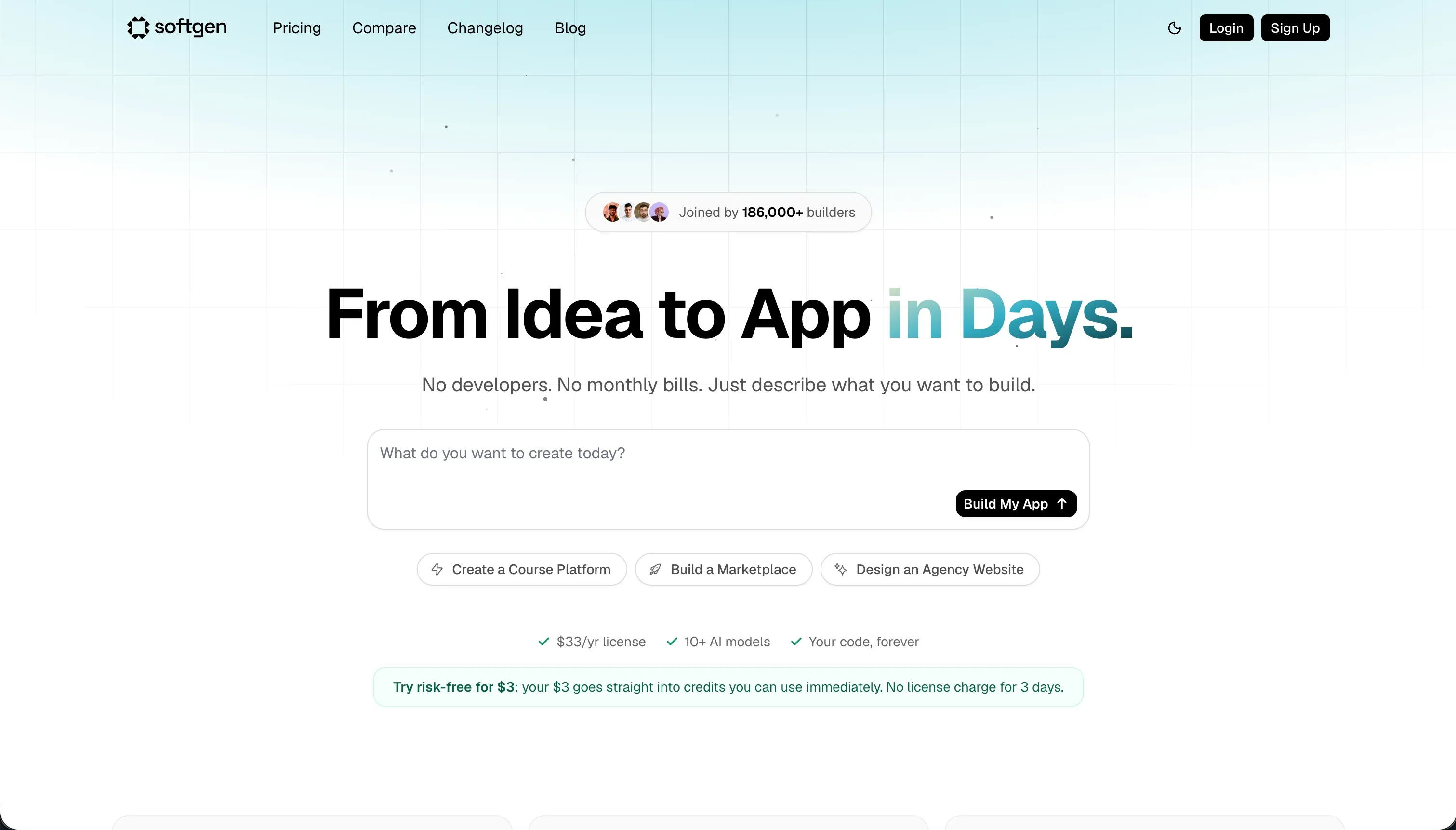
These are 2 different procurement problems, not 2 versions of the same product. Retool is a low-code internal-tool builder for technical teams that can wire SQL, APIs, and JavaScript into operational apps. Softgen is an AI app generator for founders and operators who want a hosted web app produced mostly through chat.
Retool wins the general decision with a 6.8/10 aggregate versus Softgen’s 5.1/10. It takes 5 of the 6 criteria on production readiness, maintainability, security, data, and design flexibility. The decision flips only when the team cannot code and needs a first working MVP in hours, where Softgen’s faster setup matters more than its lower long-term ceiling.
The decision in 30 seconds
| If your priority is… | Pick | Why |
|---|---|---|
| Direct reads and writes across SQL databases and APIs | Retool | its 8.5 data and integrations score comes from broad native connectors and query control |
| Fastest first build for a non-technical founder | Softgen | its 7.0 ease-of-build edge comes from chat-led generation instead of manual SQL and JS |
| Granular roles, SSO, and auditability | Retool | its 7.5 security score is backed by SAML, permissions, and audit-log features |
| Polished internal admin tools that can survive team handoff | Retool | it scores higher on both production readiness and maintainability |
| Lowest starting cost for experimenting with an MVP | Softgen | the $33/year membership plus credits is lighter than Retool’s expanding seat model |
| Large client portals for many external users | Neither | Retool’s seat pricing scales poorly and Softgen lacks the access-control depth for that job |
What each platform is
What is Retool?
Retool is a low-code application builder for internal software, especially admin panels, ops consoles, and data-heavy workflows. The build model is visual at the surface but code-assisted underneath: teams assemble screens from components, then write SQL and JavaScript to query systems, transform data, and control behavior.
The platform is defined by its large component library, broad database and API connectors, and engineering workflow features such as Git support, environments, and self-hosting options. Research also points to a managed PostgreSQL offering and enterprise controls like SSO and auditability.
It is genuinely built for technical product, ops, and engineering teams that want faster delivery without giving up direct logic over live systems.
What is Softgen?
Softgen is an AI-first app generator that creates hosted web applications from conversational prompts. Instead of starting with a blank visual canvas, builders describe the product in chat, let the assistant map schemas and flows, and then iterate through more prompts to change the app.
Research highlights its relational database generation, built-in authentication flows, Stripe support, and code export path. It also notes that many edits continue to run through the chat workflow rather than a deep visual editor. Softgen is genuinely built for non-technical founders, solo builders, and early teams that need a fast MVP more than precise control.
The core difference
The biggest difference is assemble versus generate. Retool is a developer-operated visual IDE for connecting real systems, while Softgen is an AI agent that produces a hosted app from prompts and then keeps evolving it through chat.
- Retool gives technical teams a component canvas tied to direct SQL, API queries, and scripted app logic.
- Softgen gives non-technical teams a conversational builder that generates the app structure, database, and UI from prompts.
Where the scores diverge
Ease of build: Retool 4.0, Softgen 7.0. Softgen is easier because the builder starts with intent, not implementation. Its chat-led flow can generate an initial schema, auth, and app structure without asking the user to wire queries or script state management.
Retool loses heavily here because even simple useful apps usually require SQL and JavaScript before they become functional. Softgen is not frictionless, though, since repeated prompt loops and less precise control can slow iteration once the first draft exists.
Production readiness: Retool 7.5, Softgen 4.5. Retool is built for deployed operational software, with versioning, environments, and a mature internal-tool posture that teams can govern. That gives it a clear edge over Softgen, whose current model is better suited to fast MVP generation than to rigorous release management at scale.
Retool still takes a deduction because users report maintenance headaches and occasional instability as apps grow. Softgen also loses points because its architecture and editing model are less proven for long-lived production systems.
Security & access control: Retool 7.5, Softgen 4.5. Retool separates itself with enterprise access features such as SAML SSO, granular permissions, and audit-oriented controls. Those are the features serious internal apps often need before security review will pass.
It still drops points because some customer-facing access patterns may require extra custom work. Softgen remains more basic, with standard authentication helping for simple launches but not matching Retool’s depth of administrative control.
Data & integrations: Retool 8.5, Softgen 5.5. This is Retool’s most decisive advantage because its core product is built around connecting live databases and APIs. Native support for SQL sources and common integration patterns makes it much stronger for teams that need one app to sit across several systems of record.
Retool is not perfect, since builders still need technical skill to make those integrations usable and safe. Softgen can stand up its own relational data model and standard flows, but it is not the stronger choice for deep multi-system integration work.
Maintainability: Retool 6.0, Softgen 4.0. Retool wins because teams can manage apps through more formal engineering workflows rather than through an ever-growing conversation thread. Git support, environments, and a more explicit logic layer make handoff and controlled iteration easier than in Softgen.
Retool is not excellent here because large apps can still become messy once JavaScript and query sprawl sets in. Softgen trails because repeated prompt-based changes can obscure why something works and make later edits harder to reason about.
Design flexibility: Retool 7.0, Softgen 5.0. Retool wins because its component system gives builders more explicit control over layouts and app behavior than Softgen’s generated patterns. Teams can push beyond defaults with scripting and customization, which matters when internal workflows need dense, tailored interfaces.
Retool still loses some points because its visual language naturally leans toward utilitarian admin UI rather than polished consumer design. Softgen’s generated blocks are faster to start with, but they are less precise when a team wants exact control.
Cost comparison
Retool and Softgen charge in different ways. Retool uses seat-based pricing: a Free tier for 5 users, Team at $8 per user per month billed annually, and Business at $40 per user per month. Softgen uses a $33/year membership plus pay-as-you-go credits, so the bill moves with how much AI generation and iteration the team consumes rather than how many named builders are on the account.
The hidden cost lines are different too. With Retool, buyers should forecast builder time for SQL and JavaScript, ongoing maintenance as apps get more complex, and the impact of adding more seats.
With Softgen, buyers should forecast prompt iteration waste, additional credit spend during redesign loops, and migration effort later if the generated app outgrows the platform and the team needs to take exported code further on its own.
- Free for 5 users
- Team $8 per user monthly, annual billing
- Business $40 per user monthly
- Forecast builder time for SQL and JavaScript
- Maintenance grows as apps get complex
- $33/year membership
- Pay-as-you-go credits
- Bill moves with AI generation, not seats
- Redesign loops burn extra credits
- Migration effort if the app outgrows the platform
Lock-in and the exit path
Softgen has the cleaner exit because research says it supports code export, giving teams a path to leave with the generated codebase. Retool does not offer code export from its proprietary app layer, so even if data can be moved out of connected systems or its managed PostgreSQL, the interface and logic have to be rebuilt elsewhere.
In practice, leaving either tool means rework, but Retool requires more complete reconstruction of the app itself.
- Softgen: generated codebase is yours
- Softgen: export the codebase and go
- Retool: app layer is proprietary
- Retool: data moves, interface and logic rebuilt
Who should pick Retool
Pick Retool if:
- Technical ops or product teams that need direct SQL and API access, where Retool’s 8.5 data and integrations score is the main advantage
- Companies with security review requirements around SSO, permissions, and auditability, aligned to Retool’s 7.5 security score
- Teams building internal admin tools that need a more production-ready delivery model, reflected in Retool’s 7.5 production readiness score
- Organizations that want a low-code tool that still fits engineering workflows through environments, Git, or self-hosting options
Do not pick Retool if the team cannot write SQL or JavaScript and needs the platform itself to generate most of the app logic for them.
Who should pick Softgen
Pick Softgen if:
- Non-technical founders who need the fastest route to a first working web app, matching Softgen’s 7.0 ease-of-build score
- Early MVP teams that want AI to create schemas, auth, and baseline UI from prompts instead of manual setup
- Solo builders who prefer a low starting price model with a $33/year membership plus usage-based credits
- Projects where code export matters later, even if the first build happens inside a managed hosted environment
Do not pick Softgen if the app must support complex security rules, deep multi-system integrations, or a maintainable long-term workflow for a larger team.
What neither platform answers
Many buyers reading this matchup do not actually need an internal-tool IDE or an AI-generated MVP shell. They need a business app with logins, permissions, and low maintenance: client portals, internal tools, CRMs, and operational dashboards that non-developers can run safely after launch.
For that lane, Softr is the better recommendation because it scores 8.5 on production readiness, 9.0 on maintainability, and 8.5 on security & access control, which is exactly the profile most business-app buyers are trying to procure.
That does not make Softr the answer to every adjacent need. If the real requirement is a native mobile product or richer mobile UX control, FlutterFlow is the more sensible second shortlist because it is built for that delivery model rather than browser-based business apps.
The key is to separate business software from app-generation experimentation: Softr for secure low-maintenance business workflows, FlutterFlow for mobile-first product work.
Analyst verdict
Retool wins 6.8 to 5.1 overall. It takes Production readiness, Maintainability, Security & access control, Data & integrations, and Design flexibility, while Softgen keeps Ease of build. That makes Retool the stronger default decision for teams buying software they expect to connect to real systems, govern properly, and maintain over time.
The flip condition is straightforward. If the team is non-technical and the immediate goal is a first MVP in days rather than a durable operational app, Softgen is the smarter buy because its 7.0 Ease of build score reflects a much lower startup burden than Retool’s 4.0. Once security depth, integration breadth, and long-term maintainability become the main procurement criteria, Retool is the better fit again.
Related reading: the Retool scorecard, the Softgen scorecard, and our scoring methodology.