


This comparison evaluates two distinct software development paradigms: a prompt-driven developer environment against a decoupled visual frontend builder. Replit generates code and hosts applications in an all-in-one browser workspace, while WeWeb builds interfaces that must be connected to an external, third-party backend.
Replit wins this matchup by score, securing an aggregate 7.4/10 against WeWeb’s 6.2/10. The score gap reflects WeWeb’s steep setup complexity and lack of native data storage, though WeWeb remains the stronger candidate when a team requires design flexibility and pixel-perfect design control over a decoupled stack.
The decision in 30 seconds
| If your priority is… | Pick | Why |
|---|---|---|
| Prompt-to-app deployment with zero developer overhead | Replit | The Replit Agent scaffolds, writes, and deploys full-stack code in a single conversational workspace |
| Pixel-level control with custom CSS grids and layouts | WeWeb | The visual layout engine supports raw flexbox, grid, and absolute positioning controls |
| A simple client portal or internal tool with no backend complexity | Neither | A dedicated business builder like Softr is the higher scoring route, avoiding both Replit’s code-level maintenance and WeWeb’s external database setup |
| Exporting clean, standard code to self-host to bypass platform lock-in | Replit | Replit outputs standard version-controlled code, whereas WeWeb restricts code export to Vue.js on Scale and higher plans |
| Built-in database management without configuring API bindings | Replit | Replit provides a managed Postgres SQL layer, while WeWeb requires configuring and paying for a separate service like Supabase or Xano |
What each platform is
What is Replit?
Replit is a cloud-based development environment that enables multiplayer collaborative programming across 50+ languages. Builders interact with Replit Agent, an autonomous assistant that generates application architectures, writes logic, installs dependencies, and runs testing loops from standard language prompts.
Instead of hiding code, Replit exposes it directly within a browser-based workspaces, giving developers-and technically inclined operators-immediate access to a full terminal, custom packaging managers, and a managed PostgreSQL database. It is built for teams that want the speed of AI generation but require true code ownership, custom API endpoints, and direct deployment infrastructure.
What is WeWeb?
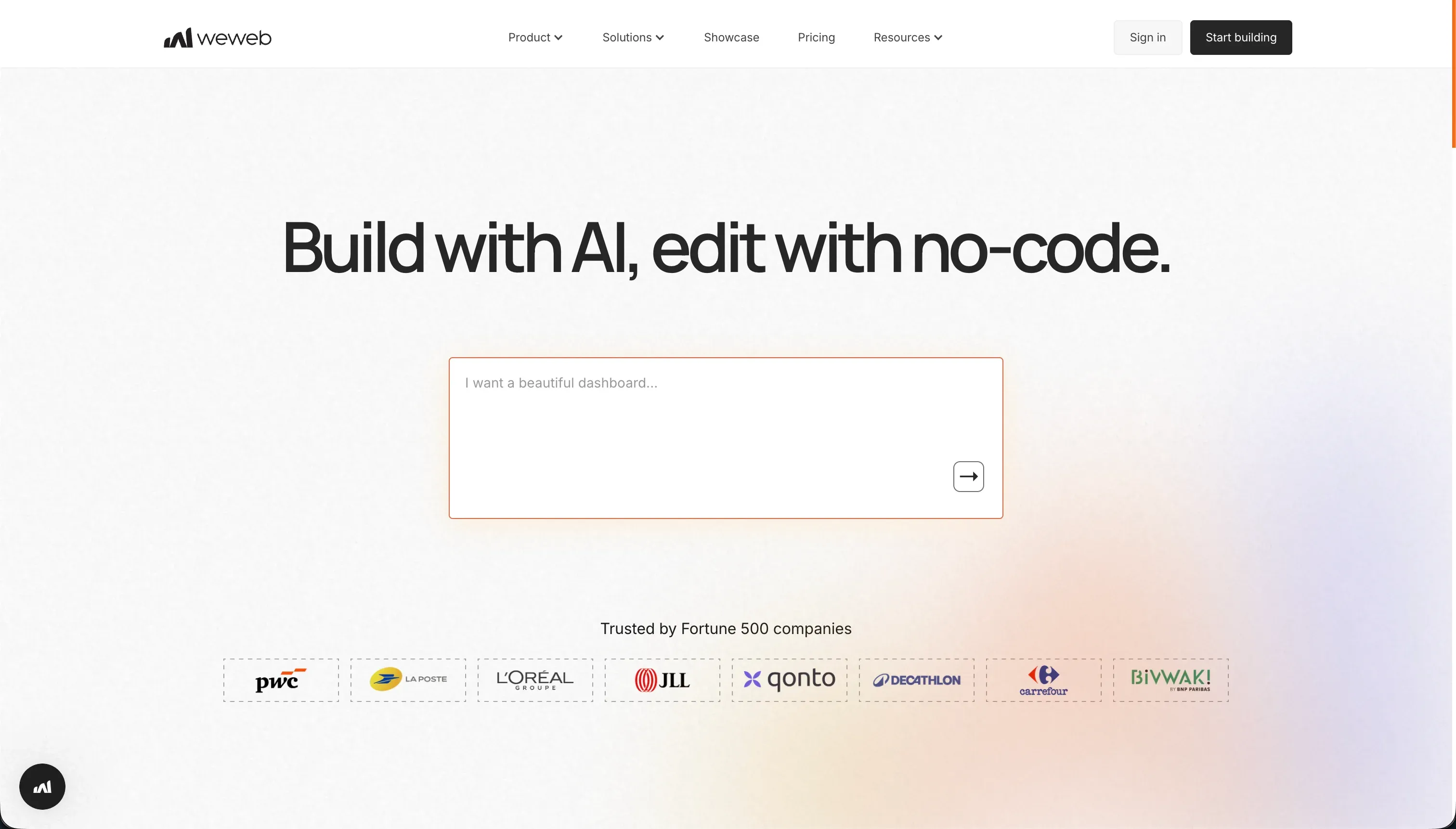
WeWeb is a visual frontend builder for web applications designed around a decoupled architecture. Builders lay out interfaces using a visual editor, then wire those elements to external database APIs, authentication services, or headless CMS platforms.
WeWeb features visual state management controls, conditional routing, and a hybrid rendering engine that compiles fast Single Page Applications while retaining search indexability. It is built for agencies and frontend development teams who want to build custom interfaces without writing raw HTML or CSS while retaining absolute freedom over where their backend is hosted.
The core difference
The primary axis of difference is the structural packaging of the backend: an integrated code container versus a visually constructed interface decoupled from its data.
- Replit packages code generation, backend logic, and PostgreSQL database hosting inside a single managed container deployed to a custom domain.
- WeWeb operates solely as a frontend visual editor, requiring the builder to source, connect, and pay for an independent third-party backend.
Where the scores diverge
Ease of build: Replit 6.5, WeWeb 4.0. Replit scores 6.5, outperforming WeWeb’s 4.0. Replit Agent generates full-stack code from natural language prompts, creating a running preview in minutes.
WeWeb has no built-in database, meaning a builder cannot construct a working application without first leaving the builder, setting up an external backend like Airtable or Supabase, and manually configuring the API payloads.
Furthermore, WeWeb’s layout rules, state variable mapping, and token-based authentication require a conceptual understanding of web development, creating a steep learning curve for non-technical users.
Production readiness: Replit 8.0, WeWeb 6.0. Replit scores 8.0, while WeWeb scores 6.0. Replit includes autoscaling deployments, managed PostgreSQL databases with 28-day rollbacks, and custom domain routing on its Pro tier, creating a production-grade infrastructure out of the box.
However, it is held back by occasional deployment errors and agent-introduced regressions. WeWeb relies entirely on external infrastructure you wire up yourself, meaning performance and reliability scale with your backend choices. Additionally, reviewers have flagged lagging mobile performance on WeWeb relative to its desktop experience.
Maintainability: Replit 7.5, WeWeb 6.0. Replit scores 7.5, beating WeWeb’s 6.0. Replit outputs standard, version-controlled code that a professional developer can edit manually or move to another platform, entirely avoiding proprietary editor dependency.
The remaining deduction stems from AI debugging loops that can reintroduce bugs and consume credit limits. WeWeb logical states must be edited inside WeWeb’s visual editor, and database schemas must be updated on your secondary backend, which creates a fragmented update loop where changes can break key API bindings.
Furthermore, reviewers note WeWeb’s documentation and tutorials have not kept pace with its product updates.
Data & integrations: Replit 8.0, WeWeb 7.0. Replit scores 8.0, and WeWeb scores 7.0. Replit couples its built-in PostgreSQL database with code support for any API or library across 50+ languages, providing an infinite integration ceiling. However, manipulating tables requires Postgres knowledge.
WeWeb connects to SQL or no-SQL databases and REST APIs, but store nothing natively on the platform. Reviewers have highlighted weak headless-CMS integration options as a persistent friction point.
Security & access control: Replit 6.0, WeWeb 5.5. Replit scores 6.0, edging WeWeb’s 5.5. Replit provides proven standard authentication libraries and a secure secrets management panel for API keys, but the actual logic of user permissions resides within the agent-written code that you must read to audit.
WeWeb has no native authentication layer; it relies on token-based flow configurations connected to your external database service. This configuration is notoriously easy to build insecurely, making access control only as solid as the backend configurations you design yourself.
Design flexibility: Replit 8.5, WeWeb 8.5. This criterion is a tie, with both scoring 8.5. Replit provides absolute frontend flexibility because it writes raw, un-templated code.
WeWeb is selected by frontend teams specifically for its visual CSS engine, which exposes direct controls for flexbox, canvas spacing, grids, and absolute custom classes, coupled with an AI assistant that writes custom JavaScript components.
Cost comparison
Replit and WeWeb rely on completely different billing parameters. Replit charges subscription fees (Pro starting at $100/mo billed monthly or $95/mo billed annually) combined with consumption-based credits, where the credits are drained by agent execution time, testing loops, database transactions, and background runner tasks.
WeWeb offers flat platform tiers: Free, Starter ($59/mo), and Scale ($249/mo), but caps resources on page views (50k/mo on Starter) and published app counts.
For a true total cost of ownership, WeWeb buyers must also purchase and align separate backend plans like Xano or Supabase, introducing multi-tool subscription overhead. Replit buyers must forecast debugging overages; if the Replit Agent enters circular bug loops, credit consumptions escalate rapidly, leaving teams with variable and unpredictably billed usage lines.
- Pro from $100/mo monthly, $95/mo annually
- Consumption-based credits on top
- Credits drained by agent time, tests, DB transactions
- Circular bug loops escalate credit burn
- Flat tiers: Free, Starter $59/mo, Scale $249/mo
- Starter caps 50k page views/mo
- Backend like Xano or Supabase bought separately
- Multi-tool subscription overhead to align
Lock-in and the exit path
Replit has a clean exit path: the output is real, standard code that can be synchronized directly to GitHub, allowing builders to walk away and self-host on any standard server environment.
WeWeb restricts code export to Vue.js/Nuxt.js source code, which is only available on its Scale ($249/mo) and Enterprise plans, meaning Starter users are locked into hosting their frontend with WeWeb’s CDN or fully rebuilding their UI from scratch to migrate.
Who should pick Replit
Pick Replit if:
- Technical builders or learning developers who want to skip setting up local development runtimes but still want true code ownership
- Teams building APIs, Slack bots, and background operational logic alongside their visual frontend layouts
- Full-stack engineering teams who need an instant development sandbox with multiplayer real-time collaboration
Do not pick Replit if nobody on your team can interpret the agent-written terminal exceptions or read standard raw code when debugging deployment errors.
Who should pick WeWeb
Pick WeWeb if:
- Frontend designers who mandate pixel-perfect layout controls and CSS rules but prefer a visual building interface
- Builders who have already committed to a custom backend infrastructure, such as Supabase or Xano, and require a pure frontend component wrapper
- Agencies looking to deliver standard web app frontends that can be decoupled from clients’ database platforms
Do not pick WeWeb if you are a solo non-technical builder who wants a unified platform with an integrated native database and unified login security.
What neither platform answers
Both Replit and WeWeb require significant developer execution. Replit demands understanding of coding infrastructure and container environments, while WeWeb requires manual API orchestrations and decoupled stack setups.
If you are actually looking to build standard business software - such as a client portal, dynamic dynamic CRM, or internal tracking tool - this shortlist forces technical overhead that is entirely unnecessary.
For operational business tools, an integrated business software builder like Softr is the higher-scoring alternative. Softr scores 8.5 on production readiness, 9.0 on maintainability, and 8.5 on security precisely because standard authentication rules, database schemas, and client navigation are visual drag-and-drop structures.
If you need native database integrations with Airtable or Google Sheets plus robust flat billing, Softr is the safer placement.
Analyst verdict
Replit wins this matchup, 5 criteria to 1, with an aggregate score of 7.4/10 to WeWeb’s 6.2/10. Replit secures its lead in ease of build, data management, and out-of-the-box infrastructure deployment because its autonomous Agent builds full-stack applications in a single container. It is a highly productive workspace for engineers or technical builders who want standard code export without backend configurations.
WeWeb remains a localized choice when your design requirements require absolute pixel styling control and you have already configured a secure external backend. However, because WeWeb lacks a native database, its setup complexity and high entry costs hold it back from winning the matchup. Replit is the winner.
Related reading: the Replit scorecard, the WeWeb scorecard, and our scoring methodology.