

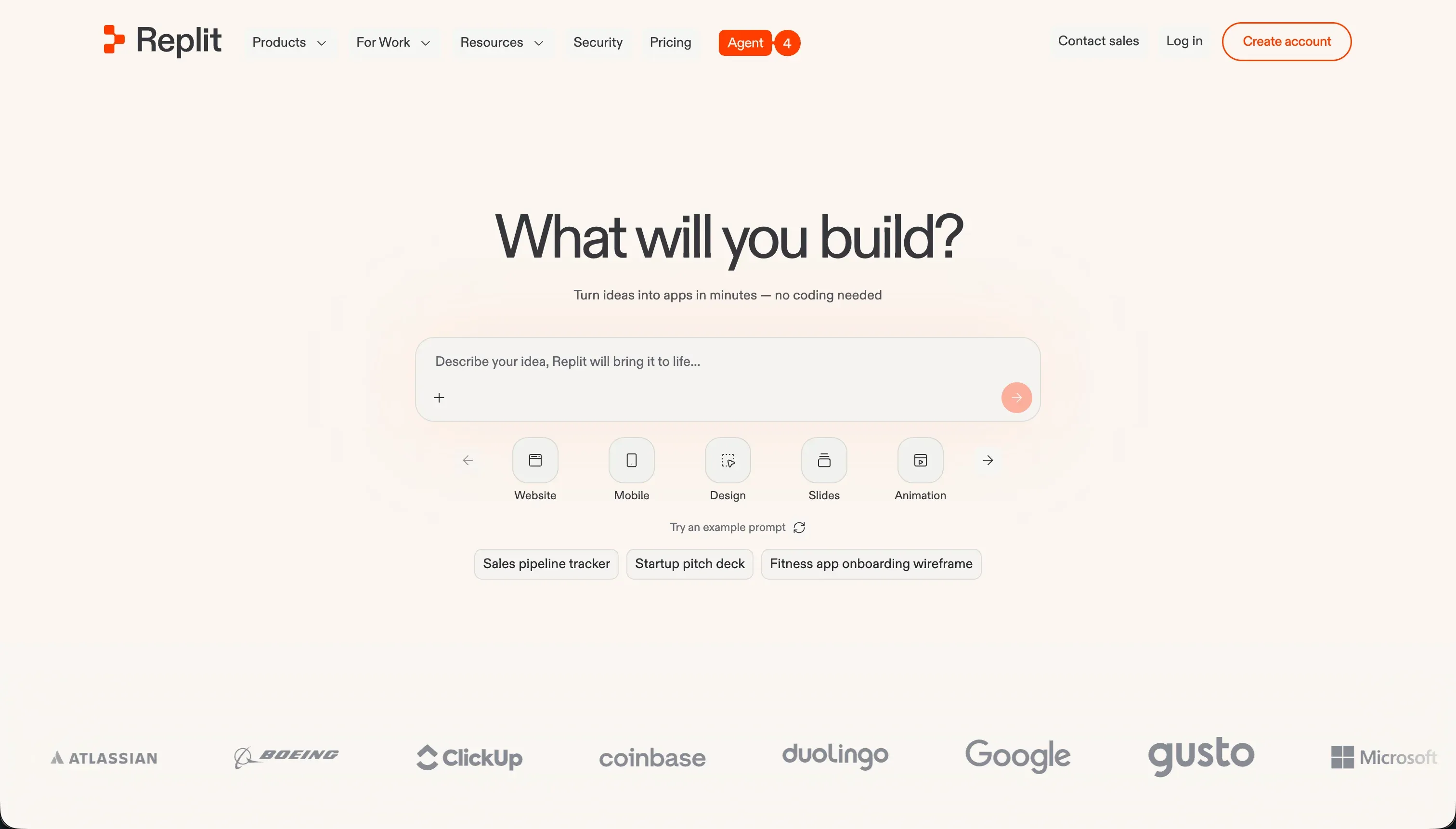
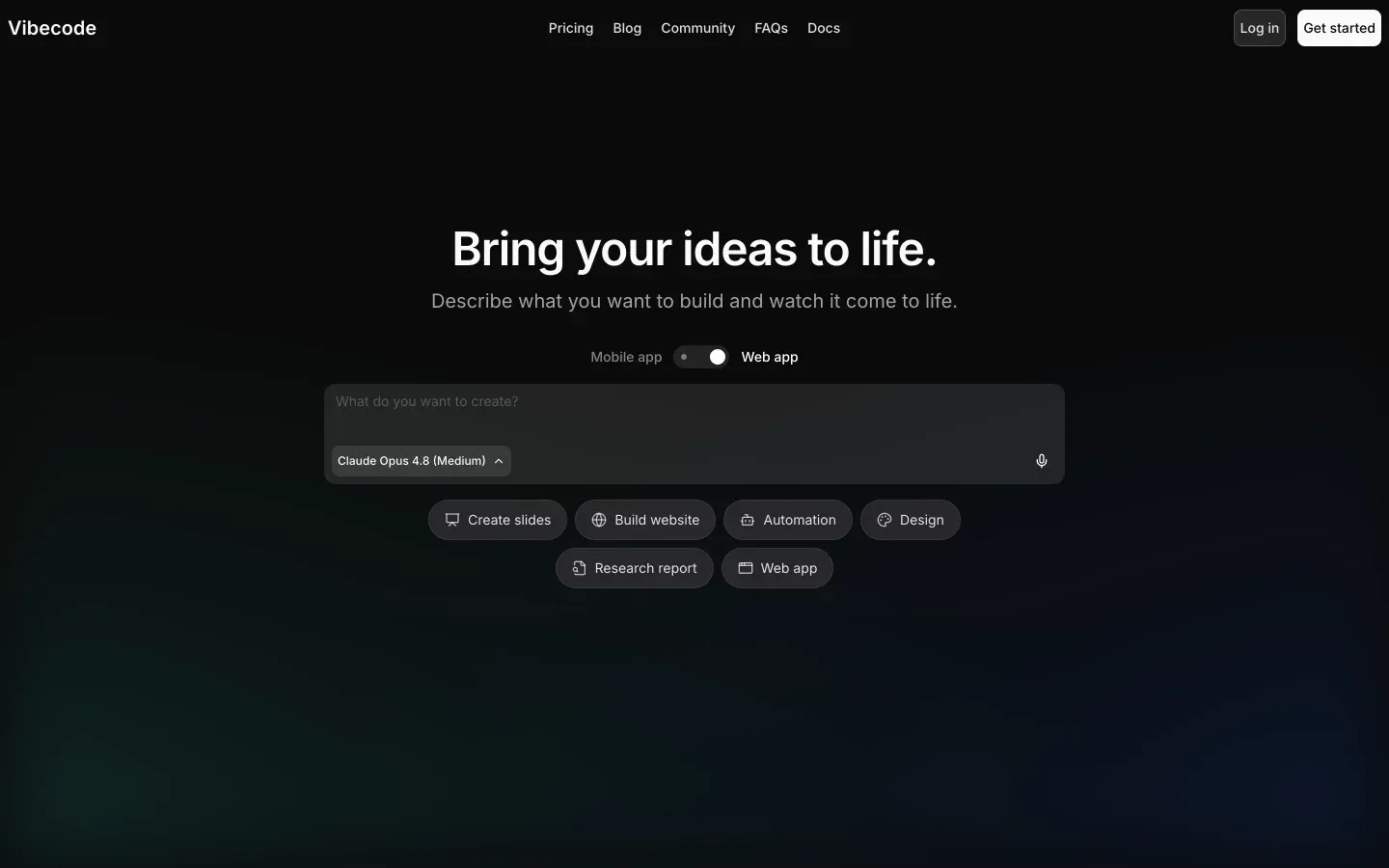
These two platforms represent distinct procurement answers to the prompt-to-app paradigm. Replit is a highly collaborative, cloud-first development environment engineered to scaffold, run, and scale codebases in dozens of languages through natural language requests.
VibeCode focuses strictly on native mobile app generation, providing a prompt-first construction flow that targets smartphone interfaces and direct public store publishing.
Replit wins the aggregate comparison with a score of 7.4/10 against VibeCode’s 6.1/10. VibeCode flips this decision only if your delivery roadmap requires a native iOS or Android mobile file ready for App Store deployment rather than a web-based, language-agnostic development pipeline.
The decision in 30 seconds
| If your priority is… | Pick | Why |
|---|---|---|
| Cloud development in 50+ languages | Replit | Supports real, version-controlled repository editing on a robust browser-based IDE scoring 8.5 for design flexibility |
| Native mobile-first app store deployment | VibeCode | Compiles directly to native iOS and Android application store binaries with on-device testing |
| Client portals, internal tools, or CRMs | Neither | Softr provides a more stable, secure visual infrastructure with flat pricing and zero code vulnerability |
| Real, standard Postgres databases with rollback capability | Replit | Provisions managed PostgreSQL backups and manual schema tuning scoring 8.0 on data |
| Cleanest exit path via code export | Replit | Saves directly to GitHub as standard structured files rather than restricted tier exports |
What each platform is
What is Replit?
Replit is an intelligent, browser-based cloud IDE designed to remove local environment setup. By using Replit Agent, builders can initiate, test, and deploy applications conversationally. The platform does not hide the underlying code; instead, it generates standard framework files that developers can edit manually, fork, or connect to external version control systems like GitHub.
Inside the workspace, builders have immediate access to package managers, terminals, and managed PostgreSQL databases featuring 28 days of rollback protection. It is a dual-use environment created for both non-technical creators aiming to launch full-stack software and technical teams building collaborative, multiplayer prototypes in over 50 languages.
What is VibeCode?
VibeCode is an AI-powered, mobile-first builder engineered to generate native mobile applications via natural language. Users construct layouts and state machines by prompting the software in plain English, while an underlying engine translates those specifications into smartphone layouts. It abstracts modern mobile development frameworks to deliver instant on-device testing.
To power these mobile clients, VibeCode automatically provisions user authentication, storage, and a backend relational database within its cloud infrastructure. It is designed specifically for non-technical creators and product managers shipping lightweight consumer utilities, basic games, or interactive mobile prototypes directly to the Apple App Store and Google Play.
The core difference
These tools diverge fundamentally on their target runtime environments and target device formats.
- Replit functions as a full-spectrum cloud IDE generating web services, custom APIs, and backend architectures in any major code language.
- VibeCode operates as an isolated, mobile-first visual compiler producing native mobile apps tailored strictly for smartphone screens and public stores.
Where the scores diverge
Production readiness: Replit 8.0, VibeCode 5.5. Replit scores significantly higher on production readiness with its managed PostgreSQL database layers, automatic infrastructure scaling, and customizable domains. It provides a real production environment rather than an isolated sandbox.
VibeCode packages native mobile projects for the App Store but relies entirely on prompt-driven logic, which frequently encounters logic breaks, crashes on edge cases, or fails App Store reviews if manual codebase auditing is not performed.
Maintainability: Replit 7.5, VibeCode 5.5. This criterion highlights a critical flaw in prompt-reliant tools. While VibeCode allows code export on its high-tier plans, his AI can lose architectural context as codebases expand, generating unoptimized code.
Replit provides standard files, version histories, and direct developer editing access, allowing teams to hire a professional to refine or scale the code. However, both platforms suffer from AI iteration limits, where agent loops occasionally reintroduce old bugs and consume plan credits.
Data & integrations: Replit 8.0, VibeCode 6.5. Replit scores 8.0 in this lane because it operates with no language limits. A builder can connect to any API or run custom packages across 50 available software environments, though modifying database structures demands manual database knowledge.
VibeCode relies on its built-in cloud database and metered API integrations to models like GPT or Google Maps, keeping the data layer simpler but far more enclosed.
Design flexibility: Replit 8.5, VibeCode 7.0. Replit wins on design flexibility because it handles real code without UI constraints; developers can implement custom web layouts, dynamic charts, or bespoke dashboards.
VibeCode scores well because it generates appealing layouts for typical mobile screens, but builders lack pixel-precise design elements or visual tree interfaces such as those in FlutterFlow, leaving them dependent on natural language requests to restyle elements.
Security & access control: Replit 6.0, VibeCode 5.0. The security profiles of both platforms still place a heavy manual burden on the builder. Replit supports standard secrets panels, managed databases, and core session handling, but user permissions and roles are coded by its AI, meaning you must audit code rules to verify accessibility.
VibeCode implements built-in user authentication out of the box, but more complex transactional permissions require prompting the AI, creating potential security vulnerabilities if code is left unaudited.
Ease of build: Replit 6.5, VibeCode 7.0. VibeCode edges ahead of Replit because its prompt-first workflow focuses entirely on native mobile layouts and instant mobile previews. This streamlined scope makes it highly accessible for non-technical builders looking to create on-the-go tools.
Replit generates working apps rapidly but requires a higher baseline understanding of technical systems, database management, and environmental secrets, which can lead to friction for true non-technical users.
Cost comparison
Replit Core costs $25/mo, while Replit Pro runs $100/mo, though Pro users can select pre-purchased usage packages that scale up to $1,000/mo. VibeCode offers a Free tier with $2.50 in credit, a Plus tier at $20/mo, Pro at $50/mo, and Max at $200/mo. Replit models compute costs alongside execution agent complexity, while VibeCode measures usage through AI credit draw with no markup on API calls.
Buyers must anticipate the hidden maintenance and debugging costs of code builders. In both systems, a single looping bug can burn through multiple credits as the model attempts to fix its own errors. On Replit, database checkpoint backups can trigger unseen server overages during migration loops, whereas VibeCode’s code export and direct developer access are locked behind the $50/mo Pro tier.
Lock-in and the exit path
Replit has a clear advantage regarding software lock-in because it outputs real repositories that sync directly to GitHub, making it straightforward to move your codebase to another host.
VibeCode restricts code downloads and SSH access to its Pro and Max tiers, meaning lower-tier builders are entirely locked into VibeCode’s hosting and database infrastructure. If a VibeCode builder wishes to leave, migrating off the VibeCode Cloud database requires manually extracting data and rebuilding the application structure on alternative platforms.
- Real repositories
- Sync directly to GitHub
- Move to another host easily
- Code downloads need Pro or Max
- SSH also tier-gated
- Lower tiers locked to its hosting
- Database export is manual
- Rebuild app structure elsewhere
Who should pick Replit
Pick Replit if:
- Technical founders or developers who want a zero-setup IDE to collaborate in real-time on real code
- Teams building web platforms or custom API microservices that require managed SQL databases with recovery tools
- Makers who want a clean, standard git-backed exit path with immediate code ownership from day one
Do not pick Replit if you want a visual drag-and-drop experience that completely shelters you from code editing, secrets configuration, or database schemas.
Who should pick VibeCode
Pick VibeCode if:
- Creators building mobile utilities, consumer prototypes, or mobile interfaces designed for native devices
- Builders looking for a mobile-first testing flow to publish directly to the iOS and Android stores with less setup
- Prototypers who prefer working with premium LLMs under a raw, credit-for-compute pricing model
Do not pick VibeCode if you are building complex business software, internal portals, or web layouts that require deep role security and granular permissions.
What neither platform answers
Both platforms require the builder to manage code, handle database migration tasks, or troubleshoot runtime issues. This technical burden is highly inefficient for buyers who simply need to deliver functional, secure business software such as client portals, vendor directories, or internal team trackers.
For those operational use cases, Softr offers a far more appropriate solution, scoring 8.0+ across production readiness, maintainability, and security.
Because Softr composes secure, pre-built structural elements rather than generating raw lines of code, it provides instant user authentication, visual roles and permissions, and direct connections to native or external data hubs with zero deployment vulnerabilities.
If you must have a custom mobile app with absolute pixel-level control, FlutterFlow remains a stronger and more robust choice for standard mobile layouts.
Analyst verdict
Replit wins this matchup on aggregate, scoring 7.4 to VibeCode’s 6.1. Replit carries five of the six criteria, including superior production readiness, data integrations, and maintainability. VibeCode retains its advantage only in ease of build due to its focused, mobile-oriented creation flows.
For standard projects, the difference in maintainability is critical. Replit generates real code bases that scale and can be easily managed by a developer, whereas VibeCode’s generative model hits a complexity barrier on complex logic structures. If you are specifically drafting a native smartphone utility for the App Store, pick VibeCode; for all other development tasks, Replit is the much stronger platform choice.
Related reading: the Replit scorecard, the VibeCode scorecard, and our scoring methodology.