

The decision between Lovable and Adalo represents a choice between two distinct build models. Lovable operates as an AI-powered code generator that outputs a real React and Supabase codebase from natural language prompts. Adalo relies on a classic visual drag-and-drop canvas coupled with a proprietary, fixed-width mobile element engine.
Analyzing the capabilities of both platforms reveals that Lovable holds the scored aggregate advantage at 5.5 to Adalo’s 4.6. Lovable wins on frontend design freedom and rapid initial prototyping, while Adalo keeps simple visual layouts for basic mobile apps.
However, because both systems carry severe scaling and maintenance liabilities, serious engineering teams should look to a development platform like Replit to gain the speed of AI code generation with standard, deterministic code editing.
The decision in 30 seconds
| If your priority is… | Pick | Why |
|---|---|---|
| Rapid prompt-to-app mockup | Lovable | Genuinely fast initial generation with a React and Supabase stack scoring 7.5 on ease of build |
| Native mobile app store publishing | Adalo | Built-in packaging pipelines for Google Play and Apple App Store deployment |
| Responsive desktop web layout | Lovable | Adalo apps use fixed-width layouts that resemble stretched phone screens on desktop |
| Production-ready security rules | Neither | Lovable requires raw Supabase RLS configuration, while Adalo lacks centralized role-based access controls |
| Predictable long-term maintenance | Neither | Lovable suffers from prompt-only regression loops, and Adalo lacks complex logic or fragile API stability |
| Granular data security & permissions | Neither | Adalo relies on per-element visibility filters, whereas Lovable security depends entirely on manually audited RLS rules |
What each platform is
What is Lovable?
Lovable is an AI-powered full-stack application builder that translates plain-English prompts into functional web software. It builds a real codebase featuring a React and TypeScript frontend, a Node.js backend, and a Supabase PostgreSQL database.
Instead of hiding the underlying components, the builder has full access to standard code, complete with GitHub synchronization and direct Figma design importing.
This developer-focused setup is built for rapid software prototyping and early validation. Lovable uses a conversation-driven layout editing model where users prompt the AI agent to make changes, add sections, or wire up workflows.
Because it outputs standard code, it is widely utilized by founders and technical operations teams looking to scaffold software that can eventually be handed off to local IDEs like VS Code or Cursor.
What is Adalo?
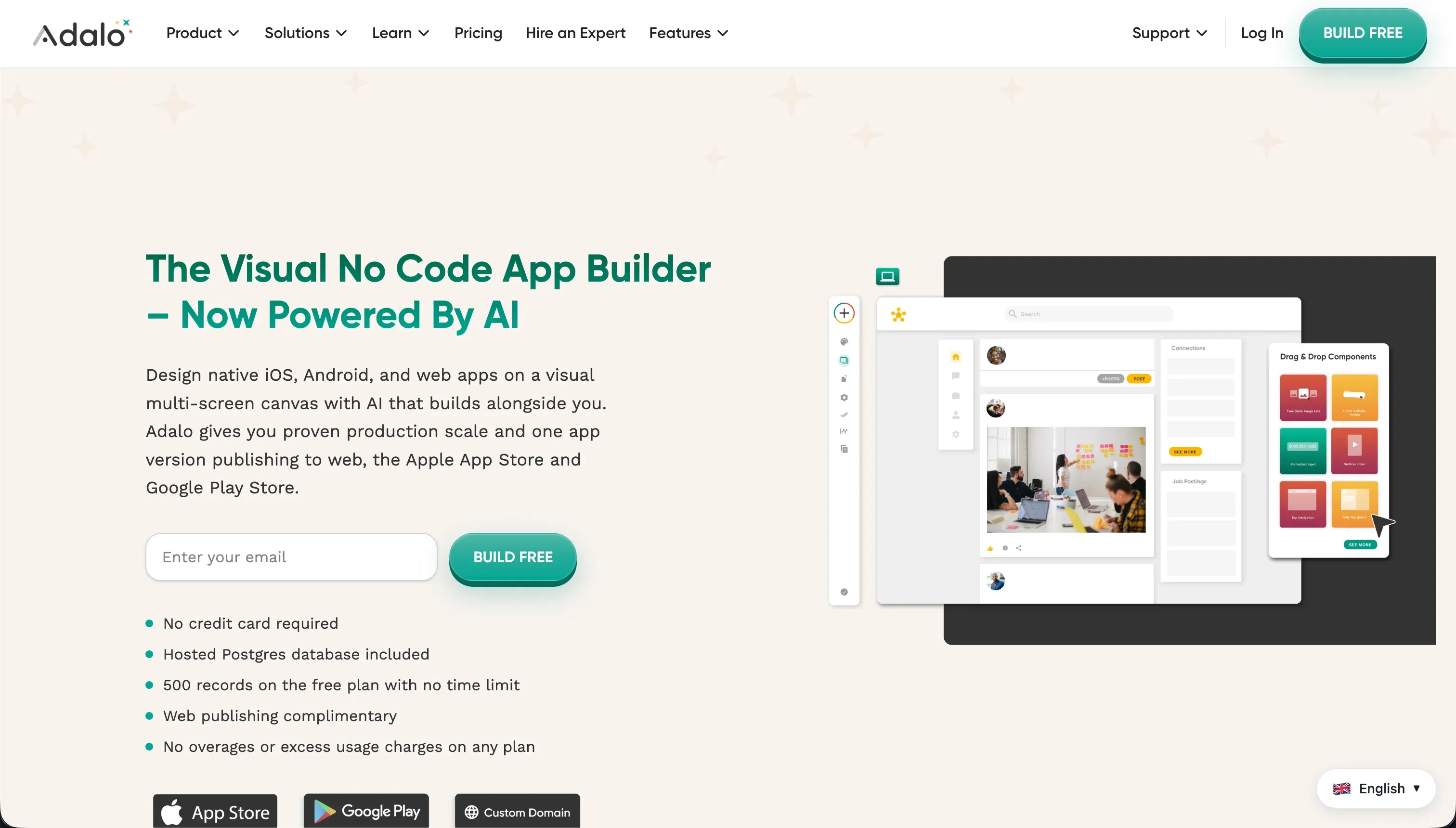
Adalo is a visual drag-and-drop platform designed primarily to build and publish mobile-first applications. It allows non-technical creators to place buttons, images, charts, and input forms freely on a blank visual canvas.
It features a built-in relational database to store user records, alongside action workflows that handle screen transitions, database modifications, and push notifications natively.
This canvas-centric tool is built for designers, startup founders, and lightweight creators aiming to launch simple mobile MVPs. Its primary advantage is that it manages the complex structural packaging required to deploy applications directly to the Apple App Store and Google Play Store.
This makes it a popular starting point for directories, catalogs, and basic workflows that do not require complex backend configurations.
The core difference
The primary axis of divergence between these two platforms is the nature of their underlying technology stack: code generation versus visual canvas hosting.
- Lovable generates a raw React, TypeScript, and Supabase database codebase that you edit strictly through natural language prompts.
- Adalo runs your application on a proprietary, visual drag-and-drop layout engine hosted on fixed-width mobile-first screens.
Where the scores diverge
Design flexibility: Lovable 8.0, Adalo 5.0. Lovable wins this handily at 8.0 compared to Adalo’s 5.0. Lovable can generate any layout your team can describe in text, bolstered by direct Figma token imports. Adalo’s visual canvas allows free placement of elements, but is restricted to a fixed-width screen model, yielding desktop web portals that feel like stretched phone screens.
Ease of build: Lovable 7.5, Adalo 6.0. Lovable scores 7.5 under this evaluation, outperforming Adalo’s 6.0 score because its prompt-to-app generator outputs a complete, multi-page app with mock data in minutes. Adalo offers a low learning curve initially but hits a wall when configuring basic utilities.
Capterra reviewers report that standard features like password recoveries or multiple image uploads are tediously difficult and buggy to build on Adalo’s canvas.
Data & integrations: Lovable 6.5, Adalo 5.0. Lovable scores 6.5, leveraging Supabase’s real PostgreSQL relational database and native GitHub syncing toolchains. Adalo scores 5.0 due to strict database records limits on paid plans, a lack of two-way real-time external data sync, and clunky, fragile external REST API integration loops that often require complete rebuilds.
Production readiness: Lovable 4.0, Adalo 3.5. Lovable scores 4.0 and Adalo drops to 3.5. Lovable builders report that while the first 70% of a prototype builds instantly, the final 30% of business logic hits a strict complexity wall.
Adalo is worse: reviewers describe daily internal server errors landing on paying users, unacceptable native Android rendering performance, and database fragility, including cases of major data loss.
Maintainability: Lovable 3.5, Adalo 4.0. At a 4.0 score, Adalo slightly beats Lovable’s 3.5 metric. While simple navigation changes are easy on Adalo’s visual canvas, complex automation logic is fragile and external API configurations frequently require manual rebuilding from scratch after updates.
Lovable’s prompt-only iteration is highly prone to regression loops where fixing one layout bug silently breaks another, quickly accumulating severe schema and code debt.
Security & access control: Lovable 3.5, Adalo 4.0. Adalo scores 4.0, while Lovable scores 3.5. Adalo offers basic user roles but lacks centralized role-based access control, requiring developers to write complex visibility filters on every individual layout element.
Lovable is even more demanding: database security depends entirely on Supabase Row-Level Security rules that must be manually configured, and a non-technical builder has no reliable visual way to verify what code has been exposed.
Cost comparison
Lovable Pro starts at 25€/mo for 100 monthly credits but permits credit scaling up to 2,250€/mo for 10,000 credits. Unused credits roll over, but credit consumption is variable: every layout edit prompt costs 3 to 4 credits, meaning debugging loops can deplete pools rapidly. Adalo scales from $36/mo (Starter) to $200/mo (Business), but enforces punishing data record limits, starting at 10,000 records on Starter.
Buyers must anticipate major hidden maintenance and overage costs for both tools. Lovable users frequently face unexpected credit billing when running the AI code agent specifically to diagnose platform-introduced regressions. Adalo buyers face expensive plugin marketplaces for basic features and are forced into higher subscription tiers as their internal databases grow past record caps.
Lock-in and the exit path
Lovable offers real code ownership, exporting standard React and TypeScript code directly to GitHub, which makes it the cleaner exit platform if you need to migrate to local environments. Adalo does not support code exporting; leaving the platform requires rebuilds from scratch, and exporting your database can be difficult, as file links do not consistently transfer with the exported CSV files.
- Exports React and TypeScript to GitHub
- Standard code, works in local environments
- Clean code ownership
- No code exporting
- Rebuild from scratch required
- Database export loses file links in CSVs
Who should pick Lovable
Pick Lovable if:
- Founders aiming to build and validate a standard React and Supabase prototype in less than a week.
- Designers who want to import high-fidelity Figma components directly into a functional database state.
- Development teams with a planned developer handoff, utilizing Lovable for rapid visual scaffolding before local code refactoring.
Do not pick Lovable if your app must run reliably for years without continuous developer oversight; the code iterations are prompt-only, creating major database maintenance liabilities.
Who should pick Adalo
Pick Adalo if:
- Makers aiming to ship standard catalogs or simple consumer MVPs directly to native Apple and Google App Stores.
- Founders who do not need responsive desktop sizing and are satisfied with mobile-only layouts.
- Non-technical builders seeking a drag-and-drop canvas layout without any text-to-code components.
Do not pick Adalo if you are constructing custom business applications, portals, or databases that require high uptime, desktop screen sizing, or secure role permissions.
What neither platform answers
Both Lovable and Adalo assume the builder’s goal is to construct a product with highly custom or mobile-specific layouts. However, the majority of business operators are actually building client portals, partner directories, or internal operational tools.
For this class of application, Lovable hands you a fragile codebase to compile, while Adalo forces you to design mobile screens that look stretched on desktop screens, all with weak security models.
If you need custom business software, Softr represents a safer procurement choice. Softr scores 8.5 on production readiness, 9.0 on maintainability, and 8.5 on security & access control.
This is because user authentication, page permissions, and data constraints are pre-built into the platform rather than generated by AI or assembled using fragile element-by-element visibility rules.
If you need a fully scalable, code-first canvas that supports custom React scripting with predictable, secure outputs, Replit is the more robust alternative to Lovable’s prompt-only sandbox.
Analyst verdict
Scoring the criteria reveals Lovable holds the aggregate lead at 5.5 to Adalo’s 4.6. Lovable dominates on ease of build and layout design flexibility, while Adalo beats Lovable on basic visual layout maintainability and simpler database role configuration. The decision hinges entirely on screen context and deployment goals.
If you are building a simple mobile MVP aimed at public app stores, Adalo’s built-in target packaging makes it the logical choice.
For teams aiming to build fully functional, AI-integrated web applications with clean code bases, neither tool provides the reliability needed for a multi-year lifecycle. Instead, we recommend using Replit to gain the speed of text-to-code builders alongside a deterministic, professional cloud IDE that will not lock you into hidden databases or prompt-whack-a-mole regression loops.
Related reading: the Lovable scorecard, the Adalo scorecard, and our scoring methodology.