

This is a comparison between two fundamentally different approaches to developer automation and app construction. Codex belongs to the category of terminal-based AI coding agents that operate directly inside local repositories, and Base44 is situated in the conversational, no-code AI app builder category.
Each has been engineered to solve a distinct procurement problem, resulting in divergent scores when evaluated for production deployments.
Codex wins on aggregate with a 7.1/10 score compared to Base44’s 5.2/10. Although Base44 provides a significantly faster start for non-technical users, its low scores on operational stability and maintainability make Codex the higher-scoring long-term choice for teams with engineering oversight.
The one situation that flips this recommendation is if you have zero developers on your staff, in which case Codex is unusable and you must look elsewhere.
The decision in 30 seconds
| If your priority is… | Pick | Why |
|---|---|---|
| Fast MVP launching for non-technical founders | Base44 | Scapes database, auth, and hosting from a single prompt with zero local configuration |
| Long-term codebase health and regression prevention | Codex | Native git branches, reviewable code diffs, and containerized pull-request workflows score 8.0 |
| Unlimited data sources and enterprise API reach | Codex | Accesses any database, API, or package natively supported by the underlying language at 8.5 |
| Granular user groups and button-level permission control | Neither | Base44 lacks native visual button-level rules and Codex requires engineers to write manual security code |
| High-fidelity code review and continuous testing integrations | Codex | Works natively under technical review workflows with isolated agent branch tasks |
What each platform is
What is Codex?
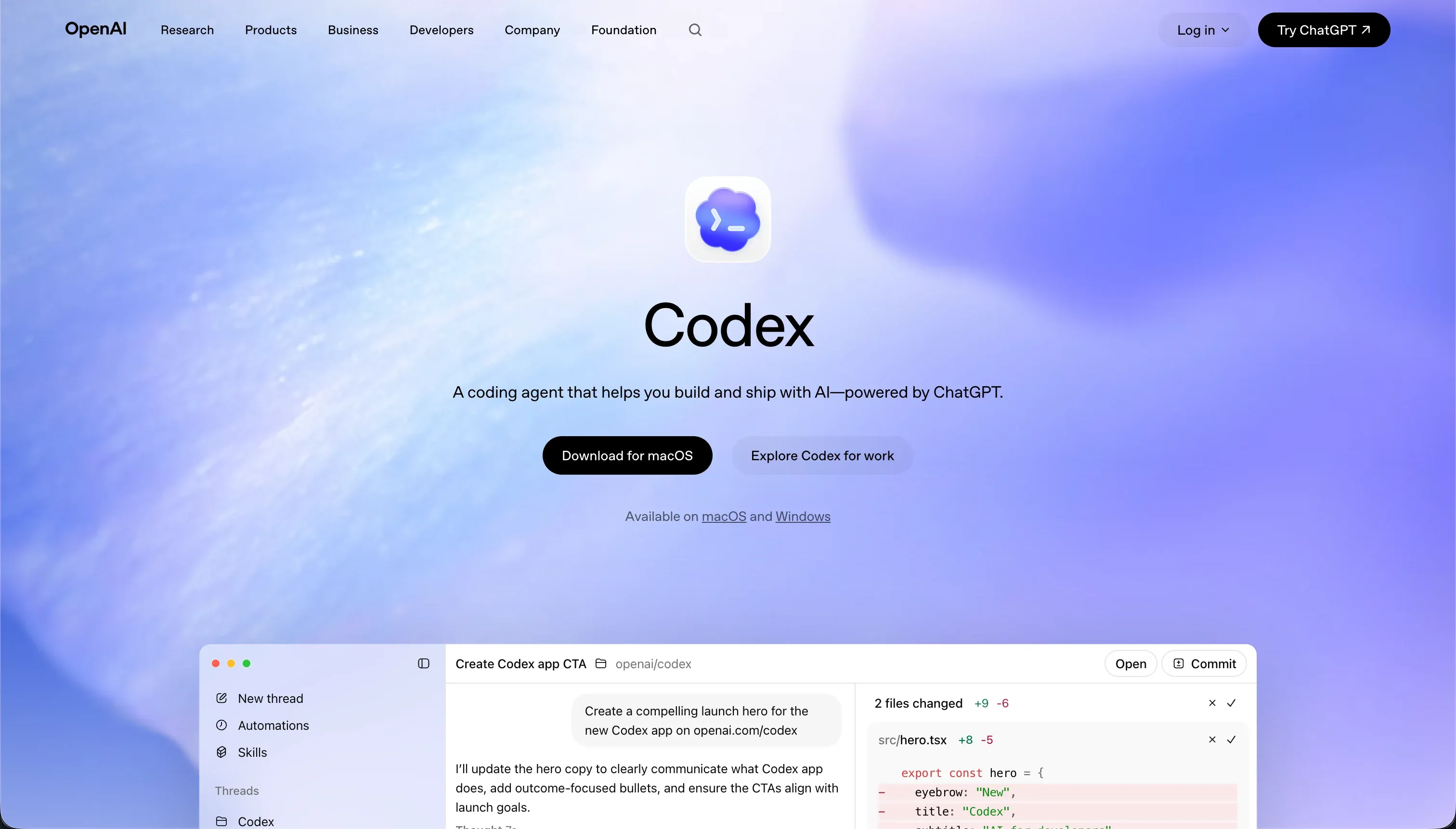
Codex is a terminal-based AI coding agent and desktop command application bundled with ChatGPT subscription tiers. Instead of running on a middleman server, it operates locally inside your existing repository. The core mechanics rely on an autonomous agent that reads local files, creates independent git branches, runs terminal test suites, edits the codebase, and opens ready-to-test pull requests.
Key features include parallel task execution inside containerized git worktrees, low-overhead token usage for cost-effective refactoring runs, and a desktop dashboard to observe agent execution logs. It is explicitly target-built for developers, software engineers, and engineering leads looking to offload repetitive scripting, maintenance loops, and pull-request creation.
What is Base44?
Base44 is an AI-powered conversational web application builder designed to generate full-stack interfaces from natural language prompts. It scaffolds an entire working environment including a user interface, a managed PostgreSQL database schema, user authentication, and system hosting in a single pass.
Changes are made either conversationally in a builder side-chat or through a visual click-to-tweak editor.
Under the hood, Base44 relies on LiteLLM for external connections, incorporates design tokens for theme styling, and supports front-end exports to GitHub. The platform is designed for solo builders, operations managers, and non-technical founders seeking to prototype and launch interactive web apps, simple software tools, and workflows without managing servers.
- Runs locally in your existing repo
- Agent reads files, edits code, runs tests
- Opens ready-to-test pull requests
- Parallel tasks in containerized git worktrees
- Built for developers and engineering leads
- Scaffolds UI, database, auth and hosting in one pass
- Managed PostgreSQL schema and user authentication
- Conversational side-chat or click-to-tweak editing
- Front-end exports to GitHub
- Built for solo builders and non-technical founders
The core difference
The primary axis these two platforms differ on is code control: Codex serves as a hands-off mechanical developer inside an isolated code repository, while Base44 is an all-in-one conversational runtime that abstracts backend complexity in exchanges for lock-in.
- Codex acts as an engineer-in-a-box writing raw commits and running test suites locally inside your environment.
- Base44 orchestrates a closed, hosted full-stack environment where you prompt and edit components through a browser interface.
Where the scores diverge
Maintainability: Codex 8.0, Base44 3.5. Codex achieves an 8.0, its strongest score, by utilizing isolated containerized branches, clean git history commits, and standard review flows that make bulk refactoring runs highly tractable. Base44 drops to 3.5.
Its editing agent is heavily flagged for throwing users into regression loops, where fixing a single layout or data issue creates several subsequent bugs, causing builders to burn credits trying to escape automated loops.
Ease of build: Codex 4.0, Base44 7.5. Base44 scores 7.5, operating as a genuinely fast platform for generating a functional web application with a database, auth, and hosting from a single prompt. Codex lands far below at 4.0 because it does not feature a consumer-grade visual builder.
It is a terminal tool and git utility; non-technical users cannot install or run it successfully. The margin here is defined by who can physically navigate the tool.
Production readiness: Codex 7.0, Base44 4.0. Codex scores a competitive 7.0 because it generates standard code that is compiled, tested, and reviewed under a team’s existing CI/CD standards, though handlers report the agent occasionally overcomplicates requirements. Base44 scores 4.0 due to structural instability.
Multiple user reviews show servers dropping roughly once a week and production apps breaking for active users. The lack of standard infrastructure isolation means updates can render live systems unusable.
Data & integrations: Codex 8.5, Base44 5.5. Codex scores 8.5 because it operates natively inside your code, meaning it can reach any API, third-party framework, or database system your language supports, though you must write the connection code. Base44 scores 5.5.
It includes a built-in PostgreSQL database, but its reliance on LiteLLM imposes API limits, and reviewers flag low limits on PDF parsing alongside latency on larger data queries.
Design flexibility: Codex 9.0, Base44 6.5. Codex scores 9.0 since it writes raw framework files where your custom styling library face no platform limitations. Base44 scores 6.5. Its click-to-tweak editor and layout tokens help style basic elements, but structural templates, portals, and authorization gates remain locked to Base44 defaults.
Security & access control: Codex 6.0, Base44 4.0. Codex scores 6.0, providing strong sandbox protection inside containerized workspaces, let down by script-execution sandboxing risks and the fact that any app-level permissions must be coded manually. Base44 scores 4.0 because its security layer is highly basic.
Registration and login screens stay locked to system designs, role groupings lack granular button-level or field-level security, and the system is not architected for per-user data isolation.
Cost comparison
The financial cost profiles of these two tools are driven by distinct usage behaviors. Codex billing lives entirely inside your wider OpenAI ChatGPT subscription. The Pro tier costs $200/mo, and developers report average API token spends running between $100 and $200 per seat per month. Every file refactor, terminal command lookup, and code generation run directly consumes OpenAI token API fees.
Base44 uses a dual credit model. You pay a subscription fee starting at $16/mo (billed annually) for Starter up to $160/mo for Elite, but your plan limits you to a set of monthly Message credits for app editing and Integration credits for user database queries or emails.
Because fixing bugs often throws Base44’s agent into regression loops, builders report losing hours of working time and hundreds of credits on issues that remain unresolved.
Lock-in and the exit path
Codex has near-zero vendor lock-in because it produces industry-standard React, Python, or TypeScript code that is committed directly to your private GitHub repository, leaving you with complete system ownership. Base44, by contrast, creates severe vendor lock-in.
While you can pay $480 annually to export raw frontend files to GitHub, the database structure, hosted engine, and backend functions stay trapped inside Base44’s closed database systems.
- Frontend files: exported, $480/yr
- Frontend: standard React on GitHub
- Database structure: stays trapped
- Database: yours, in your repo
- Hosted engine: stays trapped
- Hosted engine: full ownership
- Backend functions: stay trapped
- Backend functions: Python or TypeScript, yours
Who should pick Codex
Pick Codex if:
- Engineering teams who want an autonomous agent to handle testing loops, write boilerplate, and draft pull requests inside local code repos
- Teams that mandate a strict code-review process, relying on GitHub diffs and containerized branches to verify all AI changes
- Projects with unique tech stacks that require direct connection to proprietary databases or third-party web frameworks
Do not pick Codex if you do not know how to run a terminal, configure Git repositories, or review raw code files yourself.
Who should pick Base44
Pick Base44 if:
- Builders who need to create a rapid prototype, visual static mockup, or workflow demo in a weekend without local developer tools
- Makers on non-technical teams looking to test early app ideas using standard templates and basic authentication templates
- Solo operators with low data volume needs who can utilize the broad free plan limits (such as a postgres database and analytics)
Do not pick Base44 if your application requires mission-critical uptime, per-user workspace isolation, or complex permission controls.
What neither platform answers
Both tools focus heavily on prompt-dependent code generation. Codex is built as a command-line developer utility, while Base44 is a conversational builder prone to regression loops and server dropouts. If you are trying to deploy a professional business portal, internal dashboard, CRM, or client tool, this prompt-to-code paradigm introduces massive maintenance overhead.
For operational software, a dedicated business platform like Softr represents a significantly more reliable choice. Softr scores 8.5 on production readiness, 9.0 on maintainability, and 8.5 on security precisely because authentication, row-level roles, and database schemas are pre-built, visual configurations instead of generated code.
If you require advanced native mobile features and offline frameworks, we recommend evaluating FlutterFlow alongside it for a standard team build.
Analyst verdict
The scorecard awards the aggregate victory to Codex, 7.1 to 5.2. Codex outscores Base44 across five criteria, hitting 8.0 on maintainability, 8.5 on data & integrations, and 9.0 on design flexibility. Because it works natively as a git branch agent, senior developers can review and safely ship its output in production.
Base44 scores 4.0 on production readiness and 3.5 on maintainability, which reflects real user reports of weekly server outages and destructive regression loops that quickly consume paid credits.
The final decision is highly conditional. If you are a developer looking to automate repository refactors and build standard codes, Codex is the high-performing choice. If you have zero coding skills, cannot navigate Git templates, and require a fast, low-consequence mock-up, Base44 is the only tool of the two you can use, but we highly counsel evaluating a robust visual development alternative first.
Related reading: the Codex scorecard, the Base44 scorecard, and our scoring methodology.