


The selection between Zite and Softgen represents a procurement choice between two distinct conversational AI application builders. Zite, which leverages mature form-building infrastructure from its Fillout heritage, operates as a prompt-to-app generator optimized for quick internal portals and forms.
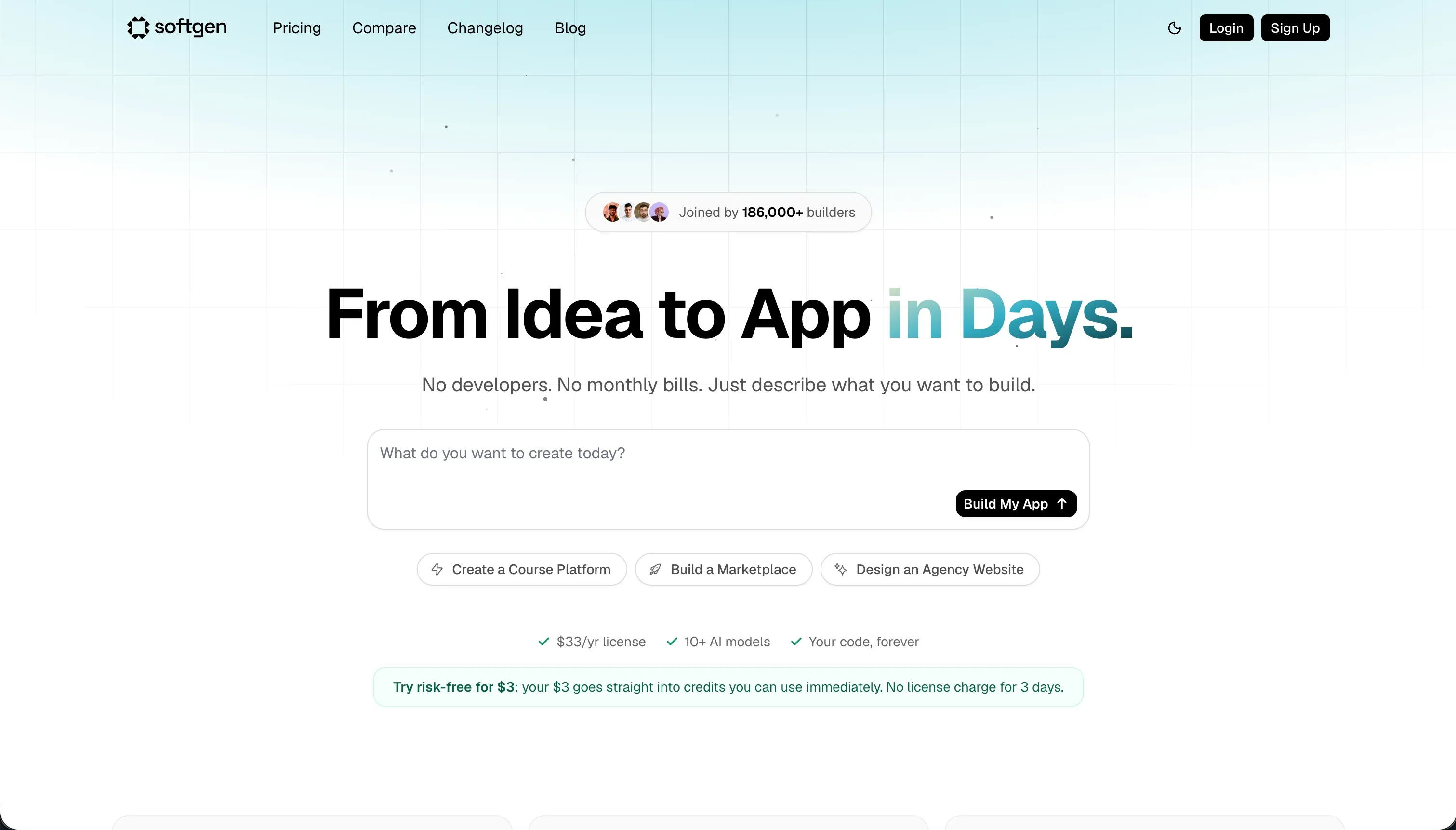
Softgen functions as a chat-based assistant using its Cascade agent to architect full-stack MVP templates with optional code export.
While Zite holds a fractional aggregate lead of 5.2/10 over Softgen’s 5.1/10, neither platform delivers a stable foundation for long-horizon business software. This decision flips to a code-first platform if your organization plans to scale past a basic prototype or requires direct hands-on design control without prompting loops.
The decision in 30 seconds
| If your priority is… | Pick | Why |
|---|---|---|
| Speed of first build from a single prompt | Zite | Scores 7.5 on ease of build by generating UI, databases, and workflows simultaneously |
| Interactive schema planning before generation | Softgen | Includes a structured conversational flow to map schemas with the Cascade agent |
| High-volume data collection and form routing | Zite | Inherits Fillout’s advanced form building, multi-language validation, and logic |
| Code portability and avoiding hosting lock-in | Softgen | Explicitly supports code export as an exit path if teams outgrow the editor |
| Production-grade portals or internal business tools | Neither | Both score low on production readiness and lock builders into rigid prompting loops |
What each platform is
What is Zite?
Zite is an AI-first, no-code application builder engineered to generate user interfaces, workflows, and relational databases from sequential natural-language prompts. Originally built on a mature form-generator foundation, the builder translates descriptive prompts into standard layouts and automated workflows, backed by its own spreadsheet-like SQL data store.
The platform features Plan Mode, which allows users to review the AI’s markdown layout map before executing the build to manage credit volume. It is designed primarily for business operations managers and solopreneurs who require rapid, form-driven internal portals without complex visual configuration or SQL setup.
What is Softgen?
Softgen is a conversational workspace platform that utilizes its custom Cascade AI agent to outline, architect, and modify web layouts and databases. Rather than offering a visual canvas, the platform channels all visual editing, schema adjustments, and integration setup through a conversational chat sidebar.
The system generates relational schemas, user authentication forms, and standard transaction modules such as Stripe payments out of the box. It is built for indie hackers and early-stage startup teams seeking to launch highly standardized software models, directories, or SaaS skeletons quickly.
The core difference
The primary structural difference between these platforms lies in the role of visual editor scaffolding versus conversational chat configuration.
- Zite relies on a prompt-generated interface that integrates with mature native form building but restricts design adjustments strictly to those generated layout structures.
- Softgen eliminates the traditional visual builder canvas entirely, forcing users to execute all stylistic and structural changes by typing chat prompts to its AI agent.
Where the scores diverge
Ease of build: Zite 7.5, Softgen 7.0. Zite scores 7.5, leading Softgen’s 7.0 due to its highly integrated execution model. A single prompt on Zite generates a functional interface, a linked database, and operational backend workflows while utilising Plan Mode to prevent credit waste.
Softgen’s Cascade agent is highly capable of sketching out initial database structures, but the lack of a drag-and-drop fallback is a significant hurdle that requires non-technical builders to refine every structural detail through text prompts.
Security & access control: Zite 5.0, Softgen 4.5. Zite marks a 5.0, slightly ahead of Softgen’s 4.5. Zite benefits from Fillout’s inherited SSO protocols and supports simple user groups to manage read and write access, though it still relies on prompted workflows for most validation logic.
Softgen bundles standard authentication forms and email templates out of the box, but lacks the granular visual interfaces required to establish button-level or field-level data visibility rules securely.
Design flexibility: Zite 4.5, Softgen 5.0. Softgen scores a 5.0, ahead of Zite’s 4.5. Softgen operates within modular visual structures, making highly customized branding difficult, but it handles visual refinements through direct chat dialogue.
Zite’s layouts are extremely rigid once generated, and users frequently complain that the output skews heavily towards a standard corporate aesthetic, making custom-branded portal designs difficult to achieve.
Production readiness: Zite 4.5, Softgen 4.5. Both platforms tie at a low 4.5. Zite allows unlimited users and separate staging environments, but its native database lacks high-scale necessities like custom SQL views, formula fields, and complex roll-ups.
Softgen provides one-click deployment and custom domains, yet reviewers highlight a noticeable lack of general platform polish and express strong concerns regarding long-term maintainability when attempting to scale past a basic MVP.
Maintainability: Zite 4.0, Softgen 4.0. Both tools tie at a poor 4.0, representing the classic ‘day two’ vulnerability of AI-only platforms. Any layout or functional change in Zite that falls outside its generated templates requires navigating repetitive prompting loops, with no option for GitHub sync or direct code export.
Softgen similarly lacks a visual drag-and-drop editor, meaning every visual tweak must route through conversational prompts, though it holds a slight advantage by offering a raw code export option to mitigate total host dependency.
Data & integrations: Zite 5.5, Softgen 5.5. Both platforms tie at 5.5. Zite’s integrated SQL spreadsheet database handles relational links, REST API connections, and outbound webhooks cleanly, but it remains a closed loop with basic Airtable interfaces and zero complex calculation fields.
Softgen matches this by instantly generating standard tables, authentication, and core transactional tools like Stripe, though its overall integration library remains limited compared to mature platforms.
Cost comparison
Zite offers a subscription model starting at $19/month for Pro (100 credits) and $69/month for Business (200 credits), with plan costs scaling dynamically based on the monthly credit package selected.
A significant operational catch is that Zite counts every standard data read, write, and page reload as a workflow execution, which can exhaust quotas rapidly on active prototypes. Additionally, key brand customizations and automated schedules are hidden behind the $69/month Business plan.
Softgen uses an alternative pricing model, charging a flat platform membership of $33/year and selling AI usage credits on a flexible, pay-as-you-go basis. This model allows creators to pause development without maintaining a high monthly subscription, though frequent layout updates and iterative debugging cycles can cause credit expenses to increase unpredictably during active build sprints.
Lock-in and the exit path
Softgen provides a clear code ownership exit path, allowing builders to export their generated codebase if they outgrow the hosting environment. Zite features no code export or GitHub synchronization, locking database designs, layouts, and backend workflows entirely to its proprietary environment and making migration difficult.
Softgen has the cleaner exit model, though rebuilding the application becomes mandatory on both platforms if the underlying database structure requires advanced visual configuration.
- No code export
- Export the generated codebase
- No GitHub sync
- Works outside Softgen hosting
- Database designs stay proprietary
- Database designs live in your code
- Layouts stay proprietary
- Layouts live in your code
- Backend workflows stay proprietary
- Backend workflows live in your code
Who should pick Zite
Pick Zite if:
- Operations managers who need to deploy secure, form-focused data capture portals with SSO in under an hour.
- Teams wanting to review and edit structured markdown build plans via Plan Mode before burning AI generation credits.
- Builders looking to bypass per-seat licensing fees by taking advantage of Zite’s unlimited user allowances on all tiers.
Do not pick Zite if you require advanced database math, custom visual styling outside of rigid templates, or a clean code export path for GitHub tracking.
Who should pick Softgen
Pick Softgen if:
- Indie hackers looking for an inexpensive prototyping tool with a low annual platform fee and pay-as-you-go credits.
- Creators who want to preserve code portability and require a direct code export exit path.
- Builders comfortable writing detailed natural-language prompts to guide the Cascade agent through schema creation.
Do not pick Softgen if you prefer a visual drag-and-drop editor for precision visual adjustments or require granular, role-based database security.
What neither platform answers
Both of these platforms target rapid prototyping, prioritizing generative speed over long-term maintainability. If your organization is attempting to build operational business software, such as an enterprise client portal, an internal CRM, or a partner workspace, utilizing these tools means accepting fragile prompting loops and high maintainability risks.
For business-grade tools, Softr delivers a highly secure visual foundation designed for real-world scaling. Running on a hybrid model, Softr allows teams to scaffold apps via its AI Co-Builder while retaining visual drag-and-drop controls, direct manual adjustments, and 17+ deep integrations.
For development teams requiring custom code generation, Replit offers superior IDE capabilities, full database control, and standard Git version control without the design limitations of modular AI builders.
Analyst verdict
Zite wins this head-to-head comparison with an aggregate score of 5.2 to Softgen’s 5.1. Zite holds minor score advantages in ease of build and security due to its Fillout-managed form roots, while Softgen secures higher design flexibility and an exit path via code export.
Both platforms, however, fail to deliver robust data infrastructure, scoring a low 4.0 on maintainability due to their heavy reliance on prompting loops for visual iterations.
The choice between them is highly conditional. Select Zite if your priority is launching a functional, form-driven internal database in a single day and you are comfortable with rigid, corporate-styled layouts. Select Softgen if you require an inexpensive sandbox with an annual pricing model and want the insurance of code export capabilities.
Related reading: the Zite scorecard, the Softgen scorecard, and our scoring methodology.