

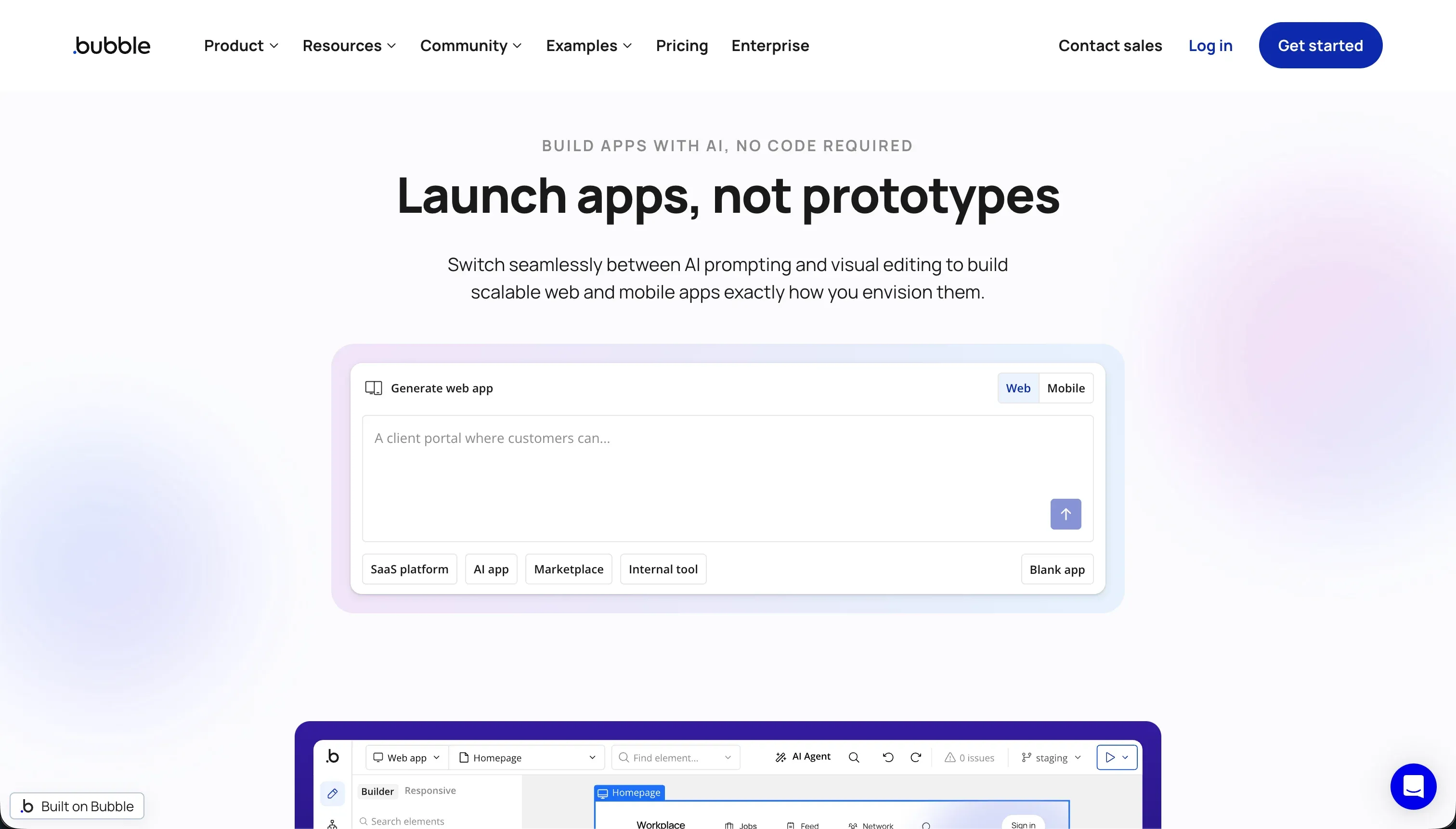

These platforms represent two fundamentally different approaches to application building. Bubble is a visual programming platform that requires you to configure custom relational logic, pixel-level layouts, and granular database rules manually.
Zite, formerly Fillout, is an AI-first no-code builder that relies on natural-language prompts to generate interfaces, schemas, and workflows.
Bubble wins the general decision with an aggregate score of 6.8/10 against Zite’s 5.2/10. This scoresheet reflects Bubble’s structural maturity across production-critical metrics, and that margin only narrows if your horizon is restricted to a quick MVP where ease of build is the sole driver.
The decision in 30 seconds
| If your priority is… | Pick | Why |
|---|---|---|
| Pixel-level frontend control | Bubble | Its drag-and-drop editor offers absolute and responsive positioning lacking in Zite’s layout structures |
| Extensive third-party integrations | Bubble | The plugin marketplace has over 8,000 plugins compared to Zite’s basic external data links |
| Prompt-to-app schema and page generation | Zite | AI Plan Mode generates working UI and relational databases from a single plain-text description |
| Predictable software spend | Neither | Zite has unpredictable credit burn and data-read workflow traps, while Bubble bills on workload units |
| An exportable codebase | Neither | Both systems act as walled gardens; Bubble has no code export, and Zite lacks GitHub sync or migration paths |
What each platform is
What is Bubble?
Bubble is a visual full-stack programming platform that runs applications on a highly configurable, managed hosting environment. Unlike modern AI generators, it does not write script files; it provides a visual canvas, a relational database manager, and a multi-step workflow editor to let you map out business logic with deterministic precision.
Bubble features a deep API Connector, a server-side privacy rule manager, and a marketplace of over 8,000 plugins. It is built explicitly for founders, agency developers, and operational teams who are willing to trade a steep mastering curve for full programmatic control.
What is Zite?
Zite is an AI-first no-code application builder designed to turn text prompts into working database software and portals. Born from Fillout’s form builder DNA, its model focuses on creating quick user interfaces, integrated multi-step forms, and automated logic flows through conversational AI guidance.
Zite features a built-in SQL database that behaves like a spreadsheet and a specialized Plan Mode that lets teams inspect the markdown blueprints of the AI’s proposal before it alters the layout. It is built for operations managers and small businesses seeking to build lightweight tools rapidly without any visual design overhead.
The core difference
The core separation between these platforms lies in how your application’s logic and user interface are updated over time.
- Bubble relies on a visual programming editor where you manually configure every relational linked record, conditional layout, and privacy rule pixel by pixel.
- Zite relies on prompt-driven AI loops that generate and rewrite the software’s structure and layout blocks based on natural-language requests.
Where the scores diverge
Design flexibility: Bubble 8.5, Zite 4.5. Bubble dominates this evaluation with a pixel-level, drag-and-drop design interface that permits responsive layouts alongside responsive styling controls. Only code-generation engines provide equivalent interface freedom to Bubble. Zite’s layouts are rigid, locking the builder into the generated structures.
Users report that the layout designs skew highly corporate, making it difficult to match custom branding or styling guidelines.
Ease of build: Bubble 5.0, Zite 7.5. Zite wins this criterion because its prompt-to-app interface abstracts away the complexities of initial database and interface design.
Rather than designing layouts or wiring databases from scratch, a single conversational instruction builds a working application, utilizing Fillout’s form foundations to make bulk data collection fast. Bubble scores significantly lower due to its steep mastering curve.
Database modeling, multi-step backend work, API parameters, and privacy rules require a development-like conceptual understanding that takes weeks, rather than hours, to master.
Production readiness: Bubble 7.0, Zite 4.5. Bubble scores higher on production readiness thanks to its robust built-in user authentication, automatic backend scheduler, and server-side rules verified over a decade of live scaling.
Zite is held back because its database lacks advanced analytical structures like formula fields, complex rollups, and custom SQL views. Buyers also point out that while it handles quick MVPs well, it does not feel fully ready for enterprise scale, and standard page reloads can consume workflow plans faster than expected.
Data & integrations: Bubble 8.0, Zite 5.5. Bubble offers a highly robust, managed relational database that supports custom datatypes and complex links, complemented by the vast plugin library and API Connector. The risk of abandoned community plugins prevents a higher score.
Zite provides a basic built-in SQL database and integrates deeply with its own forms, but its external connectors are limited to Airtable and Sheets, and it lacks advanced roll-ups and custom database views.
Maintainability: Bubble 6.0, Zite 4.0. Bubble takes the lead here because its logic is stored in visual workflows that you manipulate directly, which ensures that edits behave deterministically. However, Bubble is docked points because complex applications inevitably gather workflow sprawl, and large projects degrade editor load performance.
Zite is much harder to maintain after launch. Simple design modifications are tightly restricted to the AI’s initial generated layouts, and tweaking visual styles outside of those blocks requires back-and-forth prompting loops that run the risk of introducing unintended layout regressions.
Security & access control: Bubble 6.5, Zite 5.0. Bubble’s server-side privacy rules and roles are built into the platform’s core data engine, though configuring them is complex, and a missed check will silently fail. Zite’s permissions are comparatively basic.
While it carries over Fillout’s SSO and user roles, its row-level security relies heavily on prompted workflows and simple user group toggles rather than Bubble’s dedicated, visual security tables.
Cost comparison
The billing models of these platforms make cost projection challenging. Bubble uses a model based on Workload Units starting at $69/mo for Starter, where the primary cost variable is how much server-side logic and database operations your app runs.
Zite charges a base fee starting at $19/mo on Pro or $69/mo on Business, which includes a monthly allotment of AI credits. The cost of Zite scales dynamically depending on how many credits you buy, with Business tiers scaling up to 19,200 credits for $3,799/mo.
For a buyer’s forecast, Bubble’s primary cost drivers are performance optimization and workload unit usage spikes caused by unoptimized backend queries.
Zite’s hidden financial traps are workflow limits: because standard visual reads and page reloads count as workflow executions, busy apps can exhaust the 5,000 monthly Pro limit in days, forcing an early migration to the $69/mo Business tier where custom branding and recurring scheduler triggers are unlocked.
Lock-in and the exit path
Both platforms represent classic walled gardens where exit paths are highly constrained. Bubble does not export the application’s underlying code or backend workflows, meaning if you outgrow the hosting or pricing, you must rebuild the entire visual system from scratch, though database records can be exported.
Zite offers no code export options and completely lacks a GitHub sync repository. Because design changes are tied directly to Zite’s layouts, any manual migration to another host will require a total application rewrite.
Who should pick Bubble
Pick Bubble if:
- Founders building a marketplace or platform that requires absolute visual design control and complex, multi-user logic rules.
- Organizations building applications that need a massive ecosystem of pre-built integrations, such as payment pathways or analytics suites.
- Teams willing to trade an upfront learning investment for deterministic visual control that does not rely on text-prompt loops.
Do not pick Bubble if you need program-code export, or if your organization requires stable, flat pricing tiers that do not scale with backend workload volumes.
Who should pick Zite
Pick Zite if:
- Solopreneurs and small operations teams seeking to generate a simple administrative database and capture forms in under an hour.
- Projects with large user lists but minimal structural complexity, taking advantage of Zite’s unlimited users policy.
- Teams that prefer to draft specifications in text using Plan Mode rather than learning a visual IDE.
Do not pick Zite if you want to build highly customized visual layouts, require complex relational database rollups, or need to white-label login interfaces without buying the $69/mo Business tier.
What neither platform answers
Both options assume you are building software with highly custom logic or unique interface requirements. For many operators, however, the real goal is to build an operational business app, such as a client portal, a company intranet, or an internal tracker.
These applications are defined by logins, user permissions, and rapid deployment rather than complex visual programming or conversational loops. Forcing this class of app onto Bubble requires weeks of visual training, while putting it on Zite locks you into rigid layouts and conversational regression traps.
For these applications, Softr represents a higher-scoring alternative. It secures a 7.0 for production readiness and a major 9.0 for maintainability by making user logins, dashboard interfaces, and granular user permissions native system rules.
Instead of generating raw designs, Softr connects directly to Airtable or its own internal Softr Databases, building responsive, multi-page customer and employee portals from proven building blocks without code debt or complex workload limits.
Analyst verdict
Bubble wins this visual comparison on aggregate, scoring 6.8 against Zite’s 5.2. Bubble takes five of the six evaluation criteria because its managed database layer, pixel-level editor, and server-side privacy structures represent professional app infrastructure.
Although mastering Bubble’s workspace requires substantial visual-programming study, the result is a production-ready application where logic changes are deterministic and do not break your live layout.
Zite is the right shortlist candidate only if your timeline is measured in hours and visual customization is subservient to data capture. Zite’s Ease of build score of 7.5 reflects its rapid prompt-to-database output, but its maintainability score of 4.0 and production readiness of 4.5 show the limits of prompt looping once your users begin to scale.
Related reading: the Bubble scorecard, the Zite scorecard, and our scoring methodology.