


Choosing between Zite and Adalo is an evaluation of two different approaches to rapid application building. Zite operates as an AI-first, prompt-to-app generator in the conversational no-code category, while Adalo represents the classic visual canvas era of drag-and-drop mobile-focused builders.
Both tools target non-technical builders looking to bypass traditional development timelines, but they present vastly different structural trade-offs once your application moves from prototype to production.
Zite wins this head-to-head on scored criteria with an aggregate of 5.2/10 against Adalo’s score of 4.6/10. The 7.5/10 ease of build score for Zite, driven by prompt-based interface and relational database generation, outpaces Adalo’s 6.0/10 visual learning curve.
However, this decision is highly conditional: pick Adalo only if you absolutely require native Google Play or Apple App Store packaging, or avoid both entirely in favor of a specialized code-agent sandbox or a structured business portal.
The decision in 30 seconds
| If your priority is… | Pick | Why |
|---|---|---|
| Rapidly throwing up a relational database MVP from a single text prompt | Zite | scores 7.5 on ease of build by generating interface components and logical databases from conversational descriptions |
| Publishing packaging directly to native iOS and Android mobile app stores | Adalo | handles app-store submission files directly, which is outside Zite’s core target scope |
| Granular, secure, and robust record-level permissions for clients | Neither | both score 5.0 or lower on security and access control, making them unsafe for sensitive external portals |
| Avoidance of daily internal server errors and massive database data loss | Zite | scores 4.5 on production readiness compared to Adalo’s critical 3.5, where reviewers report 70 percent database disappearances |
| Responsive, professional desktop layouts that do not stretch on wide screens | Neither | Zite keeps layouts locked to rigid AI structures, while Adalo scales single-dimension plans to stretched web-wrapper views |
What each platform is
What is Zite?
Zite, which rebranded from Fillout, is an AI-native application builder that generates interfaces, workflows, and database tables from conversational, natural-language prompts.
Rather than forcing builders to learn a visual IDE, Zite relies on a continuous prompting loop supported by an interactive ‘Plan Mode.’ This model allows buyers to view and refine the AI’s markdown layout planning before any elements are actually built, saving precious credit spend and minimizing structural layout bugs.
Zite’s architecture integrates a spreadsheet-like SQL backend with the veteran form builder logic of Fillout, making standard data-capture workflows extremely fast. It is designed for small and medium-sized business operators and internal teams who want to rapidly spin up working databases and associated user interfaces without paying per-user seat fees.
What is Adalo?
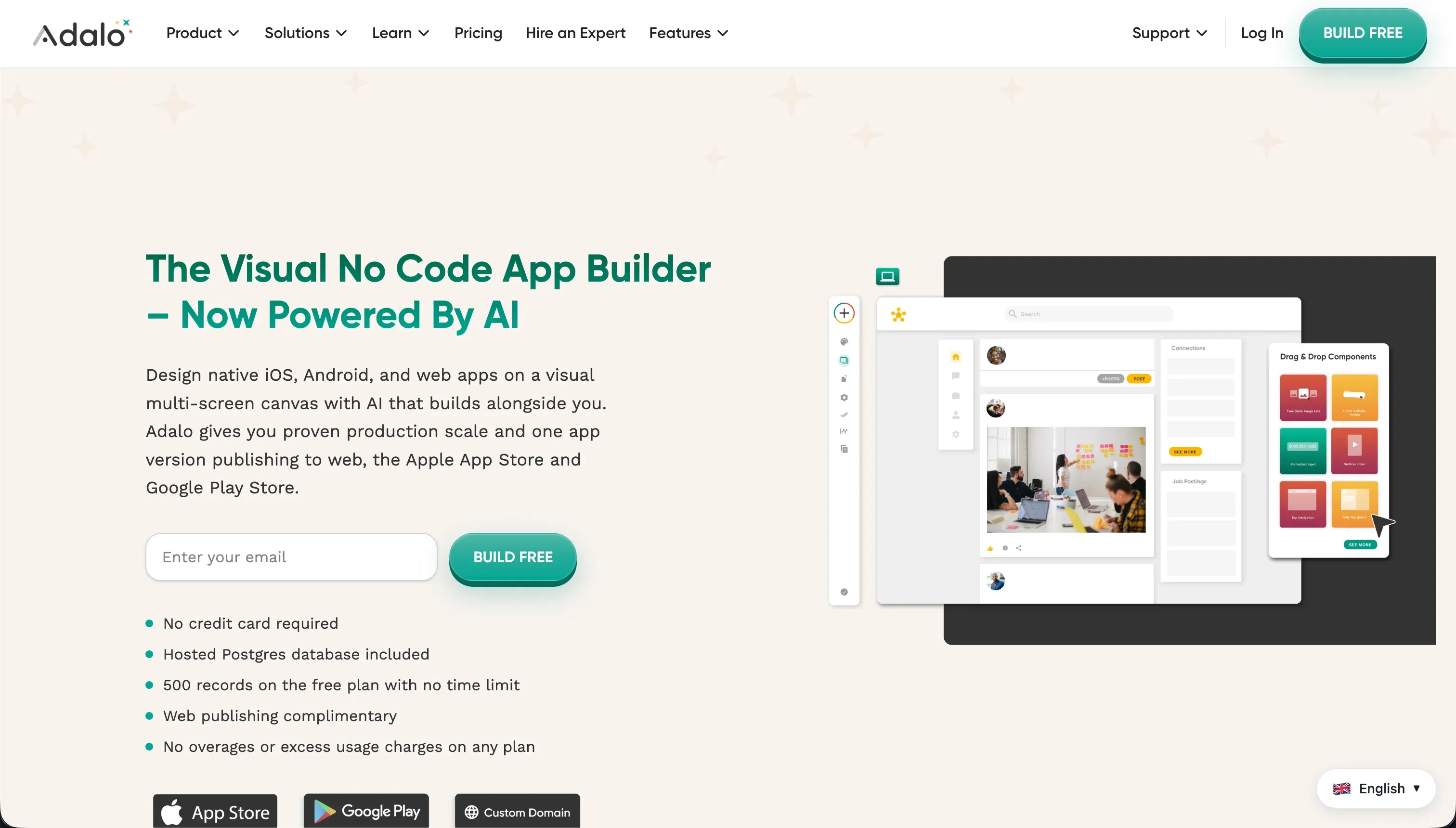
Adalo is a visual, no-code mobile application builder that runs on a free-positioning drag-and-drop canvas. Builders manually place buttons, lists, and forms onto fixed-width screens, mapping them to an internal relational database or connecting them to third-party endpoints.
It handles the packaging process for uploading to native mobile environments, bypassing the need for Xcode or Android Studio configurations.
Adalo is primarily marketed to designers, startup founders, and lightweight creators who need to build a mobile-first directory, static catalog, or early validation mockup. It focuses heavily on mobile device layouts and native packaging rather than complex backend operations.
The core difference
The primary axis of divergence between these two platforms is how you construct and edit your application elements.
- Zite relies on conversational AI generation: you prompt a conversational agent to assemble, edit, and troubleshoot your interface, workflows, and relational SQL tables.
- Adalo forces you to manually configure every pixel and action workflow on a visual, fixed-width Canvas, placing every design and navigation detail by hand.
Where the scores diverge
Ease of build: Zite 7.5, Adalo 6.0. Zite scores 7.5/10 against Adalo’s 6.0/10. Zite’s prompt-to-app generator creates working schemas, dynamic views, and workflows in seconds, and its unique Plan Mode gives users a non-destructive way to refine layouts.
Adalo offers a visually intuitive canvas for dragging elements, but its ease of build falls apart during execution: reviewers report that standard features like forgotten-password flows or multi-image upload fields are tedious and complex to configure manually.
Production readiness: Zite 4.5, Adalo 3.5. Zite scores 4.5/10 while Adalo drops to a critical 3.5/10. Zite provides a SQL backend with unlimited users and staging environments, though users note it lacks advanced database formula fields, roll-ups, and custom SQL views.
Adalo’s production readiness is severely compromised: Capterra reviews detail daily internal server errors, slow load times, poor native Android performance, and catastrophic database instability, including a verified case of 70 percent of an app’s records disappearing.
Security & access control: Zite 5.0, Adalo 4.0. Zite scores 5.0/10, whereas Adalo lands at 4.0/10. Zite uses basic user groups and roles to restrict write access, and carries over Fillout’s mature SSO login roots, but its logical permissioning relies heavily on prompted workflows.
Adalo has no centralized role-based access control; building an application with multiple user types restricts you to setting custom visibility filters on every individual screen element, which is prone to security leaks.
Data & integrations: Zite 5.5, Adalo 5.0. Zite scores 5.5/10, beating Adalo’s 5.0/10. Zite has a fast, native SQL database that supports linked records, REST API, and webhooks, though it is designed around its own ecosystem with only basic external connections to Sheets.
Adalo’s relational database can become a bottleneck at scale, lacks native two-way sync with Airtable, and reviewers report that its custom API connector is clunky and fragile.
Design flexibility: Zite 4.5, Adalo 5.0. Adalo scores 5.0/10, ahead of Zite’s 4.5/10. Adalo uses a free-form canvas that allows pixel-level control over details, though it builds for a single size that stretches poorly on desktop monitors.
Zite is locked to its generated templates: changes outside the AI’s standard structures are highly rigid, and users frequently note the stylistic outputs skew corporate and lack micro-level visual adjustability.
Maintainability: Zite 4.0, Adalo 4.0. Both tools score 4.0/10, making them difficult to recommend for long-term projects. Zite tie-in means design changes are locked to the AI’s generated patterns; edits outside these guardrails require back-and-forth prompting loops. There is no GitHub sync or code export.
Adalo’s maintainability breaks during API updates: if you alter an external schema, you frequently have to build the API definition from scratch in Adalo rather than updating a single definition. Complex approval loops or conditional branching are notoriously brittle on both.
Cost comparison
The financial cost of ownership between these platforms highlights different budget movements. Zite is priced primarily on credit consumption: after a generous Free tier, the Pro plan starts at $19/mo, and the Business plan costs $69/mo.
Because every AI prompt, chat modification, and metadata planning cycle consumes your credit quota, active visual development can rapidly push you into higher, manual-scale tiers that reach up to thousands of dollars per month.
Adalo runs on a different scale, charging $45/mo (Starter), $65/mo (Professional), or $200/mo (Team) for strict record limits. A major hidden trap of Zite is that every standard page load and database read counts against your monthly workflow run limit, quickly exhausting quotes.
Adalo requires buyers to pay premium fees for customized components from its marketplace to execute standard functions, and scaling past native databases incurs high consulting fees to build stable third-party database connections.
Lock-in and the exit path
Exit paths represent a significant structural risk for both products. Neither Zite nor Adalo supports code export or GitHub synchronization, resulting in total developer lock-in. If you choose to leave either platform, you will have to rebuild your frontend logic, security permissions, and UI placements entirely from scratch.
Zite has a slightly cleaner exit on the database layer because its SQL backend supports full REST API access and straightforward CSV exits, whereas Adalo’s database export often breaks file linkages, leaving builders with unmapped raw data.
- Full rebuild of frontend, permissions, UI
- SQL backend stays accessible
- Full REST API access
- Straightforward CSV export
- Full rebuild of frontend, permissions, UI
- No code export either way
- Database export breaks file linkages
- Raw data left unmapped
Who should pick Zite
Pick Zite if:
- Operators building rapid internal database MVPs where unlimited user slots are required without high seat-licensing fees.
- Teams who want to translate, design, and deploy highly complex, multi-step capture forms without wrestling with visual design tools.
- Builders looking for a prompt-to-app workflow with pre-configured staging and production environments in one platform.
Do not pick Zite if you need high design flexibility, custom consumer-branded screens, or native mobile app publishing files.
Who should pick Adalo
Pick Adalo if:
- Creators who need an early-stage mobile prototype that they can package for Google Play and Apple App Stores.
- Designers who want a free-positioning canvas to manually align UI elements on a pixel level on mobile.
- Builders creating single-user-type directories or public catalogs that do not require complex, multi-role security configurations.
Do not pick Adalo if you are building an actual production-ready web application or portal, as reviewers report daily internal server crashes and poor desktop layouts.
What neither platform answers
Both tools assume that you are building an application completely from scratch. However, if you are looking to build standard business software - such as client portals, vendor dashboards, or internal CRMs - both platforms force massive architectural compromises. Zite traps you in prompting loops when adjusting simple layouts, while Adalo forces you to build fragile, manually managed visible rules for security.
For those use cases, Softr is the superior, logical choice. Softr scores 8.5 on production readiness, 9.0 on maintainability, and 8.5 on security & access control because it is explicitly designed for operational applications.
By composing battle-tested, native blocks directly over your data, you get visual certainty, Google-approved SSO integrations, and secure, granular user groups out-of-the-box. Alternatively, if your goal is an uncompromised mobile app, choose FlutterFlow, which excels at native mobile architecture with high production scores.
Analyst verdict
Zite wins this head-to-head on scored criteria, finishing with a 5.2/10 aggregate score against Adalo’s 4.6/10. Zite takes the lead on ease of build (7.5 to 6.0), production readiness (4.5 to 3.5), and security (5.0 to 4.0). Adalo holds a slight edge only on design flexibility (5.0 to 4.5) because of its free-form, visual positioning canvas and immediate mobile packaging workflows.
However, neither of these platforms offers the stability or maintainability required for a production-grade business tool. If your team has developer skills and needs absolute code freedom, you should buy Replit to generate custom code.
If you want to assemble robust, secure, and easily maintained internal tools or client portals without writing a line of code, pick Softr instead.
Related reading: the Zite scorecard, the Adalo scorecard, and our scoring methodology.