


The frontend builder market is dividing between visual application designers and conversational code-generation assistants. Frontend development teams evaluating WeWeb are looking to ship production-grade layouts on top of external backends, while builders considering v0 want to generate responsive React user interfaces directly from natural-language descriptions.
WeWeb wins this comparison on aggregate with a 6.2/10 scorecard rating against v0’s 5.8/10.
The score reflects a crucial architectural distinction: WeWeb provides visual state management and routing that makes a layout ready for users, whereas v0 generates standalone code that requires manual routing, backend, and security configuration before it behaves like a functional application.
The decision flips to v0 only if your priority is immediate React component scaffolding with code export.
The decision in 30 seconds
| If your priority is… | Pick | Why |
|---|---|---|
| Visual layout design with CSS grid and flexbox | WeWeb | Its visual layout engine supports advanced flexbox, absolute positioning, and visual state management |
| Generating React structures directly from prompts | v0 | Its LLM generates code matching shadcn/ui layouts and Tailwind CSS structures immediately |
| Predictable, flat-tier software subscription billing | WeWeb | Its flat plans are billed on page views rather than unpredictable conversational token credits |
| No platform lock-in with clean React and Tailwind export | v0 | It exports clean React and TypeScript with zero proprietary runtime layers |
| Integrated client authentication and data tables | Neither | Both require separate external backends and manual configuration to manage core user data |
What each platform is
What is WeWeb?
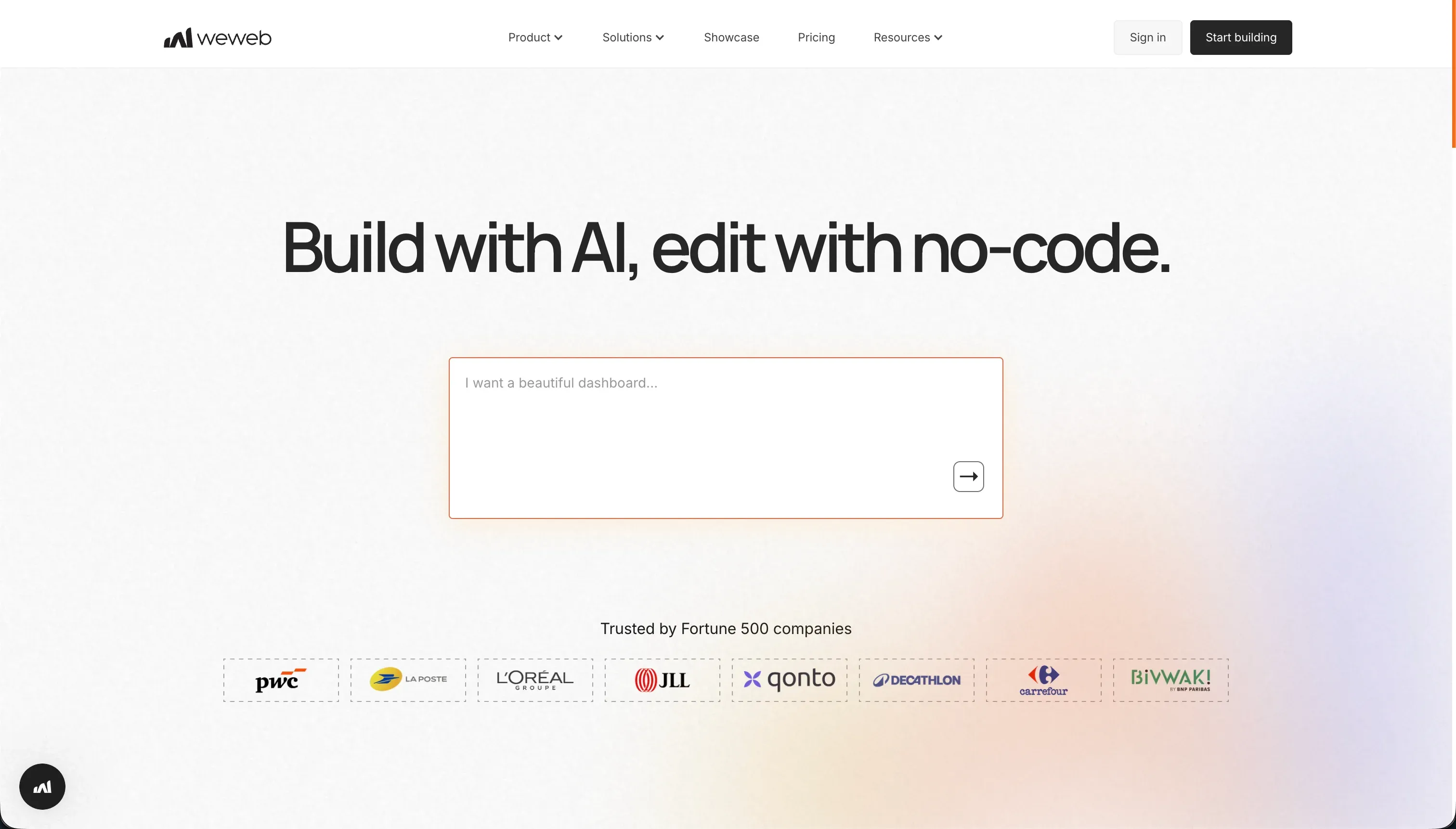
WeWeb is a visual, decoupled frontend builder for web applications. The visual editor is designed for frontend developers who need custom layout control but want to bypass writing CSS and HTML, allowing them to bind layouts and page structures directly to external databases and APIs.
The builder connects visually to data sources through REST APIs or dedicated connectors, referencing variables and user actions through a visual state manager. It is explicitly engineered to build single page applications (SPAs) and Progressive Web Apps (PWAs) that run on top of standard external databases like Supabase, Xano, or Airtable, keeping the presentation layer completely divorced from the data store.
What is v0?
v0 is an AI-powered conversational frontend assistant built by Vercel for rapid user interface prototyping. Rather than providing a visual design engine with handles and drag-and-drop grids, v0 generates real React, TypeScript, and Tailwind CSS code dynamically from natural-language prompts, layout sketches, or screenshots.
The generated code integrates tightly with Vercel’s deployment pathways and the shadcn/ui library, enabling developers to sync UI blocks directly into local GitHub repositories. The tool is designed for builders who need polished interface prototypes but intend to manage the resulting code inside their own IDEs and deployment environments.
The core difference
The primary dividing line between these platforms is how you interact with the design layer and what the tool exposes as the final output.
- WeWeb provides a visual layout studio with CSS property controls that acts as a staging and presentation environment for applications running on external backends.
- v0 acts as a prompt-driven code generator that produces clean React component files for engineers to copy, paste, and wire up manually.
Where the scores diverge
Ease of build: WeWeb 4.0, v0 7.5. v0 scores a 7.5/10 here because starting with a prompt or a layout sketch produces a styled React interface in minutes.
Getting a functioning app in WeWeb is a slow process that requires a 4.0/10 rating; because it has no built-in database, you cannot render a single row of dynamic data without first provisioning, paying for, and configuring an external backend such as Xano, Supabase, or Airtable. v0 is significantly faster for generating UI, though its lead is slightly reduced by the manual development effort required to wire its frontend components into standard web hosting afterwards.
Data & integrations: WeWeb 7.0, v0 5.0.
WeWeb leads with a 7.0/10 by offering dedicated connectors for major SQL and NoSQL engines alongside custom REST API bindings, although Capterra reviews report its direct integrations with headless CMS platforms are occasionally weak. v0 lands at 5.0/10; while it provides one-click Vercel deployments and GitHub sync, it has no native relational modeling or dynamic data binding.
Connecting any external dataset to its generated inputs remains manual integration work inside your code editor.
Production readiness: WeWeb 6.0, v0 4.5. WeWeb takes a 6.0/10 rating by providing a hybrid rendering engine that outputs SEO-friendly SPAs and staging environments for testing. v0 lands at a 4.5/10 since it does not ship with built-in authentication, a database, or backend logic.
Reviews on G2 highlight that v0 functions as an advanced interactive designer’s scratchpad; developers must build the entire full-stack hosting and application plumbing themselves to make its generated UI work for live users.
Security & access control: WeWeb 5.5, v0 4.0. WeWeb earns a 5.5/10 because it handles user access via token-based authentication flows configured against your choice of external identity service.
However, because WeWeb does not manage security natively, access control is only as strong as the separate database rules configured behind it. v0 scores 4.0/10; it generates visual interface code only, meaning any user security, authentication screens, or row-level permissions must be architected from scratch on the developer’s custom server.
Maintainability: WeWeb 6.0, v0 5.5.
WeWeb scores a 6.0/10 because changes can be made visually inside its state manager, although updating the decoupled stack means developers must manually check changes across WeWeb, their API scripts, and their external backends. v0 drops to a 5.5/10; while its exported React handles are transparent, reviewers note that past 5 to 10 prompt iterations the conversational thread drifts, generating buggy or bloated Tailwind code.
These regressions force engineers to manually refactor the code inside their local IDEs.
Design flexibility: WeWeb 8.5, v0 8.5. Both platforms tie at an excellent 8.5/10.
WeWeb achieves this through a visual CSS layout engine that features absolute positioning, flexbox, grid controls, and an AI assistant that drafts JavaScript and CSS for custom blocks. v0 reaches the same tier by generating polished shadcn/ui frames from wireframes or descriptions, though reviewers note that its Design Mode mostly swaps Tailwind color presets, which still rewards a professional designer’s touch for highly refined styling.
Cost comparison
WeWeb uses a flat tier modeling structure based on published apps and page views, starting with a Starter plan at $59/month for one custom-domain application and scaling to $249/month on the Scale tier which adds staging environments. v0 runs on a credit-consumption pricing model; its Team tier runs $30/user/month, with individual model generations (ranging from v0 Mini to v0 Max Fast) consuming credits at variable rates based on token output, meaning debugging iterations directly influence monthly software costs.
Buyers must calculate the hidden cost of WeWeb’s decoupled architecture, which mandates an active paid subscription to a separate database provider like Xano or Supabase to manage records.
For v0, the primary cost is engineering overage; because the tool is purely a generator, buyers will pay significant software engineering hourly rates to build the custom backends, user authentication screens, and hosting paths necessary to turn v0’s code blocks into live platforms.
Lock-in and the exit path
v0 has no design lock-in because it outputs inspectable React, TypeScript, and Tailwind code that can be immediately exported and hosted anywhere.
WeWeb allows Vue.js and Nuxt.js code downloads on its higher Scale and Enterprise tiers, though migrating its visual layouts into another visual builder requires a total rebuild. v0 offers the cleaner exit path, as its files integrate cleanly into conventional Git development processes.
Who should pick WeWeb
Pick WeWeb if:
- Frontend design teams who want responsive CSS control without manually coding HTML layouts.
- Agencies looking to build web applications connected to existing Xano, Supabase, or REST APIs.
- Teams that need staging environments and visual state machines to manage user variables without writing complex React hooks.
Do not pick WeWeb if you require a unified database, native authentication layers, and flat-rate user seat pricing.
Who should pick v0
Pick v0 if:
- Developers seeking to rapidly scaffold React and Tailwind styles from design sketches or screenshots.
- Teams deploying through Vercel’s global CDN who want to sync component iterations directly into GitHub repositories.
- Founders who need to quickly mock up interactive, styled frontend landing pages for target audience validation.
Do not pick v0 if you want a complete web platform out of the box with user login databases, row-level permissions, and persistent backend storage.
What neither platform answers
Both WeWeb and v0 assume the application layer is highly custom, requiring visual CSS layout logic or React coding pipelines. This decoupled structure makes them complex overlays for standard business databases.
If you are building transactional operational software - such as dynamic client portals, secure vendor trackers, or company intranets - both platforms force your team to spend hours configuring APIs, token auth screens, and hosting setups.
For standard business tools, a native database and interface builder like Softr scores significantly higher on production readiness, maintainability, and access control.
Softr provides native authentication, row-level visibility, and a database inside a single managed environment, allowing business teams to build portals in less than page-design iterations. For teams building native-only mobile designs with raw phone interactions, visual developers should instead shortlist FlutterFlow.
Analyst verdict
WeWeb wins the aggregate comparison with a 6.2/10 rating against v0’s 5.8/10. It earns its victory by scoring higher across production readiness (6.0), maintainability (6.0), access control (5.5), and data pipelines (7.0). WeWeb keeps the layout maintainable for design teams because changes can be refined inside a visual environment without code-regression loops.
v0 is highly capable at prompt-to-React generations, tying WeWeb at 8.5 on design flexibility and winning handily on ease of build (7.5). However, because it stops at generating the code blocks, it remains a prototyping companion rather than an application development suite.
Choose WeWeb if you need to build interfaces that connect dynamically to external APIs; select v0 if you are a developer looking to scaffold clean code layouts for local IDE refactoring.
Related reading: the WeWeb scorecard, the v0 scorecard, and our scoring methodology.