

This comparison details a head-to-head matchup between a visual frontend application builder and an AI-driven frontend prototyping utility. Front-end engineering teams looking to build production-grade web interfaces coordinate on WeWeb, a decoupled utility designed on classical web layout rules.
Design and prototyping groups looking to clone existing sites conversationally look to Same.new, an environment built strictly for quick visual iteration.
WeWeb wins on aggregate, scoring 6.2/10 against Same.new’s 4.1/10. Because Same.new lacks security layers, databases, and a stable deployment engine, its primary utility sits within prompt-based layout experimentation. When the application must sustain real-world business transactions, WeWeb is the higher-scoring purchase.
The decision in 30 seconds
| If your priority is… | Pick | Why |
|---|---|---|
| Visual design of live URL cloned to React code | Same.new | clones basic styling, layout, typography, and colors from a single URL input |
| Connected production web application with multi-environment deployment | WeWeb | scores 6.0 in production readiness and operates as a single page application with staging limits |
| Granular user groups and conditional route rules | WeWeb | handles conditional page routing and state configuration directly within a visual editor panel |
| Simple, prompt-driven UI mocking with low financial starting risk | Same.new | offers a low entry model starting at $10 for prototype experimentation |
| Client database access or secure administrative operations | Neither | WeWeb stores nothing natively and Same.new has no database connection layer out-of-the-box |
What each platform is
What is WeWeb?
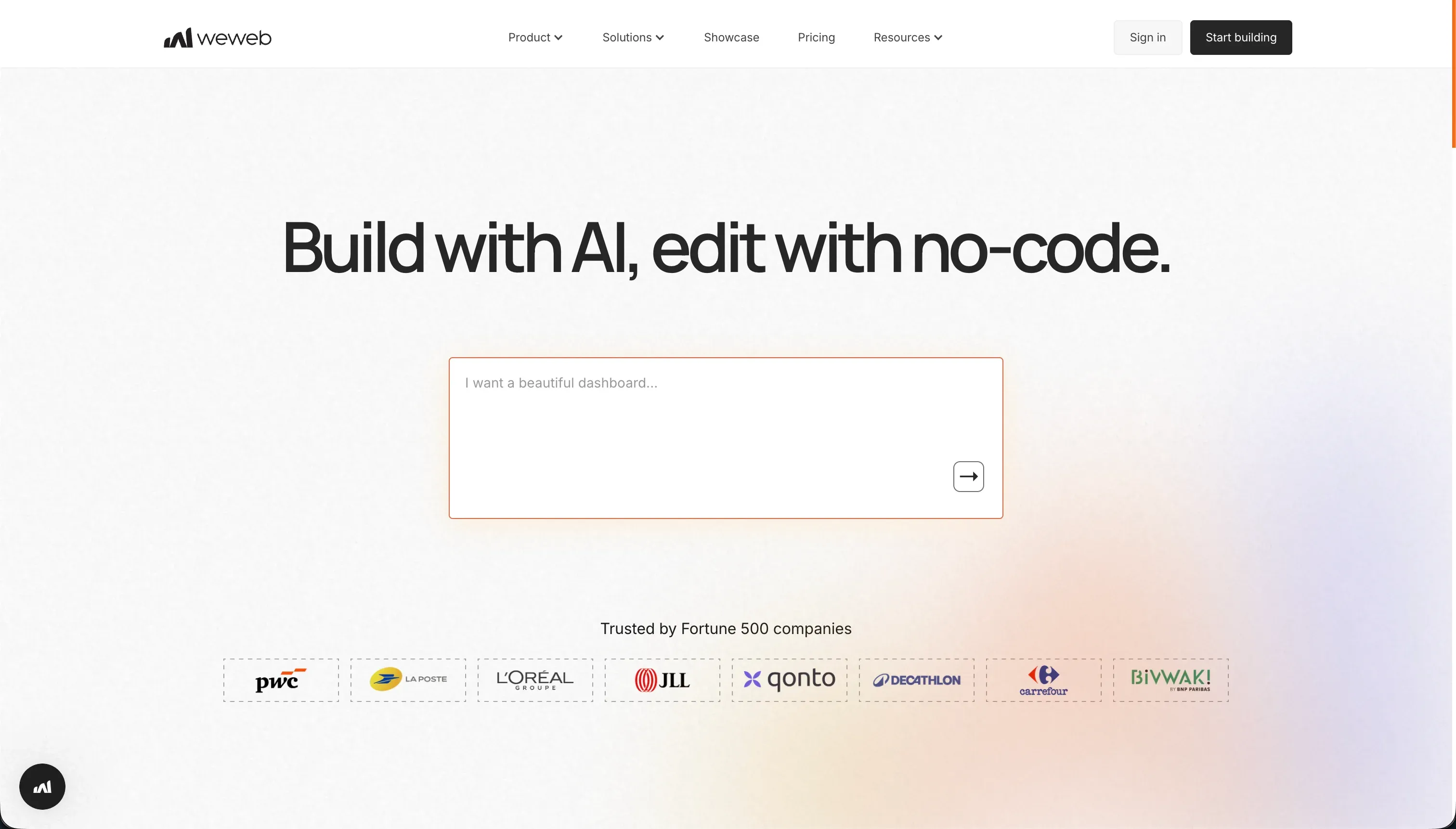
WeWeb is a visual web application builder operating on a decoupled frontend framework, designed specifically to produce single-page layouts. It connects dynamically to external data layers and APIs to decouple the user interface from business-critical operations. The design workspace uses a direct-manipulation interface that translates visual layout changes directly into structured component code.
The system runs on structured visual state management, allowing developers to configure logical page variables and coordinate API payloads visually. With features like the WeWeb AI Assistant generating inline JavaScript classes for customized styling and advanced code rendering, it is built directly for agencies, consulting developers, and frontend teams who require precise interface output.
What is Same.new?
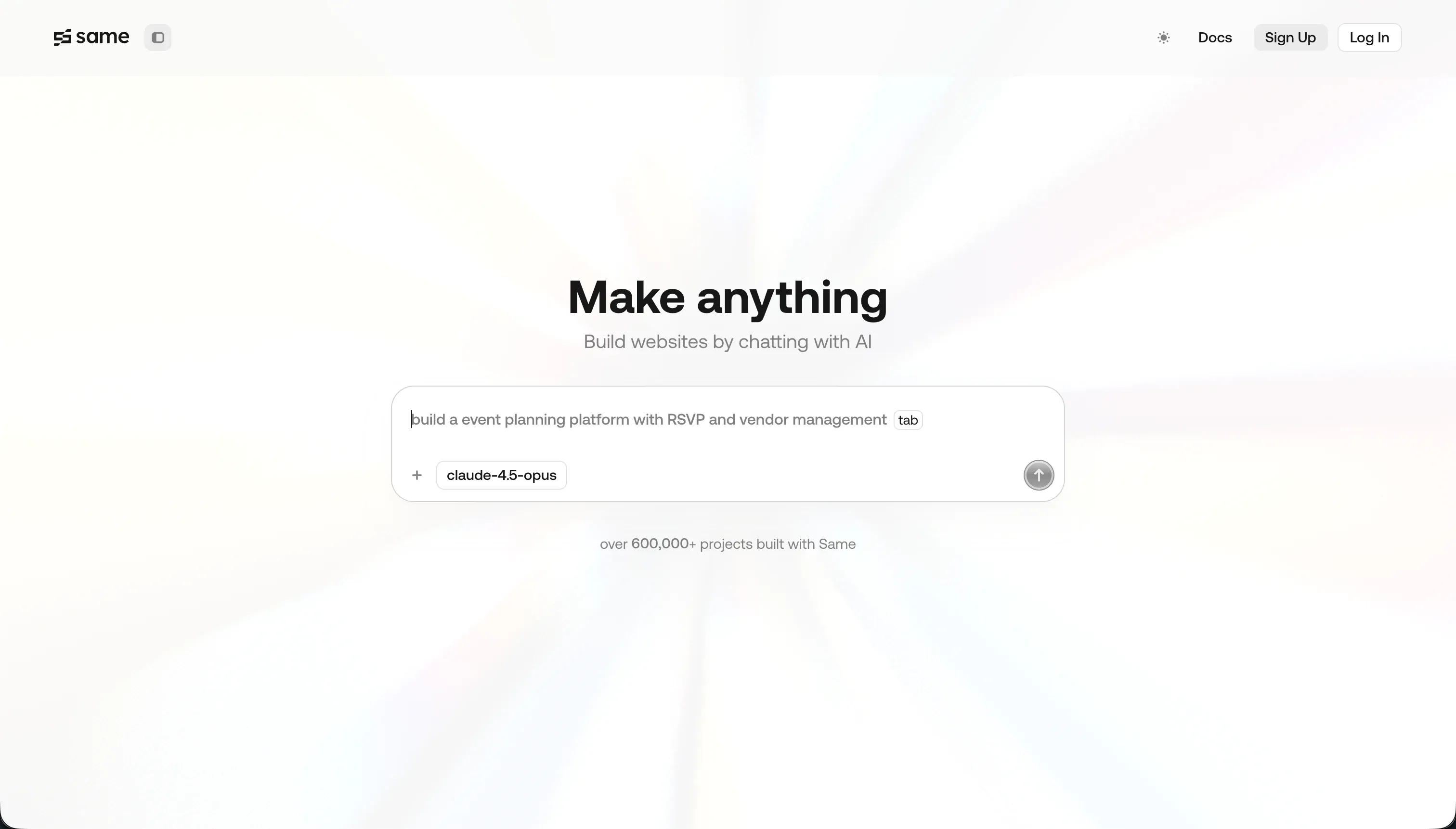
Same.new is an automated web design cloner and prototyping canvas that translates prompt requests into visual user interface files. It utilizes artificial intelligence to read the structure of a target website url and output matching React and Tailwind CSS markup. Iteration on design states happens conversationally, relying on structural prompting to execute modifications.
The product features visual component cloning and instant duplicate options to isolate individual layout styles for design-focused operators. Same.new is built primarily for visual designers and front-end teams looking to rapidly blueprint templates and visuals before moving into production.
The core difference
The primary operational difference defines how each platform processes web layout logic.
- WeWeb is a visual design tool for structured frontend applications that binds interface components directly to live, external database environments.
- Same.new is an isolated AI visual canvas that generates code markup from a conversational prompt editor.
Where the scores diverge
Production readiness: WeWeb 6.0, Same.new 3.0. WeWeb scores 6.0 because its rendering framework delivers high-performance SPAs with staging environments provided on its secondary scale tier, though mobile performance has been noted to occasionally lag desktop experiences. Same.new is capped at an unstable 3.0.
It offers zero native enterprise persistence or backend layers, making it a pure frontend prototype utility. Additionally, users report severe service instabilities, highlighting that historical rebranding transitions left existing, active websites in read-only states or entirely broken.
Maintainability: WeWeb 6.0, Same.new 3.0. WeWeb scores a moderate 6.0; logic is presented in a visual state editor, but any multi-layer logic update forces the operator to manually modify both WeWeb and the third-party backend, and technical documentation historically lags design releases. Same.new scores an unsustainable 3.0.
Programmatic edits run conversationally through prompts that can occasionally behave disruptively, with users noting situations where a single design adjustment directly overrode and erased over 1500 lines of functional page logic.
Data & integrations: WeWeb 7.0, Same.new 4.0. WeWeb’s 7.0 score reflects standard, responsive data connection capabilities to third-party SQL layers, Airtable instances, and external REST APIs, though native data storage is nonexistent and headless CMS workflows remain difficult.
Same.new scores a 4.0, as it does not query secure backend frameworks or handle high-complexity calculations natively. It strictly generates layout components that developers must wire manually to API structures outside the tool.
Security & access control: WeWeb 5.5, Same.new 3.0. WeWeb scores a 5.5, indicating that security is entirely reliant on the third-party database layer. Authentication uses token properties configured against these secondary providers, and single-sign-on (SSO) features are gated behind expensive enterprise options.
Same.new drops to a nominal 3.0 because there is no built-in authentication, permission control, or user directory, forcing builders to construct security layers manually in exported code files.
Design flexibility: WeWeb 8.5, Same.new 6.5. WeWeb’s 8.5 is its highest score because the interface permits detailed layouts using CSS flexbox rules, absolute CSS alignment, and grid systems alongside custom styling files. Same.new scores a 6.5, managing URL-to-code conversions easily for static layouts but struggling to cleanly arrange nested tables, complex grids, and live dashboard elements.
Ease of build: WeWeb 4.0, Same.new 5.0. Same.new secures a 5.0 on this criterion because pasting a target URL directly creates a formatted web template in seconds. However, complex interactive state remains unstable, demanding manual code correction once the interface limits simple layout elements.
WeWeb drops to a 4.0 because it has no built-in database layer; every build requires the engineer to subscribe to and fully map an external database like Xano, Supabase, or Airtable. Visualizing layouts, conditional page routing, token-based authorization rules, and JSON payloads within the interface requires a solid grip of raw web architecture concepts.
Cost comparison
WeWeb is billed on a rigid infrastructure model, running from a free tier up to Starter ($59 per month billed monthly) and Scale ($249 per month billed monthly), with advanced SSO and self-hosting restricted to custom corporate structures.
The cost is predictable globally but shifts based on required environments, code-export options, and monthly traffic allowances. Same.new has transitioned to a model running on predictable monthly price limits based on token usage tiers, moving away from older, volatile raw payment cycles.
Hidden costs diverge based on builder technical backgrounds. WeWeb buyers must allocate significant capital toward third-party developer support, separate backend hosting (Xano or Supabase), and technical engineering hours. Same.new buyers face developer labor hours spent correcting fragile CSS structures and resolving manual layout bugs caused by AI output errors.
- Starter: $59 per month
- Scale: $249 per month
- SSO and self-hosting need custom pricing
- Separate backend hosting
- Developer support and engineering hours
- Token-based monthly tiers
- Less exposure to volatile payment cycles
- Labor fixing fragile CSS
- Hours on manual layout bugs
Lock-in and the exit path
WeWeb offers a clean exit path by permitting raw Vue.js and Nuxt.js script exports on its high-level Scale and Enterprise tiers, though migrating requires database reconfiguration. Same.new allows full React and Tailwind code generation for use on clean local projects. If a team leaves either ecosystem, Same.new has a cleaner exit route for pure layout output, though WeWeb provides stronger developer assets.
Who should pick WeWeb
Pick WeWeb if:
- Frontend designers building single page layout models who already maintain external databases in Xano or Supabase
- Agencies requiring visual code interfaces that exports Vue.js code structures for engineering handoff on higher tiers
- Teams that need highly distinct CSS style control, flexbox rules, and absolute grid coordinates without writing code templates from scratch
Do not pick WeWeb if you require a simple, single-tool workspace that provides a native relational database and instant, out-of-the-box user login tables.
Who should pick Same.new
Pick Same.new if:
- Prototype teams looking to clone the aesthetic and layout of an existing website via direct URL input
- Early designers who need structured React and Tailwind CSS boilerplate code templates generated through a conversational interface
- Designers building flat layouts and mockups who have access to technical development resources to wire the frontend to a server afterwards
Do not pick Same.new for complex web applications requiring real database transactions, live user accounts, or robust state management that must stay in production.
What neither platform answers
Both WeWeb and Same.new are specialized front-end platforms. This means neither offers a complete full-stack environment out of the box. For teams looking to deploy secure portals, internal management directories, or administrative business engines without the overhead of connecting separate backends, managing authentication flow errors, or facing broken code code-generation cycles, another platform must be selected.
A business application platform like Softr solves this requirement by combining a secure front-end, a native relational database, and secure user logic.
Softr scores 8.5/10 in production readiness, 9.0/10 in maintainability, and 8.5/10 in security on our card precisely because authentication, client permissions, database relationships, and web workflows are integrated features rather than decoupled parts for builders to configure manually.
Analyst verdict
WeWeb wins the score comparison comfortably, securing a 6.2 aggregate rating compared to Same.new’s 4.1. This reflects the deep division between a commercial frontend tool with staging controls and an AI design layout generator. WeWeb wins design depth, maintainability, production readiness, and secure data access, while Same.new remains a niche tool for prompt-based mockup code.
The decision is clear: choose WeWeb if you have developer resources, a separate database, and have to launch a permanent single page frontend. Choose Same.new if you are in the visual blueprint stage and specifically want a quick, HTML/CSS structure generated from a target website URL.
Related reading: the WeWeb scorecard, the Same.new scorecard, and our scoring methodology.