

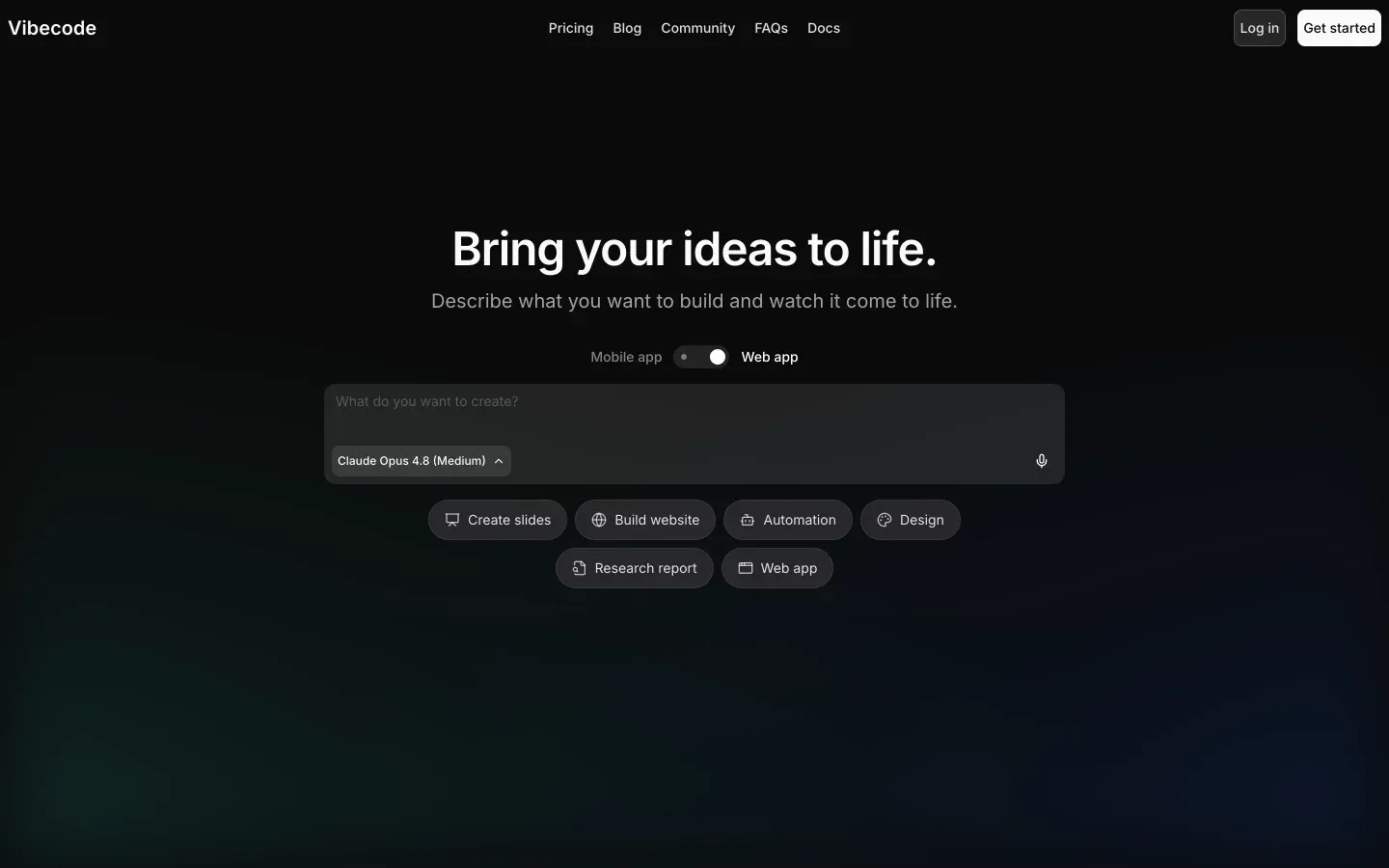
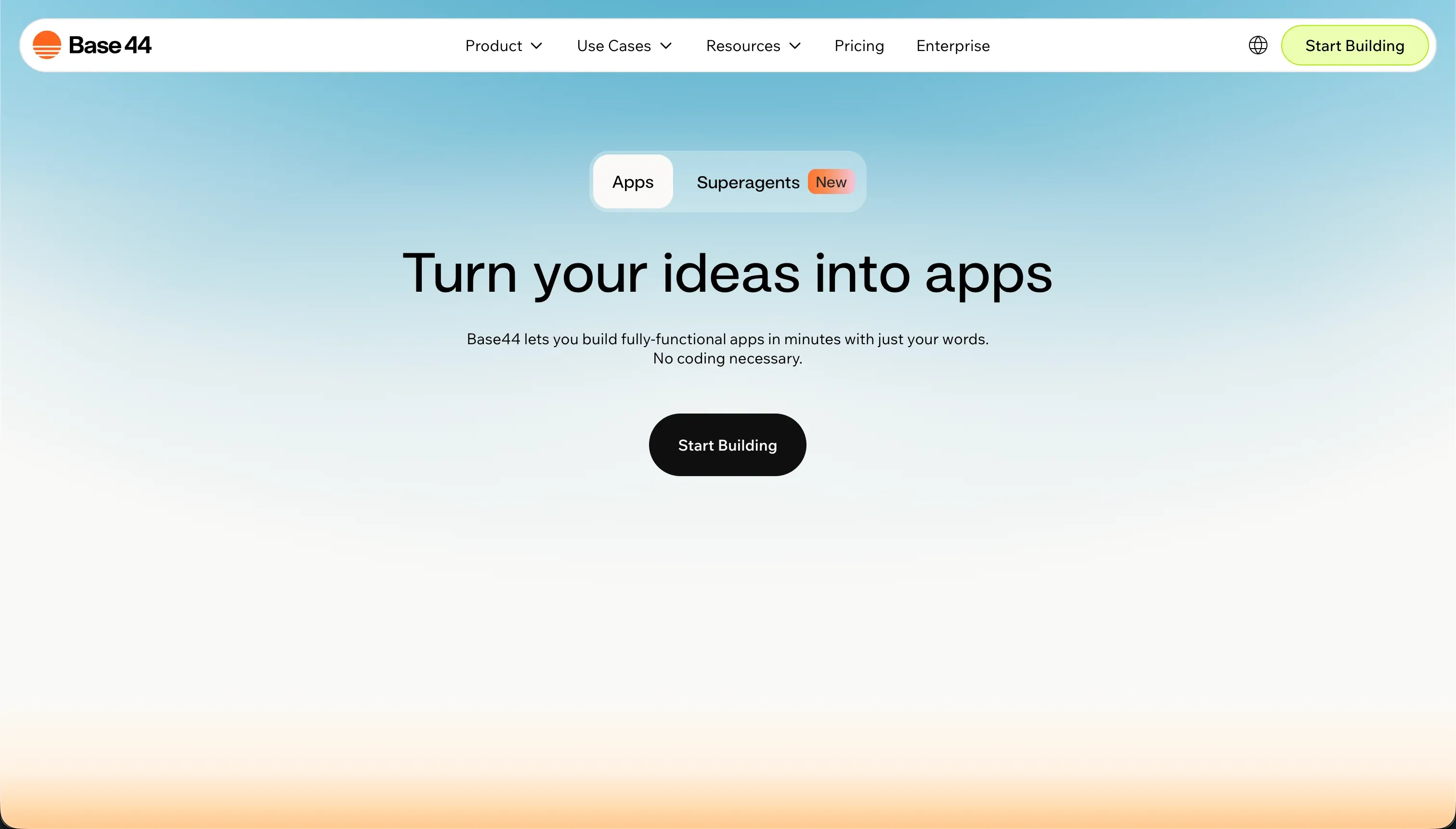
This comparison evaluates two distinct approaches within the emerging vibe-coding landscape: mobile-first native app generation against conversational web app scaffolding.
VibeCode focuses entirely on building native iOS and Android apps from natural language, whereas Base44 generates full-stack web applications, combining a PostgreSQL database, user authentication, and hosting behind a single prompt interface.
VibeCode wins this direct matchup with an aggregate score of 6.1/10 against Base44’s 5.2/10. Because VibeCode supports code export and direct developer access, it avoids the absolute maintainability trap that handicaps Base44. The decision only flips to Base44 if your absolute priority is launching a simple web prototype in under an hour without ever having to touch or understand code.
The decision in 30 seconds
| If your priority is… | Pick | Why |
|---|---|---|
| Native mobile layouts and app store packaging | VibeCode | Optimised specifically for smartphone native outputs and direct publishing |
| Instant conversational web prototyping | Base44 | Scaffolds database, hosting, and frontend from a single prompt |
| Long-term codebase ownership and exit paths | VibeCode | Offers complete code export and direct SSH access on Pro and Max tiers |
| Critical row-level security or custom role controls | Neither | Both rely on raw, unaudited AI-generated code or basic, rigid default models |
| Stable operational business portals or CRMs | Neither | Both risk regression loops or production downtime that fail business-critical workflows |
What each platform is
What is VibeCode?
VibeCode is an AI-powered, mobile-first app builder designed to generate, test, and publish native mobile applications using natural language.
The platform operates on a prompt-based model where the builder acts as a product director, describing features in plain English while the underlying system provisions native mobile layouts, user authentication, a backend database, and cloud storage (VibeCode Cloud).
Unlike traditional web-first builders, VibeCode is explicitly engineered for native smartphone deployment. It includes visual on-device testing and on-device previewing tools, while paid Pro and Max tiers support direct publishing to Apple’s App Store and Google Play, alongside developer-oriented escape routes like code export and direct SSH access to external IDEs.
What is Base44?
Base44 is an AI-driven, full-stack web application builder that scaffolds entire web environments from single natural-language instructions. When a user prompts the AI with an application concept, Base44 sets up user authentication, designs a managed PostgreSQL database schema, programs the front-end layout, and configures hosting in a single autonomous pass.
Once the application is generated, non-developers can refine UI elements using a conversational builder chat or a click-to-tweak visual editor for adjusting spacing, fonts, and colors. The platform targets builders, non-technical founders, and software prototypers looking to deploy immediate minimum viable products (MVPs) directly to the web.
The core difference
The primary dividing line between these platforms lies in their deployment targets and exit strategies: native mobile compilation with standard code accessibility versus conversational web-app generation locked into vendor-controlled database infrastructure.
- VibeCode targets native mobile devices (iOS and Android) and preserves standard development workflows by allowing Pro and Max tier users to export their TypeScript code or edit live via SSH.
- Base44 targets instant, self-contained web deployments, managing all server-side operations and holding the backend PostgreSQL database permanently inside its closed infrastructure.
Where the scores diverge
Maintainability: VibeCode 5.5, Base44 3.5. VibeCode scores 5.5, while Base44 falls to a critical 3.5. VibeCode protects maintainability by offering code exports and direct SSH edit tunnels to Cursor, allowing professional developers to step in when the AI hits a logical ceiling. Base44 locks builders into a conversational prompting environment.
Reviewers describe a severe edit regression loop where Base44’s editing agent introduces several new bugs while trying to resolve a single existing one, draining hundreds of credits in loop cycles without resolving key architectural issues.
Production readiness: VibeCode 5.5, Base44 4.0. VibeCode’s 5.5 comfortably outperforms Base44’s low 4.0. While VibeCode presents risks, such as prompt-generated code containing bugs that can trigger app store rejection without manual audits, it successfully compiles native packages and provisions stable built-in structures.
In contrast, Base44 suffers from severe production instability. Real builders report that Base44 apps frequently break in production for active users, and platform servers go down as often as once a week, making it highly unreliable for projects requiring persistent uptime.
Security & access control: VibeCode 5.0, Base44 4.0. VibeCode secures a 5.0, whereas Base44 stays restricted at 4.0. VibeCode builds basic authentication and user management automatically, but because security logic is written by the AI, it require manual code verification to prevent unauthorized data exposure.
Base44 provides a basic out-of-the-box model, but it cannot be customized. Registration and login screens are locked to rigid default styles, and builders report that the platform lacks the underlying framework required for multi-user data isolation or granular, button-level accessibility permissions.
Data & integrations: VibeCode 6.5, Base44 5.5. VibeCode scores 6.5, outpacing Base44’s 5.5. VibeCode couples its built-in cloud storage with standard API integrations (maps, weather, OpenAI, Gemini) directly metered through raw, un-marked-up AI usage costs. Base44 ships with a managed PostgreSQL engine, but it runs connections through LiteLLM.
This architecture imposes rigid API limits, resulting in significant latency when handling large files or processing PDFs, which limits the platform’s suitability for high-throughput workflows.
Ease of build: VibeCode 7.0, Base44 7.5. Base44 takes the lead here with a 7.5 against VibeCode’s 7.0. Base44 scaffolds a database, auth, and hosting instantly with zero pre-build configurations, allowing non-developers to refine aesthetic tokens with a simple click-to-tweak interface.
VibeCode is also highly efficient, utilizing plain-English prompts for mobile apps and instant on-device previewing, but compiling for mobile devices naturally introduces more deployment friction than publishing to a web URL.
However, both platforms are capped by a complexity wall: when apps expand beyond basic setups, builders on both sides face prompting fatigue as the AI struggles with larger logbooks.
Design flexibility: VibeCode 7.0, Base44 6.5. VibeCode wins this comparison with a 7.0 against Base44’s 6.5. VibeCode generates responsive native smartphone screens easily from prompts and offers an on-screen visual preview, though it lacks the granular, component-by-component widget control found in traditional mobile builders.
Base44 relies on standardized design tokens and a click-to-tweak editor to make styling edits, but critical layouts (such as client login flows) conform strictly to unalterable Base44 templates, limiting professional branding options.
Cost comparison
VibeCode operates on a credit-based consumption model. Paid plans start at $20/month (Plus), rising to $50/month (Pro) and $200/month (Max), where each tier includes a matching dollar-for-dollar allotment of raw API credits used to power GPT or Gemini endpoints with zero markup. This makes your ongoing expenses directly proportional to how much you prompt and how heavily your app utilizes AI features.
Base44 features a complex dual-pricing model. Plans range from $20/month (Starter) to $200/month (Elite) when billed monthly, but they separate your spend into ‘Message Credits’ (consumed when editing your app with prompt loops) and ‘Integration Credits’ (consumed by your end users taking actions like querying the database or sending emails).
Buyers must prepare for highly variable monthly software bills, as recursive debugging loops can rapidly exhaust building credits, while user scale will quickly trigger integration credit overages.
- $20 Plus, $50 Pro, $200 Max
- Dollar-for-dollar API credits
- Powers GPT or Gemini endpoints
- Zero markup on credits
- Cost tracks your prompting and AI usage
- $20 Starter to $200 Elite, monthly
- Message Credits for prompt-loop editing
- Integration Credits for end-user actions
- User actions like queries and emails burn credits
- Overages hit as users scale
Lock-in and the exit path
VibeCode has a clear, accessible exit path on its Pro ($50/mo) and Max ($200/mo) plans, permitting users to download their complete React Native or TypeScript source code and take full ownership of their deployment. Base44 introduces deep vendor lock-in.
While you can export frontend assets to GitHub on the Builder tier, the database schema and backend server logic remain fully trapped within Base44’s closed runtime environment. Leaving Base44 requires a complete, ground-up rewrite of your application and database architecture, making it a high-risk long-term operational choice.
Who should pick VibeCode
Pick VibeCode if:
- Mobile creators who need to build native iOS and Android apps specifically destined for the Apple and Google Play stores.
- Prototypers who require direct code export or external editor access via SSH to co-develop alongside platforms like Cursor.
- Builders looking for a mobile-first utility or lightweight native app with straightforward database and third-party API needs.
Do not pick VibeCode if you are building complex desktop web applications, operational multi-tenant systems, or business dashboards that require precise, pixel-perfect layout control.
Who should pick Base44
Pick Base44 if:
- Early-stage founders needing to assemble a fast, disposable full-stack web MVP to validate a concept over a single weekend.
- Non-technical teams looking for a conversational click-to-tweak experience to build simple, low-traffic web pages without managing server infrastructure.
- Makers on a budget seeking to experiment with postgres databases using a generous free tier that includes basic hosting and authentication.
Do not pick Base44 if your application is intended to run as a reliable, production-grade business where server instability, regression loops, and lacks of data isolation would threaten operational safety.
What neither platform answers
Both compared tools assume the builder wants to manage software environments and code structures, even if they are utilizing generative prompts to execute them. If you are actually looking to deploy a production-grade external portal, employee tool, CRM, or client workspace, both VibeCode and Base44 present severe challenges in stability, performance scale limits, and un-audited database permissions.
For operational software, a business-native platform like Softr represents a significantly safer allocation.
Softr scores 5.5 on database capacity but dominates on production readiness, maintainability, and security & access control because it uses pre-built, SOC 2 compliant security infrastructure rather than letting an AI hallucinate raw code.
Softr allows you to co-build using an AI Co-Builder, but provides visual drag-and-drop handles for ongoing layout edits and precise user permission groups, ensuring your application remains completely deterministic and stable in production. Developers requiring code-first mobile customization should look toward FlutterFlow instead.
Analyst verdict
VibeCode wins this direct head-to-head comparison on the scorecard, securing an aggregate rating of 6.1/10 against Base44’s 5.2/10. While both platforms hit an unavoidable complexity wall when applications scale beyond basic features, VibeCode takes five of the six criteria primarily because its Pro and Max tiers preserve standard developer exit paths with raw code export and SSH access.
Base44 maintains a slight advantage in ease of build (7.5 vs 7.0), but suffers from critical stability limitations. A platform with documented weekly server crashes and recursive bug regression loops is unsuitable for real-world deployments.
VibeCode remains the superior allocation of resources for native mobile prototyping, while buyers looking to build stable, relational business tools should choose Softr instead.
Related reading: the VibeCode scorecard, the Base44 scorecard, and our scoring methodology.