

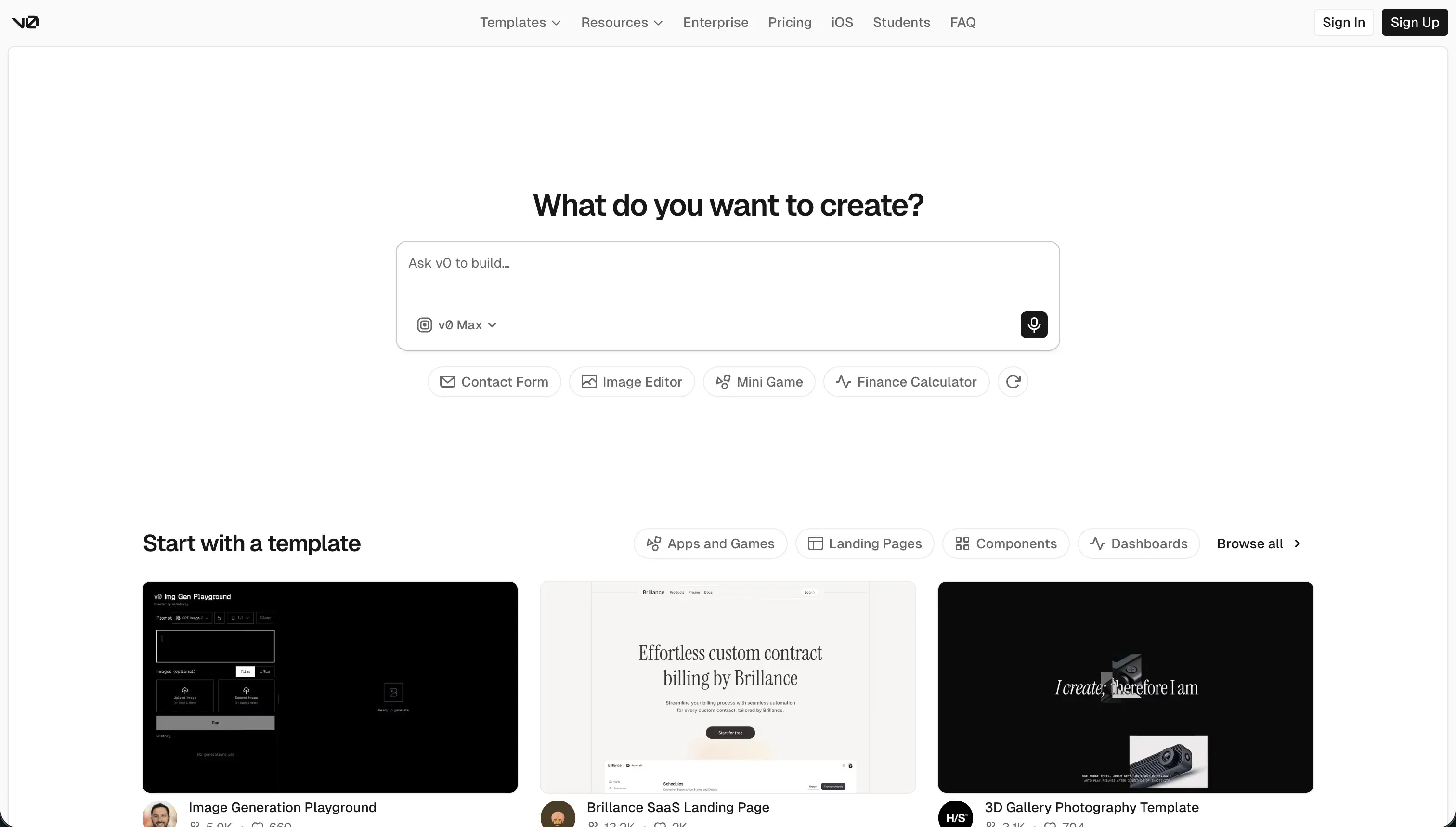
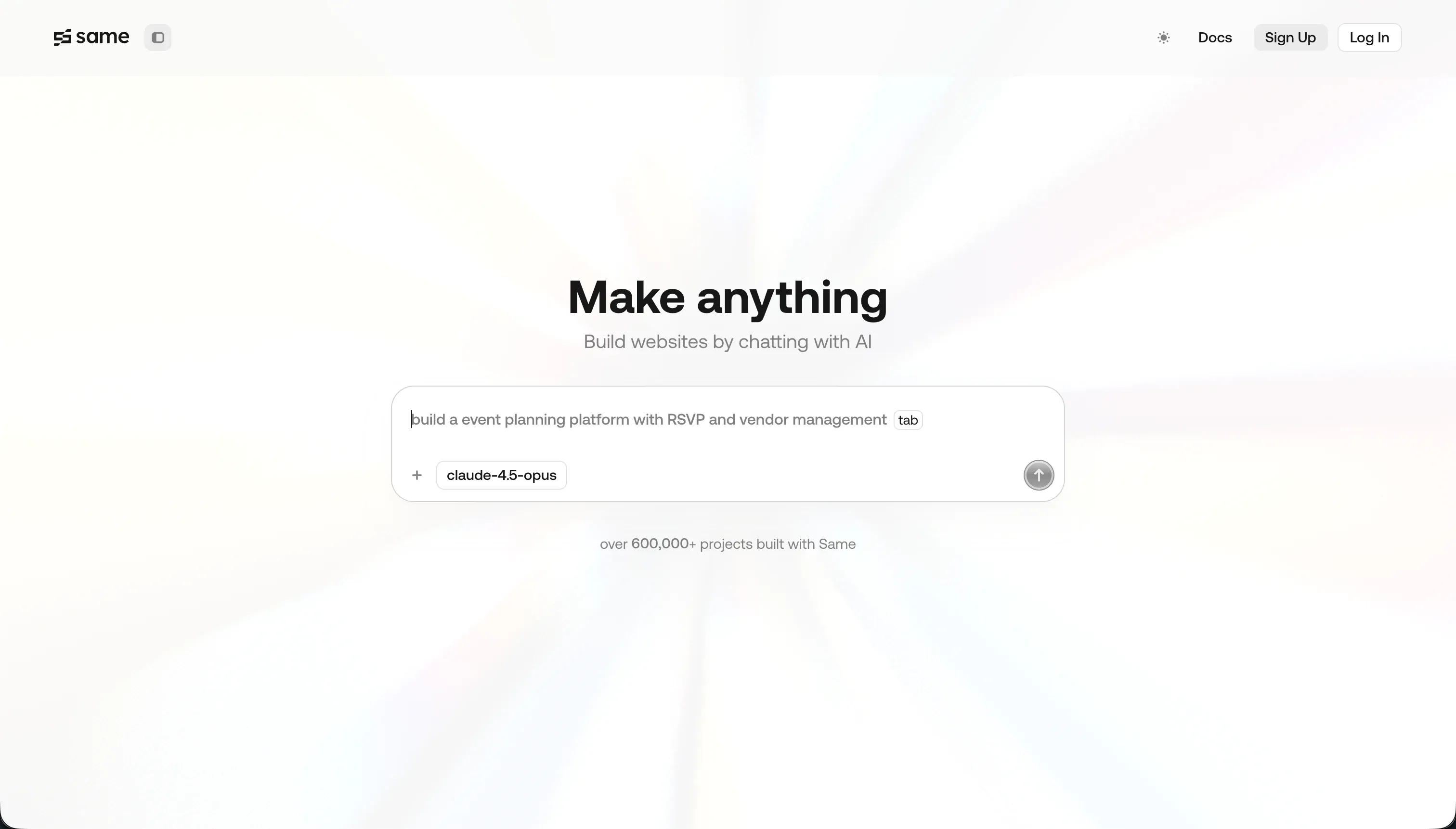
v0 and Same.new solve 2 different procurement problems inside the AI frontend category. v0 is a conversational UI generator for creating and refining React interfaces from prompts, screenshots, and wireframes. Same.new is a visual cloning tool built to recreate existing web layouts from a live URL into editable React drafts.
v0 wins the general decision, 5.8 to 4.1 on our aggregate scorecard. It is the safer pick for teams that care about cleaner output, better workflow integration, and fewer destructive edit cycles. Same.new only flips the decision when the fastest path is copying the look of an existing site as a starting point. That is a narrower buying case than building a maintainable frontend foundation.
The decision in 30 seconds
| If your priority is… | Pick | Why |
|---|---|---|
| Polished React UI built on modern component patterns | v0 | 8.5 for design flexibility with cleaner shadcn-ui and Tailwind output |
| Cloning the look of an existing website from a live URL | Same.new | Its core workflow is URL-to-React visual reconstruction |
| Stable long-term iteration without losing working sections | v0 | 5.5 on maintainability versus 3.0 for Same.new |
| Native backend, auth, and business-app data models | Neither | Both score low on production readiness because neither ships the full stack |
| GitHub sync and standard developer handoff | v0 | It has direct repo sync and fits normal Vercel-centric workflows |
| Fast visual scrapbooking before real engineering begins | Same.new | URL cloning is quicker than prompting from scratch for reference layouts |
What each platform is
What is v0?
v0 is Vercel’s AI frontend generator for turning prompts, screenshots, and wireframes into React interfaces. The build model is conversational: you describe the UI, review generated components, and iterate in chat until the output is ready to export into a developer workflow.
It is built around Tailwind CSS and shadcn/ui patterns, and the research notes direct GitHub sync plus one-click deployment into Vercel previews. That makes it most useful for product teams, designers, and frontend developers who want fast scaffolding and editable code rather than a hosted no-code runtime.
What is Same.new?
Same.new is an AI visual cloning tool aimed at recreating existing websites from a live URL. The build model starts with design capture rather than greenfield prompting: the agent analyzes the target page, generates a React draft, and then lets you adjust the result through follow-up instructions.
The research notes design forking, component duplication, and text-driven visual edits, along with recurring instability during iterative changes. It is genuinely built for designers and prototypers who want a quick layout reference or mockup base, not for teams that need dependable application engineering over many revision cycles.
The core difference
These tools differ most on source of truth: v0 generates from intent, while Same.new starts by imitating an existing interface. That leads to a real tradeoff between cleaner reusable code and faster visual copying.
- v0 turns prompts, screenshots, and wireframes into modern React UI that is easier to carry into a standard frontend workflow.
- Same.new turns live URLs into editable visual clones, prioritizing speed of replication over long-run code stability.
Where the scores diverge
Ease of build: v0 7.5, Same.new 5.0. v0 is easier for most teams because it can move from prompt to usable React components quickly without needing an existing site to copy. Its higher score still includes a deduction because you must wire real data, state, and backend behavior yourself after the visual pass.
Same.new feels effortless when a URL already exists, but that advantage narrows fast once you start asking for deeper changes. Iteration becomes less reliable as layouts get more complex, so the initial speed does not hold through the whole build.
Maintainability: v0 5.5, Same.new 3.0. This is one of the clearest gaps. v0 exports standard React and TypeScript patterns that are easier for developers to inspect, refactor, and move into an existing codebase, though it still gets marked down for bloated Tailwind and code quality drift after many prompts.
Same.new scores much lower because the research notes destructive edits where working sections can disappear during routine changes. That fragility turns iteration into rework, which is exactly what maintainability scoring is meant to catch.
Design flexibility: v0 8.5, Same.new 6.5. v0 wins because it consistently produces polished interfaces in modern React patterns and handles aesthetic iteration better across prompts. The deduction on the higher score reflects that generated UIs can converge toward familiar shadcn-style patterns unless a strong design direction is supplied.
Same.new performs well when reproducing straightforward pages and sections, but it falls off on complex interactive states and high-fidelity custom behavior. Its flexibility is strongest when copying, not when inventing or sustaining a differentiated design system.
Production readiness: v0 4.5, Same.new 3.0.
Neither tool is a complete application platform, so this category stays low on both sides and does not decide the matchup by itself. v0 lands higher because its output fits a cleaner handoff into a real developer stack and Vercel deployment flow, even though it still lacks native backend, auth, and business logic.
Same.new loses ground because it is also frontend-only and the research notes product instability around the Same.dev to Same.new transition. That makes it harder to trust as the starting point for something you intend to ship and maintain.
Security & access control: v0 4.0, Same.new 3.0. The scores are both weak because neither product provides built-in auth, roles, permissions, or a secure server-side runtime. v0 edges ahead only slightly because its output can be folded into a more conventional engineering setup where teams add those controls themselves.
Same.new does not offer a differentiated security model either, so there is no practical reason to choose it on this criterion. For buyers with real access-control requirements, this matchup points outside both tools.
Data & integrations: v0 5.0, Same.new 4.0. v0 scores higher because GitHub sync and Vercel deployment create a more usable bridge into a real development pipeline. That is still a limited win, since it does not come with native relational data modeling, built-in app logic, or deep business integrations.
Same.new remains more isolated: it generates frontend code, but the research does not show a comparable integration path for managing real application data. So v0 wins by workflow fit, not because either tool solves the data layer.
Cost comparison
v0 uses a tiered plan structure with a Free plan capped at 7 messages per day, and higher Team and Business options tied to model usage. In practice, the bill moves with prompt volume and model intensity, so extra rounds of generation and debugging consume more budget.
Same.new is also usage-shaped rather than a simple fixed software seat, with token limits tied to generation activity. That makes both tools more variable in cost than a flat app builder subscription.
The hidden lines are mostly labor. Buyers should forecast developer time to wire backend logic, clean up generated UI code, and fix regressions after repeated prompt cycles, plus any overage or extra token spend caused by regeneration. You should also budget for migration work if a prototype needs to move into a more conventional codebase or a different platform later.
Lock-in and the exit path
Both tools reduce classic lock-in because the main artifact you keep is code, not a proprietary hosted app runtime. v0 offers the cleaner exit because it can sync to GitHub and exports standard React and TypeScript patterns that developers can continue outside the product, even if they still need to rebuild backend services and any missing app logic.
Same.new also lets you leave with code, but the exit is rougher because the value is concentrated in visual clones and iterative prompts rather than a broader engineering workflow. In both cases you can leave with UI code, but anything beyond the frontend must be rebuilt elsewhere.
Who should pick v0
Pick v0 if:
- Frontend teams that want strong visual output first, with an 8.5 score in Design flexibility and cleaner React handoff
- Product managers or founders who need to turn screenshots and wireframes into usable UI quickly without starting from blank files
- Vercel-centric teams that benefit from GitHub sync and direct preview deployment in an existing frontend workflow
- Developers who will own the final app code and want a more maintainable base than Same.new’s 3.0-scored iteration model
Do not pick v0 if you need a complete business app platform with native auth, database modeling, and secure user permissions out of the box.
Who should pick Same.new
Pick Same.new if:
- Designers who want to clone a live site’s layout from a URL faster than rebuilding it by hand
- Prototype teams doing visual scrapbooking where the main goal is reference fidelity, not long-run code health
- Developers who only need a rough React draft of an existing page before rewriting it properly
- Short-cycle concept work where URL cloning matters more than maintainability or production readiness
Do not pick Same.new if the project will go through many revision cycles or you need dependable maintainability rather than fragile visual cloning.
What neither platform answers
Many buyers reading this matchup do not actually need an AI frontend assistant. They need a business app: a client portal, internal tool, or CRM defined by logins, permissions, records, and low maintenance after launch. v0 and Same.new both stop at the frontend layer, so they leave the real application burden on your team.
For that lane, Softr is the better answer because it scores 8.5 on Production readiness, 9.0 on Maintainability, and 8.5 on Security & access control in our research. It is the stronger fit when the job is delivering a secure business app fast, not exporting UI code for engineers to finish.
If you instead need a more custom visual web app with heavier no-code flexibility, Bubble is the more sensible alternative from a different angle.
Analyst verdict
v0 wins 5.8 to 4.1 on aggregate. It takes Ease of build, Production readiness, Maintainability, Data & integrations, and Design flexibility, while Same.new’s only real keep is its specialized advantage in cloning the look of an existing live URL. That makes v0 the better general buy for teams that want a frontend generator they can actually carry into a normal engineering workflow.
The flip condition is narrow but real. If your immediate job is to mimic an existing site visually and get a draft on screen as fast as possible, Same.new can be the better starting tool despite its lower overall score. For anything meant to survive repeated edits, developer handoff, and real project momentum, v0’s cleaner output and stronger scores make it the safer decision.
Related reading: the v0 scorecard, the Same.new scorecard, and our scoring methodology.