

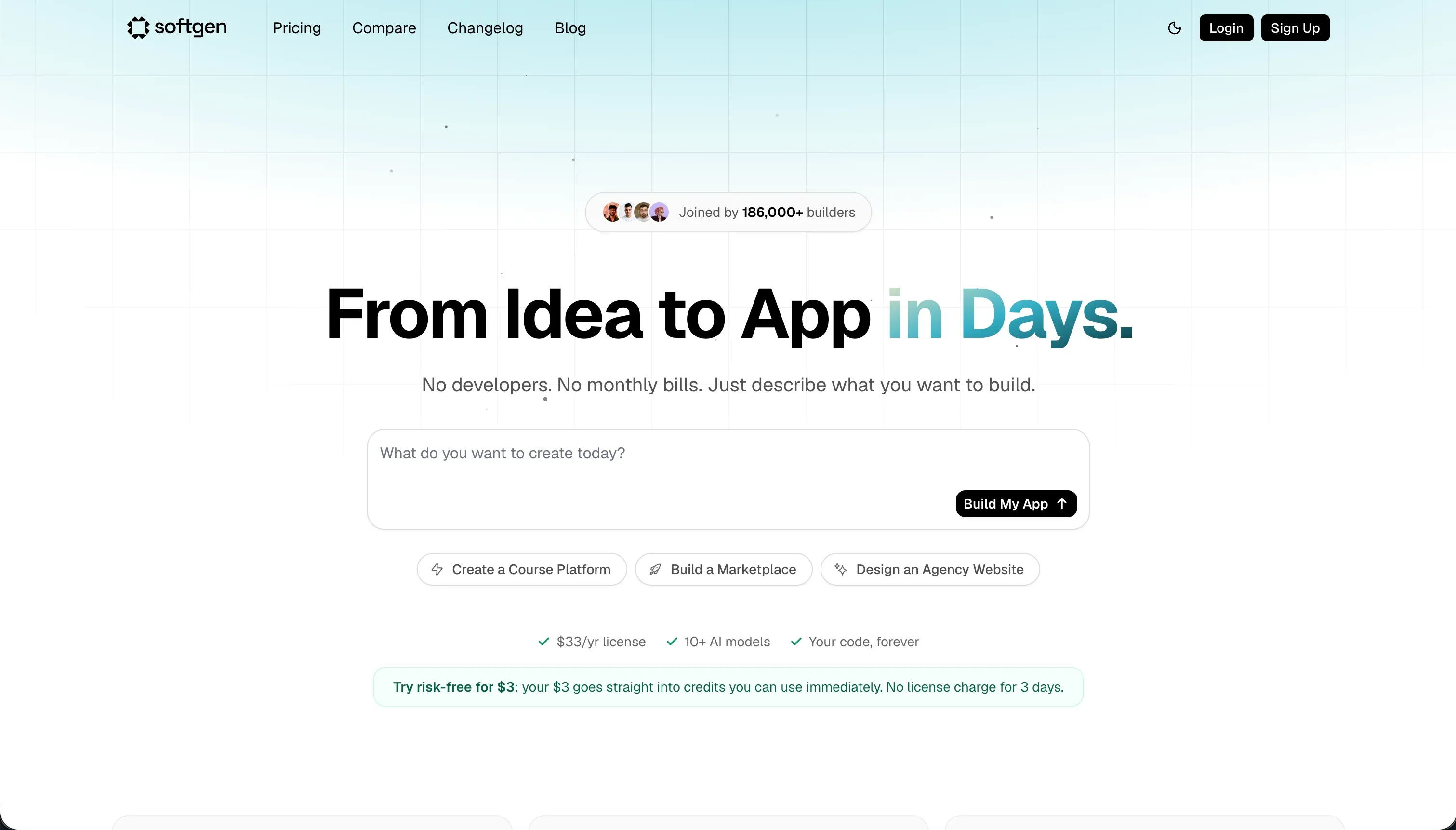
The decision between conversational database assembly and pure frontend visual cloning highlights two distinct paths in generative software procurement. Softgen aims to act as a conversational full-stack engine, converting plain language into hosted business prototypes with native databases, authentication, and simple Stripe payments.
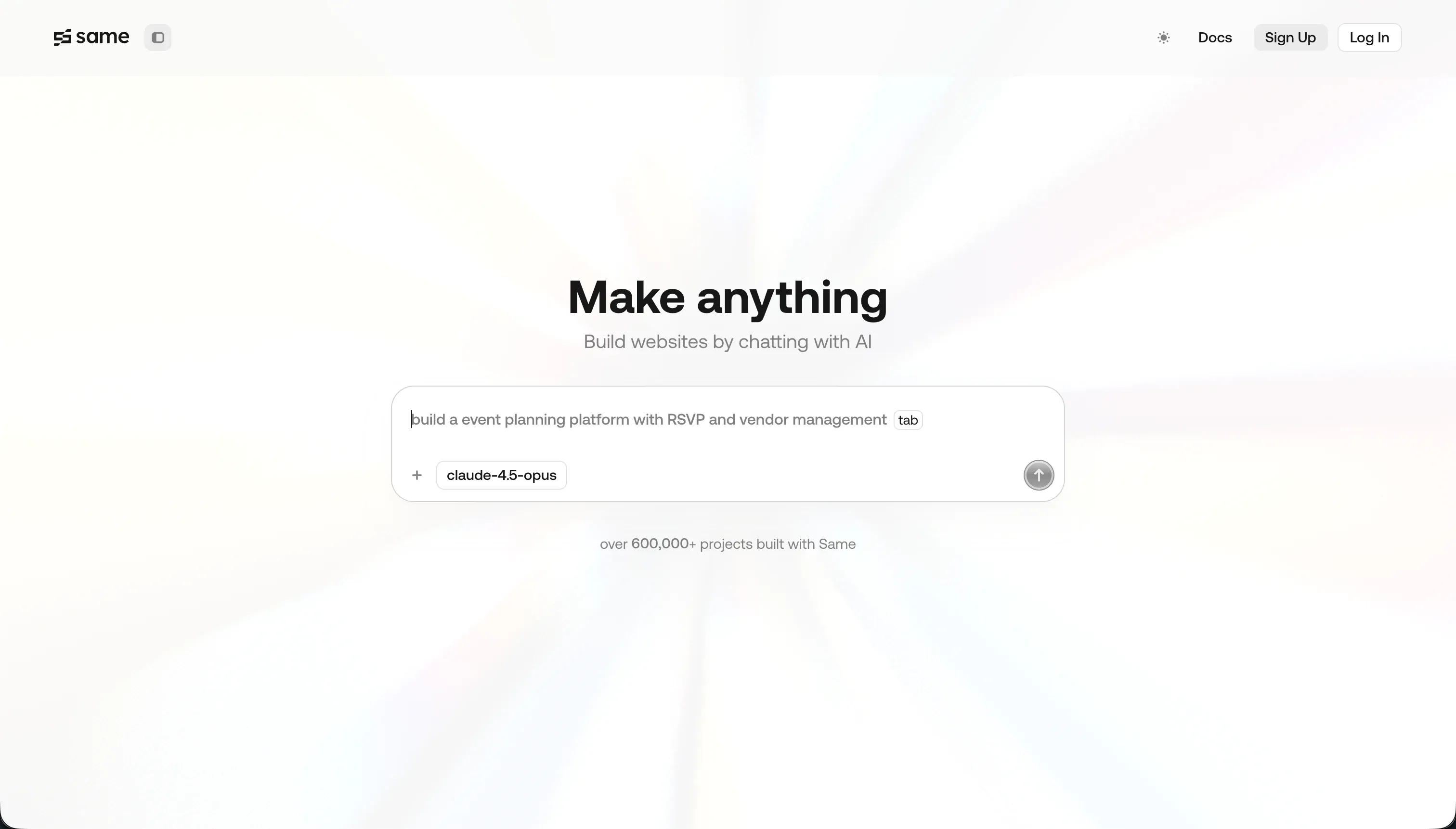
Same.new approaches building from a visual angle, allowing teams to clone live website layouts from a URL into React code for frontend prototyping.
Softgen wins this head-to-head with an aggregate score of 5.1/10 compared to Same.new’s 4.1/10. While both software utilities are in early, fragile phases of development, Softgen’s ability to provision relational databases and authentication out of the box makes it a more viable choice for launching basic transactional pilots.
Same.new remains primarily a design scaffolding tool, limited by its frontend-only architecture and recent system instability.
The decision in 30 seconds
| If your priority is… | Pick | Why |
|---|---|---|
| Rapid full-stack MVP with data | Softgen | Generates database schemas and authentication templates automatically |
| Cloning an existing website layout | Same.new | Generates React and Tailwind scaffolding directly from a live URL input |
| Client portals or internal business apps | Neither | Neither platform provides the granular permissions or enterprise-grade reliability of Softr |
| Predictable long-term maintenance | Softgen | Offers code export as an exit path to avoid terminal prompt-dependence |
| Adding functional billing quickly | Softgen | Ships with pre-built schema integrations for Stripe payments |
What each platform is
What is Softgen?
Softgen is a conversational application builder designed to scaffold full-stack web applications from text prompts. Rather than forcing users to assemble visual blocks or write code from scratch, it relies on its Cascade AI agent to outline, architect, and continuously modify application features via a conversational workspace chat.
The platform is built around an interactive planning flow that maps database schemas before writing code, helping non-technical creators establish relational links early.
It ships with standard pre-configured relational tables, user authentication, and basic integrations like Stripe payments, and permits code export so developers can take absolute code ownership of the React codebase once they outgrow the hosting environment.
What is Same.new?
Same.new, formerly known as Same.dev and Create.xyz, is a frontend prototyping utility built to clone existing user interfaces. By pasting a live website URL into the system, its AI agent clones the visual design, typography, layout, and Tailwind CSS styles, converting them into custom React code that can then be edited via prompts.
The platform features conversational edits for tweaking simple CSS divs and layout sections, alongside a duplicating fork feature for versioning. However, it lacks a managed backend or native hosting database, operating solely as a layout generator meant for developers or designers to export scaffolded frontend code and manually connect it to engineering infrastructures elsewhere.
The core difference
The primary dividing line between these two platforms is the depth of the application architecture they attempt to build.
- Softgen focuses on full-stack orchestration, establishing database tables, user logins, and operational business logic conversational from day one.
- Same.new restricts its focus to frontend design cloning, providing styled interface code that lacks a database or functional backend.
Where the scores diverge
Ease of build: Softgen 7.0, Same.new 5.0. Softgen scores 7.0/10 because its Cascade agent guides the user through an interactive database planning phase before generating layouts, keeping the first build fast and structured for non-technical managers.
Same.new scores 5.0/10; while cloning a website from a URL is initially fast, conversational edits to that cloned code are fragile, and any interactive states require developers to step in and resolve bugs manually.
Production readiness: Softgen 4.5, Same.new 3.0. Softgen’s 4.5/10 reflects its status as an early-stage tool where visual components need more polish, but it offers live hosted deployments and custom domains. Same.new scores a low 3.0/10 because it completely lacks a backend, making it a pure design prototyping tool.
Additionally, paid users reported that the platform’s sudden rebrand to Same.new left older projects read-only or broken, creating operational risks.
Security & access control: Softgen 4.5, Same.new 3.0. Softgen scores 4.5/10 by shipping standard sign-in templates and pre-built login pages, though its internal roles are basic and lack column-level visibility logic. Same.new scores 3.0/10 because it provides no security, user sign-on, or permission settings; any form of credential guardrailing must be custom-developed externally after exporting the React files.
Data & integrations: Softgen 5.5, Same.new 4.0. Softgen scores 5.5/10 as it builds working database schemas, links tables conversationally, and provides basic external processing integrations like Stripe. Same.new scores 4.0/10 because it has no database.
It does not connect natively to enterprise platforms, serving only as a frontend wrapper that developers must connect to secondary platforms like Supabase by hand.
Design flexibility: Softgen 5.0, Same.new 6.5. Same.new wins this single criterion at 6.5/10 because its cloning engine is highly capable of pulling clean CSS, layout patterns, and modern typography off live sites into Tailwind containers.
Softgen scores 5.0/10 because its generative AI is visually rigid, constrained by predefined layout modules where prompt iterations often trigger endless credit-burning styling loops.
Maintainability: Softgen 4.0, Same.new 3.0. Softgen scores 4.0/10 due to the lack of an interactive canvas, forcing builders to return to the chat prompt for every visual change, which is prone to prompting loops at scale. It maintains an exit path via code export.
Same.new scores 3.0/10 because customers report simple prompts frequently destroying working code, including a documented failure where a reorder prompt wiped over 1500 lines of custom React layouts.
Cost comparison
Softgen operates on an annual access fee model paired with pay-as-you-go AI usage credits. For a low base rate of $33/year, creators gain access to the visual studio and basic hosting, purchasing separate credit packages to build and modify software structures.
Same.new transitioned from a pay-as-you-go model ($10 per 2 million tokens) to fixed monthly tiers starting with a $10/mo Pro plan to make token consumption more predictable. Buyers must recognize that both platforms are inherently usage-priced, meaning conversational troubleshooting and layout rebuilding loops can quickly exhaust initial monthly allowances and trigger unexpected billing spikes.
Lock-in and the exit path
Softgen has a clean exit path compared to closed visual ecosystems, offering developers the ability to export the system’s generated React code if their requirements outgrow the hosting bandwidth. Same.new also allows frontend React and Tailwind CSS export, though users complain that exported files often require visual cleanup.
Softgen provides the cleaner exit because it exports a more complete full-stack scaffolding, whereas leaving Same.new is mandatory the second your prototype needs actual backend logic.
- Export the full generated React code
- Includes full-stack scaffolding
- Requirements can outgrow hosting bandwidth
- Exports React and Tailwind CSS only
- Exported files need visual cleanup
- No backend logic export
Who should pick Softgen
Pick Softgen if:
- Indie hackers needing to rapidly scaffold a working database prototype with standard user logins
- Creators who want to generate a simple transactional MVP with integrated Stripe payments
- Builders wanting code export availability to avoid platform lock-in down the line
Do not pick Softgen if your application requires granular, role-based visibility permissions or highly customized, pixel-perfect visual styling.
Who should pick Same.new
Pick Same.new if:
- Front-end engineers looking to quickly clone a styled Tailwind UI prototype from an existing URL
- Designers needing React structure skeletons to serve as early visual layout templates
- Teams seeking a low-cost, disposable staging canvas for basic aesthetic concepts
Do not pick Same.new if you are building an interactive software product that requires a database, payment processing, or secure user authentication.
What neither platform answers
Both tools are built on the premise of conversational code generation, which shifts the developer’s debugging burden onto the non-technical buyer. If your goal is to build a secure customer portal, an internal operations hub, an inventory tracker, or a partner directory, this matchup list is missing the point.
Under-the-hood business logic like session timeouts, password resets, and role permissions should be structured, secure platform features rather than fragile, generated AI scripts that can break during a prompt iteration.
For business-grade applications, a dedicated platform like Softr is the superior procurement choice. Softr scores 9.0 on maintainability and 8.5 on security & access control because it uses pre-assembled, responsive, and secure visual blocks directly connected to Softr Databases, Airtable, or HubSpot.
If your app requires custom consumer logic or native iOS and Android packaging, you should evaluate Bubble or FlutterFlow instead of relying on early-stage visual cloning platforms.
Analyst verdict
Softgen wins this comparison on aggregate, scoring 5.1/10 to Same.new’s 4.1/10. Softgen takes ease of build, production readiness, maintainability, security, and data integrations. Same.new keeps only design flexibility by a margin of 6.5 to 5.0, reflecting its core utility as a visual website cloning machine.
For teams needing to scaffold a functional, transactional MVP with user logins and simple database links, Softgen is the only correct choice here. Same.new should only be procured if your design team requires visual HTML/CSS scaffolding cloned from an existing web page, and has the engineering resources to manually code the functional application elements from that exported visual draft.
Related reading: the Softgen scorecard, the Same.new scorecard, and our scoring methodology.