


Evaluating Retool against Lovable is a study in contrasting developer abstraction layers. Retool belongs to the classic internal dev-tool category, combining visual UI components with handcoded SQL and JavaScript.
Lovable represents the generative AI vibe-coding category, turning natural language prompts into React code and Supabase databases. These platforms serve fundamentally different technical horizons, and a buyer’s score card must reflect that distinction.
Retool wins the overall decision with an aggregate score of 6.8/10 against Lovable’s 5.5/10. For any living business system, Retool’s structured database connectivity and native release environments outweigh the fast compilation loops of generative AI.
The single situation that flips this recommendation is if your team is launching an early prototype where immediate visual scaffolding is valued over long-term database stability.
The decision in 30 seconds
| If your priority is… | Pick | Why |
|---|---|---|
| Fast visual prototype from a text prompt | Lovable | scores 7.5 on ease of build, generating React frontends from conversational text |
| Database connection and real SQL queried directly | Retool | scores 8.5 on data and integrations, natively reading and writing SQL and REST APIs |
| Long-term maintainability without AI regression looks | Retool | provides explicit visual queries and commit history rather than prompt-dependent codebase updates |
| Granular visual security and native SAML SSO | Retool | offers SAML on Business, while Lovable security depends on manual Supabase rules |
| Client-facing portal with predictable flat billing | Neither | Retool’s user seats and Lovable’s prompt-credit inflation make portals expensive and fragile |
What each platform is
What is Retool?
Retool is a visual development platform designed to simplify the construction of internal business utilities, administrative consoles, and database dashboards. Rather than abstracting code away, it structures it, providing an editor where developers write raw SQL queries, coordinate state via JavaScript, and map those logic blocks to over 100 pre-built, data-dense web UI components.
The platform includes its own managed PostgreSQL database alongside a robust workflow engine and custom code-execution consoles. Built primarily for engineers and technical department leaders, Retool relies on standard developer workflows like version control, staging environments, and on-premises deployment options on Enterprise tiers, ensuring changes remain deterministic and auditable.
What is Lovable?
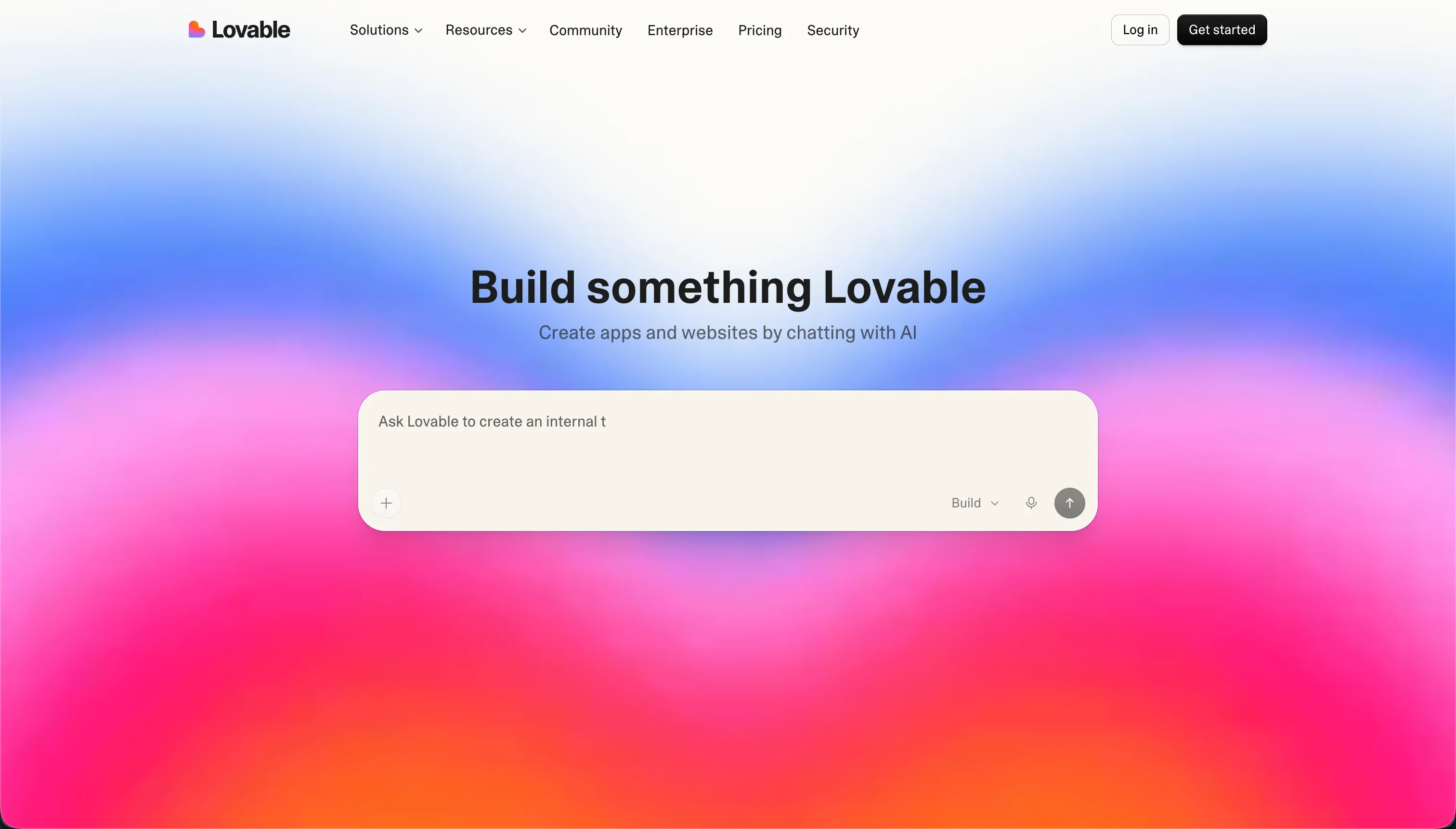
Lovable is an AI-powered conversational application builder that generates standard full-stack code bases from natural-language descriptions. Its model uses generative AI to write real React, TypeScript, and Node.js code, automatically provisioning databases and user directories through an integrated Supabase PostgreSQL backend.
Builders edit applications iteratively through chat dialog. Key features include the ability to import Figma design tokens directly into functioning React components, synchronized deployment code export to GitHub repositories, and automated pre-publish security checks. It is positioned directly for rapid software prototyping, technical founders, and operational teams looking to scaffold software instantly.
The core difference
The division between these two platforms is the difference between visual developer tooling and conversational code generation.
- Retool simplifies developer actions by wrapping standard SQL databases, REST endpoints, and custom JavaScript state in a structured visual component editor that is predictable and deterministic.
- Lovable acts as an autonomous developer agency, interpreting plain text to generate a full-stack codebase that is then compiled and hosted on Lovable Cloud.
Where the scores diverge
Security & access control: Retool 7.5, Lovable 3.5. Retool’s 7.5 score is supported by granular permission configurations on its Business tier, SAML SSO, and strict audit logs. Lovable’s 3.5 reflects that database security relies on Row-Level Security rules in Supabase that the builder must audit and configure manually.
Non-technical prompt engineers have no reliable visual way to verify what data the generated code actually exposes.
Production readiness: Retool 7.5, Lovable 4.0. Retool scores 7.5 due to built-in version control, environment branching, and self-hosting options, though it suffers from non-native external authentication patterns.
Lovable drops to a 4.0 because its database security requires manual configuration of Supabase row-level security, and platform updates frequently break existing code, stalling projects at the final 30 percent of execution.
Ease of build: Retool 4.0, Lovable 7.5. Lovable wins this criterion with a 7.5 because prompt-to-app code generation provides a working first prototype in hours, with Figma imports handling the layout. Retool scores a 4.0 because it is explicitly not a no-code tool: anything beyond a basic table layout requires a developer who knows SQL queries, custom JavaScript arrays, and API schemas.
Maintainability: Retool 6.0, Lovable 3.5. Retool secures a 6.0 because its versioning and visual SQL/JS files are inspectable, matching standard developer workflows as apps grow. Lovable’s 3.5 score stems from its conversational edit model: iteration is prompt-dependent, causing regression loops where fixing one feature breaks another, accumulating deep schema debt in AI-generated databases inside of nine months.
Data & integrations: Retool 8.5, Lovable 6.5. Retool scores an 8.5 on data because it natively queries and edits existing SQL databases, REST or GraphQL APIs, and holds a vast connector catalog.
Lovable scores a 6.5 because while its Supabase integration provides a reliable PostgreSQL backend, connections to external files, enterprise data warehouses, or third-party APIs rely heavily on how correctly you prompt the AI to write custom backend logic.
Design flexibility: Retool 7.0, Lovable 8.0. Lovable scores 8.0 because it generates any React front-end layout you can write or import from Figma. Retool’s 7.0 reflects its data-dense UI component limits. Its components look like administrative software out of the box, and achieving a polished consumer aesthetic requires heavy JavaScript customization.
Cost comparison
Retool is billed on a per-user seat model, starting at $10 per user/mo billed monthly on the Team plan, and shifting to $50 per user/mo on the Business plan. This seat-based pricing makes Retool highly cost-effective for small engineering teams managing back-office utilities, but presents a steep cost curve if deployed for thousands of external customers or client users.
Lovable Pro begins at $25/mo for a base of 100 credits, and its Business tier scales from $50/mo up to over $4,300/mo depending on requested credit scaling. The critical variable in Lovable’s cost of ownership is prompt consumption: because debugging loops and iterative edits consume 3 to 4 credits per prompt, builders can rapidly deplete their monthly credit bounds while attempting to fix compiled bugs.
- $10 per user/mo, Team plan
- $50 per user/mo on Business
- Cost tracks headcount
- Cheap for small engineering teams
- Steep for thousands of external users
- Pro starts at $25/mo, 100 credits
- Business scales $50 to $4,300+/mo
- Debugging loops burn 3-4 credits per prompt
- Iterative fixes drain monthly bounds fast
- Cost tracks usage, not headcount
Lock-in and the exit path
Retool does not offer code export, meaning if you leave the platform, your visual layout interfaces must be completely reconstructed on another builder, though raw SQL and JS queries remain highly portable. Lovable syncs its React and TypeScript codebase to GitHub, which theoretically provides an exit route.
However, long-term builders report that the generated code is highly nested and requires extensive manual development hours to refactor cleanly once separated from the Lovable runtime container.
Who should pick Retool
Pick Retool if:
- Software engineers building internal administrative consoles, business dashboards, or tools directly on top of raw SQL or PostgreSQL databases.
- Enterprise teams requiring SAML SSO, strict manual version control, environment branching, or self-hosted deployment models.
- Organizations where changes must remain highly deterministic, with zero risk of AI hallucination breaking database state.
Do not pick Retool if your goal is to build customer-facing mobile apps, public portals, or software where builders do not know how to write SQL queries and custom JavaScript code blocks.
Who should pick Lovable
Pick Lovable if:
- Startups and technical builders who need to scaffold a rapid, visual prototype or Minimum Viable Product in days to present to initial users.
- Teams planning a clear developer handover in the roadmap, where exporting the initial React frontend from GitHub is highly valuable.
- Interface-heavy projects where Figma design tokens must be directly interpreted into functioning frontends without manual layout building.
Do not pick Lovable for applications that must operate reliably in production for years; the maintenance overhead of managing conversational updates on a compiled code stack is unsustainable.
What neither platform answers
Both platforms assume the application is either a code repository to be managed or a developer-centric console. If your team is seeking to deploy an operational tool, such as a client portal, vertical CRM, or internal tracking dashboard, this comparison leaves you with a difficult choice: you either write custom database queries in Retool, or manage credit-burning code generation in Lovable.
For that operational class of software, a dedicated business app platform like Softr provides a safer procurement fit. Softr scores 7.5 on production readiness and 6.0 on maintainability precisely because its database connections, custom user roles, and login logic are pre-built infrastructure rather than generated code.
Built-in portals with secure user management publish in a fraction of Retool’s setup time, while keeping teams visually in control on a flat billing structure.
Analyst verdict
Retool wins the analytical showdown with an aggregate score of 6.8/10 against Lovable’s 5.5/10. Lovable secures its single victory on ease of build (7.5 vs 4.0), making it an excellent platform for prototyping and quick sandbox mockups.
However, Retool secures every major category needed to run safe software: production readiness (7.5 vs 4.0), maintainability (6.0 vs 3.5), security and access control (7.5 vs 3.5), and data integrations (8.5 vs 6.5).
The choice between these platforms is defined by your project’s timeframe. If you are a startup needing a visually modern SaaS MVP to show investors before handing the codebase to developers, Lovable is a productive, fast compilation accelerator.
For any business-critical utility, CRM, or data management portal that must operate reliably month after month under strict security standards, Retool’s structured developer tooling is the more sustainable long-term asset.
Related reading: the Retool scorecard, the Lovable scorecard, and our scoring methodology.