

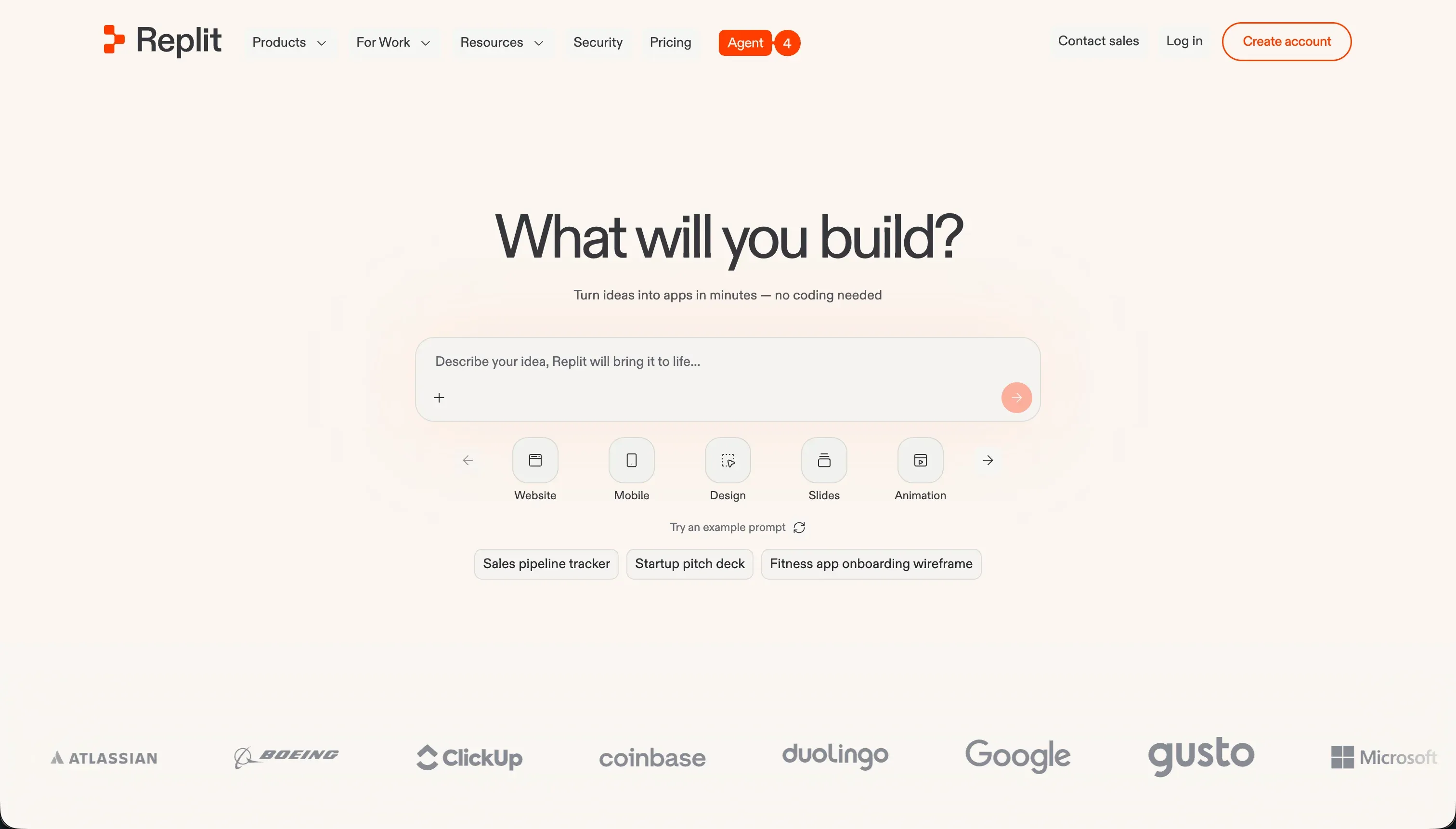
Procuring the right development environment requires choosing between raw code generation and highly structured application assembling. Replit is a cloud-based development environment that supports multiplayer collaborative coding in dozens of languages alongside an autonomous, prompt-driven AI Agent.
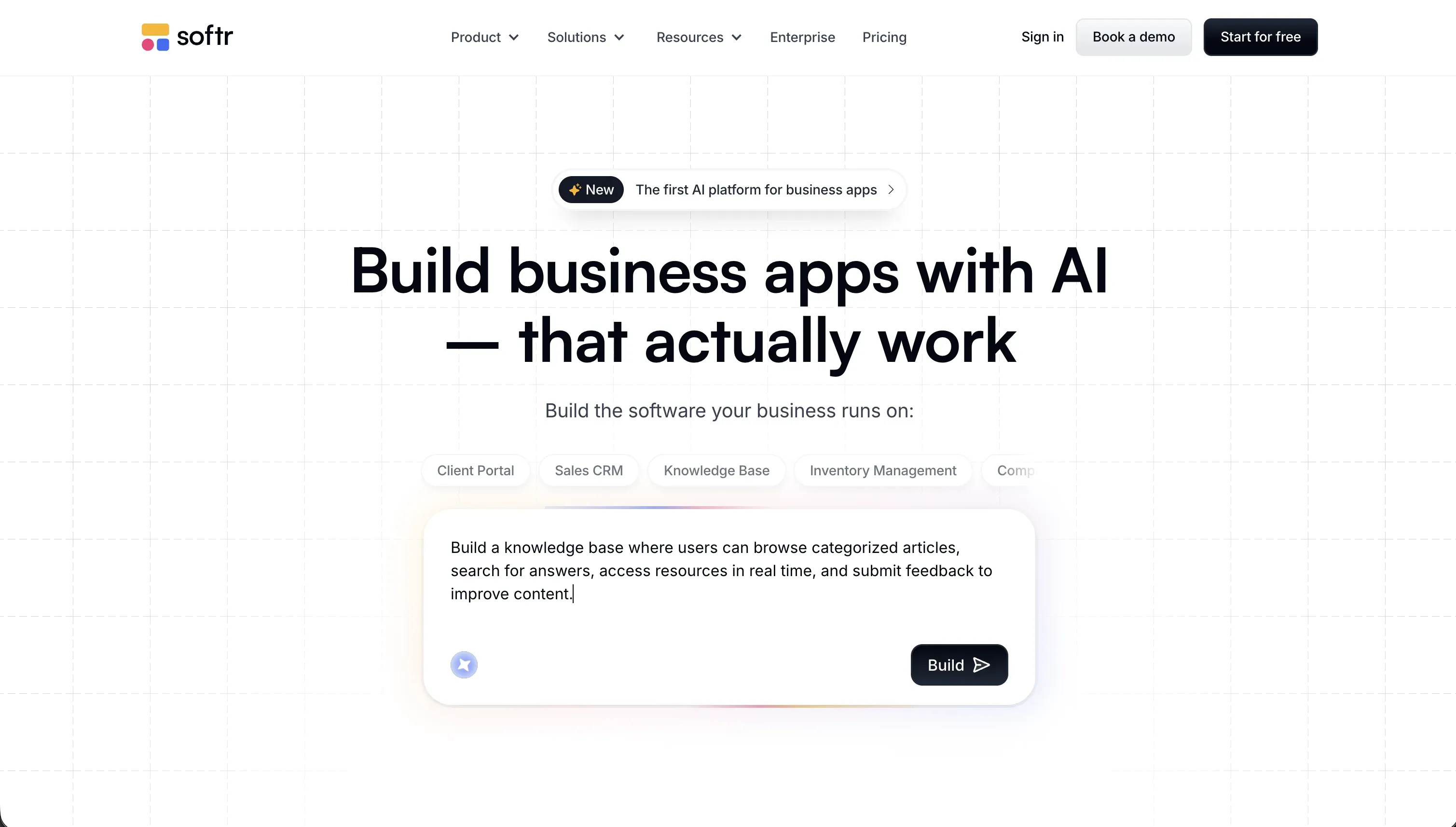
Softr, by contrast, is an AI-powered business application creation platform that helps business operators construct applications through battle-tested visual blocks over native or external databases.
Softr wins the general business-app decision, scoring 8.1 against Replit’s 7.4 overall. Softr represents the safer procurement choice for standard internal operations and client portals because it eliminates hosting setups, database schemas, and permission script writing.
Replit remains the appropriate buy when your team is technical, needs to learn programming, or is launching a fully custom software product that demands actual backend code ownership.
The decision in 30 seconds
| If your priority is… | Pick | Why |
|---|---|---|
| Client portals, internal tools, or CRMs | Softr | All core authentication, user groups, and dynamic layouts are built-in platform infrastructure rather than prompt-generated custom code |
| Full IDE access and multiplayer coding | Replit | Offers a live browser-based workspace supporting over 50 programming environments and active collaboration |
| Pixel-level frontend customization | Replit | Allows developers to build custom frontends and APIs with an 8.5 design flexibility rating free from template boundaries |
| Predictable software spend | Softr | Features flat-rate monthly tiers instead of usage-based container, deployment, and credit billing |
| An exportable application codebase | Replit | Saves real, version-controlled repository code you can host on any public web infrastructure |
| Native mobile apps for App Store distribution | Neither | Neither tool builds fully native mobile packages, pointing buyers instead to platforms like FlutterFlow |
What each platform is
What is Replit?
Replit is a collaborative, browser-based integrated development environment (IDE) that lets users write, run, and host software in over 50 programming languages. Its core feature, the Replit Agent, acts as an autonomous developer, generating entire software structures, database layers, and frontends directly from plain-language prompts.
The AI automatically runs reflection loops to scan its own code for compile errors, apply necessary dependencies, and deploy the application in a single click.
Replit features managed PostgreSQL databases, Git version control, and multi-user collaborative editors with built-in terminals. It is built explicitly for developers, technical founders, and operations managers who want to rapidly prototype SaaS MVPs, build automation scripts, or experiment with custom code without local workspace setups or hosting configurations.
What is Softr?
Softr is an AI no-code app builder designed for non-technical operations teams, business owners, and IT departments who need to build operational software.
Its AI Co-Builder allows users to generate complete applications - including a database schema, navigation menus, user group permissions, and page layouts - from a single conversational explanation. Once generated, users can modify every element manually in a visual editor, eliminating the risk of becoming trapped in endless prompt-regeneration loops.
The platform includes highly secure native Softr Databases, pre-configured connections to external tools like Airtable and HubSpot, and an AI-powered Vibe Coding block for adding secure custom components.
It is built primarily for professional services, real estate, manufacturing, and education organizations needing to digitalize workflows, build client portals, or deploy company intranets without managing technical debt or per-user database seat pricing.
- Browser IDE, 50+ languages
- Agent writes full codebases
- Managed PostgreSQL, Git version control
- Reflection loops and one-click deploy
- For developers and technical founders
- AI Co-Builder from one explanation
- Visual editor, edit every element manually
- Native databases, Airtable and HubSpot links
- Built-in user group permissions
- For ops teams and non-technical owners
The core difference
The fundamental divergence between these platforms is how they resolve application complexity and developer overhead.
- Replit functions as a complete software development space where AI writes, tests, and deploys raw code that the builder must ultimately understand, debug, and maintain.
- Softr operates as an application assembler that packages native, secure infrastructure (like logins and user groups) directly into visual panels, requiring zero system administration or code reading.
Where the scores diverge
Design flexibility: Replit 8.5, Softr 5.5. Replit secures an 8.5, easily outpacing Softr’s 5.5. Because Replit deploys a genuine codebase, developers can craft any consumer-facing frontend, custom workspace, or API layout without template restrictions or interface limitations. Softr is explicitly block-based, prioritizing speed over pixel-level accuracy.
While it features a global theme engine and styling options, plus a Vibe Coding custom block for isolated React objects, the interface boundaries are real and cannot be bypasses for fluid or unconventional web interfaces.
Ease of build: Replit 6.5, Softr 9.0. Softr scores a 9.0 whereas Replit sits at a 6.5. In Softr, the AI Co-Builder assembles pre-built, battle-tested visual blocks and immediately deploys them to a managed web page; any post-build customization is a simple drag-and-drop or checklist configuration.
In Replit, the Agent scaffolds the backend, database, and client files, but it still assumes a baseline understanding of environment variables, secrets panels, and terminal console outputs to troubleshoot silent deploy failures. While Replit is exceptionally fast for a tool that produces raw files, it remains a developer platform at its core.
Security & access control: Replit 6.0, Softr 8.5. Softr scores an 8.5, and Replit scores a 6.0. Replit supports standard auth libraries and managed database systems, but configuring which user roles see which specific records relies entirely on agent-written logic or custom code files.
Softr integrates access control directly into the dashboard: builders toggle Google Login, magic links, or domain restrictions visually, and user groups carry row-level security limits that flow to individual buttons and tables. Softr also includes a direct preview impersonation tool to instantly audit and verify access control settings visually.
Maintainability: Replit 7.5, Softr 9.0. Softr secures a 9.0 for maintainability while Replit registers a 7.5. Softr apps have no underlying code stack for the buyer to babysit; every update is a simple visual edit, and builders can adjust permissions or data rules manually without burning AI credits or risking system-wide crashes.
Replit offers the advantage of exporting real, version-controlled code, but its day-two maintenance requires serious caution. Technical and non-technical teams frequently report running into circular debugging loops where the Replit Agent creates new bugs while trying to fix existing ones, consuming credit plans and introducing technical debt.
Production readiness: Replit 8.0, Softr 8.5. Softr scores an 8.5 while Replit scores an 8.0, making this a highly close baseline. Replit offers exceptional production features like managed PostgreSQL databases with rollbacks, secure secrets environments, and autoscaling containers.
However, its score is slightly degraded by user reports of agent-introduced bugs that require manual rollback and deployment-to-editor discrepancies.
Softr takes the lead because its database operations run entirely on the server side out of the box, and its core portal features - like session management and password resets - are standard platform structures rather than custom code generated on a per-app basis.
Data & integrations: Replit 8.0, Softr 8.0. Both platforms score an 8.0 on digital integrations, representing a functional tie. Replit lets you connect anything that code can reach in over 50 languages, backed by managed SQL databases, though managing schemas requires structured Postgres database expertise.
Softr pairs its high-performance, native Softr Databases with 17+ external connectors like Airtable, Google Sheets, Hubspot, and Notion. Replit remains stronger for custom programmatic webhooks, whereas Softr is the cleaner choice for connecting existing, pre-populated business tools.
Cost comparison
Evaluating total cost of ownership reveals two completely different billing structures. Softr operates on flat-rate monthly plans: the Pro plan is $99 per month (billed annually) for 10 Team and 50 Client app users, and the Business plan is $329 per month for 30 Team and 100 Client app users and advanced SQL connections.
These plans provide absolute predictability for operational budgets because the bill is not structured around server compute time. Credit pools for Softr’s AI exist to limit model access, but running out of credits never halts app operations, as visual manual editing remains fully functional.
Replit uses a usage-based compute and credit structure. Its Core plan begins at $20 per month (billed annually, which includes $25 in credits), while Replit Pro costs $95 per month (inclusive of $100 in credits) with options to pre-purchase larger bundles. AI tasks are effort-priced based on generation complexity and compute runtime.
Reddit reports show that loop debugging errors and automatic database migrations can exhaust daily dynamic balances quickly, occasionally causing unexpected billing overages that buyers must actively manage and budget for.
Lock-in and the exit path
The exit paths for these platforms highlight a core trade-off between deployment freedom and infrastructure speed. Replit offers near-zero platform lock-in; the output is a standard codebase that can be synced directly to GitHub, exported, and self-hosted on Vercel, Supabase, or AWS with zero license dependencies.
Softr holds its builders closer, requiring the interface and user logic to be completely rebuilt if you decide to leave the environment.
However, because Softr supports connecting external database layers like Airtable or SQL, all underlying company data can remain completely separate, allowing buyers to secure clean data portability even if the visual frontend remains platform-hosted.
Who should pick Replit
Pick Replit if:
- Software developers, technical founders, or engineering teams who need an instant-on IDE to spin up SaaS MVPs or specialized APIs
- Teams that require raw code ownership, direct GitHub sync, and the capability to host their applications outside of a single vendor platform
- Builders wanting to construct visually custom consumer frontends with no template restrictions or layout constraints, backed by a managed SQL system
Do not pick Replit if your team is non-technical and cannot read error messages, manage environment secrets, or refactor agent-written code.
Who should pick Softr
Pick Softr if:
- Ops leaders, COOs, and business managers who need to build and deploy client-facing portals, intranets, or internal CRMs without writing code
- IT departments that want to empower other divisions to safely automate workflows and build tools under secure compliance guidelines without introducing shadow IT
- Teams looking for fixed, predictable monthly software bills that do not shift based on server compute time, background scripts, or query loops
Do not pick Softr if your primary project goal requires a consumer product with pixel-perfect layouts, native iOS or Android app store downloads, or an exportable node codebase.
Where neither platform fits
While Replit and Softr provide excellent answers for web-first projects, they do not resolve two specific procurement requirements. If your business depends on building and distributing native mobile applications with native device access and direct Apple App Store and Google Play Store listings, both platforms fall short.
Buyers pursuing these outcomes should shortlist FlutterFlow, which compiles and exports native code specifically designed for mobile devices.
Similarly, if your organization has strict governance policies demanding both complete, self-hosted code ownership and a 100% visual build process without managing servers or typing console scripts, neither platform hits the mark.
Replit provides the code ownership but requires developer-level workspace maintenance, while Softr provides the simple visual designer but holds you to its hosted runtime. Developers needing localized visual IDEs often look toward tools like v0 or Bubble depending on the exact engineering baseline of their team.
Analyst verdict
Softr wins this comparison with an aggregate score of 8.1 to 7.4. It is the superior platform for the majority of business operations, including client portals, directories, internal trackers, and partner CRMs.
Softr takes the lead in ease of build, maintainability, production readiness, and secure access permissions, shifting the technical complexity of software building from the user’s workspace up into platform-managed infrastructure.
Replit remains a formidable tool for technical builders, earning an 8.5 for design flexibility and an 8.0 for data handling. Choose Replit if you have an developer on staff, need a fully custom web application with zero logic boundaries, or require absolute code export and deployment independence.
For standard business workflows, however, Softr represents the more efficient, lower-risk, and faster procurement path to a production-ready system.
Related reading: the Replit scorecard, the Softr scorecard, and our scoring methodology.