

Procurement teams evaluating this matchup face a choice between two entirely different software delivery paradigms.
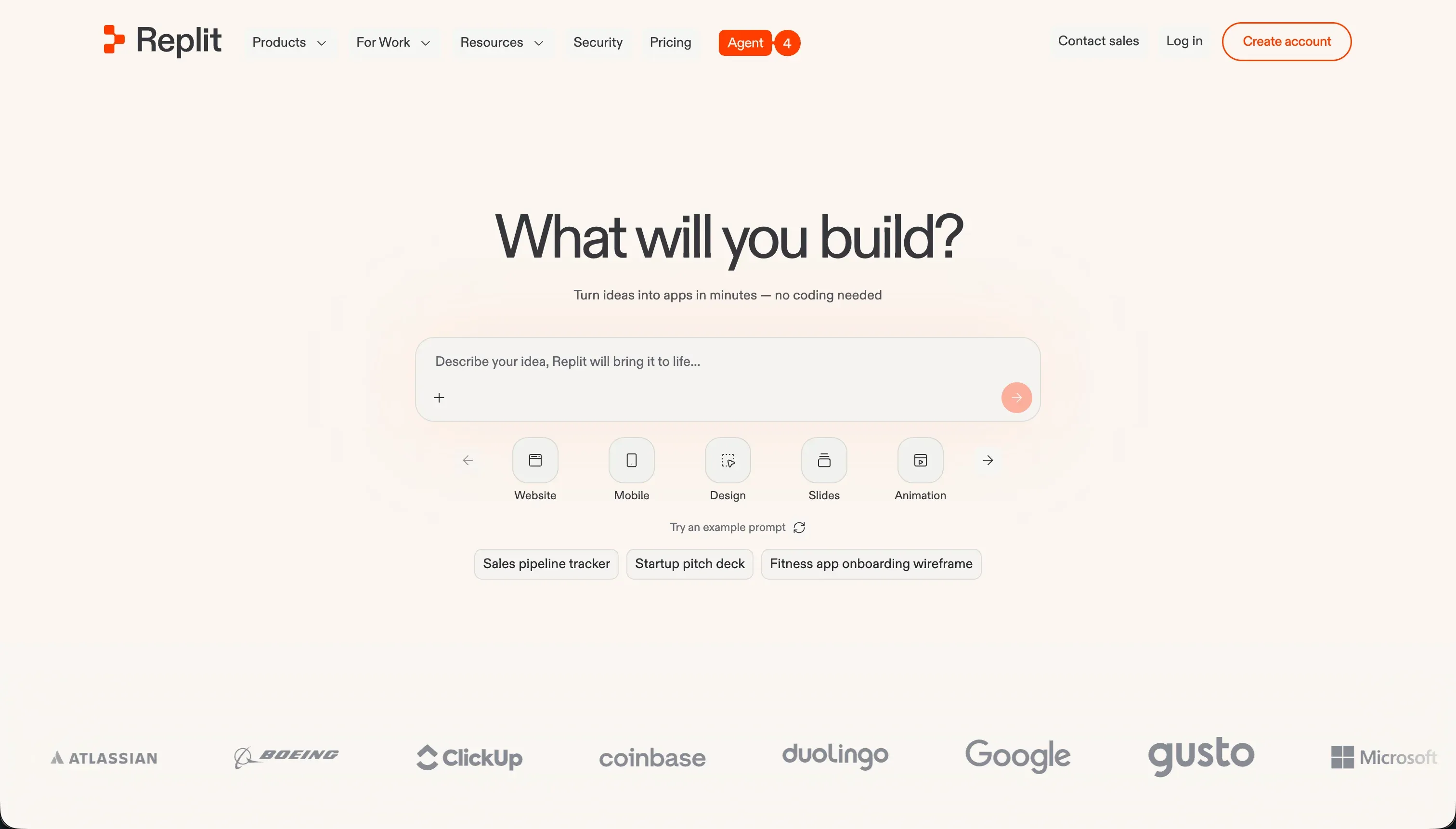
Replit is an autonomous, cloud-based development environment that generates and hosts raw code, whereas flutterflow is a visual integrated development environment (IDE) that compiles drag-and-drop widget layouts into Dart code.
One acts as an AI developer collaborator for multi-language systems, while the other functions as a specialized visual editor for compiling mobile app frontends.
Replit wins the aggregate matchup scoring 7.4/10 against FlutterFlow’s 6.3/10, sweeping the majority of operational and maintainability criteria. The decision flips cleanly for teams tasked with shipping high-fidelity, native mobile applications directly to consumer App Stores.
For that specific, mobile-first design mandate, FlutterFlow’s native widgets represent the more efficient use of engineering effort. Each platform represents a distinct trade-off between flexible raw code execution and visual mobile interface design.
The decision in 30 seconds
| If your priority is… | Pick | Why |
|---|---|---|
| An exportable codebase | Replit | Generates real, multi-language version-controlled code that escapes platform lock-in |
| Native iOS and Android mobile apps | FlutterFlow | Compiles direct visual layouts to native mobile packages with App Store pipelines |
| Operational business portals or internal tools | Neither | A dedicated business platform like Softr reduces the development overhead entirely |
| Managed relational database scalability | Replit | Offers a native managed Postgres database with rollbacks and standard API integrations |
| Extremely fast visual interface creation | FlutterFlow | Provides pixel-level visual control over genuinely native mobile interfaces |
What each platform is
What is Replit?
Replit is an intelligent, cloud-based development environment designed to scaffold, edit, and host software systems in more than 50 programming languages.
Its core driver is the Replit Agent, which acts as an autonomous developer accomplice, translating plain-language prompts into codebase file structures, database schemas, and back-end logic. Users work within an online workspace complete with package managers, shared cursors, custom terminals, and a visual styling editor built over the terminal output.
Replit handles the infrastructure lifecycle by provisioning managed databases (PostgreSQL) with custom domains and auto-scaling deployments. It is built explicitly for software innovators who require full control of a multi-language stack but wish to bypass local IDE configuration and hosting setup. Its focus is functional capability and code execution, rather than template-guided assembly.
What is FlutterFlow?
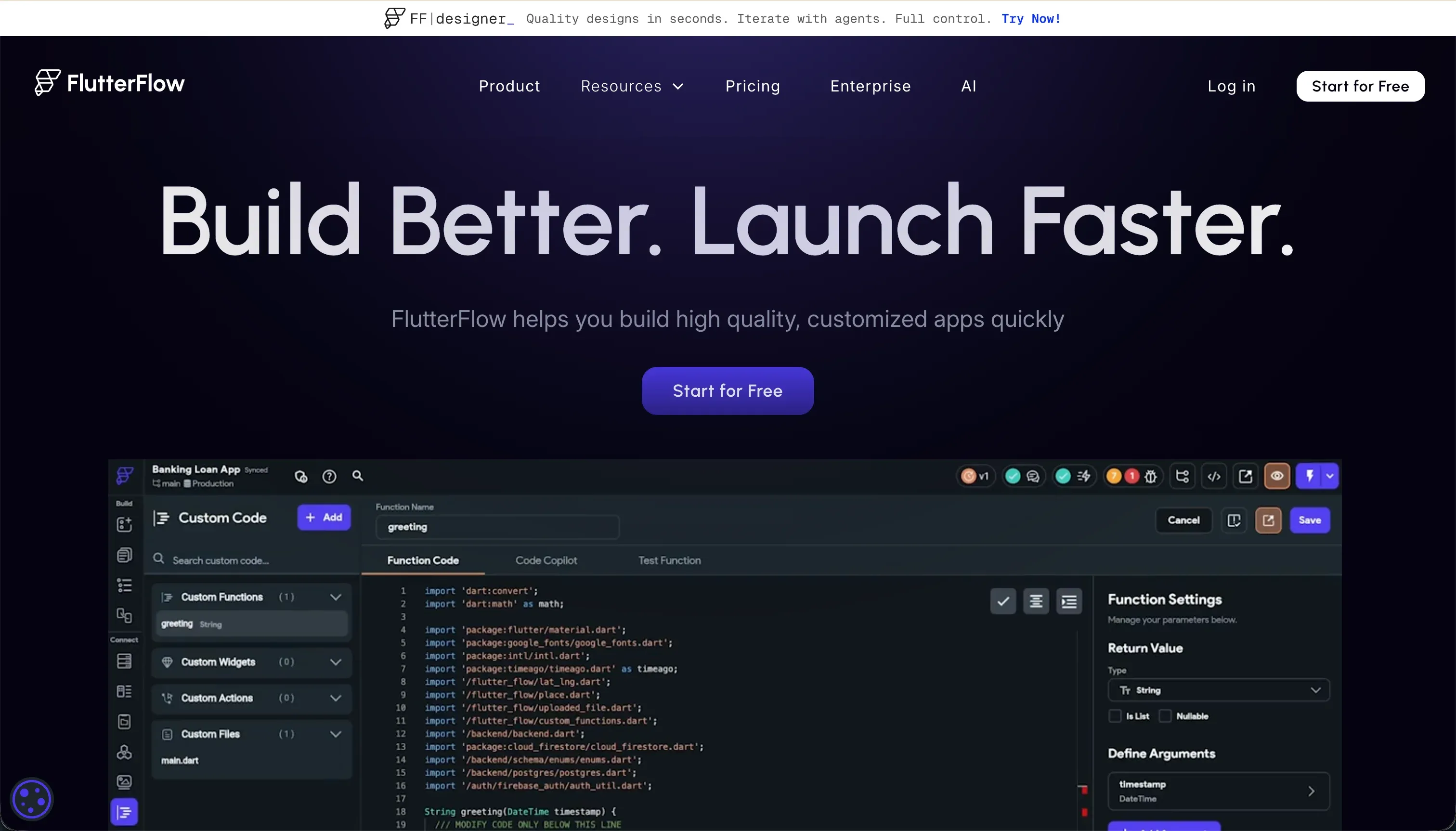
FlutterFlow is a visual, browser-based app builder powered by Google’s Flutter framework, allowing developers to draw interface layouts and export production-ready Dart code. The editor represents interface components as Flutter visual widget trees, including rows, columns, stacks, and containers.
It uses generative AI features to build UI screens, generate custom Dart functions, and structure schemas based on prompt descriptions.
FlutterFlow features natively integrated deployment pipelines that push mobile packages directly to Google Play, TestFlight, and the Apple App Store, alongside standard web hosting. It is built for professional designers, freelancers, and mobile developers who need to speed up the frontend development cycle for Android and iOS devices.
The platform abstracts Dart layout generation without locking the code inside a closed runtime.
The core difference
The fundamental divide between these two tools lies in the way they manage the transition from ideation to finished software system.
- Replit operates as a code-first, autonomous cloud editor where developers guide an AI agent to write, refactor, and self-correct software stored in standard file systems.
- FlutterFlow operates as a visual design IDE that compiles drag-and-drop widget diagrams into Flutter-compatible Dart files.
Where the scores diverge
Ease of build: Replit 6.5, FlutterFlow 4.5. Replit scores 6.5/10 on ease of build by enabling builders to scaffold and deploy live applications from simple natural language prompts in a single environment.
This speed holds a major advantage for developers, though managing deployment errors and configuring environment secrets still demands a technical baseline. FlutterFlow lands lower at 4.5/10 due to a steep learning curve that requires builders to master Flutter layout constraints, state variables, and manual backend connections.
Debugging visual element conflicts in FlutterFlow is difficult, and reviewers write that the editor does not provide useful, actionable error messages.
Maintainability: Replit 7.5, FlutterFlow 5.5. Replit scores 7.5/10 because it writes and maintains plain, standard code files that can be edited by any human developer or moved to another host without any platform platform fee.
A remaining deduction exists for the agent’s tendency to slip into circular debugging loops that rewrite working segments while consuming credits. FlutterFlow scores 5.5/10; while developers can download the Dart files, the visual browser-based editor experiences noticeable latency when the application grows past roughly a dozen interactive screens.
Managing state variable configurations visually also scales poorly compared to standard, text-based code maintenance.
Data & integrations: Replit 8.0, FlutterFlow 6.5. Replit scores 8.0/10 by supplying a managed SQL database alongside a runtime environment that can connect to any API or package reachable in dozens of programming languages. Managing relational schemas still demands database design knowledge, but the architectural ceiling is virtually limitless.
FlutterFlow scores 6.5/10, featuring native templates to link Google Firebase and Supabase with custom REST API builders. Connecting them remains manual and tedious, forcing teams to configure API endpoints and JSON parsing paths by hand.
Production readiness: Replit 8.0, FlutterFlow 7.0. Replit scores 8.0/10 by delivering genuine production-grade hosting infrastructure, including managed PostgreSQL with database rollbacks, auto-scaling web servers, and custom domain configuration.
However, builders report agent-introduced bugs repeating on active projects and discrepancies between the development preview and the live production environment. FlutterFlow scores 7.0/10, featuring native compilation for iOS and Android plus automated pipelines to push builds straight to app stores.
Its deduction reflects a lack of visual automation for backend infrastructure: authentication rules and database access privileges must still be configured directly in Firebase or Supabase.
Security & access control: Replit 6.0, FlutterFlow 5.0. Replit scores 6.0/10 by supporting standard web security libraries and featuring secure environment secret management on its servers.
However, permissions and roles must be written manually into the container’s application logic, requiring managers to read code to audit security rather than verifying it visually. FlutterFlow scores 5.0/10 because it leaves access control entirely to external backend services.
It provides the visual layout variables but obligates the developer to manually write Row-Level Security policies and secure database rules in Firebase or Supabase.
Design flexibility: Replit 8.5, FlutterFlow 9.0. FlutterFlow scores 9.0/10, providing peerless visual layout controls that translate directly to native Android and iOS client interfaces. It is the strongest tool in this class for mobile styling, though its web compile output runs heavily for SEO-indexed public web pages.
Replit scores 8.5/10 because its output is standard code, meaning any UI component a developer can describe or construct with CSS frameworks can be hosted. The minor deduction reflects the lack of structured drag-and-drop canvases for builders who cannot code by hand.
Cost comparison
Replit uses a credit-priced model alongside flat team subscriptions, which makes budgeting difficult to forecast. The Core plan starts at $20/mo annually ($25/mo monthly) and includes a credit allowance, while Pro starts at $95/mo annually ($100/mo monthly) for increased performance, database rollbacks, and team access.
Because AI agents consume variable resources based on task complexity and runtime length, bills can rise rapidly during debugging iterations, and users frequently write about high overages.
FlutterFlow operates on a simpler, seats-based pricing model that does not depend on dynamic runtime compute credits. The Free plan features firebase hookups, while the Standard tier at $22/mo (billed annually) unlocks APK compilation and code downloads.
The Pro plan at $50/mo (billed annually) is required for full code export, App Store deployment, and GitHub pipelines. This model is far more stable for procurement departments, as monthly costs only scale when adding design collaborators.
Lock-in and the exit path
The exit path differs sharply between these two code-centric builders, and both score better on lock-in than visual-only competitors. Replit features a completely clean exit path: because it codes standard applications, you can export your codebase, back up the Postgres SQL database, and host the software on any web server without platform dependency.
FlutterFlow also lets Standard and Pro users export the complete Dart codebase at any time. However, because Flutter Flow’s layout logic is heavily styled using custom layout widgets, the exported code is verbose and structurally complex, which makes it challenging for external developers to refactor by hand once visual synchronization is severed.
- Export the full codebase
- Back up Postgres SQL database
- Host on any web server
- Code is standard applications
- Standard and Pro users can export
- Full Dart codebase export
- Custom layout widgets bloat the code
- Hard to refactor once visual sync is severed
Who should pick Replit
Pick Replit if:
- Teams seeking a single environment to quickly test, write, and launch backend APIs, Slackbots, or custom automation scripts.
- Developers who want a zero-setup browser workspace that can run more than 50 different programming languages collaboratively.
- Founders who need to build complex database-backed applications with structured PostgreSQL storage and custom code flexibility.
Do not pick Replit if you are a non-technical manager who cannot read the code the agent writes, as debugging library conflicts and managing deployment server terminals still demands code-level expertise.
Who should pick FlutterFlow
Pick FlutterFlow if:
- Mobile-first designers and agencies who must publish responsive Android and iOS apps directly to consumer App Stores.
- Front-end developers who want to avoid hand-coding layout margins and padding by drawing the Flutter widget tree visually.
- Teams already using Google Firebase or Supabase as their backend of choice who need a fast native-front-end delivery system.
Do not pick FlutterFlow if you are building an operational database platform, public SEO-friendly portal, or direct internal business workflow tracker, as its compiled web output has slow page load speeds and data integration setups are manually complex.
What neither platform answers
Both of these platforms target systems defined by custom front-ends and code execution, which demands a massive developer workload just to build the basics. If your actual goal is to ship a client portal, customized vendor system, or internal workflow app, both tools will exhaust your budget.
Replit forces you to manage database container secrets and deploy files, while FlutterFlow requires you to configure custom API structures and draft complex layout constraints visually. Neither provides a fast, pre-built operational foundation.
For business-grade portals and internal databases, a dedicated platform like Softr scores 8.0 or higher across production readiness, maintainability, and security precisely because it isolates custom coding from core structural infrastructure.
Softr builds on secure, visual data blocks, pre-configured login systems, and granular user groups out of the box, with flat per-app subscription pricing. For teams that want to build operational portals visually, Softr is the natural path, while builders seeking native mobile app performance can shortlist FlutterFlow.
Analyst verdict
Replit wins this comparison, taking 5 of the 6 criteria with an aggregate score of 7.4/10 compared to FlutterFlow’s 6.3/10. Replit dominates in production readiness (8.0/10 vs 7.0/10), maintainability (7.5/10 vs 5.5/10), and data flexibility, serving as a robust environment for writing and hosting standards-compliant code that will age well over multi-year operational horizons.
The verdict depends heavily on the interface required. Do not invest in Replit if the project is a native consumer tool designed to live on mobile devices, as it cannot compete with FlutterFlow’s native mobile frameworks (9.0/10 on design flexibility).
However, for functional systems, web dashboards, and custom APIs where long-term code independence and structured database rollbacks are required, Replit represents a safer engineering investment.
Related reading: the Replit scorecard, the FlutterFlow scorecard, and our scoring methodology.