

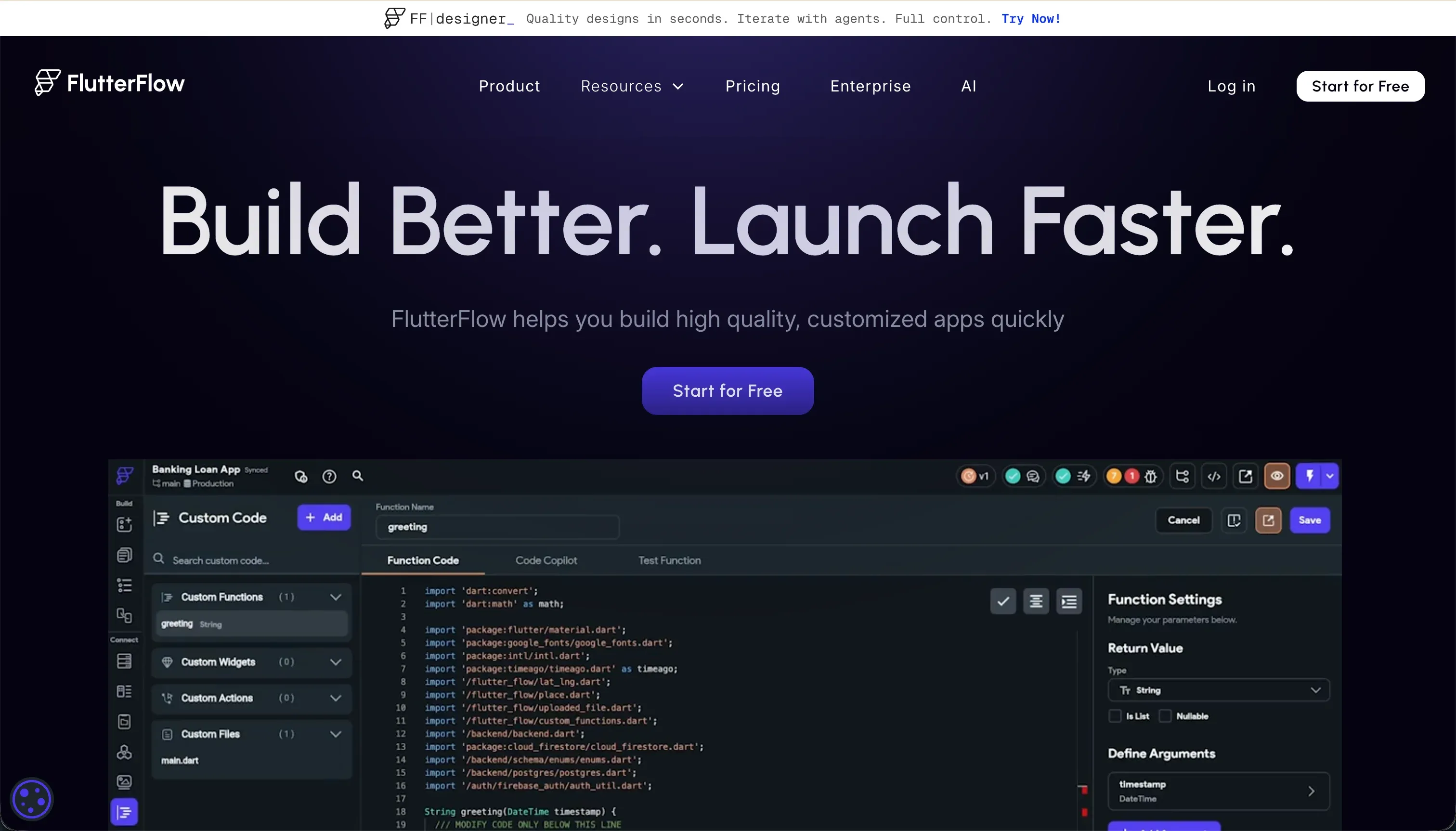
The procurement problem when comparing FlutterFlow and Base44 is choosing between a highly technical visual IDE and a conversational generative builder. FlutterFlow is built for designers and developers compiling native mobile applications directly to App Stores.
Base44 is an AI-powered conversational builder that generates full-stack web prototypes and simple business apps directly from text prompts.
Numbers before adjectives: FlutterFlow wins this comparison with an aggregate score of 6.3 out of 10, compared to Base44’s 5.2 out of 10. The aggregate recommendation only flips if your team has zero development skills, requires an instant web-app mockup from a single prompt, and does not need to support strict multi-tenant raw isolation or deep branding.
The decision in 30 seconds
| If your priority is… | Pick | Why |
|---|---|---|
| Native iOS and Android mobile app compilation | FlutterFlow | compiles to native Flutter (Dart) packages with direct App Store deployment pipelines |
| Speed to a working first-version database web mockup | Base44 | scaffolds a PostgreSQL database, auth, and hosting from a single prompt with zero setup |
| Long-term maintainability without regression loops | FlutterFlow | visual widget trees are edited directly, scoring 5.5 compared to Base44’s 3.5 editing agent |
| Granular user role security and per-user data isolation | Neither | both struggle here, making a dedicated business application builder the correct path |
| Database portability and raw frontend code export | FlutterFlow | provides full Dart code export, whereas Base44 locks database schemas in its backend |
What each platform is
What is FlutterFlow?
FlutterFlow is a visual development environment that compiles directly to native cross-platform code. It maps visual components to Flutter layout trees (Containers, Rows, Columns, and Stacks) and outputs clean Dart files. Instead of abstracting away developer tasks, the platform exposes Flutter’s design ceiling directly to the user.
Key capabilities of the visual editor include visual action configuration for state management, native Firebase and Supabase database integrations, and codeless deployment pipelines pushing binary builds directly to Apple TestFlight and Google Play. It is built explicitly for designers, freelancers, and developers who need to ship genuine native mobile apps without coding the interface manually.
What is Base44?
Base44 is an AI-powered conversational application builder designed to compile full-stack web mockups through plain English text prompts. It coordinates database modeling, frontend layout generation, styling, and hosting in a single autonomous pass. Changes are made either by chat prompting or clicking elements inside a simplified post-generation layout editor.
Key features include auto-provisioned PostgreSQL databases, built-in standard authentication screens, and integrated deployment directly on Base44’s server stack using LiteLLM connections. It is targeted at non-technical builders, operational departments, and founders who want to validate software workflows quickly with minimal initial configuration overhead.
The core difference
The primary operational divide is direct visual configuration of code compared to conversational generation of code.
- FlutterFlow acts as a visual IDE where the builder directly structures the Flutter widget tree and manages states deterministically using standard visual controls.
- Base44 acts as a conversational partner where the builder prompts an autonomous AI agent to assemble, host, and repeatedly modify the code.
Where the scores diverge
Ease of build: FlutterFlow 4.5, Base44 7.5. Base44 wins here due to its prompt-to-app structure which requires zero initial configuration for databases, authentication, or hosting. The click-to-tweak editor handles styling changes instantly, making a functional mockup available to teams in a single afternoon.
FlutterFlow is a developer’s visual tool: it requires an acute understanding of database rules, layout trees, and state variables. Refinement is hard work, and the interface is complex for non-engineers, especially when trying to debug errors without helpful platform messages.
Production readiness: FlutterFlow 7.0, Base44 4.0. FlutterFlow is the superior production container because it compiles cleanly to native iOS and Android binaries. Base44 is highly fragile: long-term builders report its servers going down roughly once a week and production apps breaking for existing users without warning.
One reviewer detailed the platform becoming completely unusable due to destructive updates during iterative feedback loops. FlutterFlow’s primary production deduction stems from its backend overhead: you must handle Firebase or Supabase configurations manually, as the platform does not automate database security rules on its own.
Design flexibility: FlutterFlow 9.0, Base44 6.5. FlutterFlow offers an exceptionally high design ceiling, providing pixel-level control and widget-grade custom styling to build beautiful, native mobile applications. Its layout model has a single weak surface: compiling to Flutter Web can cause slow loading times on SEO-indexed screens.
Base44’s styling uses design tokens and basic token parameters to handle most layout modifications, but authentication screens, core layout boxes, and page margins remain heavily tied to Base44’s default templates.
Maintainability: FlutterFlow 5.5, Base44 3.5. The maintainability scores illustrate the breakdown of conversational code agents versus visual configurations.
FlutterFlow allows direct visual access to the widget tree and exports raw Dart files, keeping a clean escape and editing path open even if the web browser lags while loading projects larger than 12 screens. Base44 relies on an editing agent that frequently falls into regression loops, where fixing one software bug creates several new ones.
Multiple community reviews confirm builders spent hundreds of credits in endless repair loops without overcoming the platform’s architectural constraints.
Security & access control: FlutterFlow 5.0, Base44 4.0. Neither platform provides comprehensive built-in security profiles, but FlutterFlow provides the necessary plumbing to connect reliable external tools.
It relies on manually configured row-level security and authentication rules in Firebase or Supabase, meaning it is secure only if you configure the hosting backends safely. Base44 provides basic role permissions inside its interface but user accounts are not custom-branded, and it is highly limited.
It lacks granular field-level or button-level restrictions, and users report it is completely unsuited for per-user data isolation or true multi-tenant security.
Data & integrations: FlutterFlow 6.5, Base44 5.5. FlutterFlow provides native, deeper support for Firebase and Supabase, plus robust JSON/REST API calls. While set up is manual and complex, it scale-tests reliably. Base44 includes an integrated PostgreSQL database out of the box, but it is deeply locked.
Its backend routines run through LiteLLM wrappers, creating strict database latency, API threshold caps, and a hard limitation when handling documents like PDFs.
Cost comparison
Base44 runs built-in subscription tiers scaling from $20/mo to $200/mo on monthly billing, but introduces a complex dual-credit usage model. Builders consume message credits when they prompt the AI to code or edit UI pages, and users consume integration credits when they perform database actions, trigger webhook tasks, or send emails.
Because every user interaction and debugging iteration runs down your allowance, predicting your software bill is nearly impossible.
FlutterFlow’s pricing is highly flat and predictable, billing $30/mo for its Standard plan and $70/mo on its Pro subscription. It places no limits on runtime user actions, data transfers, or visual edits.
Buyers must instead forecast developer overhead: because of FlutterFlow’s layout logic complexity and lack of native backend support, the true pricing driver is the hours spent manually setting up databases, security rules, and third-party integrations.
- $20 to $200/mo tiers
- Message credits per AI prompt or edit
- Integration credits on user actions
- Every debug run drains allowance
- Bill is nearly impossible to predict
- $30 Standard, $70 Pro per month
- No limits on user actions or transfers
- No limits on visual edits
- True cost is developer hours
- Hours go to databases, security, integrations
Lock-in and the exit path
FlutterFlow features an open exit path: Pro plan users can download raw, production-ready Flutter and Dart source code at any time, eliminating vendor lock-in. Base44 represents a deep lock-in risk.
While frontend pages can be exported to GitHub, the PostgreSQL schema, relational queries, authentication routines, and server logic are completely locked within Base44’s proprietary and unexportable backend infrastructure.
Who should pick FlutterFlow
Pick FlutterFlow if:
- Firms building consumer-facing native iOS and Android mobile software that require direct App Store deployment pathways.
- Development teams that require full source code export (Dart/Flutter) to ensure their mobile application remains highly portable.
- Builders looking to connect scalable and fully customized enterprise databases using manual Supabase or Firebase configurations.
Do not pick FlutterFlow if your team consists purely of non-technical operators and you need a custom web application ready for live users within a single week without setup overhead.
Who should pick Base44
Pick Base44 if:
- Founders who need a fast, functional database mockup to present to potential investors or validate a concept within 48 hours.
- Operations teams looking to test conversational prompt scaffolding without setting up hosting servers, databases, or landing pages.
- Makers on a budget utilizing the free tier to prove basic data connections and run quick user flow simulations.
Do not pick Base44 for production business software requiring strict multi-user data isolation, complex per-user billing, or highly reliable system uptime.
What neither platform answers
Both FlutterFlow and Base44 require you to manage the inherent complexity of raw database schemas and developer logic. FlutterFlow makes you define state management and widget layout structures visually, while Base44 requires you to prompt a generative AI agent to write custom code.
If you are trying to deploy a secure client portal, an internal tool, a vendor directory, or an operations dashboard, this is the wrong shortlist. You will either spend weeks learning developer principles or watch your app break in production through destructive AI updates.
For standard business application needs, Softr is the higher-performing alternative. On our scorecard, Softr rates 7.0 for production readiness and 5.5 for maintainability precisely because core operations (such as secure authentication, user groups, and dynamic permissions) are handled by reliable visual controls, not generated code.
It pairs the speed of its native Softr Databases with granular user group access, letting you deploy a secure, custom-branded business database to production on day one with zero hosting fragmentation. If your team requires a code-first pathway instead, Replit offers a more stable environment for developers.
Analyst verdict
The scorecard is unambiguous: FlutterFlow wins this matchup with an average of 6.3/10 against Base44’s 5.2/10. FlutterFlow takes five out of the six criteria, winning significantly on production readiness (7.0 vs 4.0), maintainability (5.5 vs 3.5), and security. It offers the strongest design ceiling for native mobile apps and provides a clear exit path with Dart code export.
Base44 maintains its single advantage in ease of build (7.5 vs 4.5), which is a genuine asset if you need an instant full-stack web mockup. However, because of Base44’s server instability, regression loop errors, and lack of native SaaS architecture, it cannot be recommended for reliable operations.
If you are building native iOS or Android mobile structures, select FlutterFlow. If you are deploying an internal business application or portal to web browsers, buy Softr instead.
Related reading: the FlutterFlow scorecard, the Base44 scorecard, and our scoring methodology.