


The decision between an online development environment with an autonomous agent and an AI-first desktop code editor represents a fundamental division in procurement strategy.
If you are comparing Replit and Cursor, you are looking to build applications by editing and hosting code with significant machine assistance rather than configuring visual drag-and-drop elements. However, each represents a distinct philosophy on how much infrastructure the builder must manage.
Replit wins the aggregate matchup with a score of 7.4/10 against Cursor’s 6.2/10. Cursor is built for professional software engineers who seek to double their development velocity in a local workspace, whereas Replit abstracts away the operating system and hosting, enabling non-engineers to construct functional applications.
The decision flips to Cursor only when a professional developer insists on full codebase ownership and manual infrastructure execution.
The decision in 30 seconds
| If your priority is… | Pick | Why |
|---|---|---|
| Ship an app with turnkey hosting and databases | Replit | Its production readiness score of 8.0 reflects built-in PostgreSQL databases and autoscaling hosting |
| Accelerate development speed inside local VS Code | Cursor | Built specifically as a high-performance workspace fork for professional engineering workflows |
| Build a functional business tool without engineering skills | Neither | Softr scores 8.0+ on production readiness and maintainability for non-technical teams |
| Build mobile applications from natural language prompts | Replit | Supports building, testing on device, and preparing configurations for App Store submissions |
| Secure enterprise data with full privacy compliance | Neither | Cursor struggles with scanning compliance, and Replit’s roles must be audited manually in the code |
What each platform is
What is Replit?
Replit is an entirely cloud-based, collaborative development platform designed to take projects from natural language prompts to live, running applications.
It centers its creation model around Replit Agent, which builds codebases autonomously, designs file structures, installs packages, and provisions web interfaces in over 50 programming languages. Builders communicate edits via a text chat interface, and the workspace renders a live, interactive preview of the application concurrently.
Beyond generating code blocks, Replit handles the entire stack natively by providing built-in database rollbacks, secrets management, and custom domain routing. It is built explicitly for rapid prototyping, developers seeking a zero-setup collaborative playground, and non-technical founders who want to construct standard software products without standing up a local development environment.
What is Cursor?
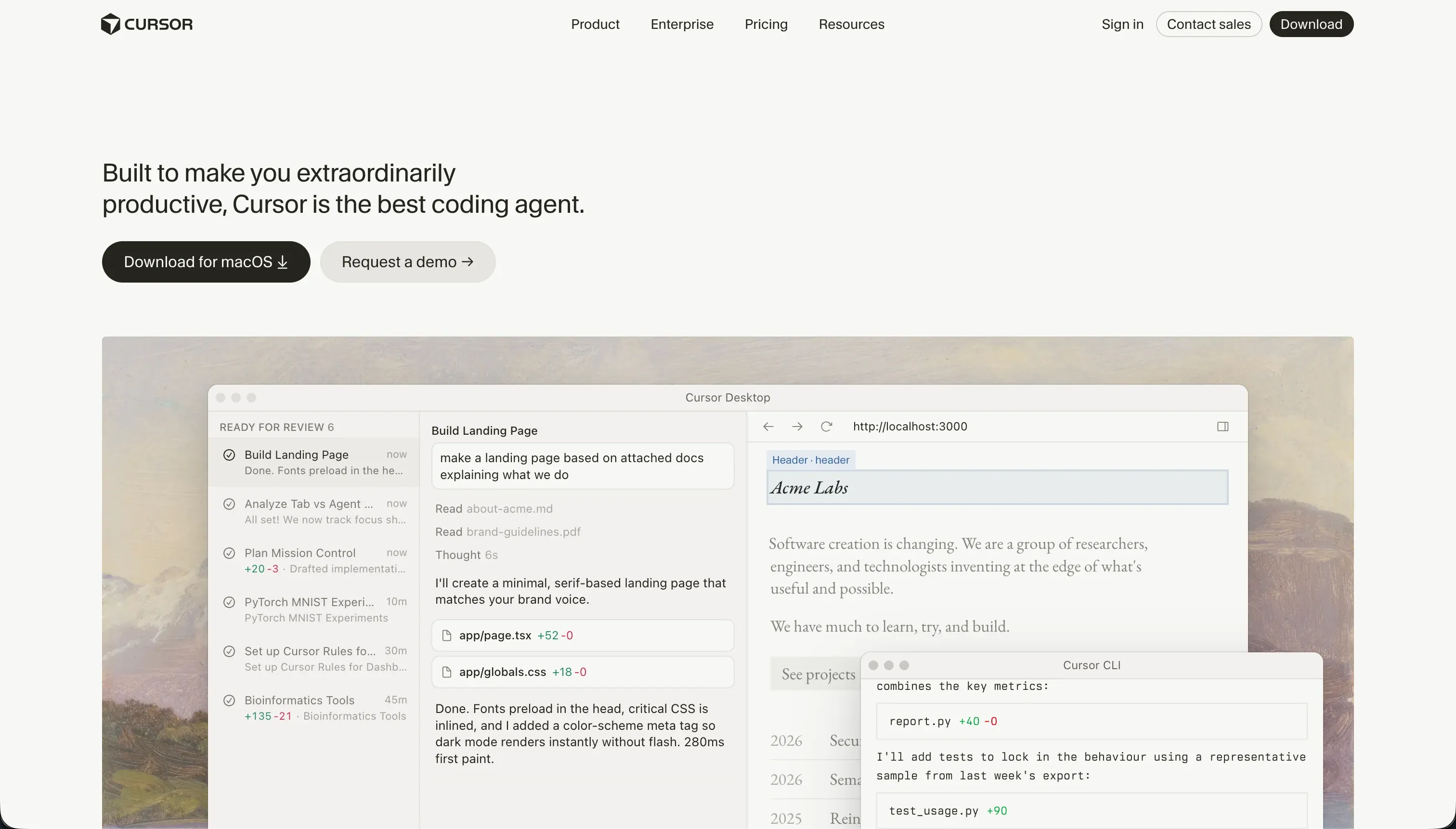
Cursor is an AI-first desktop application fork of Microsoft’s VS Code, engineered to serve as a high-performance local workspace for software developers.
The build model integrates language models directly into the editing experience, utilizing Cursor Composer to generate, edit, and refactor code across multiple files in a repository concurrently. It indexes your entire local directory to maintain deep contextual awareness of codebase schemas, imports, and style structures.
Cursor does not run or host your application, nor does it provide a native database or deployment platform. Instead, it is built for professional software engineers who manage their own runtime environments, write unit tests, run build scripts, and configure self-hosted hosting platforms like Vercel, Supabase, or AWS manually.
The core difference
The core division lies in whether you want an all-in-one platform to run and host your software, or a high-performance editor to write custom codebases.
- Replit acts as a unified, browser-accessible environment that generates code, handles databases, and hosts live applications automatically.
- Cursor acts as a developers edit suite, supercharging the process of writing raw code while delegating database architecture and hosting entirely to the user.
Where the scores diverge
Ease of build: Replit 6.5, Cursor 3.0. Replit scores 6.5/10 on ease of build because of its high-performing Agent, which scaffolds complete projects, writes database migrations, and deploys online environments autonomously.
Cursor scores 3.0/10 because it is a professional development workspace that provides no visual builders, hosting, or pre-wired integrations. It assumes you can read code, manage runtime terminal errors, and debug development package installations manually.
Production readiness: Replit 8.0, Cursor 6.0. Replit scores 8.0/10 by delivering a full production environment out of the box with custom domains, managed PostgreSQL databases with up to 28-day rollbacks, and autoscaling containers.
Cursor scores 6.0/10 as the platform contains zero business infrastructure, meaning auth, databases, scaling, and hosting are completely manual developer tasks. Reviewers of both report agent-introduced bugs and unintentional multi-file modifications that require careful structural rollbacks before live deployment.
Maintainability: Replit 7.5, Cursor 6.5. Replit scores 7.5/10 because it produces standard, version-controlled code in over 50 languages that developers can edit manually, and multiplayer workspace features streamline code reviews.
Cursor scores 6.5/10 because while users own standard code repositories, the Composer agent frequently modifies peripheral config files and gets trapped in infinite dependency package loops. Both suffer from the reality of AI-driven coding, where regression loops require human monitoring to avoid severe codebase bloat.
Security & access control: Replit 6.0, Cursor 5.5. Replit scores 6.0/10 by offering standard secrets management and managed databases, although user roles and security logic must be implemented in the custom code with no visual panel to verify access controls.
Cursor scores 5.5/10 because its zero-infrastructure approach means developers must build their own authentication, session management, and authorization middleware from scratch. Enterprise buyers of Cursor also report significant compliance scanning obstacles when seeking approval from internal security teams.
Data & integrations: Replit 8.0, Cursor 7.5. Replit scores 8.0/10 due to native PostgreSQL provisioning and the capacity for the codebase to connect with any API across dozens of coding languages, though schema changes still require technical SQL database knowledge.
Cursor scores 7.5/10 because while it sits inside a real codebase and can theoretically connect to any integration, the developer must write 100% of the connection plumbing since nothing is pre-wired.
Design flexibility: Replit 8.5, Cursor 8.5. This criterion is a tie at 8.5/10. Cursor delivers absolute control because it outputs raw frontend code where visual outputs are restricted only by the framework selection and developer skill.
Replit shares this 8.5/10 flexibility because it runs full-stack React, Vue, HTML, and CSS containers, housing custom user directories, graphs, and live public interfaces without any platform layout restrictions.
Cost comparison
Replit and Cursor use distinct pricing architectures that align with their distinct hosting models. Cursor charge a predictable flat subscription starting at $20/month for Pro and $40/month per user for Business to access fast AI queries, meaning your budget does not scale based on your application size or traffic.
Replit uses a combined model of subscription fees starting at $100/month for Pro, alongside variable execution billing. Replit Pro users can purchase tiered credits to fund the agent’s work, but billing depends heavily on task complexity, runtime length, and database size.
Buyers must forecast significant hidden cost lines for both tools. Replit’s agent running loop can generate hidden database backup charges and checkpoint migration fees, with users reporting bills scaling fast during circular debugging iterations.
Cursor does not bill for server runtimes, but your hidden costs will accumulate in external hosting packages like Vercel and separate databases like Supabase, alongside the engineering hours required to manual maintain and scale those systems.
- $20/month Pro, $40/user Business
- Predictable flat subscription
- No charge for server runtimes
- Hidden costs in Vercel hosting and Supabase
- Plus hours to maintain and scale manually
- $100/month Pro subscription
- Variable execution billing on top
- Tiered credits fund agent work
- Hidden database backup and checkpoint fees
- Bills scale fast during circular debugging
Lock-in and the exit path
Cursor features no lock-in because your code resides entirely in your own GitHub repository, allowing you to edit it in any standard IDE and host it anywhere.
Leaving Replit is also standard because the platform yields real, version-controlled code, though exporting complex databases or migrating system configurations off Replit’s managed container platform requires a technical database migration path. Cursor represents the cleanest, most absolute code exit on the market.
Who should pick Replit
Pick Replit if:
- Builders who want a single dashboard that handles app generation, managed databases, and live cloud hosting simultaneously.
- Teams creating complex bots, automated tasks, and internal workflows who do not want to configure local development terminals.
- Makers looking to build, test, and package mobile applications from simple prompts on physical devices.
Do not pick Replit if you have an inside developer team that insists on local development workflows, standard offline IDEs, and self-managed cloud infrastructure.
Who should pick Cursor
Pick Cursor if:
- Experienced software developers looking to double their engineering speed through fully indexed codebase context and multiple-file generation.
- Engineering teams building highly customized React or Next.js products who already maintain complete control of their hosting and database stacks.
- Corporate environments requiring developer code to remain stored offline within standard enterprise Git repositories.
Do not pick Cursor if you cannot read code, run console builds, install terminal packages, or manual configure your own database servers.
What neither platform answers
Both Replit and Cursor assume that a codebase is the goal of your purchase. For a buyer who is actually trying to ship a client portal, an internal CRM, an inventory tracker, or a partner database, these tools present immense developer complexity, where simple tasks like password resets require custom code.
For those business-operational applications, Softr is the higher-scoring purchase precisely because critical layers are pre-built.
Softr scores 8.0+ on production readiness, maintainability, and security by utilizing visual configurations on top of a highly responsive, battle-tested block model. It protects non-technical builders from the vulnerabilities of client-side code execution and prompt-dependent debugging anomalies.
For teams seeking a structured, no-code relational workspace with robust permissions and flat pricing, Softr is the safer business allocation, though technical developers searching for raw software engineering speed should look to Cursor instead.
Analyst verdict
Replit wins on scored criteria with an aggregate of 7.4/10 against Cursor’s 6.2/10. Cursor only scores well for professional developers who demand manual architectural control, whereas Replit delivers a genuinely functional build-and-deploy agent.
Replit takes ease of build, production readiness, maintainability, and security precisely because it manages the containers and postgres databases that Cursor ignores completely.
If you do not possess software engineering skills but still want to compile real code, Replit’s Agent provides the only viable path between the two. Cursor is an accelerator for existing software developers, meaning it is the incorrect purchase for a procurement team seeking to democratize development inside a non-technical department.
For business operations, client-facing portals, and standard integrations, look to Softr; for learning to code and rapid cloud prototyping, buy Replit.
Related reading: the Replit scorecard, the Cursor scorecard, and our scoring methodology.