

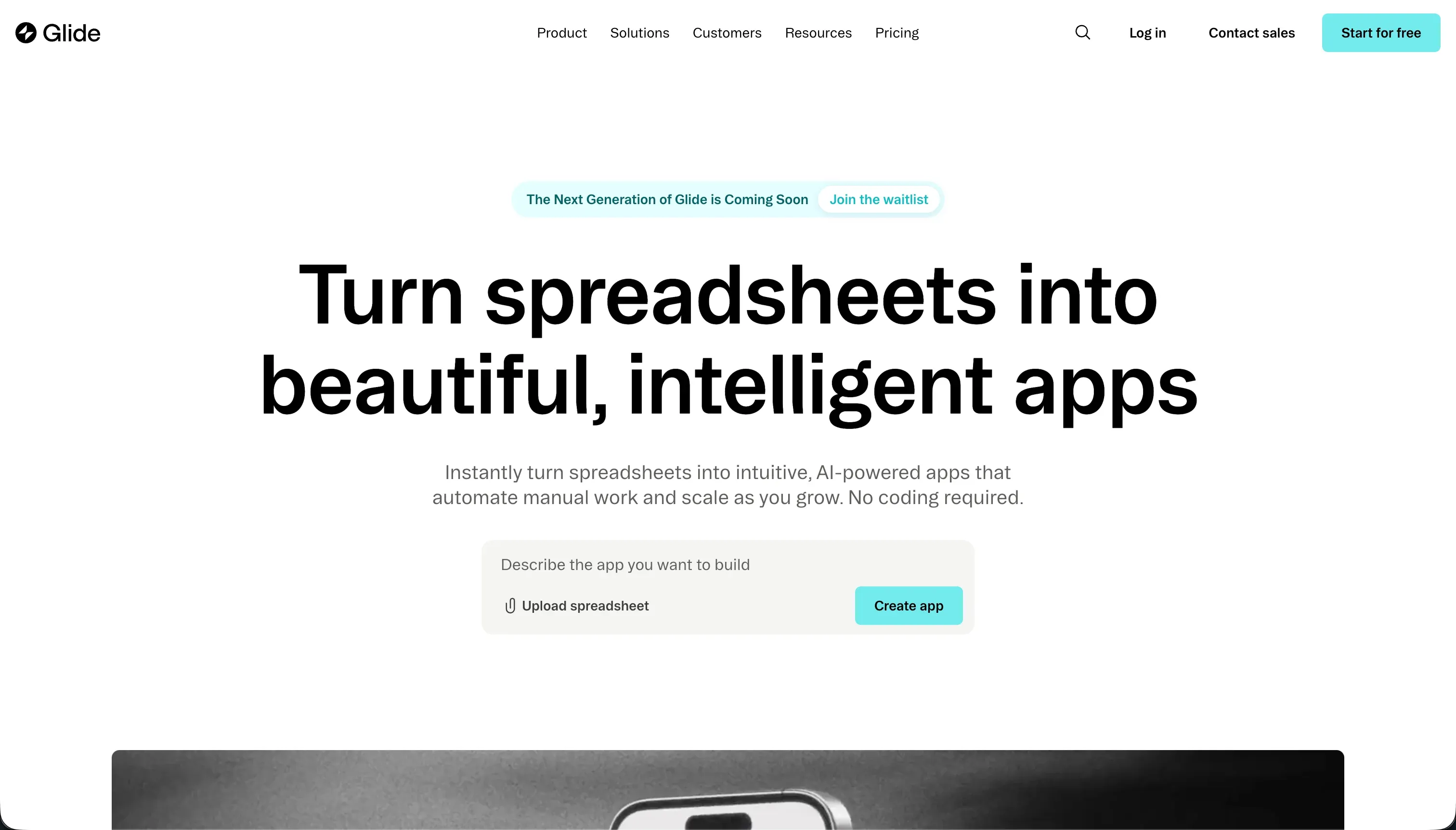
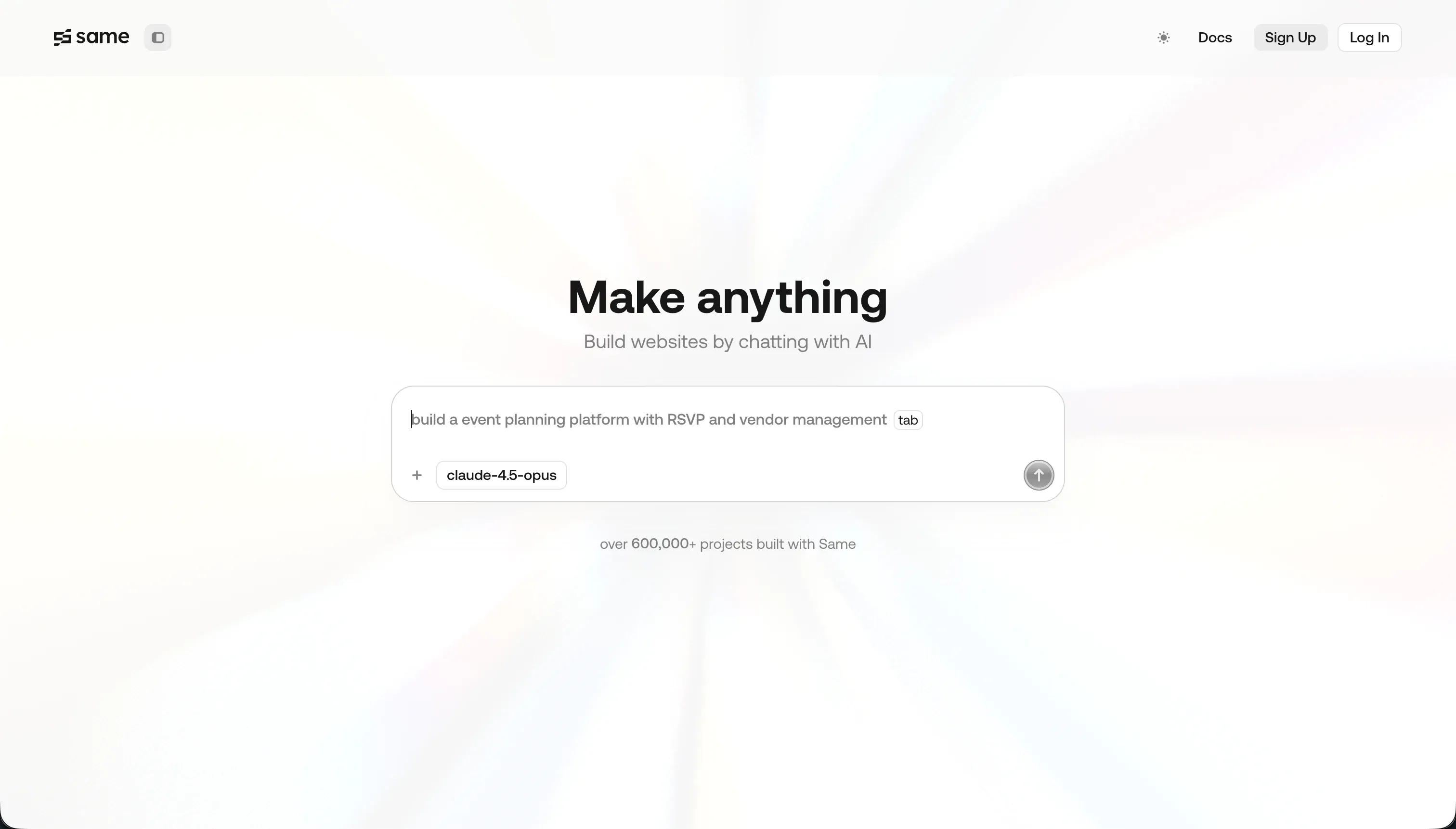
Glide and Same.new solve 2 different buying problems. Glide is a low-code business app builder for turning structured data into usable internal software. Same.new is an AI frontend prototyping tool for cloning and editing web layouts into React code.
Glide wins the general decision at 6.3/10 versus Same.new’s 4.1/10. It is the stronger choice for teams that need a working, hosted, data-backed app rather than a visual draft. The decision flips only when a developer wants a quick frontend scaffold to export and finish outside the platform.
The decision in 30 seconds
| If your priority is… | Pick | Why |
|---|---|---|
| Internal tools on top of sheets or tables | Glide | Higher ease and data scores make it faster to turn business data into a usable app |
| React frontend mockups cloned from an existing site | Same.new | Its only winning category is design flexibility, driven by URL cloning and code export |
| Secure client portals with granular external permissions | Neither | Glide is limited here and Same.new has no native auth or access controls |
| Lowest-maintenance production deployment | Glide | It beats Same.new on production readiness and maintainability with a managed runtime |
| An exportable codebase you can own | Same.new | Glide has no code export while Same.new outputs React and Tailwind files |
| Predictable total app cost at larger external-user scale | Neither | Glide can get expensive on user tiers and Same.new shifts work into developer time and token spend |
What each platform is
What is Glide?
Glide is a low-code app builder that turns structured data into responsive web apps. Its build model starts from data sources like Google Sheets, Airtable, Excel, or Glide Tables, then maps rows and fields into prebuilt screens, forms, lists, and workflows rather than asking teams to handcraft a frontend from scratch.
It includes business-ready components such as forms, lists, cards, relations, rollups, and AI-assisted columns, and it applies those inside a managed hosted runtime. That makes it genuinely suited to operations teams, internal software owners, and small businesses building trackers, CRMs, directories, and workflow tools without a full engineering team.
What is Same.new?
Same.new is an AI frontend prototyping tool that generates React and Tailwind code from prompts or by cloning an existing website URL. Its build model is code-first in output but prompt-driven in workflow: the system recreates a visual layout, then the user iterates by asking the agent to change structure, styling, and copy.
The product is centered on visual replication and exportable frontend code rather than application infrastructure. Documented behavior in the research includes URL-based cloning, conversational layout edits, and downloadable React/Tailwind output, which makes it genuinely built for developers or designers who want a fast scaffold for a web interface they will finish elsewhere.
- Starts from structured data sources
- Maps rows and fields into screens
- Prebuilt forms, lists, cards, rollups
- Runs on a managed hosted runtime
- Suited to trackers, CRMs, directories
- Generates React and Tailwind code
- Prompt or URL-based cloning
- Iterate by chatting with the agent
- Exports frontend code, no infrastructure
- Scaffold for interfaces finished elsewhere
The core difference
These tools diverge most on what they are actually trying to produce: a managed business application versus an exportable visual frontend scaffold. Glide assembles working software around data; Same.new imitates and edits presentation layers in code.
- Glide turns structured business data into a hosted app by fitting it into managed components, permissions, and workflows.
- Same.new generates frontend code and layout replicas, leaving the real application logic, backend, and hardening to the team after export.
Where the scores diverge
Ease of build: Glide 8.5, Same.new 5.0. Glide pulls ahead because it starts from the thing most business teams already have: structured data. Connect a sheet or table and the platform auto-assembles workable screens, so non-developers can get to a functioning tool quickly.
It still loses points because that speed depends on accepting Glide’s conventions and component model. Same.new is faster only for a narrow task - mocking a web UI - but prompt edits become unreliable once layouts get more complex and usually need developer cleanup.
Production readiness: Glide 6.5, Same.new 3.0. Glide is meaningfully closer to something a team can deploy because hosting, data binding, responsive components, and app structure are already part of the product.
The deduction is that it remains better for internal systems than demanding external software, and some buyers will run into plan limits or performance frustrations. Same.new falls behind because it does not provide the backend, authentication, or operational layer that makes a business app live.
What it creates is a frontend starting point, not a finished production system.
Maintainability: Glide 6.5, Same.new 3.0. Glide is easier to live with after launch because edits happen in a visual model that stays consistent as long as the app fits the platform’s patterns.
It is not perfect: as logic deepens or requirements become less templated, maintainability drops because workarounds accumulate and higher-tier features can become part of the solution. Same.new scores lower because AI-driven edits can be destructive, and teams may end up debugging generated code after simple change requests.
That turns routine iteration into engineering maintenance rather than controlled configuration.
Data & integrations: Glide 7.0, Same.new 4.0. Glide is built around data, so it naturally scores higher with native table support and familiar sources like Sheets and Airtable, plus relations and rollups that let non-technical teams model useful workflows.
It still gives up points because buyers remain inside Glide’s integration patterns rather than owning a fully open stack. Same.new is weaker because it does not really solve data at all. The frontend can be exported, but every connector, CRUD action, and backend contract still has to be implemented elsewhere.
Security & access control: Glide 5.5, Same.new 3.0. Glide wins because it at least includes native visibility rules and row-level controls suitable for many internal use cases. The score is still held back because those controls are thinner than what serious external portals and enterprise access models often require.
Same.new has almost nothing here out of the box: no native authentication flow, no session model, and no permissions layer. Any real security posture has to be designed, coded, hosted, and audited outside the product.
Design flexibility: Glide 4.0, Same.new 6.5. This is the one category that keeps Same.new in the conversation. Because it generates React and Tailwind output and can mimic existing websites, it gives developers much more freedom to shape the interface than Glide’s fixed component system does.
Even so, the score is not elite because prompt-driven control is inconsistent and visual fidelity can still require manual repair. Glide trails because its templates and block rules make business apps easy to standardize but hard to differentiate.
Cost comparison
Glide uses a flat subscription model tied to plan tier, user limits, and row limits. The research cites Maker at $49/mo billed annually for up to 25 shared users and 25,000 rows, and Business at $249/mo billed annually for 100 users and 100,000 rows, so the bill moves as more people use the app or more data is stored.
Same.new uses a token-based subscription model instead: the Pro plan starts at $10/mo with 2 million tokens, and extra usage is sold at $5 per million tokens, so cost moves with how much generation and iteration the AI performs.
Buyers should forecast more than sticker price. Glide can add hidden cost through builder time spent working around template limits, upgrades triggered by usage caps, and migration effort because there is no code export.
Same.new can look cheap in software terms but shift spend into token overages, repeated prompt/debug cycles, and developer hours to add the missing backend, auth, and production hardening after export.
Lock-in and the exit path
Glide has the heavier lock-in because you can keep underlying rows in sources like Sheets or Airtable, but you cannot export the actual application code, so the interface and platform logic must be rebuilt if you leave. Same.new offers a cleaner exit because it exports React and Tailwind source files, which gives teams something tangible to keep.
The tradeoff is that what you exit with is only the frontend layer; any serious app behavior still has to be built around it. On balance, Same.new has the cleaner exit path.
Who should pick Glide
Pick Glide if:
- Operations or department leads who need to turn spreadsheet data into an internal tool quickly and benefit from Glide’s higher ease-of-build score
- Small businesses building CRMs, trackers, directories, or workflow apps where managed hosting matters more than custom UI freedom
- Teams that want native data modeling with relations and rollups instead of coding integrations from scratch
- Buyers who prioritize production readiness and maintainability over exportable code ownership
Do not pick Glide if the app’s success depends on a highly custom frontend, code ownership, or a public-facing product with deeper external-user security expectations.
Who should pick Same.new
Pick Same.new if:
- Frontend developers who want a quick React and Tailwind scaffold cloned from an existing website or prompt
- Design or prototype teams that value visual flexibility more than built-in backend infrastructure
- Builders who need downloadable source files rather than a locked managed runtime
- Teams creating disposable mockups or early UI concepts before real engineering starts
Do not pick Same.new if you need a complete business app with hosted data, authentication, permissions, and low-maintenance production deployment.
What neither platform answers
Many buyers reading this comparison do not actually need either a rigid internal-tool builder or a frontend code cloner. They need a business app: a client portal, internal tool, or CRM defined by logins, permissions, structured data, and low day-2 maintenance.
That is the lane where Softr is usually the better fit, because it is built around secure business apps rather than raw frontend generation or spreadsheet-first internal tooling.
From the research, Softr is the stronger recommendation for this use case because it scores higher on production readiness, maintainability, and security & access control, the 3 categories that decide whether a business app survives real use.
It gives buyers native auth, permissions, and a lower-maintenance hosted setup, which is exactly what this matchup leaves uncovered. For a different angle - mobile-first delivery and more custom app UI - FlutterFlow is the sensible alternative when the requirement is closer to shipping a bespoke app than managing a portal.
Analyst verdict
Glide wins 6.3/10 to 4.1/10. It takes Ease of build, Production readiness, Maintainability, Security & access control, and Data & integrations, while Same.new keeps only Design flexibility. That split tells the story clearly: Glide is the better default purchase when the goal is a usable, hosted, data-backed app rather than a frontend experiment.
The condition that flips the decision is narrow but real. If your team already has a developer, does not need native backend infrastructure, and mainly wants to clone or sketch a web interface in React and Tailwind, Same.new can be the smarter buy because its 6.5 score in Design flexibility is the one area where Glide’s 4.0 template model falls short.
So the practical recommendation is simple: buy Glide for internal business software and operational tools, and buy Same.new only for fast frontend scaffolding that will be completed elsewhere.
Related reading: the Glide scorecard, the Same.new scorecard, and our scoring methodology.