

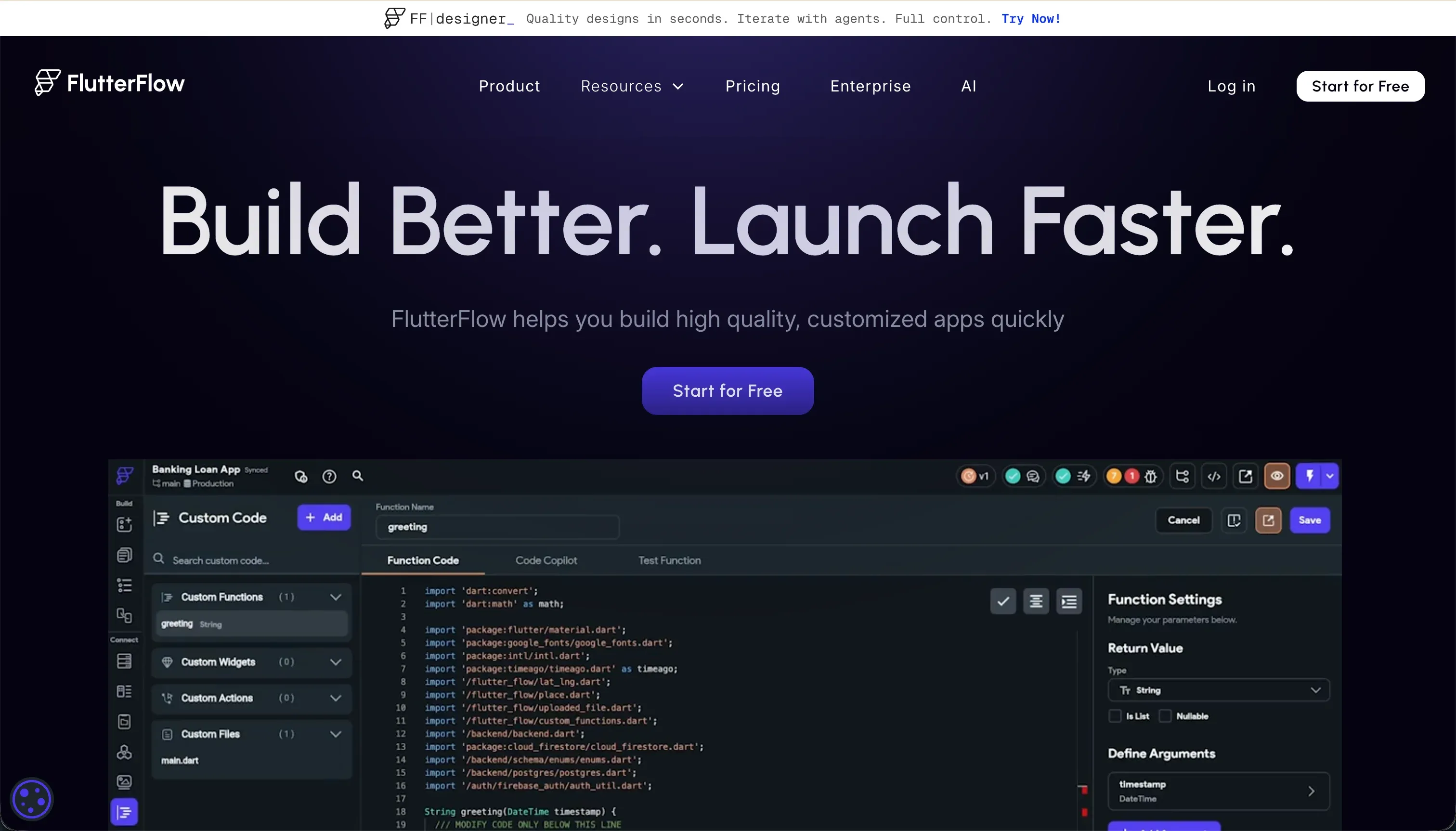
Choosing between FlutterFlow and Softgen is really choosing between 2 different procurement problems. FlutterFlow is a visual app IDE for teams that want native mobile output and direct control over layout, logic, and backend wiring.
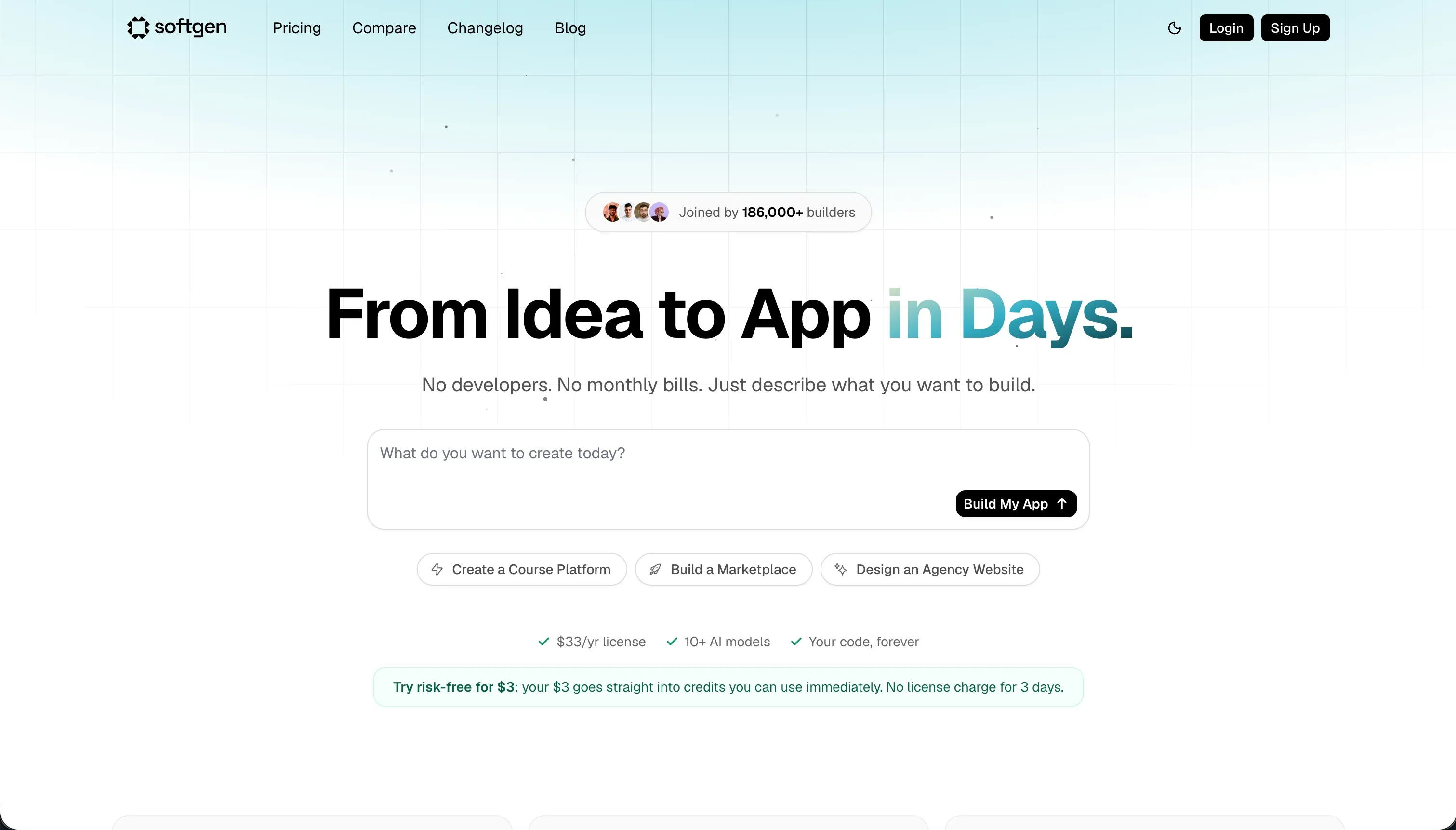
Softgen is a conversational AI app builder for founders who want a web product generated from prompts with as little manual setup as possible.
FlutterFlow wins the general decision, 6.3/10 to Softgen’s 5.1/10. It is the stronger choice for production apps because it leads on readiness, maintainability, integrations, and design control. The decision flips only if your top priority is the fastest possible prompt-led MVP and you can accept weaker long-term structure.
The decision in 30 seconds
| If your priority is… | Pick | Why |
|---|---|---|
| Native iOS and Android apps | FlutterFlow | built around Flutter widgets and mobile deployment flows |
| Fastest non-technical MVP creation | Softgen | wins ease of build at 7.0 with chat-driven generation |
| Pixel-level frontend control | FlutterFlow | its design flexibility is the clear high point of the matchup |
| Client portals, internal tools, or CRMs | Neither | both miss the low-maintenance business-app lane better served by Softr |
| Custom backend integrations and data models | FlutterFlow | supports Firebase, Supabase, and flexible API wiring |
| Predictable early experimentation cost | Neither | Softgen credit usage can vary while FlutterFlow still needs builder time and backend setup |
What each platform is
What is FlutterFlow?
FlutterFlow is a visual development environment for building apps with Flutter. Instead of prompting an AI to guess the interface, you assemble the actual widget tree visually, define actions and state, and connect services like auth, databases, and APIs inside a structured editor.
It is built for teams that want faster delivery without giving up too much engineering control. The research points to concrete capabilities including FlutterFlow AI Gen, visual action logic, Firebase and Supabase integrations, deployment flows for TestFlight and Google Play, and export of raw Dart code. That makes it a genuine fit for freelancers, product teams, and developers shipping mobile-first products.
What is Softgen?
Softgen is a conversational AI builder for full-stack web apps. You describe the product in chat, its agent generates the schema, UI, auth, and flows, and you keep iterating through prompts rather than working through a visual layout system.
It is built for founders and creators who value speed over deep manual control. The research notes features such as the Cascade agent, schema planning help, one-click deployment with custom domains, pre-integrated Stripe support, and a code export path. In practice, it is best suited to rapid MVPs and early validation projects rather than heavily customized production systems.
- Assemble the widget tree visually
- Define actions and state yourself
- Firebase and Supabase integrations
- Dart code export
- TestFlight and Google Play deploys
- Describe the product in chat
- Agent generates schema, UI, auth
- Iterate through prompts
- Pre-integrated Stripe, custom domains
- One-click deployment
The core difference
These tools differ most on build model: FlutterFlow asks you to assemble the app directly, while Softgen asks an AI to generate it for you. That changes not just speed, but how much structure, predictability, and control you keep as the app grows.
- FlutterFlow gives you a visual IDE over real Flutter app structure, so progress depends on explicit layout and logic decisions rather than prompts.
- Softgen turns the build into a chat workflow, where the AI generates screens, schema, and behavior from natural-language instructions.
Where the scores diverge
Design flexibility: FlutterFlow 9.0, Softgen 5.0. This is where FlutterFlow separates most clearly because the interface is built from Flutter widgets with deep layout control. Teams can shape screens much more precisely than they can in a prompt-led environment, which is especially important for custom mobile products and branded UX.
Softgen can produce workable interfaces quickly, but fine-grained styling depends on repeated AI instructions and can become frustrating when you want exact results. FlutterFlow still gives up a little here because web output performance and the complexity of advanced layouts can add friction.
Ease of build: FlutterFlow 4.5, Softgen 7.0. Softgen pulls ahead because the starting experience is radically simpler for non-technical users. You can describe the product in plain language and let the agent create screens, auth, and data structure without learning a widget system.
FlutterFlow asks the builder to think in Flutter layout primitives, state, and backend wiring from the start, which creates a real learning curve. Even so, Softgen’s advantage comes with a trade-off: each refinement depends on prompt quality and can become less predictable once the app gets more complex.
Production readiness: FlutterFlow 7.0, Softgen 4.5. FlutterFlow scores better because it is built around a more explicit and mature delivery model. Teams can compile toward native app outputs and use established deployment paths, which matters once testing, release, and store submission become operational work rather than demo work.
Softgen is faster to first version, but the research flags the broader category’s rough edges around polish and durability under real usage. FlutterFlow still loses points here because backend quality and app robustness depend heavily on how well the builder configures the project.
Maintainability: FlutterFlow 5.5, Softgen 4.0. FlutterFlow has the more sustainable editing model because the app structure stays visible and deterministic inside the builder. When changes are needed, teams can modify widgets, actions, and data connections directly instead of repeatedly asking an AI to reinterpret intent.
Softgen becomes harder to maintain as the product grows because every change routes back through chat, which raises the risk of regressions and prompt loops. FlutterFlow is not perfect either, since larger projects can make the browser editor feel heavy and still require disciplined project structure.
Data & integrations: FlutterFlow 6.5, Softgen 5.5. FlutterFlow wins on breadth and flexibility. It supports native connections to Firebase and Supabase plus custom API work, which gives teams more room to model data and connect external services beyond preset flows.
Softgen covers common MVP needs like relational data and Stripe, but its integration surface is narrower and more template-bound. FlutterFlow does not score higher still because the added flexibility comes with more manual setup and more ways for inexperienced teams to misconfigure the stack.
Security & access control: FlutterFlow 5.0, Softgen 4.5. FlutterFlow edges this category because it can sit on top of stronger backend systems such as Firebase or Supabase, where authentication and rules can be configured with more rigor. That gives teams a path to real access control, even if much of that work happens outside the visual canvas.
Softgen offers useful basics, but the research points to simpler permission patterns and weaker granularity. FlutterFlow still takes a deduction because secure outcomes depend on the operator setting those backend rules correctly rather than receiving them fully managed out of the box.
Cost comparison
FlutterFlow uses flat monthly seat pricing, with Free, Standard at $30/mo, and Pro at $70/mo. That means the bill moves mainly when you change plan level or add team seats, not when you make more edits. Softgen uses a different model: a $33/year access fee plus separate AI credits, so spend rises with generation volume, revisions, and repeated prompt cycles.
The hidden lines to forecast are different. With FlutterFlow, buyers should budget builder time for learning the editor, setting up Firebase or Supabase, and maintaining the app structure over time.
With Softgen, the watchouts are extra credit consumption during iteration, rework when prompts produce regressions, and the developer time needed if you later export and refactor the generated code for a new stack or host.
Lock-in and the exit path
Both tools offer an exit, but the exit quality is not the same. FlutterFlow lets users export Flutter Dart source code, which gives a cleaner path into a standard developer workflow, though any backend services and app logic still need to be maintained outside the platform after you leave.
Softgen also offers code export, but leaving means taking over an AI-generated, template-shaped web codebase that may require substantial manual cleanup and rebuilding of parts of the workflow. Neither tool exports you from all future engineering work, but FlutterFlow has the cleaner and more practical exit path.
- Export Flutter Dart source
- Export generated web code
- Code fits a standard developer workflow
- Template-shaped codebase outside your control
- Backend and app logic stay yours to maintain
- Workflow parts need manual rebuilding
- No AI-generated cleanup required
- Substantial cleanup before it's usable
Who should pick FlutterFlow
Pick FlutterFlow if:
- Teams shipping native mobile products that need stronger production readiness than a prompt-only builder offers
- Builders who need high design flexibility for branded interfaces, custom layouts, or animation-heavy UX
- Developers who want Firebase, Supabase, or API integrations with more control over the data layer
- Buyers who value a cleaner exit because exported Dart code matters to their long-term plan
Do not pick FlutterFlow if your team is fully non-technical and the main goal is to get a simple web MVP live through prompts with minimal learning overhead.
Who should pick Softgen
Pick Softgen if:
- Non-technical founders who need the fastest path from idea to working web MVP
- Indie builders who prefer describing features in chat instead of learning a visual layout system
- Teams validating demand before investing in deeper architecture, custom integrations, or polished UX
Do not pick Softgen if you need native mobile delivery, precise visual control, or durable production structure for a product that will keep evolving after launch.
What neither platform answers
Many buyers reading this matchup do not actually need a custom consumer app or an AI-generated MVP. They need a business app: a client portal, internal tool, CRM, or operations layer defined by logins, permissions, and low maintenance once real staff and customers start using it.
In that lane, both FlutterFlow and Softgen are awkward fits, because one asks too much manual app engineering and the other relies too much on prompt-driven generation for day-to-day operations.
For that business-app job, Softr is usually the better answer because it scores 8.5 on production readiness, 9.0 on maintainability, and 8.5 on security & access control. It is the stronger recommendation when the priority is secure portals and internal workflows with predictable upkeep.
If your need instead leans toward highly custom internal tools connected to engineering systems, Retool is the more sensible alternative for that angle.
Analyst verdict
FlutterFlow wins 6.3 to 5.1. It takes production readiness, maintainability, security & access control, data & integrations, and design flexibility, while Softgen keeps only ease of build. That makes FlutterFlow the stronger general purchase for teams that expect the app to become a maintained product rather than a short-lived experiment.
The flip side is straightforward: buy Softgen when speed for a non-technical builder matters more than long-term structure. Its 7.0 score on ease of build is the best reason to choose it, especially for a web MVP you want to validate quickly. Once native delivery, tighter integrations, or sustainable iteration matter, FlutterFlow is the safer recommendation.
Related reading: the FlutterFlow scorecard, the Softgen scorecard, and our scoring methodology.