

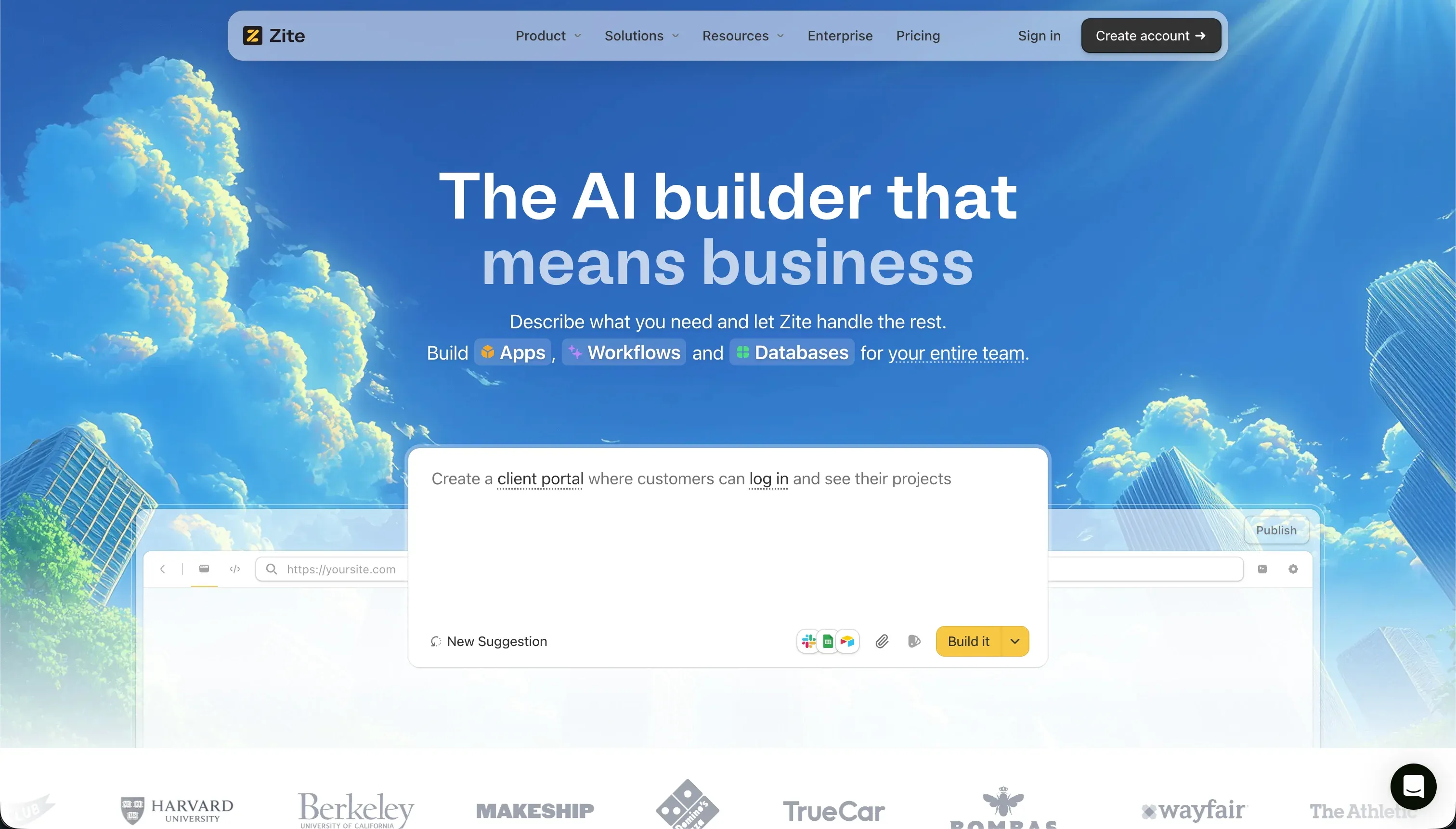
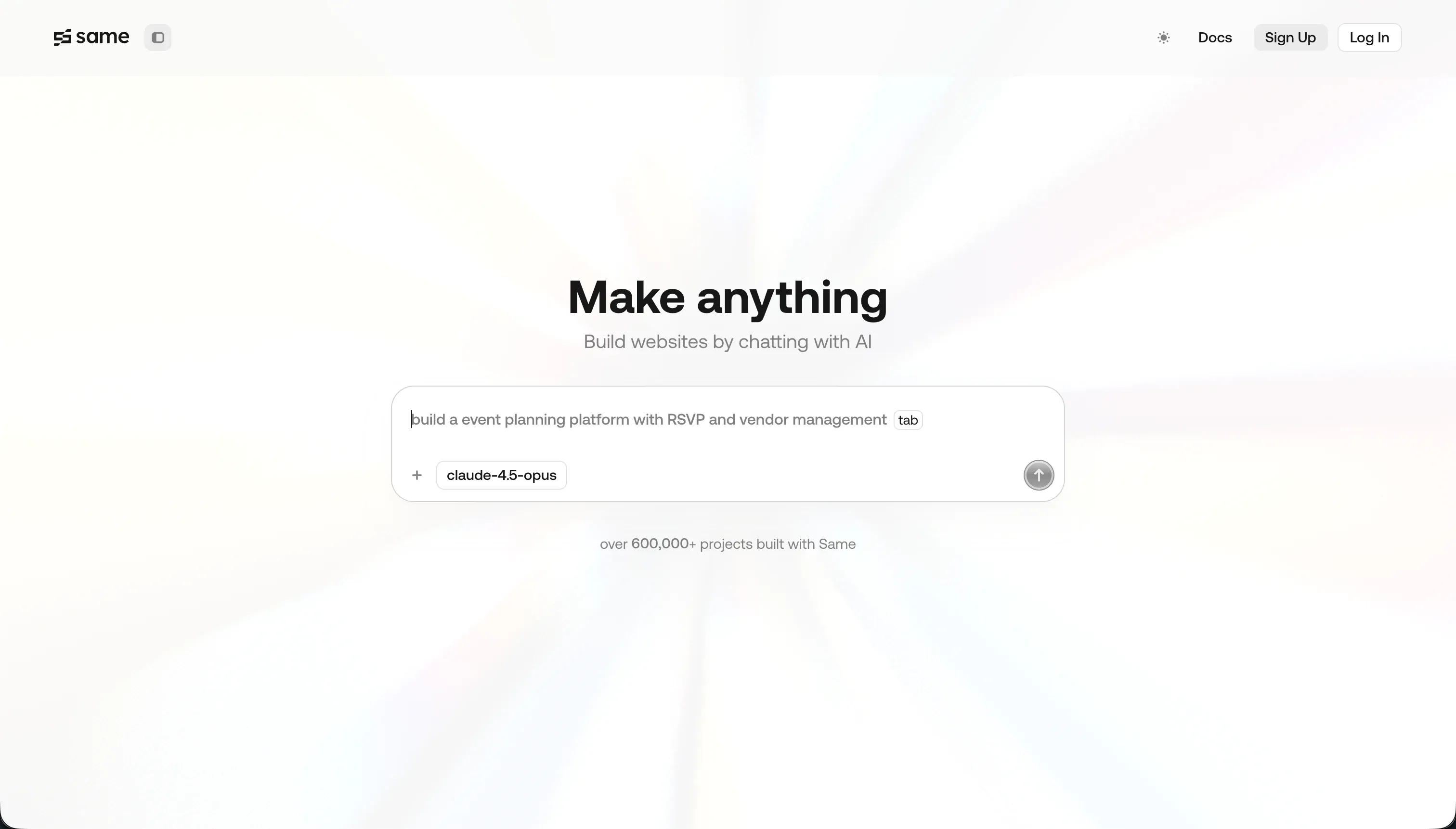
Zite and Same.new solve 2 different procurement problems: Zite is an AI app builder in the no-code business-app category, while Same.new is an AI frontend cloning tool in the prototyping category. One is trying to assemble a usable data-backed app; the other is trying to recreate a visual interface quickly for later developer work.
Zite wins the general decision at 5.2/10 versus 4.1/10 because it covers more of the stack, especially data, access, and basic operational setup. Same.new only flips the decision when 1 priority matters more than everything else: fast visual cloning into editable frontend code.
In that narrower case, its 6.5/10 Design flexibility matters more than its weaker production scores. For most buyers comparing these 2, though, Zite is the safer default.
The decision in 30 seconds
| If your priority is… | Pick | Why |
|---|---|---|
| Relational MVPs with forms and workflows | Zite | built-in SQL database and higher 5.5 score for Data & integrations |
| Clone an existing website into React fast | Same.new | best fit for URL-based frontend replication and its 6.5 Design flexibility score |
| Basic user access and business-app structure | Zite | 5.0 in Security & access control versus Same.new’s lack of native auth |
| Exportable codebase you can own and host yourself | Neither | Same.new exports code but is too weak on readiness; Zite does not export code at all |
| Stable internal tools with predictable maintenance | Neither | both score poorly on maintainability, so Softr is the more honest answer |
What each platform is
What is Zite?
Zite is an AI-first no-code app builder that generates screens, data structure, and workflows from a prompt. Its build model is conversational: you describe the app, Zite proposes and creates the app structure, then you refine it through prompts and visual edits inside its managed environment.
The product includes a built-in SQL database, workflow automation, and roots in Fillout’s form-building experience. Research also points to staging environments, unlimited users, and basic SSO and user-group support, but also notes limits around advanced formulas, roll-ups, and layout control.
It is genuinely built for operators and small teams who want to stand up simple internal tools, portals, or MVPs without managing code or infrastructure.
What is Same.new?
Same.new is an AI frontend prototyping tool that recreates the look of an existing website in React and Tailwind. Its build model starts from a live URL or visual reference, then lets you iterate on the generated frontend with natural-language prompts rather than assembling a full application stack.
Research shows that it can export raw React and Tailwind code and is strongest when used for fast visual scaffolding. The same notes also make clear that it has no native backend, authentication, or database layer, and that users have seen instability around rebrands and broken legacy projects.
It is genuinely built for designers and frontend developers who need a quick visual starting point, not teams buying a production business-app platform.
The core difference
These tools differ most on stack depth: Zite tries to assemble a whole lightweight app system, while Same.new only generates the frontend surface. That assemble-versus-clone split explains nearly every score gap.
- Zite is a managed AI app builder that creates interface, data model, and workflow logic together inside one hosted runtime.
- Same.new is a frontend code generator that clones visual layouts into React and Tailwind without supplying the app backend underneath.
Where the scores diverge
Ease of build: Zite 7.5, Same.new 5.0. Zite pulls ahead because it can generate the UI, database, and basic workflows from one prompt, which reduces the number of systems a buyer has to stitch together. Its Plan Mode also helps by letting builders review steps before spending credits.
That said, it still loses points because later edits can become frustrating prompt loops. Same.new is fast only for the first visual pass; once the interface needs interactive behavior or structural changes, the cleanup burden rises sharply.
Security & access control: Zite 5.0, Same.new 3.0. Zite wins because it includes at least basic user groups and SSO-oriented capabilities, which is more than many prototype-first AI tools offer. It still gets marked down because access control is not described as especially granular or visually manageable for complex permission models.
Same.new has no native authentication, row-level security, or permission framework at all. That means any serious access model has to be engineered outside the product, which defeats the point for many buyers.
Design flexibility: Zite 4.5, Same.new 6.5. Same.new keeps this criterion because editable React and Tailwind output gives builders more direct control over the frontend than Zite’s managed visual layer. It is not a perfect win, though, because research notes problems with deep nesting and prompt-driven changes that can damage layouts.
Zite loses here because its designs stay tied to the initial AI structure and tend toward a rigid, corporate look. If brand expression or custom frontend behavior is the main brief, this is the one criterion that genuinely favors Same.new.
Production readiness: Zite 4.5, Same.new 3.0. Zite scores higher because it at least behaves like an app platform, with staging, hosted runtime, data storage, and some access features already in place. The deduction is that its database and logic depth are still too limited for more complex operational software.
Same.new remains mostly a prototype tool because there is no native backend, auth, or operational model behind the generated frontend. Reports of broken legacy projects after rebrands further weaken confidence for long-lived production use.
Data & integrations: Zite 5.5, Same.new 4.0. Zite separates itself here with a built-in relational SQL database plus API and webhook support, so the app can actually hold and act on structured data. The deduction is that its data model still lacks some of the richer features buyers expect as apps mature, including advanced formulas and custom views.
Same.new does not really compete on this axis because it generates frontend code rather than a data system. Any dynamic data layer must be added elsewhere by a developer team.
Maintainability: Zite 4.0, Same.new 3.0. This is a weak area for both tools, and the gap is small because neither gives buyers a clean long-term maintenance story. Zite is slightly better only because the app remains in one managed system, but it loses points when layout and behavior changes depend on rigid AI-mediated edits and there is no GitHub sync.
Same.new also struggles because prompt-based changes can break working sections and create cleanup work for developers. Since both scores are low, this criterion does not create a confident advantage so much as a warning.
Cost comparison
Zite uses a credit-based subscription model. Research cites a Free tier with 50 credits, Pro starting at $19 per month for 100 credits, scaling up to $3,769 per month for 19,200 credits, and Business beginning at $69 per month.
Same.new, by contrast, moved from pay-as-you-go pricing at $10 per 2 million tokens to tiered subscriptions, so the spend driver is token consumption from generation and iteration rather than app users or a flat software seat alone.
The hidden lines to forecast are different. With Zite, builder time can get lost in prompt-edit loops, and usage can rise through workflow runs, reads, queries, and page activity; migration risk is also high because there is no code export.
With Same.new, the watchouts are token burn during repeated bug-fixing, developer cleanup after broken generations, and the eventual cost of rebuilding backend, auth, and production plumbing outside the tool.
Lock-in and the exit path
Same.new has the cleaner exit because it lets you export the generated React and Tailwind code, even though you still need to rebuild or separately provide backend systems, authentication, and production infrastructure.
Zite does not offer code export or GitHub synchronization in the research provided, so leaving means rebuilding the application logic, interface, and stack elsewhere; at most, buyers can expect to move underlying data rows, not the working app itself. Between the two, Same.new is plainly easier to leave.
- Export React and Tailwind code
- Rebuild backend yourself
- Rebuild auth yourself
- Rebuild production infrastructure
- No code export in research
- No GitHub sync in research
- Rebuild app logic and interface
- Rebuild the whole stack
- At most, move data rows
Who should pick Zite
Pick Zite if:
- Teams that need a simple internal tool or portal fast and value Zite’s 7.5 Ease of build more than deep customization
- Operators who want built-in relational data and workflows without assembling a separate backend stack, reflected in Zite’s 5.5 Data & integrations score
- Buyers with basic access needs such as user groups or SSO-style setup who can live with Zite’s middling 5.0 Security & access control score
Do not pick Zite when code ownership, deep frontend customization, or a mature long-term maintenance path matters more than getting a lightweight app online quickly.
Who should pick Same.new
Pick Same.new if:
- Designers who want to clone an existing website into a workable React starting point as quickly as possible
- Frontend developers who care more about editable code output than native backend features or access control
- Prototype teams where the main success criterion is visual speed, not production readiness, and Same.new’s 6.5 Design flexibility is the deciding score
Do not pick Same.new when you are actually buying a business application platform with auth, data, workflows, and reliable long-term production behavior.
What neither platform answers
Many buyers reading this matchup are not really choosing between 2 experimental AI builders; they need a business app with logins, permissions, records, and low maintenance for staff or clients. That is a different lane from frontend cloning or prompt-built lightweight apps, and it is where Softr is the better fit.
Softr’s research scores are stronger where operational buyers care most: 8.5 for Production readiness, 9.0 for Maintainability, and 8.5 for Security & access control.
Choose Softr when the real brief is a client portal, internal tool, or CRM-style workflow that has to stay stable after launch.
If your alternative priority is not business-app stability but mandatory code ownership and self-hosting, pair that recommendation with Replit instead, because it is the more sensible route for buyers who need direct control of the codebase rather than a managed runtime.
Analyst verdict
Zite wins 5.2 to 4.1 overall. It takes Ease of build, Production readiness, Maintainability, Security & access control, and Data & integrations, while Same.new keeps Design flexibility. That makes Zite the better default for buyers who actually need a lightweight app rather than just a visual shell.
The decision flips only when frontend freedom and code export matter more than backend completeness. Same.new’s 6.5/10 in Design flexibility is the one meaningful edge in this matchup, but its weak readiness and lack of native data or auth stop it from being the general recommendation. If that code-first condition matters, the smarter purchase is usually Replit rather than either tool.
Related reading: the Zite scorecard, the Same.new scorecard, and our scoring methodology.