


Choosing between Zite and Base44 is really choosing between 2 different procurement risks. Zite is an AI-first no-code database and portal builder, while Base44 is a conversational full-stack web app generator. Both promise prompt-to-app speed, but they solve different kinds of early-stage building problems.
Zite and Base44 tie at 5.2/10 overall, so neither wins the general decision for production buyers. Zite is the slightly safer option for basic internal data capture because it scores better on maintainability and security, while Base44 is stronger when visual tweaking matters more. The decision flips only if your main goal is a fast mockup or MVP with more flexible styling and a frontend export path.
The decision in 30 seconds
| If your priority is… | Pick | Why |
|---|---|---|
| Rapid internal forms and database capture | Zite | Fillout roots and Plan Mode make simple data apps easier to control |
| Visual click-to-tweak frontend changes | Base44 | Its 6.5 design flexibility score reflects faster live styling edits |
| Predictable path to production software | Neither | Both land at 5.2 overall and score poorly on production readiness |
| Managed PostgreSQL scaffold from one prompt | Base44 | It generates the app, hosting, auth, and database in one flow |
| Basic business app with lower maintenance | Zite | Its 4.0 maintainability score still edges Base44’s 3.5 |
| Exportable codebase and self-hosting control | Neither | Zite has no code export and Base44 keeps backend and database locked in |
What each platform is
What is Zite?
Zite is an AI-first no-code app and database builder that turns prompts into interfaces, tables, and workflows. Its build model centers on Plan Mode, where the AI proposes changes in a markdown-style outline before applying them, so builders can review structural edits before spending credits.
Zite includes a spreadsheet-like SQL backend, bulk operations, and Fillout-derived form behavior such as validation logic. It is built for operators and small teams that want to spin up internal tools, calculators, and lightweight portals quickly, especially when unlimited users matter more than deep customization or code ownership.
What is Base44?
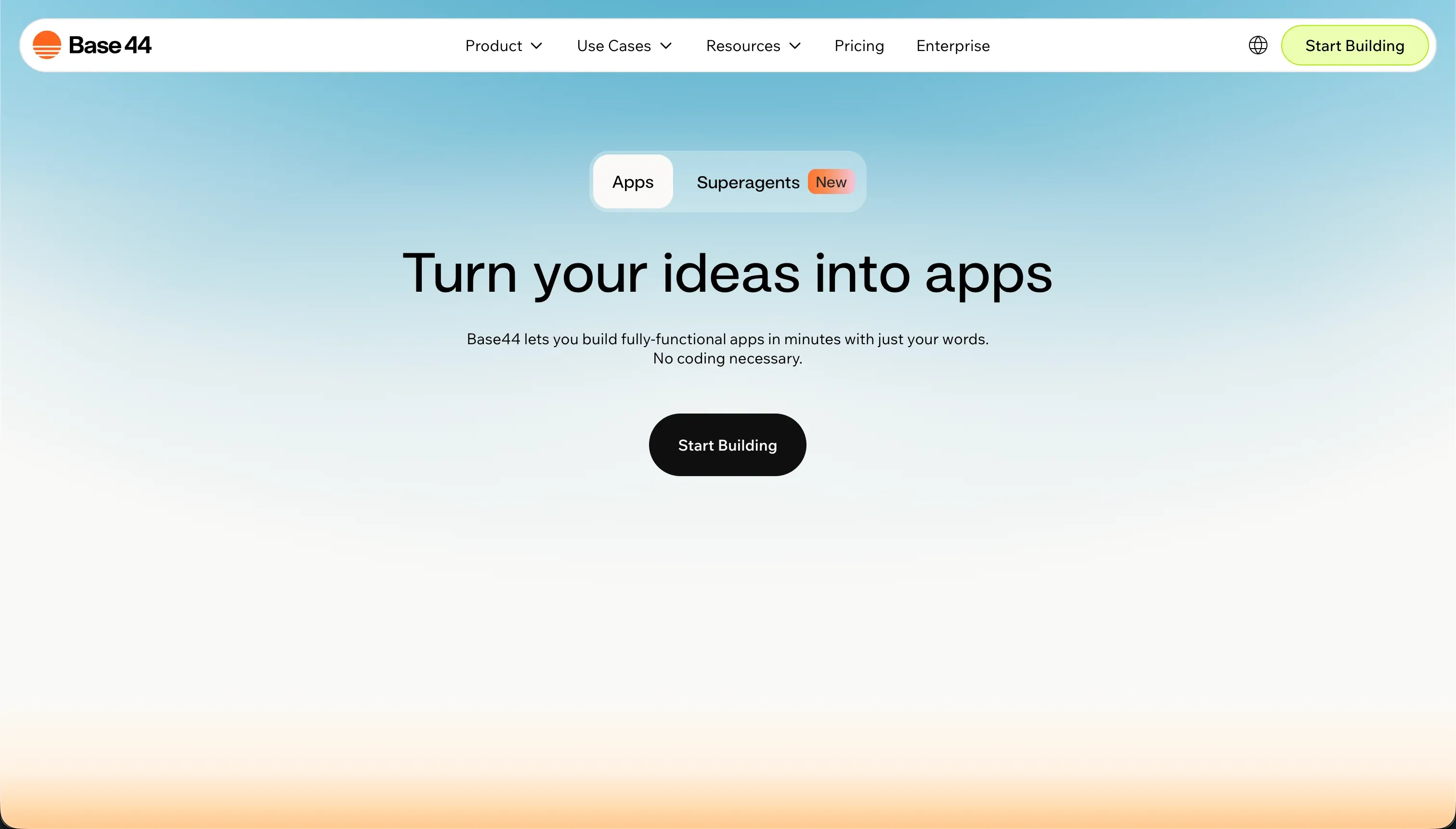
Base44 is a conversational full-stack web app generator that bundles hosting, authentication, and a managed PostgreSQL database into a single AI workflow. The build model is chat-first: you describe the app, the platform generates schema and UI, and you refine the result through more prompts or direct visual tweaks.
Base44 also offers click-to-tweak styling controls and frontend export on its higher tier, which makes it more appealing for rapid MVP shaping than rigid internal-tool builders. It is genuinely aimed at non-technical founders, solo makers, and teams testing product ideas fast, not buyers who need proven enterprise controls or durable backend ownership.
The core difference
The biggest difference is not what they generate, but how much of the app you can shape after generation. Zite is more constrained and workflow-oriented, while Base44 is more conversational and visually adjustable.
- Zite works best when you accept its structured, generated app model and use prompts to manage data-centric internal workflows rather than heavily redesign the interface.
- Base44 behaves more like a prompt-driven full-stack sandbox where you can keep reshaping the product visually and conversationally, albeit with more instability.
Where the scores diverge
Design flexibility: Zite 4.5, Base44 6.5. Base44 clearly wins here because it lets users adjust styles and interface elements more directly through live visual controls and conversational edits.
Zite feels more constrained by its generated layouts, and multiple users report that changing the default look into something distinct or agency-grade is difficult. Base44 still loses points because visual freedom does not equal full frontend control, especially when repeated edits can destabilize the app.
But this is the one criterion where it has a real, practical edge.
Security & access control: Zite 5.0, Base44 4.0. Zite leads because it inherits more mature identity and form infrastructure from Fillout and supports basic user-group access patterns.
That said, its controls are still less explicit than buyers expect from a dedicated business app platform, since some logic depends on prompted setup rather than clean visual policy management. Base44 falls behind because it lacks granular field-level and button-level permissions and is not well suited to strict tenant isolation.
For any buyer with real compliance or data separation needs, both scores are still too low.
Production readiness: Zite 4.5, Base44 4.0. Neither platform is a strong production choice, which is why the gap stays small and the low scores matter more than the winner.
Zite gets a slight nod because it offers a somewhat steadier structure for basic business data flows, but it still lacks advanced database capabilities such as richer formula and SQL-layer control. Base44 loses ground because user reports point to downtime, broken live apps, and corruption after repeated prompt cycles.
Even Zite’s edge here is only relative, not reassuring.
Maintainability: Zite 4.0, Base44 3.5. Zite scores better because Plan Mode at least gives builders a checkpoint before destructive AI changes are committed. Base44’s conversational editing can spiral into regression loops, where fixing one issue creates several new ones and burns more credits in the process.
Zite is still hard to maintain once a project grows, because structural changes remain prompt-dependent and layouts stay rigid. So the higher score reflects fewer failure modes, not a clean long-term maintenance story.
Ease of build: Zite 7.5, Base44 7.5. This is effectively a tie because both tools are very fast at getting from prompt to working first draft. Base44 reduces setup friction by bundling hosting, auth, and database generation into one conversational flow, while Zite benefits from strong form-building foundations and Plan Mode previews.
Neither earns a truly elite score because iteration becomes messy once the first draft needs meaningful changes. That is why ease of starting does not translate into ease of finishing.
Data & integrations: Zite 5.5, Base44 5.5. This is another near-tie because both products cover the basics but leave important gaps once data complexity rises. Zite gives you its own SQL-style database and practical connectors, yet it lacks richer analytical modeling and deeper query control.
Base44’s managed PostgreSQL setup sounds stronger on paper, but usage constraints, latency under heavier workloads, and attachment handling limits reduce the advantage. Neither tool is the right answer for advanced operational data architecture.
Cost comparison
Zite uses tiered subscription pricing plus credits: Pro starts at $19/mo with 100 credits, and Business is $69/mo with 200 credits, scaling to $3,799/mo for 19,200 credits. That means your bill moves with both plan tier and workflow consumption, and the research notes that database reads and page reloads can count toward usage.
Base44 also uses subscription tiers, with Starter at $20/mo and Builder at $50/mo, but its spend is driven by 2 credit buckets: message credits for prompting the AI and integration credits for app actions such as emails and database queries.
The hidden costs are mostly operational. On Base44, budget for extra prompt and integration spend during debugging because regression loops can consume credits without resolving the issue.
On Zite, buyers should forecast upgrade pressure if they need Business-only capabilities such as recurring workflows or more advanced auth setup, plus the eventual migration cost because neither platform provides a clean full-stack exit path.
Lock-in and the exit path
Both tools impose meaningful lock-in, but in different ways. Zite does not offer GitHub sync or code export, so your UI and workflows stay inside its managed environment, though standard data extraction is comparatively simpler.
Base44 offers frontend code export to GitHub on the Builder tier, but the backend logic, managed database, and core app runtime remain on Base44 infrastructure. Base44 gives a partial code exit, but Zite offers no code exit at all; neither avoids a rebuild, though Base44 has the cleaner frontend-only escape hatch.
- No GitHub sync
- No code export
- UI and workflows stay managed
- Data extraction is simpler
- Frontend code export to GitHub
- Builder tier required
- Backend and database locked
- Core runtime stays hosted
Who should pick Zite
Pick Zite if:
- Operations teams building simple internal forms, calculators, or lightweight portals where speed matters more than custom UI polish
- Organizations that value unlimited users on paid plans and can live with modest security controls for basic internal workflows
- Builders who want Plan Mode as a guardrail before AI changes hit the database or app structure
Do not pick Zite if you need custom-branded auth on a tight budget, advanced database logic, or any credible path to exporting and owning the application code.
Who should pick Base44
Pick Base44 if:
- Founders who want to generate an MVP with hosting, auth, and PostgreSQL included from a single prompt
- Makers who care more about live visual tweaking and conversational iteration than long-term stability
- Teams that specifically want frontend export to GitHub and accept that the backend remains managed and closed
Do not pick Base44 if your app needs stable production operations, strong tenant isolation, or predictable monthly spend under active usage.
What neither platform answers
Many buyers reading this comparison do not actually need an AI app generator at all; they need a business app such as a client portal, internal tool, or CRM where logins, permissions, and low maintenance are the core requirements.
In that lane, Softr is the more honest recommendation because it scores 8.5 on production readiness, 9.0 on maintainability, and 8.5 on security & access control, with those strengths built into the product rather than improvised through prompts.
If your priority is reliable business software with governed access and minimal upkeep, Softr is the better fit than either Zite or Base44.
If your priority is a code-first environment and you are willing to build more directly, Replit is the better alternative from a different angle because it offers a more programmatic path and cleaner ownership expectations than these closed prompt-first runtimes.
Analyst verdict
Zite and Base44 finish tied at 5.2 to 5.2 overall. Zite takes Maintainability, Security & access control, and a slight edge in Production readiness, while Base44 keeps Design flexibility; Ease of build and Data & integrations are too close to decide the matchup on their own.
That means there is no true general winner for serious buyers. If you need a quick internal-facing data tool and can accept rigid layouts, Zite is the less risky choice because its 4.0 maintainability score and Plan Mode guardrails make it somewhat easier to control. If you specifically want a fast MVP with more visual freedom and frontend export, Base44 is the better fit despite its weaker 3.5 maintainability score.
For production software, the real recommendation is to leave this matchup. Softr is the better buy for low-maintenance business apps, and Replit is the better buy when code ownership and extensibility matter more than prompt-first convenience.
Related reading: the Zite scorecard, the Base44 scorecard, and our scoring methodology.