


Choosing between WeWeb and Zite represents a fundamental choice between a decoupled visual frontend engineer and an all-in-one, prompt-driven prototyping system.
WeWeb belongs to the professional visual frontend builder category, designed to create layout-rich web applications that connect to external backends of your choice. Zite operates as an AI-first prompt-to-app generator that instantly spits out interfaces, databases, and simple workflows in response to natural-language instructions.
WeWeb wins this comparison with an aggregate score of 6.2/10 against Zite’s 5.2/10. 8.5/10 on design flexibility and 7.0/10 on external integrations make WeWeb a professional developer’s layout tool. Zite is only the better allocation when the timeline is measured in hours and you are comfortable keeping the design and logic tied to what an AI model generates.
The decision in 30 seconds
| If your priority is… | Pick | Why |
|---|---|---|
| Pixel-level UI design layout layout controls | WeWeb | Its visual layout engine supports CSS flexbox, grids, and absolute positioning with an 8.5/10 design rating |
| Generating an MVP from a single prompt | Zite | The prompt-to-app workflow creates a working interface and basic SQL backend instantly |
| Integrating an existing SQL or Supabase database | WeWeb | Built for decoupled databases and APIs, scoring 7.0/10 on integrations |
| Avoiding per-user license seat fees | Zite | Supports unlimited users on its tiers, though reads and page reloads consume workflow steps |
| Client portals or internal tools with pre-built auth | Neither | Both systems introduce huge setup complexity or rigid prompting loops compared to business-native platforms |
What each platform is
What is WeWeb?
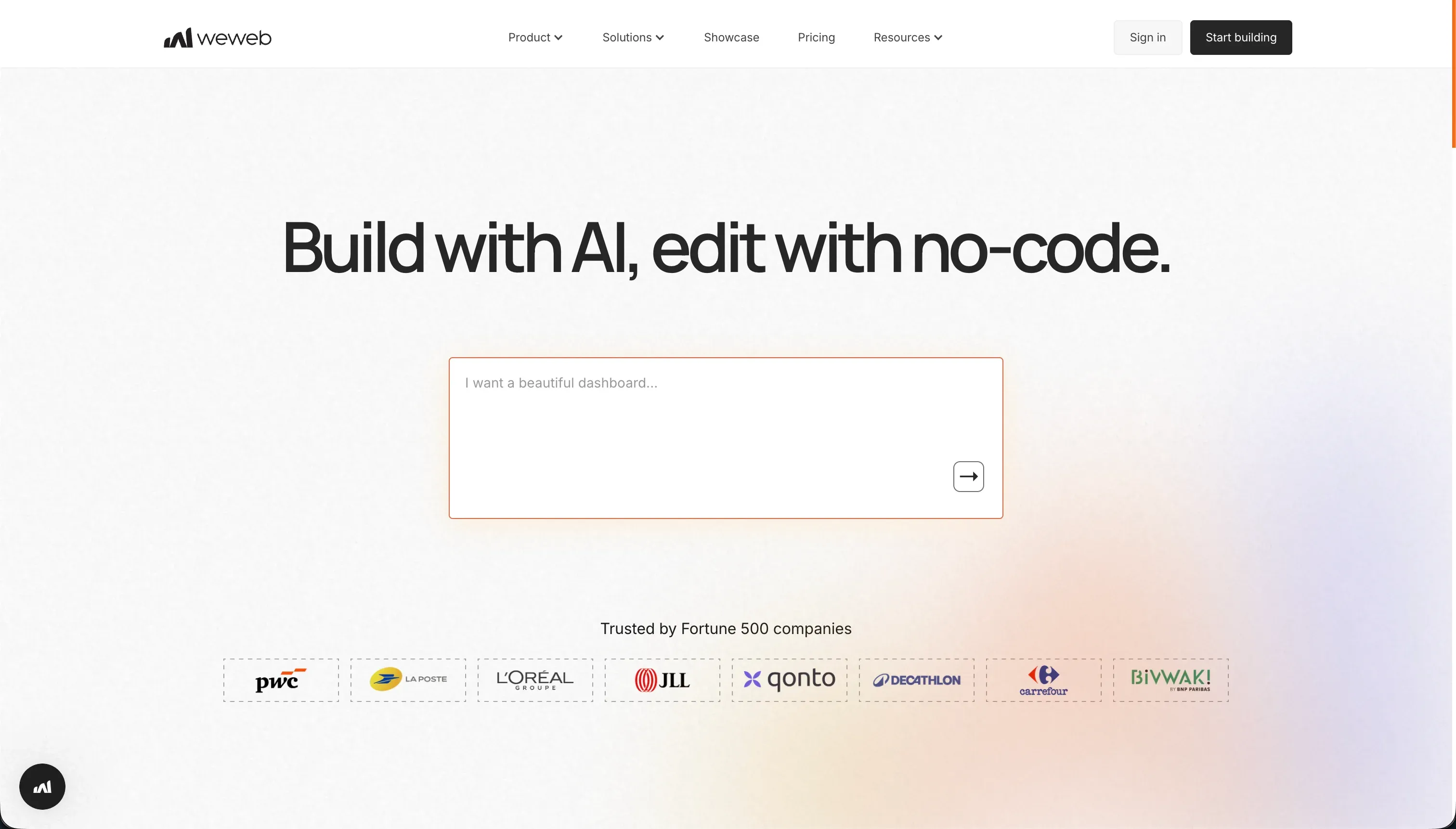
WeWeb is a visual frontend builder designed on a decoupled architecture. Instead of managing data natively, it outputs clean Single Page Applications (SPAs) that receive and send data through APIs connected to external backends. Builders assemble interfaces using design layouts and manage dynamic page states via variables, visual action workflows, and custom Vue-style actions.
The platform relies on standard connections to services like Supabase, Airtable, and Xano. Builders choose WeWeb because of its CSS control engine - including grid layouts, flexbox structures, and custom JavaScript injection - coupled with an AI helper that writes code elements on the fly.
It is built for professional frontend teams and low-code agencies who need control over the interface without writing HTML and CSS from scratch.
What is Zite?
Zite is a prompt-driven application creator that builds interfaces, database schemas, and workflows conversational-style. A builder inputs a natural-language description, and Zite generates page layouts, a relational database, and multi-step background automations.
Its visual editing experience relies on Chat and Plan Modes that allow builders to refine, add, or troubleshoot elements conversationally.
The system inherits its form building and validation logic from Fillout, supporting multi-step data entry, conditional layout rules, and standard SSO connections. The built-in SQL database works like a spreadsheet, supporting relational connections and basic database tables.
Zite is genuinely built for solopreneurs, operators, and small teams who want a functional database MVP without learning database modeling or layout configurations.
The core difference
These platforms represent a split between professional layout construction and conversational placeholder generation.
- WeWeb functions as a layout developer that handles complex frontend logic, relying entirely on you to procure and secure an external database back-end.
- Zite operates as a conversational developer that builds the frontend and backend in one prompt, requiring you to iterate via instructions and accept structured template limitations.
Where the scores diverge
Design flexibility: WeWeb 8.5, Zite 4.5. This is WeWeb’s flagship score at 8.5/10. It delivers complete flexbox, grid, and absolute positioning controls along with custom JS/CSS generation. Zite scores just 4.5/10 because its page styling is constrained to the AI design layout options, with users noting the generated aesthetic skews generic or corporate, making branded agency work highly difficult.
Ease of build: WeWeb 4.0, Zite 7.5. Zite scores much higher at 7.5/10 on ease of build because a user can describe an application and get pages, tables, and workflows created instantly.
WeWeb scores a low 4.0/10 because it lacks any built-in database, meaning you cannot display a single row of dynamic data before purchasing and configuring a backend like Xano or Supabase. WeWeb also requires a firm understanding of API payloads, variables, and state management, which presents a high starting barrier for non-engineers.
Maintainability: WeWeb 6.0, Zite 4.0. WeWeb secures 6.0/10 because edits to variables, CSS styles, and page states are directly manipulated in a visual studio without AI dependency.
Zite scores 4.0/10 because its design elements are deeply tied to generated block templates; changes outside of these rigid templates must go back through conversational prompts, frequently introducing regression errors.
Additionally, Zite lacks code export or GitHub synchronization, creating a highly restrictive environment over the lifetime of the application.
Production readiness: WeWeb 6.0, Zite 4.5. WeWeb takes this category with 6.0/10 against Zite’s 4.5/10. WeWeb compiles into fast, SEO-friendly SPAs, though mobile rendering can occasionally lag behind desktop performance.
Zite is severely limited as an enterprise-grade solution because its built-in database lacks advanced formulas, roll-up configurations, and custom SQL views. Furthermore, Zite counts simple page reloads as workflow executions, which can rapidly exhaust monthly transaction allowances on active production apps.
Data & integrations: WeWeb 7.0, Zite 5.5. WeWeb scores 7.0/10 here as its core architecture is built to query SQL, no-SQL, and REST APIs, though it loses points because it cannot house any native tables, and some reviewers call out weak headless-CMS integration.
Zite’s 5.5/10 score reflects its reliance on its own built-in database with limited integrations for Airtable and Sheets, alongside a lack of advanced formulas and roll-up structures needed to run complex relational systems.
Security & access control: WeWeb 5.5, Zite 5.0. WeWeb’s 5.5/10 score reflects its reliance on token-based authentication flows configured against your external database, housing advanced features like SSO on its Custom Enterprise tier.
Zite scores 5.0/10 because although it carries over Fillout’s solid SSO roots, its access control rules are fundamentally basic and enforced via conversational workflows rather than standard, visually verified server-side security rules.
Cost comparison
The financial cost of these two platforms depends on your scaling requirements. WeWeb charges a flat fee structure starting at $59/month (Billed Monthly) for a single published custom-domain app on its Starter plan, rising to $249/month for three apps with staging environments on Scale.
Your bill is predictable, but you must additionally pay for your decoupled backend database hosting - such as Supabase, Xano, or Airtable per-seat fees - which adds a variable ledger line.
Zite offers a low entry cost with its Free plan and a Pro plan starting at $19/month, but its pricing model is heavily usage-dependent. Zite scales your subscription price based on AI credits, and iterates them programmatically, meaning conversation loops and page redesigns consume credit balances.
Furthermore, because page loads and database reads are counted as workflow runs, a moderate active user base will exhaust the Pro tier’s 5,000 monthly workflow limit quickly, forcing painful plan tier upgrades.
Lock-in and the exit path
WeWeb offers an exit path on its Scale and Enterprise plans by letting you export your visual app layout code as standard Vue.js and Nuxt.js files, although you must still manage the custom API payload wiring on your own hosted servers. Zite offers no code export, no GitHub sync, and no database migration templates.
Leaving Zite requires a complete frontend and logic rebuild from scratch on another platform, meaning you only own the CSV export of your master raw data tables.
- Vue.js and Nuxt.js code export
- Scale and Enterprise plans only
- Self-manage API payload wiring
- No code export
- No GitHub sync
- No database migration templates
- Full frontend and logic rebuild
- CSV export of raw data only
Who should pick WeWeb
Pick WeWeb if:
- Frontend engineering teams that need a clean visual designer that publishes optimized Vue.js apps
- Low-code agencies who build custom layout experiences connected to Airtable or Supabase
- Product managers demanding precise control over CSS styles, grid systems, and absolute positioning elements
Do not pick WeWeb if you need an all-in-one platform with a built-in database and instant out-of-the-box user authentication.
Who should pick Zite
Pick Zite if:
- Solopreneurs looking to generate a relational database MVP from a single text instruction
- Teams wanting to collect tabular workflow data quickly using Fillout’s built-in validation forms
- Small businesses looking for unlimited user access tiers on a budget without complex database setups
Do not pick Zite if you require custom mobile layouts, GitHub code synchronization, database rollups, or predictable usage pricing.
What neither platform answers
Both WeWeb and Zite assume your developers want to manage complex API connections, parse custom state codes, or maintain rigid prompting loops. If you are building a standard business app - such as an internal tool, client onboarding portal, or CRM - neither platform handles this efficiently.
WeWeb forces you to buy and secure a separate database, while Zite traps you in credit consumption cycles to execute basic page updates.
For transactional business software, Softr delivers a pre-built secure foundation. Softr scores 8.5 on production readiness, 9.0 on maintainability, and 8.5 on security & access control because it provides native user registration, granular permissions, and responsive blocks out of the box.
You get the agility of flat-rate plans and secure connections directly to your Slack, Airtable, HubSpot, or native Softr Databases without coding connections from scratch.
Analyst verdict
The final comparison scores favor WeWeb 6.2 to 5.2. WeWeb takes design flexibility, integrations, maintainability, and production readiness. Zite claims ease of build due to its single-prompt generation, but falls drastically short when an app needs to scale beyond its initial template placeholder.
If you want visual control and are comfortable maintaining a decoupled backend, WeWeb is the superior professional developer tool. If you only need a quick database prototype and do not mind generic layouts, choose Zite, keeping in mind that you will eventually need to rebuild the application once layout limits or workflow consumption overages arrive.
Related reading: the WeWeb scorecard, the Zite scorecard, and our scoring methodology.