

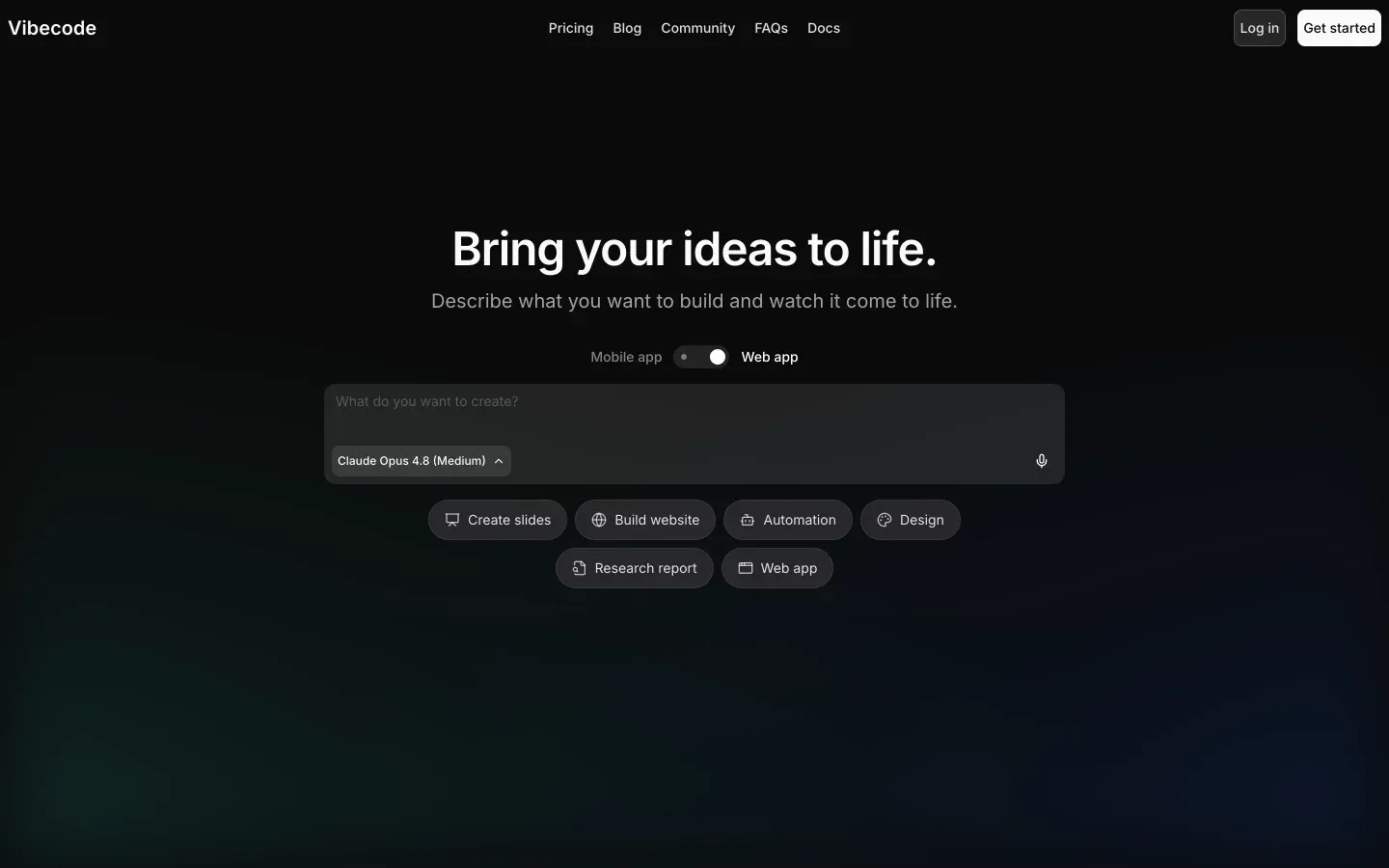
VibeCode and Softr represent two fundamentally different approaches to building modern software without writing code. VibeCode belongs to the mobile-first vibe coding tool category, generating raw code from natural-language prompts to build smartphone apps.
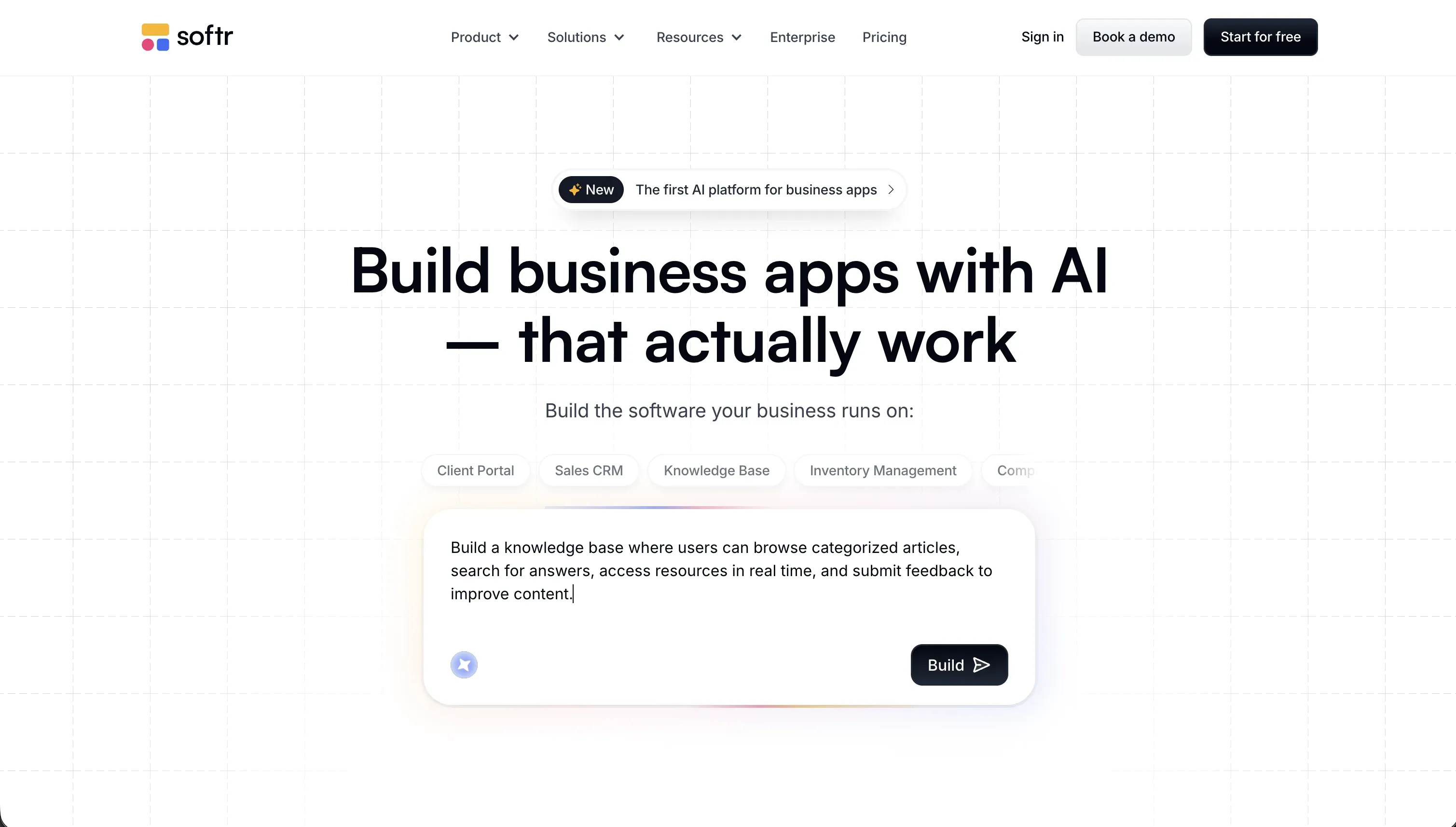
Softr belongs to the AI-powered business app category, utilizing a structured, visual interface built on secure platform infrastructure to deliver operational software.
Softr wins the aggregate procurement decision, 8.1 to 6.1, by offering higher reliability, security, and long-term maintainability for the business portal and internal tool class. VibeCode flips the decision only when the target is a native smartphone application intended for distribution directly to the Apple and Google app stores.
The decision in 30 seconds
| If your priority is… | Pick | Why |
|---|---|---|
| Client portals, CRMs, or team intranets | Softr | Its authentication, data restrictions, and visual layout blocks are secure by default |
| Native mobile apps on the App Store | VibeCode | It packages native app files for iOS and Android directly from plain-English prompts |
| Fastest build for non-technical teams | Softr | Ease of build scores 9.0 against 7.0 by avoiding debugging loops |
| Long-term maintainability without technical debt | Softr | No generated codebase to maintain, and visual settings allow manual edits |
| Predictable software cost without overages | Softr | Flat-rate pricing plans with clear user limits replace raw AI credit systems |
| An exportable codebase with SSH access | Neither | Only VibeCode offers code export, but teams requiring code ownership should evaluate Replit instead |
What each platform is
What is VibeCode?
VibeCode is an AI-powered, mobile-first application builder that compiles native smartphone apps from plain-English descriptions. Operating on a vibe coding paradigm, the platform prompts users to act as product directors, translating text descriptions into user interfaces, built-in databases, and cloud hosting without requiring manual programming.
VibeCode packages applications directly for deployment to the Apple App Store and Google Play Store. It provisions an automated backend and a native on-device previewer, targeting builders who want to spin up lightweight mobile utilities, quick native prototypes, or lightweight consumer games.
On its higher tiers, it provides a developer-friendly escape hatch by exposing raw code export and direct SSH access to external editors like Cursor.
What is Softr?
Softr is an AI app builder designed to compose secure operational software without developer dependencies. Builders can describe their application requirements to the AI Co-Builder, which instantly generates a connected relational database, page layout, user permissions, and navigation menu that are fully editable via a drag-and-drop studio.
The platform ships with pre-engineered components like forms, kanbans, tables, calendars, and dashboards that natively inherit global styling. Softr connects dynamically to native Softr Databases as well as external data sources like Airtable, Notion, and Google Sheets, enabling multi-tenant portals, internal CRMs, and partner trackers.
It also includes an advanced Vibe Coding block to generate bespoke UI elements that safely run server-side queries.
The core difference
The core divergence between these two platforms lies in what the AI actually produces when you prompted it.
- VibeCode generates a custom native mobile codebase from scratch, placing the responsibility of managing code structure and edge-case exceptions entirely on the AI.
- Softr composes standard visual configuration settings on top of a runtime environment that uses battle-tested, pre-built infrastructure packages.
Where the scores diverge
Maintainability: VibeCode 5.5, Softr 9.0. The maintainability gap is a wide 9.0 to 5.5 in favor of Softr. Softr apps have no generated software code to maintain or debug. Visual updates are simple toggles, and any AI-generated block works with near-parity to manual editing without burning credits. VibeCode leaves you with a custom codebase.
As your application scales, VibeCode’s AI can lose context of large projects, resulting in unoptimized, messy code that becomes extremely difficult to modify or troubleshoot on Day Two.
Security & access control: VibeCode 5.0, Softr 8.5. Softr scores 8.5 for access control, whereas VibeCode scores 5.0. Softr provides secure user groups, page rules, and row-level data restrictions processed client-safe on the server, permitting administrators to visually confirm security settings via a live preview impersonation tool.
VibeCode includes built-in user authentication, but you are responsible for testing and auditing how the AI actually implements database security rules. Safe data structures must be read and verified line-by-line, creating significant leaks and security risks for unreviewed builds.
Production readiness: VibeCode 5.5, Softr 8.5. Softr scores 8.5, and this high reliability reflects its platform infrastructure. Secure logins, session limits, and database operations run on standard server systems with SOC 2 Type II compliance and European data hosting.
VibeCode scores 5.5 because its prompt-engineered approach builds custom code for every app. Taking a generated codebase directly into production risks unhandled edge-case crashes and security gaps that can easily fail official Apple App Store or Google Play reviews without manual audits.
Ease of build: VibeCode 7.0, Softr 9.0. Softr outscores VibeCode 9.0 to 7.0 due to its visual hybrid editor. With Softr, the AI Co-Builder handles assembly, but the builder retains immediate visual control of all properties in the sidebar.
This means you do not have to re-prompt the AI to tweak styles, align buttons, or fix mobile responsive layout issues. VibeCode generates native mobile screens quickly from text prompts, but building deeper application logic can run into a complexity wall where the AI hallucinates, prompting fatigue sets in, or the generated code loses logic structure.
Data & integrations: VibeCode 6.5, Softr 8.0. Softr leads data and integrations 8.0 to 6.5. Softr databases are built natively, relational by default, and connect directly to external business sources like Airtable, Google Sheets, and Notion, alongside full REST APIs on the Business plan.
VibeCode relies on its own VibeCode Cloud storage and built-in database setup. While VibeCode can link external API calls (such as GPT or maps), every external execution is metered through your plan’s raw AI credit allocation, which can rapidly exhaust resources during heavy production usage.
Design flexibility: VibeCode 7.0, Softr 5.5. VibeCode scores 7.0 for design flexibility, outpacing Softr’s 5.5. VibeCode specializes in smartphone layout design, creating native layouts with instant on-device testing. Softr relies strictly on structural, pre-engineered blocks under a global theme engine.
Even though it provides an isolated visual Vibe Coding block to build custom React components that safely extend your menus, layouts remain limited by a standard page grid designed strictly for business efficiency rather than consumer pixel-perfection.
Cost comparison
VibeCode and Softr run on fundamentally different billing models, making upfront cost forecasting a priority for procurement teams. Softr uses flat, predictable subscription plans matching fixed app capacities. Basic is $19/mo and Pro is $99/mo when billed annually, offering clear user, database, and workflow operation plateaus.
While Softr plans include AI credits, exhausting them does not halt development; any styling or logic update can be made manually inside the editor without prompt fees.
In contrast, VibeCode uses an direct credit-consumption model on tiers like Plus ($20/mo), Pro ($50/mo), and Max ($200/mo) where payment converts directly into raw AI model execution. Buyers should note that every design iteration, layout fix, and database change in VibeCode requires re-generating code and consuming plan credits.
Complex debugging or iterative refactoring loops can create unforecastable software spend, forcing teams to pay premium credit overages simply to maintain an active native MVP.
- Basic $19/mo, Pro $99/mo annual
- Fixed user, database, workflow plateaus
- Included AI credits
- Manual edits never cost prompt fees
- Plus $20, Pro $50, Max $200/mo
- Every change regenerates code
- Debug loops consume credits too
- Overages needed to keep MVP live
Lock-in and the exit path
The lock-in characteristics show an important technical divide. Softr does not export application code, meaning the frontend layout, permissions, and workflows must be rebuilt to migrate to a new stack, although your data can be moved freely out of a native Softr Database.
VibeCode offers a cleaner developer exit path on its Pro ($50/mo) and Max ($200/mo) tiers, allowing full source code download and direct SSH access to work in local environments. However, VibeCode bases are heavily optimized for its cloud runtime, meaning custom code cleanups are required if you move the codebase to standardized self-hosted resources.
- Softr: data exports freely
- Softr: data moves out intact
- Softr: no application code export
- Softr: rebuild layout, permissions, workflows
- VibeCode Pro, Max: full source download, SSH
- VibeCode: run the codebase locally
- VibeCode bases tuned to its cloud runtime
- VibeCode: cleanup needed for self-hosting
Who should pick VibeCode
Pick VibeCode if:
- Creators who want to design, test, and publish native mobile utilities, simple companion tools, or lightweight consumer games directly to the iOS and Android App Stores.
- Technical prototypers who need to spin up native smartphone MVPs quickly using prompts, while keeping an exit route open via Pro-tier code downloads.
- Teams focused primarily on native smartphone-centered designs where mobile preview speed is the core validation metric.
Do not pick VibeCode if you are building mission-critical business portals, internal team databases, or CRMs where unreviewed AI-generated code introduces unpredictable logic crashes and security risks.
Who should pick Softr
Pick Softr if:
- Operations professionals building secure portal applications, inventory managers, vendor workflows, or client collaboration boards.
- IT departments that require verified compliance standards, including SOC 2 Type II validation and secure EU-based data storage.
- Non-technical business owners who need to visually modify application parameters, permissions, and styles after launch without relying on AI prompt budgets.
Do not pick Softr if your priority is compiling native iOS and Android packages for public app store listings instead of rolling out responsive Progressive Web Apps.
Where neither platform fits
If your project demands native deployment onto public app stores but requires a highly customized mobile interface, neither VibeCode nor Softr represents a professional-scale fit.
VibeCode compiles native packages but hits a logic complexity wall, while Softr is architected for responsive web portals and Progressive Web Apps (PWAs) rather than native listings.
Buyers with this requirement should evaluate FlutterFlow, which generates clean, production-grade Dart code structures with a drag-and-drop widget tree and full app-store export frameworks.
If your organization enforces strict code ownership, self-hosting, and manual version control on GitHub right from day one, platform locked-in systems will not pass security. You should instead select a code-first AI workspace like Replit.
Replit generates readable, maintainable standard code structures in an open workspace that technical team members can edit, audibly verify, and self-host on independent developer resources.
Analyst verdict
Softr wins this comparison with an aggregate score of 8.1 to VibeCode’s 6.1. It represents a more reliable procurement decision for any operating environment where application stability, audited user permissions, and clear maintainability are central requirements. By substituting raw generative code with pre-built framework components, Softr removes the risks of silent database crashes and logic drift.
VibeCode is a targeted tool for compiling lightweight mobile designs directly from natural language. If your sole goal is launching a native phone utility on the public App Store, VibeCode’s code compilation handles that specific loop better, but the team must be prepared to monitor plan limit credit burn and manually audit security policies.
Related reading: the VibeCode scorecard, the Softr scorecard, and our scoring methodology.