

These 2 tools solve different procurement problems. VibeCode is a mobile-first AI app builder for generating native-style mobile apps from prompts, while Emergent is an AI full-stack web app generator aimed at spinning up browser-based products from chat. One is closer to a mobile packaging workflow; the other is closer to an autonomous web scaffolding agent.
VibeCode wins the general decision 6.1/10 to 5.0/10. It takes the safer lead on production readiness, maintainability, data & integrations, and design flexibility. Emergent only flips the choice when 1 priority matters more than everything else: getting an initial web prototype live as fast as possible. If the app must survive iteration, handoff, and billing scrutiny, VibeCode is the stronger buy.
The decision in 30 seconds
| If your priority is… | Pick | Why |
|---|---|---|
| Native mobile layouts with App Store compilation | VibeCode | Built around mobile generation and packaging rather than browser-first scaffolding |
| Fastest full-stack web prototype from a single prompt | Emergent | Matches the higher ease profile for first-pass web scaffolding at 7.0 |
| Safer iteration after the first build | VibeCode | Its 5.5 maintainability beats Emergent’s 3.5 and includes export-oriented escape hatches |
| Predictable AI credit spend | VibeCode | Research points to cleaner credit translation while Emergent users report costly edit loops |
| Secure client portals or internal tools | Neither | Both score weakly on security control and rely too heavily on generated rules |
What each platform is
What is VibeCode?
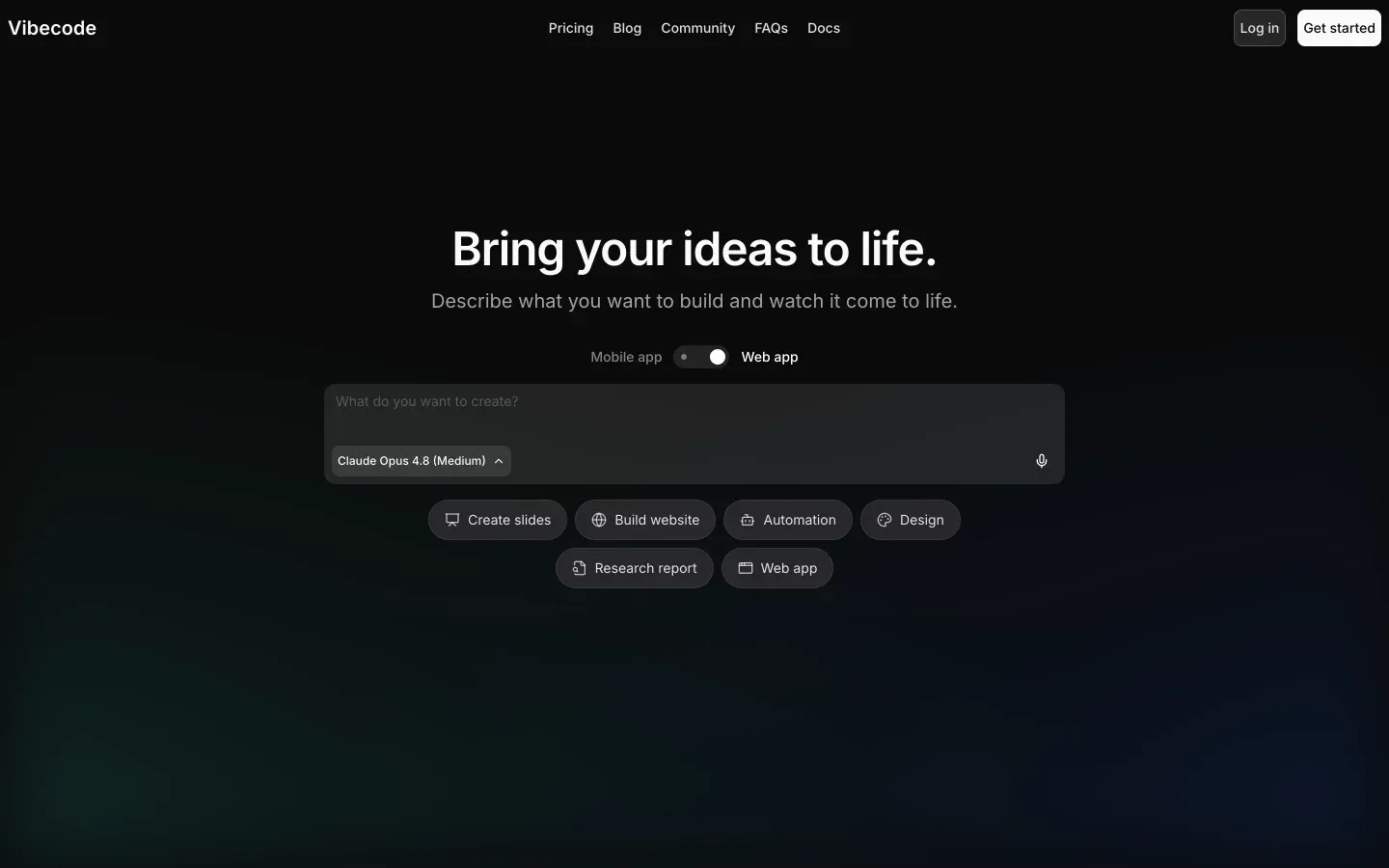
VibeCode is an AI-powered, mobile-first app builder that turns natural-language prompts into native-style mobile applications. The build model is conversational: you describe the app, the system generates and updates the underlying implementation, and you validate it through mobile-oriented previews and testing rather than manually assembling every screen from scratch.
The research highlights on-device testing, a built-in relational database, user authentication, cloud storage through VibeCode Cloud, and higher-tier code export with SSH access to external editors. That mix makes it genuinely suited to founders, solo builders, and developers who want a fast mobile MVP but still need a credible path to inspect or move the code later.
What is Emergent?
Emergent is an AI application generation environment for full-stack web apps created from a prompt. Its build model centers on an autonomous agent that scaffolds frontend views, backend logic, routing, and database structure, then keeps revising the project through chat-driven edit requests inside hosted preview containers.
The research points to rapid first-pass generation of schemas, routes, and UI, but also to recurring issues such as agent wake errors, repeated debugging loops, and blocked access during build failures. In practice it is built for teams or prototypers who value speed to a browser demo more than they value stable long-term maintenance.
- Conversational prompts to native-style mobile apps
- Validate via mobile previews and testing
- Built-in relational database and auth
- Code export with SSH at higher tiers
- Suited to a fast MVP you can still inspect
- Autonomous agent scaffolds frontend, backend, routing, database
- Chat-driven edits in hosted preview containers
- Rapid first-pass schemas, routes and UI
- Agent wake errors and debugging loops recur
- Aimed at speed to a browser demo
The core difference
The biggest difference is not just mobile versus web. It is guided mobile generation with an export path versus autonomous web generation inside a managed agent runtime.
- VibeCode packages a mobile-first build flow that stays opinionated about app form factor while still giving stronger escape hatches through code export and SSH access.
- Emergent optimizes for prompt-to-web-app speed, but depends far more heavily on its own agent and container layer to keep the project editable and runnable.
Where the scores diverge
Production readiness: VibeCode 5.5, Emergent 3.5. VibeCode separates itself by offering a more credible route from prototype to shippable app, with built-in backend services and a workflow aimed at real mobile deployment. It still loses points because prompt-generated apps can fail on edge cases and require review before any serious store launch.
Emergent falls behind because the research cites agent wake failures, preview-versus-production gaps, and blocked access during hosting issues. Those are platform-level reliability problems, not just normal prototype rough edges.
Maintainability: VibeCode 5.5, Emergent 3.5. VibeCode scores better because it gives buyers a cleaner handoff path through code export and SSH access on higher plans, so the project is not trapped entirely inside the platform. It still is not elite on maintainability, since large AI-generated codebases can lose coherence as the app grows.
Emergent takes the larger deduction because users report the edit agent redoing work, looping on the same bug, and burning credits on tiny revisions. That makes ongoing ownership expensive and hard to trust.
Data & integrations: VibeCode 6.5, Emergent 5.5. VibeCode leads because the research points to a built-in database and cloud storage model that is more stable for ongoing use than pure first-pass scaffolding. It still gives up points because advanced pipelines and more complex integration needs can outgrow the prompt-first workflow.
Emergent starts well by wiring schemas and routes quickly, but loses ground when projects become more realistic in scale. Reports of structural breakdowns and unstable iteration make that early convenience harder to trust in a live app.
Design flexibility: VibeCode 7.0, Emergent 6.0. VibeCode wins here because it is purpose-built for mobile-first layouts and real-time smartphone-oriented app composition. The deduction is that it still does not offer the same fine-grained visual control as a dedicated design-led builder.
Emergent remains usable for general web layouts, but its output is less polished for mobile presentation and depends on the agent to interpret design intent repeatedly. That makes design refinement less reliable as requirements get more specific.
Security & access control: VibeCode 5.0, Emergent 4.5. Neither tool is a strong security choice, which is why this criterion stays relatively close. VibeCode gets a slight edge because it includes built-in authentication, but buyers still have to audit what the AI produced and verify routes and permissions manually.
Emergent trails because access behavior is generated conversationally and confidence drops further when the environment itself becomes unstable during container or backend issues. In short, both can create access logic, but neither gives the visual, policy-first control a business app team would want.
Ease of build: VibeCode 7.0, Emergent 7.0. This is effectively a near-tie and it does not decide the matchup. VibeCode is strong because a user can describe a mobile app in plain language and get screens and app behavior without setting up a traditional native toolchain first.
Emergent is equally strong at that first moment for web apps, since it can scaffold frontend, backend, and schema from one prompt. The deduction on both sides comes after the first win: VibeCode becomes less comfortable on advanced logic, while Emergent makes structural edits depend heavily on chat and agent behavior.
Cost comparison
The pricing models are both credit-driven, but they behave differently in practice. VibeCode starts at Plus for $20/mo and goes to Max for $200/mo, with research describing a no-markup translation to underlying LLM API usage on qualifying plans.
Emergent also runs from Standard at $20/mo to Pro at $200/mo, but the bill moves not just with usage volume: unused credits expire monthly, and extra credit packages auto-renew by default.
The hidden costs to forecast are builder time, repeated edits, maintenance friction, overages, and migration work. VibeCode’s extra line items are mostly the human time needed to review generated mobile logic and the future cost of moving exported code into a normal engineering workflow.
Emergent adds a bigger risk of credit burn during agent retries and debugging loops, plus the cost of rebuilding if the managed environment becomes the bottleneck. In both cases, plan price is only the starting line; iteration behavior is what changes total ownership cost.
Lock-in and the exit path
VibeCode has the cleaner exit path. Research says it offers code export and SSH access on higher plans, which means a team can leave with working source assets even if they must still rebuild parts of the workflow around them.
Emergent appears much stickier because the app is generated and managed across its own agent and container system, and the research does not point to an equally clean export path. With Emergent, leaving is more likely to mean recreating frontend behavior, backend setup, and operational structure elsewhere.
Who should pick VibeCode
Pick VibeCode if:
- Founders or solo builders who need a mobile-first MVP and care more about shipping an app than hand-coding a native stack from day one
- Teams that want stronger long-term escape hatches, since VibeCode scores 5.5 on maintainability and includes code export and SSH access on higher tiers
- Buyers who want more predictable credit economics than Emergent’s reported edit-loop behavior
- Projects where mobile presentation matters more than desktop-first web scaffolding, supported by VibeCode’s 7.0 design flexibility score
Do not pick VibeCode if your project is really a secure internal business app or a complex web product that needs visually managed permissions and enterprise-grade operational controls.
Who should pick Emergent
Pick Emergent if:
- Prototypers who need a browser-based proof of concept fast and value first-pass generation over long-term stability
- Teams exploring product ideas where a 7.0 ease-of-build experience matters more than maintainability after launch
- Buyers who specifically want prompt-generated full-stack web scaffolding with backend routes and schema creation from one request
Do not pick Emergent if you need predictable maintenance, stable production behavior, or strict control over credit spend once iteration begins.
What neither platform answers
Many buyers reading this matchup do not actually need a prompt-first code generator at all. They need a business app: a client portal, internal tool, CRM, or operations workspace defined by logins, permissions, structured data, and low-maintenance handoff.
That is the lane where Softr is usually the better answer, because it is designed around prebuilt business-app primitives rather than asking non-technical teams to police generated code.
In the research, Softr scores 8.5 on production readiness, 9.0 on maintainability, and 8.5 on security & access control, which is exactly why it fits that procurement problem better.
If your need is a stable business application, choose Softr. If your need is mandatory code ownership and a self-hostable exit from day one, Replit is the more sensible alternative angle because it is closer to a coding environment than a managed no-code runtime.
VibeCode and Emergent both sit in the middle: fast to generate with, but weaker when governance, maintainability, and security become the real buying criteria.
Analyst verdict
VibeCode wins 6.1 to 5.0. It takes production readiness, maintainability, data & integrations, and design flexibility, while Emergent only keeps ease of build and stays relatively close on security & access control. That is enough of a spread to make VibeCode the default recommendation for most serious buyers in this matchup.
The reason is not that VibeCode is flawless. Its own scores remain mid-table, especially where prompt-generated logic still needs human review, but it gives buyers a more credible ownership path through export and SSH access and avoids the worst runtime complaints found in Emergent’s research.
Emergent’s problem is that its value is concentrated in the first session, then erodes once repeated edits, agent loops, and container instability start to matter.
The decision only flips if your app is a short-lived web prototype and speed to a browser demo is the whole job. In that narrow case, Emergent’s 7.0 ease-of-build profile can be enough. If you expect the product to live beyond the prototype phase, VibeCode is the safer recommendation.
Related reading: the VibeCode scorecard, the Emergent scorecard, and our scoring methodology.