

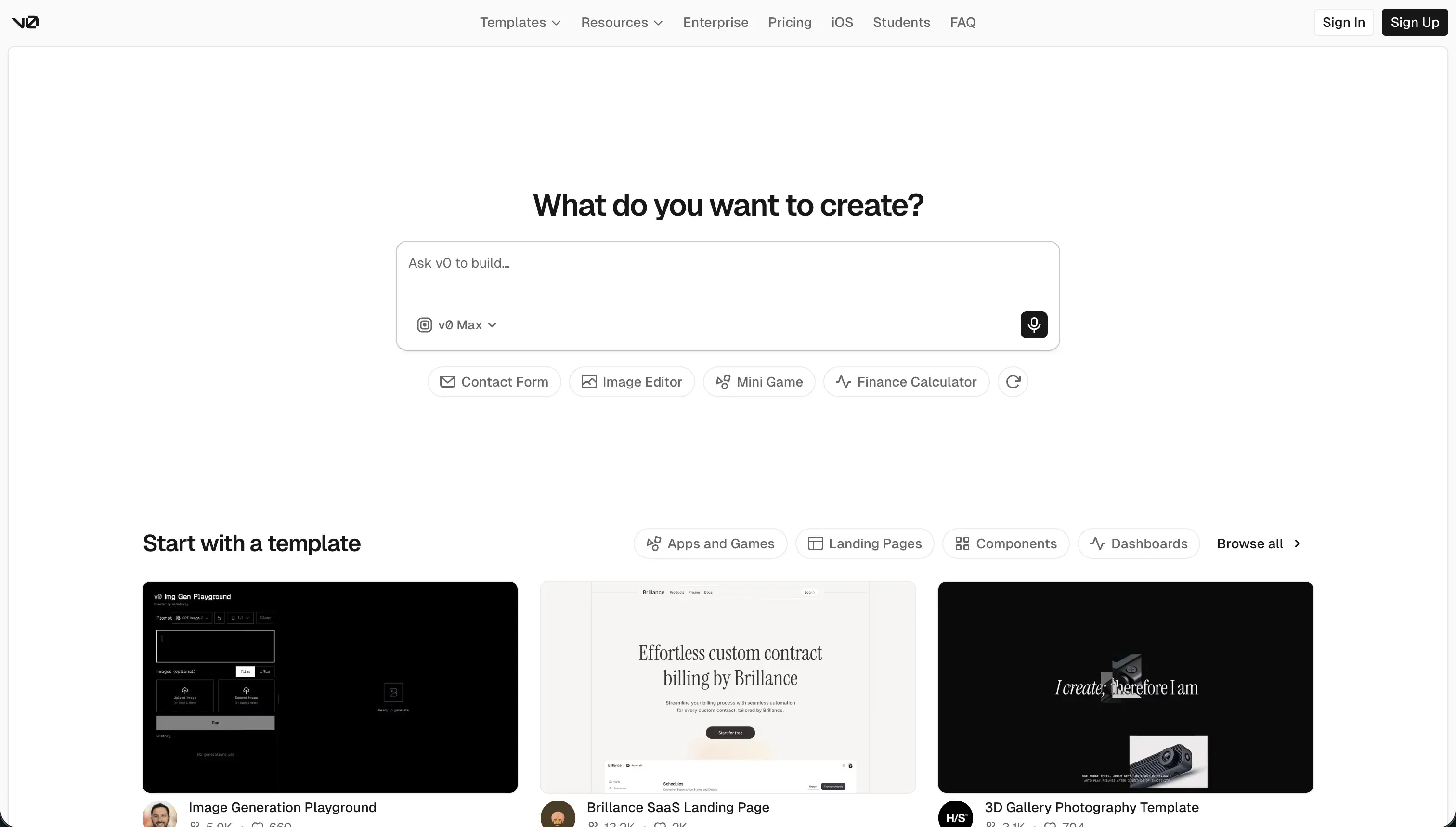
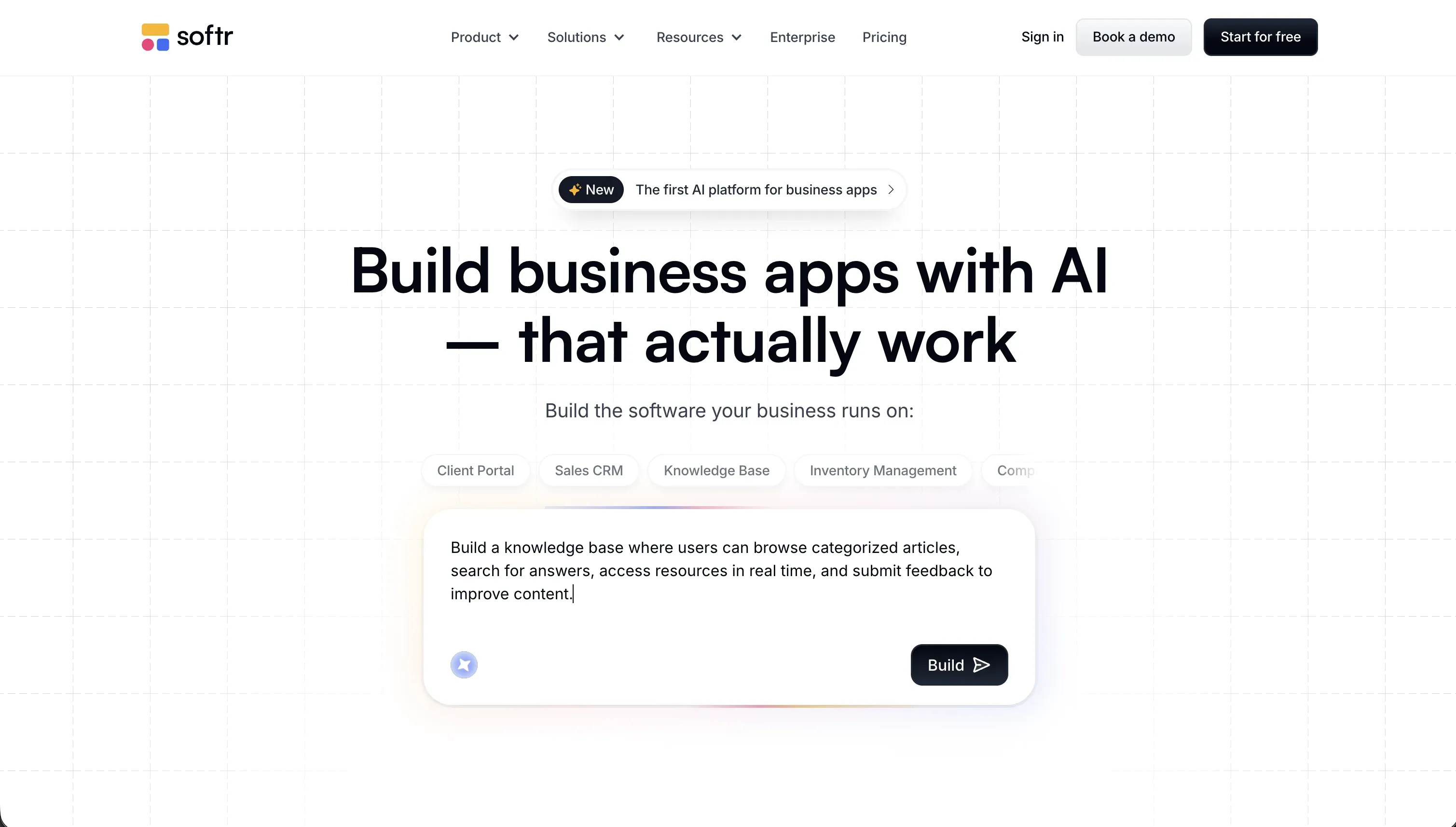
v0 and Softr solve entirely different procurement problems for teams building software. v0 is an AI-powered frontend generation assistant designed for building and deploying responsive user interfaces from natural-language prompts.
Softr, by contrast, is an AI no-code app builder that provides a full-stack runtime including a database, user authentication, and granular row-level permissions.
Softr wins the general business-app decision with an aggregate score of 8.1 against v0’s 5.8. Because v0 restricts its output strictly to frontend code, it is the correct choice only when you have a developer prepared to manually architect, connect, and self-host a custom codebase.
For client portals, internal tools, and operational workflows, Softr provides the infrastructure that non-technical teams can operate immediately.
The decision in 30 seconds
| If your priority is… | Pick | Why |
|---|---|---|
| Internal tools, client portals, and CRMs | Softr | Auth, permissions, portal routing, and hosting are native, pre-built infrastructure |
| Custom React / Tailwind frontend code | v0 | Generates clean React and TypeScript with shadcn/ui layouts from prompts |
| Fastest build for a non-technical manager | Softr | AI Co-Builder generates a secure database and pages in minutes without code |
| Pixel-level layout control and sketch imports | v0 | Imports image assets and details custom designs with Tailwind CSS adjustments |
| Secure database tables without developer help | Softr | Provides a native, relational database built explicitly for business data |
| Code ownership and git sync requirement | Neither | v0 exports frontend code but leaves hosting/db, and Softr manages the runtime |
What each platform is
What is v0?
v0 is an AI-powered frontend generation assistant built by Vercel. It enables developers and designers to generate polished, responsive user interfaces by describing pages in natural language, uploading sketches, or feeding screenshots into the model. The generator outputs real React components styled with Tailwind CSS and styled with shadcn/ui architectures.
Because v0 does not provide databases, server-side APIs, user authentication, or persistent storage, the tool resides firmly in the prototyping and UI design phase. It is genuinely built for engineers, non-technical founders, and designers who need to fast-track visual prototyping and require clean, exportable markup to drop into a standard local development process.
What is Softr?
Softr is an AI no-code app builder engineered to build and run database-driven business software. Its creation experience revolves around a hybrid visual editor where builders can describe their software to an AI Co-Builder to generate everything from schemas and page layouts to user permissions, or configure those elements manually.
Standard elements like tables, calendars, kanban boards, and forms are pre-built to keep pages responsive and secure.
Softr manages the entire software infrastructure natively. It features built-in authentication, granular row-level data restrictions, a native relational database, and multi-platform automation workflows without requiring any command-line setup. The system is designed for business operators, Operations managers, and IT departments who need functional portals and databases without handling technical debt.
The core difference
The fundamental divide between these platforms is the difference between generating design-driven frontend code and running an operational business-app environment.
- v0 acts as a conversational layout generator that leaves full-stack infrastructure, databases, and APIs to a developer’s manual code.
- Softr operates as a fully hosted, zero-code environment that keeps databases, security, and interface elements in one unified runtime.
Where the scores diverge
Security & access control: v0 4.0, Softr 8.5. Softr scores 8.5 while v0 scores 4.0. Access control is Softr’s core asset, offering native user group logic, conditional buttons, and server-side data extraction that prevents client-side exploitation. With v0, there is no native safety layer, password recovery workflow, or domain-based restrictions.
Access control behaves as an invisible risk inside generated applications because LLMs tend to implement client-side authorization, which is unsafe for private corporate data and easily bypassed by bad actors.
Production readiness: v0 4.5, Softr 8.5. Softr’s score of 8.5 dwarfs v0’s 4.5 here. Business portals require hosting, SSO, auto-updating frameworks, and session management to work cleanly for real users. Softr ships with SOC 2 Type II compliance, EU data hosting, and pre-built operational infrastructure. Conversely, v0 is a UI scratchpad.
Buyers on G2 and Product Hunt note that a v0 page is not an app; there are no transactional capabilities, database pipelines, or user sessions, meaning 80% of what a production system requires must be coded by hand after export.
Maintainability: v0 5.5, Softr 9.0. Softr leads 9.0 to 5.5. Softr prevents technical debt because builders edit dynamic blocks inside a visual canvas without re-prompting. Running out of AI credits does not stall changes because manual visual controls are always available to add database fields or change visible buttons.
In contrast, v0 is prone to context loss; users report that code quality drifts and becomes exceptionally buggy past five to ten messages. Developers frequently spend time purging bloated Tailwind code, restructuring un-componentized single-page React files, and correcting hallucinated dependencies.
Data & integrations: v0 5.0, Softr 8.0. Softr scores 8.0, and v0 scores 5.0. Softr provides its native, relational database alongside direct integrations for 17 external sources like Airtable, SQL databases, HubSpot, and Google Sheets.
It also supports the Model Context Protocol (MCP) to let external AIs securely read or write database schemas. v0 features Git sync and Vercel CDN deployments, which are excellent for engineers. Yet, because v0 has no native database, relational models, or live data binding, every data source requires manual backend integration work after visual generation.
Design flexibility: v0 8.5, Softr 5.5. v0 wins this criterion 8.5 to 5.5. It creates beautiful, freeform shadn/ui code from simple prompts or UI screenshots. The styling engine in v0 gives developers total frontend expression with CSS and Tailwind. Softr’s layout is block-based, restricting pages to standard structural containers.
Although Softr handles this ceiling with a centralized design theme panel and a secure, AI-powered Vibe Coding custom block that inherits global themes, it cannot provide the pixel-perfect, custom design model that v0 generates naturally.
Ease of build: v0 7.5, Softr 9.0. Softr scores 9.0 whereas v0 has a 7.5. Softr’s AI Co-Builder sets up web applications complete with schema relationships, sample data, nested user groups, and pages. From that point on, builders edit the app manually or conversationally.
Although v0 generates highly polished, responsive screens instantly from prompts, achieving a usable application requires a developer to assemble a local IDE, establish environment variables, resolve npm dependency conflicts during migration, and link the UI components to databases.
Cost comparison
The pricing frameworks represent a split between SaaS tiers and usage-based token limits. Softr is billed on a flat-tier architecture starting with a Free plan and moving to $19/mo Basic, $99/mo Pro, and $329/mo Business tiers when billed annually.
Since Softr does not bill per seat or compute consumption, its cost remains highly predictable as application traffic increases. AI credits scale on each tier (5 to 100) and are used for fast configurations. When credits run out, operators still maintain and scale their software visually.
v0 bills on a token credit structure. While v0 has Free options, the Team tier costs $30/user/mo and the Business tier costs $100/user/mo, with credit consumption calculated by the size of the input and output tokens of the chosen model. This usage-based model makes billing unforecastable for active projects.
Operators report exhausting credits quickly during complex debugging cycles. When credits drain, builders are blocked from code generation unless they pay premium overage fees.
- Free plan, then $19, $99, $329 per month billed annually
- No per-seat or compute billing as traffic grows
- AI credits per tier scale from 5 to 100
- When credits run out, visual maintenance still works
- Free option, Team at $30/user/mo, Business at $100/user/mo
- Credits consumed by input and output token size
- Complex debugging cycles drain credits fast
- Builders blocked from code generation without overage fees
Lock-in and the exit path
v0 has a clear advantage on exportability because Vercel maintains no platform lock-in. It outputs clean React, TypeScript, and standard Tailwind markup that you own, inspect, and host in any environment. Leaving Softr requires rebuilding the interface.
Although Softr Database records can be exported easily and its structural connections to services like Airtable and HubSpot are transparent, the block-oriented layout templates, page visibility rules, and workflow triggers are tethered to Softr’s managed runtime and cannot be transported to another backend.
- React, TypeScript, Tailwind markup: you own it
- Database records export easily
- Host it in any environment, no lock-in
- Block layouts, visibility rules, workflow triggers stay on Softr's runtime
- Interface travels with you
- Interface must be rebuilt
Who should pick v0
Pick v0 if:
- Software engineers and startup founders who need to quickly generate and prototype frontend interfaces.
- Teams with existing dev infrastructure (Next.js, Vercel, Supabase) that just need clean React markup to jumpstart building.
- Projects requiring bespoke layout models, specific Tailwind styles, or custom design details that standard SaaS blocks cannot parse.
Do not pick v0 if you lack the developer resources or database architecture needed to code, wire, and secure the backend logic your UI components require.
Who should pick Softr
Pick Softr if:
- Operations heads, founders, and IT groups wanting responsive portals, CRMs, or intranets without writing or hosting code.
- Teams that need strict, multi-tenant row-level security and user permissions that non-technical managers can easily audit and protect.
- Projects that require a secure native database connected directly to instant workflows and pre-configured business services like Stripe or HubSpot.
Do not pick Softr if your priority is creating a consumer-grade native mobile app for app store distribution or you have custom React components that must be hosted outside of a managed runtime.
Where neither platform fits
If your business requires a native mobile application distributed through Apple and Google Play stores, both of these platforms fail to meet the standard. Softr focuses on responsive web portals and Progressive Web Apps (PWAs), whereas v0 scaffolds standard web component code.
To obtain native mobile packages and export compile-ready code, you should shortlist FlutterFlow, which outputs clean Dart components and supports app store pipelines.
Similarly, if your goal is full application self-hosting combined with mandatory code ownership, yet you do not want to manage separate servers for database packages, APIs, and CDN, Replit is the more realistic route. Replit operates a complete cloud agent to generate backend and frontend layers together while keeping the entire stack inspectable and deployable.
Analyst verdict
Softr wins the aggregate matchup 8.1 to 5.8 by serving the distinct operational requirements of a production environment. For business teams and operators whose daily lives rely on client portals, secure record access, and CRM pipelines, Softr is the safer and more cost-predictable choice.
It supplies the authentication, database structure, and administrative control necessary to run a portal on day one with zero developer overhead.
v0 is a specialized design utility. Its 8.5 design flexibility score is highly valuable for developers who need to iterate fast layouts. But because it has no access control, database connections, api layers, or user session logic, it functions as a visual sketchpad rather than an application development environment.
Choose Softr to operate a secure workflow without technical debt; choose v0 when your dev team needs to fast-track visual React code generation.
Related reading: the v0 scorecard, the Softr scorecard, and our scoring methodology.