

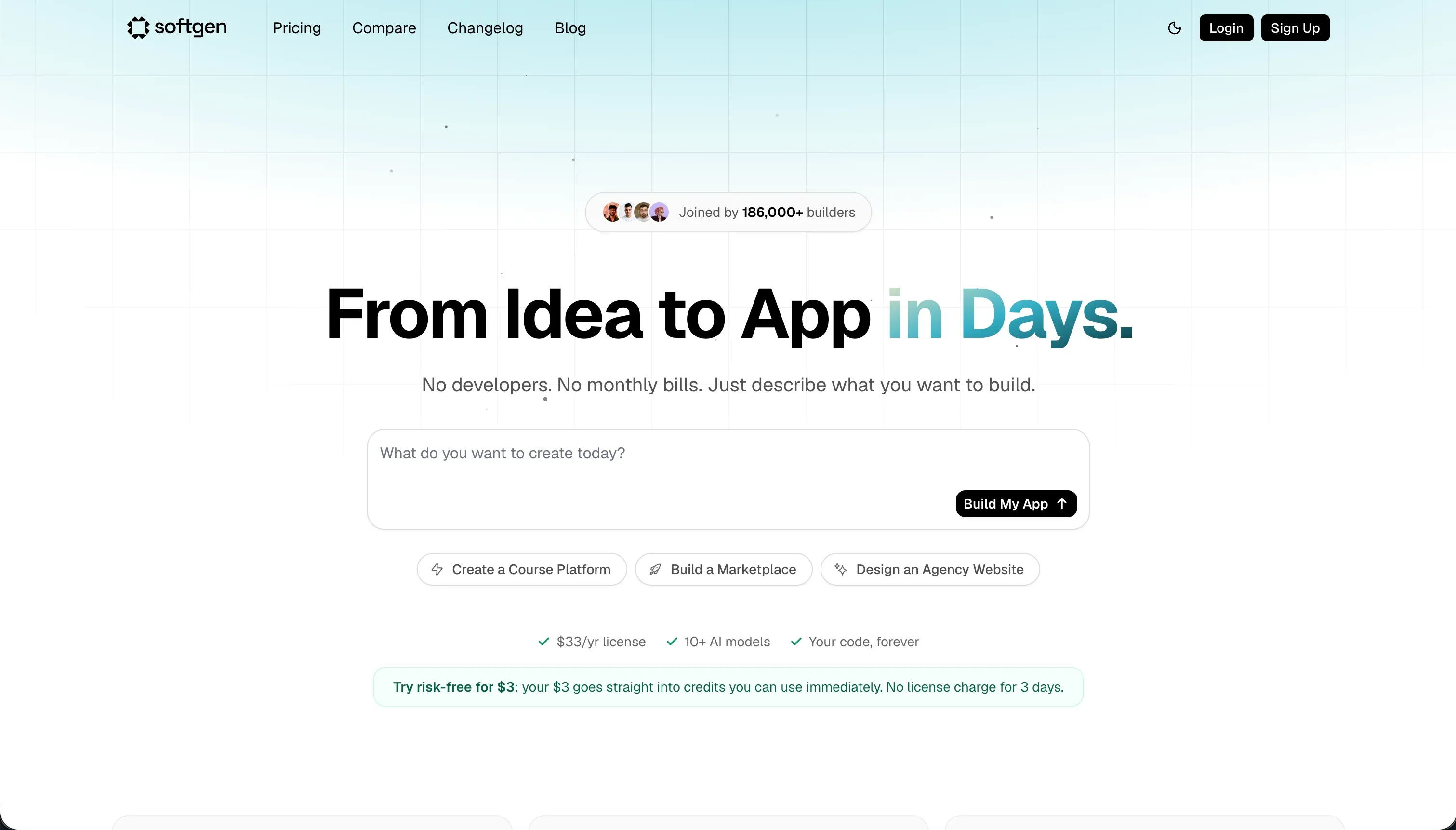
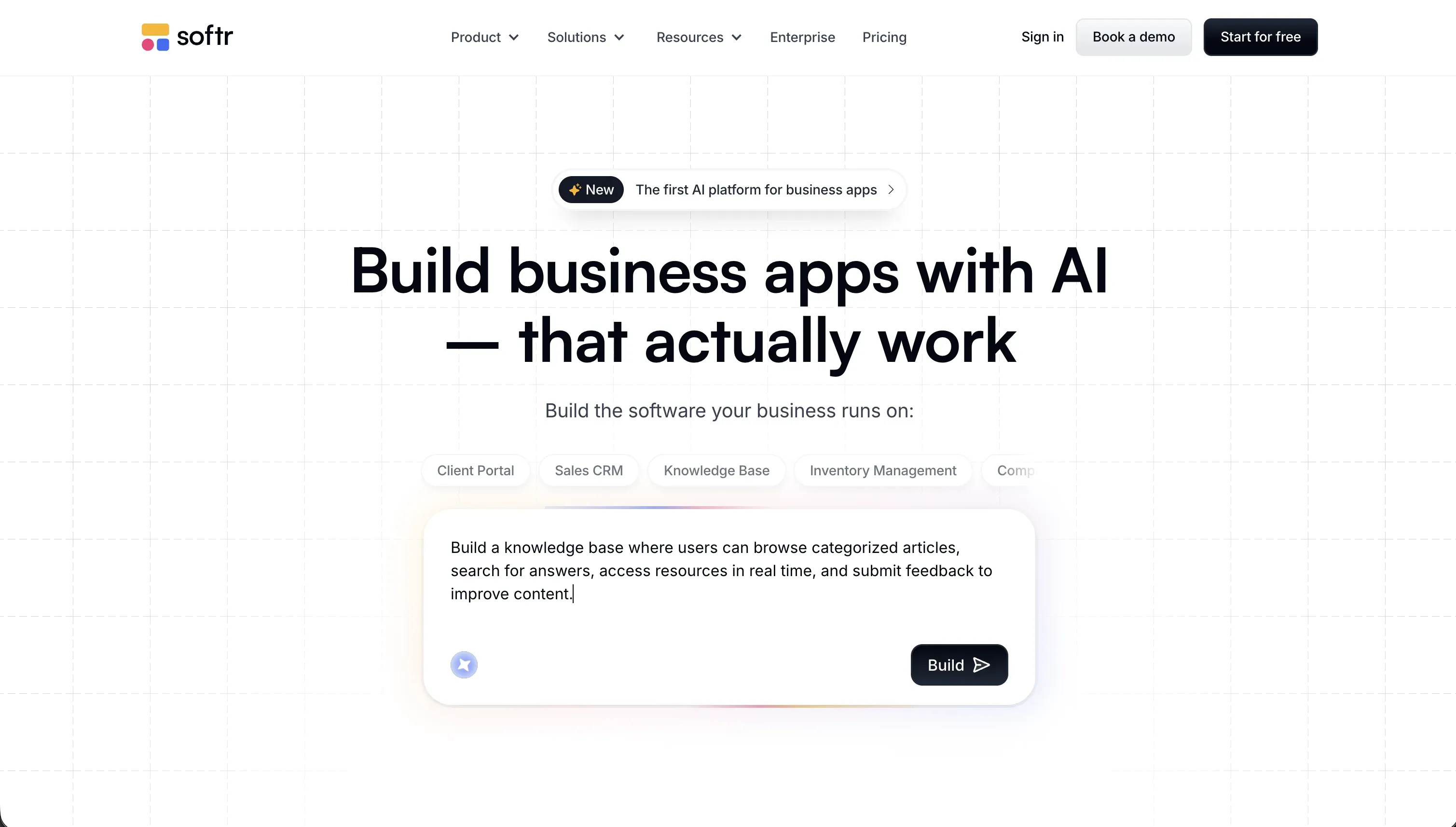
Softgen and Softr represent two fundamentally different approaches to AI-assisted app building. Softgen operates as a conversational AI code architect designed to capture structural ideas in chat prompts and translate them into custom web applications.
Softr operates as an enterprise-grade, block-based business application platform that utilizes its AI Co-Builder to orchestrate and assemble robust, battle-tested components.
Softr wins the general comparison with an 8.1/10 aggregate score against Softgen’s 5.1/10. For portals, internal operational tools, and customer-facing workflow apps, Softr is the more reliable choice. Softgen is only favored if building early-stage, disposable prototypes where low initial platform access costs are more critical than day-two maintenance.
The decision in 30 seconds
| If your priority is… | Pick | Why |
|---|---|---|
| Client portals and internal tools | Softr | Pre-built platform infrastructure like visual user groups and row-level permissions score 8.5 |
| Low cost MVP prototyping | Softgen | A low annual membership fee of $33/year avoids monthly recurring platform plans |
| Day-two app maintenance | Softr | Manual visual editing without prompting saves on credit burn and has a 9.0 maintainability score |
| Enterprise security and compliance | Softr | SOC 2 Type II compliance and EU-based data hosting come standard on its standard infrastructure |
| Mobile app store distribution | Neither | Both systems prioritize web applications and responsive sites over native iOS or Android packages |
What each platform is
What is Softgen?
Softgen is a conversational AI application builder engineered to generate full-stack web applications entirely through natural language chat. Utilizing its Cascade AI Agent, the platform acts as an interactive planning partner that guides users through planning database schemas and outlining layouts before generating the user interface and underlying database schemas.
Built primarily for indie hackers and creators who want to validate early ideas, Softgen generates templates containing user auth, basic relational databases, and light customer integrations such as Stripe payments. It lacks a visual canvas, meaning any adjustments to layout, copy, or styling require the builder to return to the conversational chat interface to prompt the agent.
What is Softr?
Softr is an AI app builder for business apps designed to build operational software like client portals, internal tools, and CRMs. Its AI Co-Builder generates databases, pages, navigation paths, and user permissions from flat text, while also giving the builder a stable drag-and-drop studio to manually edit any setting, layout, or block.
It features native Softr Databases alongside official connections to 17 external sources like Airtable, SQL, and Notion. With built-in features like a global theme engine, secure server-side CRUD operations, and an advanced Vibe Coding block for scoped custom React components, Softr is built to support operations teams from high-growth startups to large enterprises.
The core difference
The primary design divergence lies in how the interface is adjusted and managed after the first build is rendered.
- Softgen forces the builder to handle all visual, style, and copy adjustments through repetitive chat prompting loops.
- Softr combines AI generation with a visual drag-and-drop builder, allowing manual, credit-free changes at any time.
Where the scores diverge
Maintainability: Softgen 4.0, Softr 9.0. This is a significant gap: Softr scores 9.0, Softgen scores 4.0. Because Softr uses native, pre-built structural blocks, updating an app month down the line involves changing simple toggle settings without risking broken generated code.
In contrast, Softgen apps are generated strictly through AI chat, raising the risk of building technical debt over time. While it does offer code export, non-technical teams face a steep learning curve if they have to debug exported code.
Production readiness: Softgen 4.5, Softr 8.5. Softr takes this criterion 8.5 to 4.5. Production business applications require infrastructure that is stable and secure out of the box. Softr provides built-in user authentication, automatic hosting, and SOC 2 Type II certification.
Softgen provides one-click hosting, but its generation engine is described by reviewers as early-stage, lacking refinement for companies planning to support real users at scale without encountering software bugs.
Security & access control: Softgen 4.5, Softr 8.5. Softr scores 8.5 with visual visibility settings that carry row-level database permissions directly down to individual actions and buttons. All database actions run securely on the server side to protect against client-side exploitation.
Softgen scores 4.5; although it provides standard sign-in and authentication templates, its security controls are basic and lack the granular, field-level visibility constraints required by modern procurement departments.
Data & integrations: Softgen 5.5, Softr 8.0. Softr scores an 8.0 by promoting native Softr Databases alongside robust APIs and 17 external connectors like SQL, Google Sheets, and Airtable. Softgen scores a 5.5, restricted mostly to standard generated database schemas and simple Stripe integrations.
While this setup covers standard MVP checkout flows, it cannot match the breadth of live transactional sources Softr native integrations support out of the box.
Ease of build: Softgen 7.0, Softr 9.0. Softr scores a 9.0 by resolving the visual prompting fatigue common in early builders. When its AI Co-Builder scaffolds an app, the creator can immediately click on any element to visually adjust themes, text, and settings manually.
Softgen scores a respectable 7.0 because its Cascade agent is excellent at mapping database schemas and generating initial layouts in plain language, but it loses points because minor adjustments require writing additional chat prompts rather than allowing direct, manual visual edits.
Design flexibility: Softgen 5.0, Softr 5.5. Both systems have structural caps, with Softr scoring 5.5 and Softgen scoring 5.0. Softr locks developers into structured, highly stable responsive blocks, though it provides deep CSS customizations and an AI Vibe Coding block for custom React components.
Softgen is also confined to rigid, predefined layout modules, and attempts to force highly custom aesthetics through conversational chat frequently trigger repetitive prompting loops that consume credits quickly.
Cost comparison
Softgen and Softr represent two different pricing approaches. Softgen utilizes an annual membership of $33/year to cover basic platform access and hosting, combined with pay-as-you-go credit packages to fund design, iterations, and updates.
This setup keeps base costs low for builders who only need sporadic iterations, but it introduces unforecastable expenses during active debugging phases when prompting loops burn through credits.
Softr charges flat, monthly or annual subscription plans ranging from Basic at $19/mo to Business at $329/mo (billed annually). These plans provide predictable monthly costs tied to transparent limits for app users, database records, and workflows.
Because Softr allows manual, non-AI visual edits directly inside its editor, builders do not have to consume AI credits for basic color, copy, or field updates, making the total cost of ownership highly predictable.
- $33/yr base plus credits
- Cheap if edits are sporadic
- Debugging loops burn credits unpredictably
- Flat $19 to $329/mo
- Limits on users, records, workflows
- Manual edits skip AI credits entirely
Lock-in and the exit path
Both platforms represent a degree of platform lock-in on the visual interface layer, as neither exports a system that can be directly mapped to another visual drag-and-drop editor. Softgen has the cleaner programmatic exit path because it allows developers to export the raw generated codebase once they outgrow the system.
Softr requires you to rebuild the visual interface to leave, although its relational database and schemas can be exported or run on external databases like Airtable or SQL, keeping business data cleanly decoupled.
- Visual interface layer
- Softgen: raw codebase export
- Softgen: code out, visual layer lost
- Softr: database and schemas stay exportable
- Softr: data out to Airtable or SQL, interface rebuilt
- Neither exports to another visual editor
Who should pick Softgen
Pick Softgen if:
- Early-stage indie hackers looking to build and deploy disposable SaaS wireframes on a very low upfront budget.
- Builders who want to export a generated codebase as a quick starter template for manual developer handoff.
- Creators who prefer a conversational, planning-centric setup process when mapping out initial database schemas.
Do not pick Softgen if you are building a business-critical application that must be safely maintained and updated monthly by a non-technical operations team.
Who should pick Softr
Pick Softr if:
- Ops managers and business heads who need to build secure, client-facing portals or internal ERPs connected directly to operational data.
- Teams seeking enterprise compliance, including SOC 2 Type II authentication and secure, server-side row-level permissions.
- Non-technical teams who want visual certainty when making ongoing app changes without paying for recurring developer hours or burning through AI credits.
Do not pick Softr if your product roadmap explicitly demands full raw code ownership and self-hosting capabilities away from a managed platform.
Where neither platform fits
Neither Softgen nor Softr is built to compile native mobile assets suitable for Apple App Store or Google Play Store distribution. If your application’s viability relies on native mobile device integrations, proximity notifications, or mobile-first app packages, you should evaluate FlutterFlow instead.
Similarly, if your team must have full code ownership, self-hosting rights, and git-based deployment workflows from day one, you should opt for a code-first AI workspace like Replit. Choosing a web-focused, block-based, or hosted platform when you need raw code custom environments will only result in an expensive platform migration later.
Analyst verdict
Softr wins this comparison with a decisive 8.1 to 5.1 aggregate score. This margin is driven by Softr’s superior ratings in production readiness (8.5 vs 4.5) and maintainability (9.0 vs 4.0). For any company building client portals, operational dashboards, or team CRMs, Softr provides the necessary security infrastructure, visual feedback, and reliable performance that modern organizations demand.
Softgen remains a niche platform for makers trying to prototype simple SaaS directories at lowest possible cost. Its pay-as-you-go credit architecture is ideal for sparse builds that do not need regular updates, but it cannot match the reliable, day-two visual editor and secure role logic that underpins daily operations on Softr.
Related reading: the Softgen scorecard, the Softr scorecard, and our scoring methodology.