

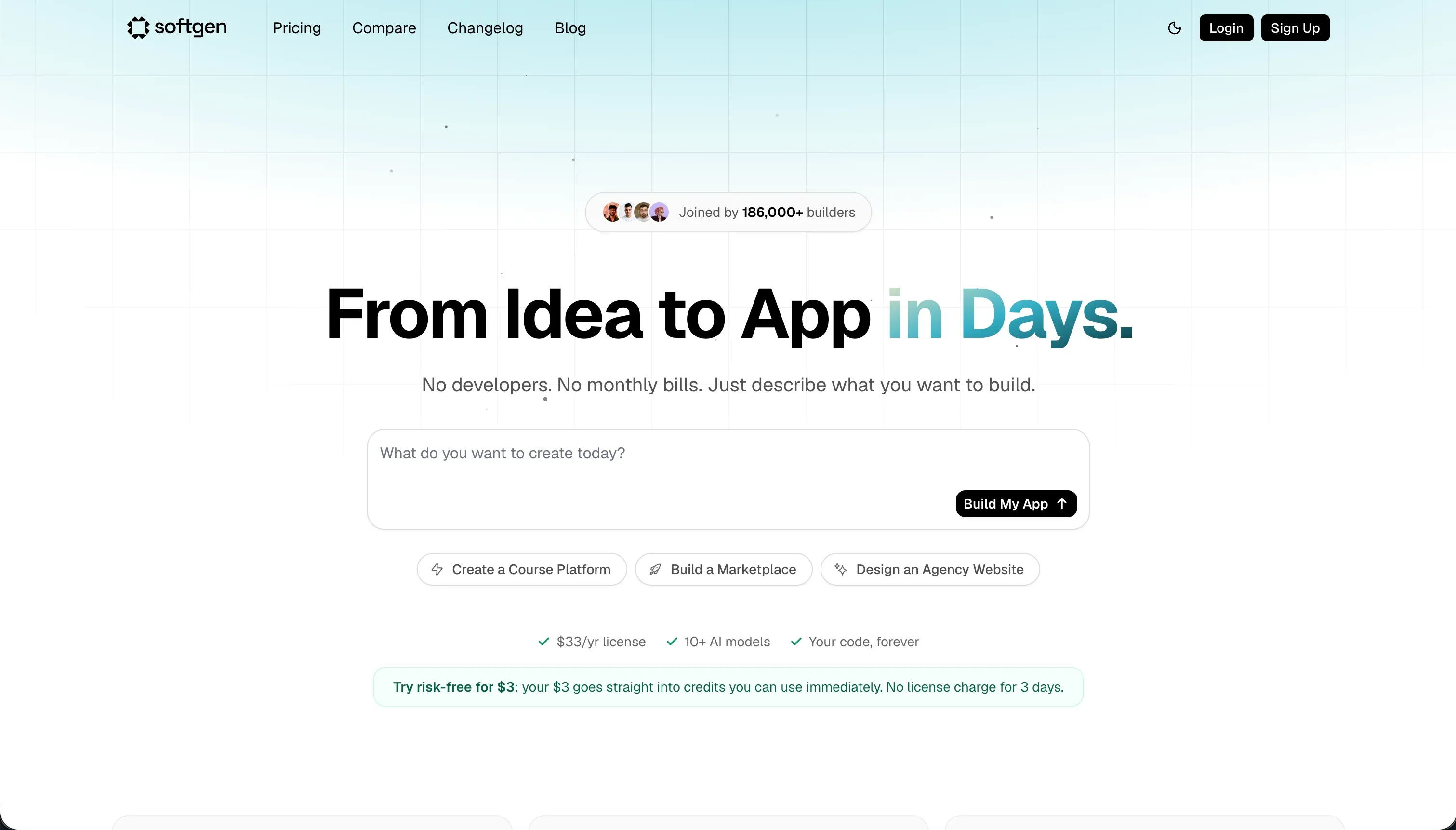

Choosing between generative AI application builders often means deciding which set of early-stage software limitations you are prepared to manage. Softgen and Emergent represent two conversational approaches to this problem, both operating in the AI-powered application builder category.
Both tools attempt to bypass visual layout configurations by generating functional prototypes directly from plain-language chat interactions.
Softgen wins this evaluation by a narrow margin, scoring 5.1/10 against Emergent’s 5.0/10 on our aggregate scorecard. Softgen maintains a safer production environment and provides a clearer code-export option, making its codebase less volatile for actual business use.
Emergent remains highly competitive for rapid, first-draft web mockups, but users face steep financial and operational risks when attempting to maintain or update an Emergent app past its initial generation.
The decision in 30 seconds
| If your priority is… | Pick | Why |
|---|---|---|
| Fastest initial mockup from a single prompt | Emergent | Scores 7.0 on ease of build, generating database schemas, routing, and UI elements in minutes |
| A reliable path to export code if you outgrow the tool | Softgen | Permits code export as a clean exit path (scoring 4.0 on maintainability) to escape platform scaling limits |
| A production-grade client portal or business app | Neither | Both score 4.5 or lower on production readiness and maintainability due to severe prompting loops and agent-related errors |
| Predictable billing with zero credit-overage worries | Softgen | Features a low annual platform fee ($33/year) and pay-as-you-go credits, avoiding unexpected auto-renewal bundles |
| High-fidelity custom web interfaces from raw layout prompts | Emergent | Scores 6.0 on design flexibility by generating unique web aesthetics directly through conversation |
What each platform is
What is Softgen?
Softgen is a chat-driven, conversational application builder that uses an AI workspace helper to architect, generate, and edit web software. Its core build model relies on the Cascade AI agent, which works with users to outline, structure, and assemble layouts before committing them to generated code.
Instead of editing on a visual pixel-level canvas, developers and non-technical founders use natural language to tweak sections, change copy, and add database tables.
The platform scaffolds functional setups containing unified relational databases, user authentication templates, and standard external integrations like Stripe payments. This design methodology targets indie hackers, creators, and teams looking to quickly ship MVP directories, SaaS outlines, or lightweight web products.
Softgen is built to eliminate the blank-canvas syndrome by converting functional design schemas into live, hosted web applications with custom domain support.
What is Emergent?
Emergent is a full-stack AI platform built to generate entire web and mobile applications from a single conversational interface. The platform automatically provisions development containers, scaffolds backend database schemas, structures application routing rules, and crafts custom UI elements from normal user prompts.
Any subsequent layout changes, copy updates, or complex workflow additions are processed iteratively via its chat-based ‘edit agent’ workspace.
The system includes built-in cloud hosting with public preview capabilities and automatic GitHub repository synchronization. It is aimed at non-technical startup founders, operational builders, and developers who require immediate full-stack application scaffolds.
However, because its architecture runs on live virtual containers, the platform manages real-world infrastructure behind the scenes, creating a heavy reliance on its AI execution layers to maintain software stability.
The core difference
The primary difference between these two tools lies in how the generating AI handles structural updates to the application database and frontend code.
- Softgen guides the user through an interactive, step-by-step planning flow to map database schemas and outline layout modules before generation begins, containing code complexity from the start.
- Emergent relies on an open-ended conversational edit agent that directly modifies the full-stack container on the fly, editing database routing, backend files, and styles concurrently from chat inputs.
Where the scores diverge
Production readiness: Softgen 4.5, Emergent 3.5. Softgen scores 4.5/10 against Emergent’s 3.5/10. Softgen provides standard one-click deployments and custom domain linking that function as expected, but its environment remains simple and lacks some mature scaling tools.
Emergent’s score is weighed down by developmental instability, with users regularly reporting persistent container failures throwing ‘Error Waking Up Agent’ warnings.
Additionally, reviewers report that Emergent apps regularly suffer from discrepancies where the preview mode does not match the live production build, making actual app launches highly unpredictable.
Design flexibility: Softgen 5.0, Emergent 6.0. Emergent scores 6.0/10, while Softgen scores 5.0/10. Softgen restricts its generating AI to a pre-defined library of visual modules, which ensures layout alignment but makes it very difficult for builders to achieve highly customized aesthetics without triggering repetitive, credit-burning prompt loops.
Emergent has the capability to write and compile entirely bespoke React code files, creating highly tailored, custom web interfaces from simple descriptive text. However, this flexibility is strictly limited to web environments; its mobile application setup is reported as immature and unfinished.
Maintainability: Softgen 4.0, Emergent 3.5. Softgen scores 4.0/10, while Emergent scores 3.5/10, illustrating the severe risk of technical debt in pure AI-chat environments.
Softgen lacks a drag-and-drop editor, forcing builders to return to the chat prompt for every visual change, which is slower but at least predictable; critically, it provides a code export path to escape platform constraints.
Emergent lacks an exportable exit path and suffers from a highly volatile edit agent that triggers on revisions as small as two lines of code, often dragging builders into infinite loops that break previously working features and can drain thousands of dollars in wasted credit cycles.
Ease of build: Softgen 7.0, Emergent 7.0. Both tools score an identical 7.0/10, representing a exceptionally low barrier to entry for non-technical users.
Softgen uses its Cascade agent to help users plan out their schema and establish visual blocks logically, while Emergent relies on a single open prompt that outputs a fully structured web framework including functional routers and mock databases in minutes.
Both succeed at converting conversational ideas into working prototypes without demanding manual code input, though both suffer from prompting fatigue once the initial scaffold is built and detailed tuning begins.
Security & access control: Softgen 4.5, Emergent 4.5. Both platforms score 4.5/10. Softgen provides basic out-of-the-box user registration templates and login security, but lacks granular visibility logic to show or hide specific interface elements based on user roles.
Emergent generates authentication flows directly into its code scaffold, but because permissions are written entirely by the generator rather than configured visually, verifying security is difficult.
These security concerns are worsened by reports of deployment container failures blocking administration backend access, preventing builders from auditing access rules.
Data & integrations: Softgen 5.5, Emergent 5.5. Both platforms score 5.5/10 here. Softgen comfortably handles relational databases and connects smoothly to standard functional APIs like Stripe, but the absolute surface area of its integrations is narrow compared to traditional builders.
Emergent excels at generating custom database models and routing protocols on its own servers, allowing for a broader range of visual data flows. However, this capacity breaks down on larger repositories once the codebase reaches a size where the AI agent loses context and begins corrupting database files during automated updates.
Cost comparison
Softgen uses a unique, builder-oriented pricing model that features a flat, low-cost annual membership of $33/year covering platform access, hosting, and domain routing.
All app generation, component edits, and AI modifications are funded by purchasing pay-as-you-go credit packages, ensuring that users with stable applications do not face ongoing subscription costs. This model is highly cost-effective for static MVPs or lightweight directories that require rare updates once launched.
Emergent operates on a traditional recurring credit tier, offering a Free plan, a Standard plan at $20/mo, and a Pro tier at $200/mo (billed annually).
Both systems use credits as the active currency for software development, but because Emergent relies heavily on automated agents to execute even simple bug fixes, credit exhaustion is a heavy operational risk.
In Emergent’s ecosystem, a single troubleshooting or refactoring loop can trigger the edit agent repeatedly, consuming hundreds of dollars in credits on a single feature, with some users reporting spending close to $10,000 AUD on repeated debugging loops.
- $33/year flat membership
- Hosting and domains included
- Pay-as-you-go credit packages
- No subscription for stable apps
- Best for static MVPs
- Free, $20/mo, $200/mo tiers
- Credits fund all development
- Agents run even simple fixes
- Debug loops burn hundreds of dollars
- Users report ~$10,000 AUD spend
Lock-in and the exit path
The exit paths for these platforms diverge completely, which is the most critical long-term consideration for any buyer. Softgen supports complete code ownership, allowing builders to cleanly export the generated code repository if they outgrow the service, making it a viable starting point for traditional development teams.
Emergent offers no viable code export or standalone database migration paths. If your application outgrows Emergent’s hosting container or suffers from a complete agent failure, the entire software interface and structured backend must be completely rebuilt from scratch on another platform.
- Full code repository lives on the platform
- Softgen: clean export of the full code repo
- App runs on the provider's hosting
- Emergent: whole interface and backend rebuilt from scratch
- Data sits in the platform's database
- Emergent: no code export or database migration path
Who should pick Softgen
Pick Softgen if:
- Indie hackers who need to rapidly spin up a directory or landing page MVP without committed monthly overhead.
- Teams seeking a low-risk prototyping path that allows them to export the generated codebase once the platform’s constraints are hit.
- Builders looking for structured databases and uncomplicated authentication setups without the risk of system container failures.
Do not pick Softgen if you need highly customized web aesthetics that diverge from standard predefined layouts, as prompting the AI for styling tweaks will trigger repetitive, expensive credit loops.
Who should pick Emergent
Pick Emergent if:
- Founders who need a quick, highly custom aesthetic mockup for a pitch demo or user validation session this week.
- Builders looking to test complex, prompt-generated database routing behaviors on isolated web-only containers.
- Teams looking to prototype completely custom design components from descriptive conversational text.
Do not pick Emergent for real production applications with multiple active users, as container failures, ‘Error Waking Up Agent’ loops, and unverified security rules make it highly volatile over a long-term horizon.
What neither platform answers
Both Softgen and Emergent operate under the assumption that conversational AI must manage your entire application layer from the ground up. This results in standard, critical utility features like domain-signup restrictions, password recovery, and role-based permissions being synthesized from scratch by an AI.
This ‘vibe coding’ methodology often introduces fragile, unverified logic and unstable visual containers, rendering both tools unsuitable for production-grade operational apps.
If you are building a client portal, internal tool, company CRM, or custom database application, you do not need to prompt an AI to design authentication or maintain server infrastructure. A dedicated business application builder like Softr solves this ‘Day Two’ maintainability crisis by utilizing pre-built, battle-tested components.
Softr scores 8.5/10 on production readiness and 9.0/10 on maintainability on our scorecard because things like roles, permissions, layouts, and relational data tables are visually configured rather than hallucinated.
For Teams requiring complete visual layout control without code, Glide serves as another secure, production-ready portal option.
Analyst verdict
Softgen wins this head-to-head comparison with an aggregate score of 5.1/10 compared to Emergent’s 5.0/10. While both platforms are excellent for rapidly building a first functional prototype, the scorecard shows that Softgen provides a safer developmental environment.
Softgen takes the edge in production readiness (4.5), maintainability (4.0), and access control, largely because its visual sandbox is more stable and its deployment paths are more reliable.
Emergent keeps the advantage in design flexibility (6.0), housing a more capable generation engine that produces highly customized visual layouts from simple prompts.
However, because Emergent’s core infrastructure is highly volatile, prone to persistent waking agent errors, and prone to credit-draining debugging loops, its design advantages come at an extremely high financial and operating cost.
Softgen is the superior purchase in this comparison, as its code export capabilities provide a secure exit path if your product outgrows the builder.
Related reading: the Softgen scorecard, the Emergent scorecard, and our scoring methodology.