


Retool and Softr both solve the operational bottleneck of custom software, but they address entirely different builder personas and technical stacks. Retool is a developer-centric internal tool builder designed to construct administrative dashboards and database search views.
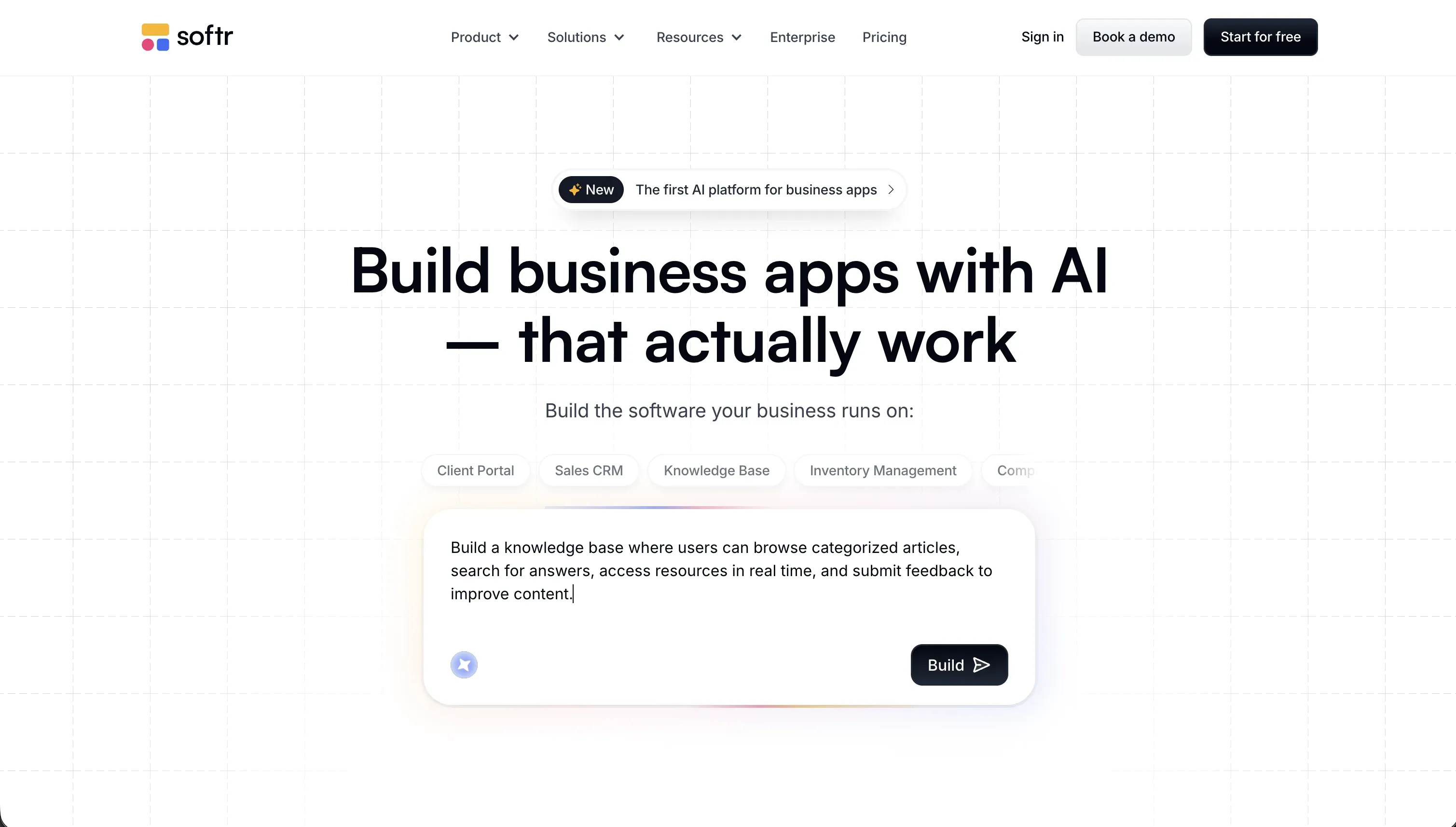
Softr is an AI no-code app builder built for non-technical operations teams and business leaders to create client portals, intranets, and workflow tools.
Softr wins the aggregate business-app decision by a calculated score of 8.1 to 6.8. While Retool offers excellent direct data connectivity, its high technical barrier and seat-based pricing model often limit its use to internal engineering teams.
Softr provides a production-ready application foundation including user authentication, pre-built responsive layout blocks, and a high-performance native database that can be safely configured without writing SQL or JavaScript.
The decision in 30 seconds
| If your priority is… | Pick | Why |
|---|---|---|
| Client or partner portals with external user sign-ups | Softr | Ships native, toggle-based authentication and visual user groups with no custom plumbing needed |
| Direct SQL database reads, writes, and complex REST API operations | Retool | Directly reads and writes SQL databases and REST or GraphQL APIs with an 8.5 data score |
| Fastest path for a non-technical department or business operator | Softr | AI Co-Builder generates databases and layout pages in minutes, scoring 9.0 on ease of build |
| Unlocking deep custom styling and complex pixel-level controls | Retool | Over 100 pre-built developer components and custom JavaScript libraries keep it at 7.0 for flexibility |
| Predictable software spend for thousands of portal users | Softr | Provides flat-rate plans with generous user limits compared to Retool’s strict seat-based pricing |
| An exportable codebase with mandatory self-hosting on any server | Neither | Both systems require you to construct and run your interface within their proprietary runtimes |
What each platform is
What is Retool?
Retool is a visual development platform designed to construct secure internal applications, administrative consoles, and utility dashboards on top of existing data. Its operational model is highly code-forward, relying on a visual component library that developers configure by writing SQL, structuring data payloads via JavaScript, and building custom query variables.
Retool features a managed PostgreSQL database, a robust JavaScript console to manage app state, and advanced developer operations including git-based version control, environment branching, and self-hosted deployments on its Enterprise plan. It is explicitly targeting software engineers, IT administrators, and technical squad leaders who need to scaffold backend utilities quickly without writing custom frontend CSS.
What is Softr?
Softr is an AI app builder for operational business applications designed to help teams build portals, directories, and internal trackers without writing code. The platform utilizes an AI Co-Builder to turn plain-language instructions into unified databases, visual pages, navigation rules, and user roles, allowing non-technical operators to construct custom business systems.
Softr provides high-performance native Softr Databases, secure user authentication (passwords, magic links, Google OAuth), pre-built visual blocks, and advanced workflow logic. Built for knowledge workers, operational leads, and IT-governed decentralized development, Softr allows businesses to replace manual spreadsheets and fragile paperwork pipelines with secure, branded workspaces.
The core difference
The division between these platforms is defined by the technical baseline required to launch, update, and manage the final product.
- Retool asks the builder to operate as a developer - managing system states, writing direct queries, and structuring API responses.
- Softr asks the builder to behave as a business analyst - utilizing native prebuilt blocks and visual toggle menus with a hybrid AI engine.
Where the scores diverge
Ease of build: Retool 4.0, Softr 9.0. This is the widest gap in the comparison. Softr scores higher because its AI Co-Builder generates a functioning schema and responsive front-end pages in minutes, while manual changes remain easily accessible via visual configuration controls.
Retool holds a lower score as it remains a visual environment built for engineers. To build workflows or format components in Retool, operators must write JavaScript syntax and construct manual SQL queries, creating a steep learning curve that locks out non-technical staff.
Maintainability: Retool 6.0, Softr 9.0. Softr maintains a superior score because apps are built out of standard, platform-governed visual components without any code-level dependencies to track. Retool apps become increasingly complex to maintain as they grow; developers must document written SQL queries and JS scripts manually.
G2 reviewers flag that Retool apps become harder to organize over time, and some Capterra users maintain external copies of SQL code as a fallback against interface saving malfunctions.
Design flexibility: Retool 7.0, Softr 5.5. Retool secures the higher score here with more than 100 industrial-grade visual components and support for custom JavaScript styling, although its default layouts are highly dense and look like developer-focused internal panels.
Softr enforces strict visual ceilings because apps must be constructed from prebuilt, responsive layouts rather than a free-form, pixel-perfect visual design canvas, though its global theme engine is far easier for non-designers to brand.
Production readiness: Retool 7.5, Softr 8.5. Softr carries a distinct advantage here because authentication, user groups, and row-level permissions are fully pre-built and managed by Softr’s infrastructure. Buyers do not have to test code-level flaws on utility pages like password recoveries.
Retool is designed for internal tools and lacks native onboarding or external sign-up flows, meaning external portal security must be custom-developed. Furthermore, Capterra reviews detail post-update UI bugs in Retool, plus instances where SQL content vanished during saving operations.
Security & access control: Retool 7.5, Softr 8.5. Softr secures its advantage by offering password, OTP, and raw magic-link sign-ins as out-of-the-box toggles, running database queries on the server side to protect secrets.
Retool matches this security with SSO, SAML, audit logs, and self-hosting options on Enterprise, but receives deductions because external-user portal infrastructure is not native and must be written from scratch using custom integrations.
Data & integrations: Retool 8.5, Softr 8.0. This is Retool’s strongest score. Built to sit directly on top of databases, Retool allows builders to effortlessly write SQL queries against relational systems, REST APIs, or GraphQL endpoints.
Softr is highly capable, using native Softr Databases alongside external connectors like Airtable, Google Sheets, and Notion, but it loses a half-point because connecting SQL databases and REST APIs is locked behind the Business plan.
Cost comparison
Retool relies on a seat-based pricing model, charging a fee per active user per month. While this is viable for small internal operations teams, it represents an escalating cost curve for external use cases. Constructing a customer boarding network or a vendor portal with hundreds of active users will draw massive monthly license costs, as you must purchase user seats for both internal operators and end portal users.
Softr charges flat, tiered platform rates with generous caps on active app users, making portal-based application budgets predictable. Hidden cost factors also diverge: Retool demands experienced engineering labor for ongoing maintenance, SQL query optimization, and UI scripting.
Softr reduces builder time and script maintenance of the application, though buyers must forecast credit consumption on intensive AI tasks inside databases and automated workflows.
- Per active user per month
- Seats for staff and portal users
- Escalates with external use cases
- Needs engineering labor
- SQL tuning and UI scripting
- Flat tiered platform rates
- Generous user caps
- Predictable portal budgets
- Less builder and script time
- Forecast credits for AI workflows
Lock-in and the exit path
Neither Retool nor Softr gives the buyer an exportable application codebase; leaving either platform will require a complete rewrite of your interface layer. Softr makes data migration easier if you use external sources like Google Sheets or SQL databases, and its native databases are easily exported or connected to external workflows via its MCP server.
Retool connects directly to your databases, ensuring your raw data was never locked inside a proprietary structure to begin with, but any complex UI state logic or query configurations must be completely rewritten if you exit the platform.
- Neither platform exports app code
- Softr native database, exportable
- Softr data exports or connects via MCP server
- Retool raw data stays on your DB
- Retool data was never locked in a proprietary structure
- Softr and Retool interface layers
- Both require a complete rewrite
Who should pick Retool
Pick Retool if:
- Engineering and IT departments building highly specific internal utilities, db scripts, or admin panels on private servers.
- Projects where the interface must execute direct SQL commands and run granular queries across GraphQL or REST endpoints.
- Internal tools requiring enterprise version control, git branching, and mandatory self-hosting on custom clouds.
Do not pick Retool if you need to launch a client-facing portal, customer dashboard, or onboarding system for external users who cannot be logged under expensive per-seat pricing licenses.
Who should pick Softr
Pick Softr if:
- Operations teams and business operators who need to launch professional client, customer, or partner portals quickly.
- Organizations looking to empower non-technical staff to safely build and adapt their own tools without incurring shadow IT security risks.
- Teams seeking highly secure, predictable flat pricing with built-in user roles, row-level access control, and GDPR-compliant German hosting.
Do not pick Softr if your application requirements revolve around writing custom SQL scripts, managing dense visual data grids, or constructing heavily customized developer tools.
Where neither platform fits
If you are trying to publish custom native applications to the iOS or Android stores, neither Retool nor Softr is designed to deliver. Softr creates modern, fully responsive web apps and PWAs, while Retool builds web-based internal portals; neither outputs compile-ready mobile packages.
If App Store distribution is a hard requirement, you should evaluate FlutterFlow to build native layouts with Dart environments.
Additionally, if your operations require direct ownership of the source code, custom self-hosting environments without platform runtimes, or custom script compilation, both no-code setups fail to fit. To ensure full code-level control and write actual source layers, standard engineering tools like Replit provide a better foundation, giving you complete repository ownership from day one.
Analyst verdict
Softr wins the aggregate comparison 8.1 to 6.8. Its visual, block-based architecture, secure auth pipelines, and conversational AI Co-Builder make it the far better choice for standard business templates, external portals, and team-operated workflows.
Softr absorbs the technical decisions - allowing operators to manage roles, edit fields visually, and add new pages safely without the constant risk of silent data leaks or deployment crashes.
Retool remains a developer’s environment, earning its 8.5 score in data & integrations through raw, uninhibited query flexibility. It is the correct build engine only when developers are the sole users and your application relies on direct SQL queries and API-heavy console panels. If standard operations must run the software, Softr is the more robust, secure, and cost-effective operational hub.
Related reading: the Retool scorecard, the Softr scorecard, and our scoring methodology.