

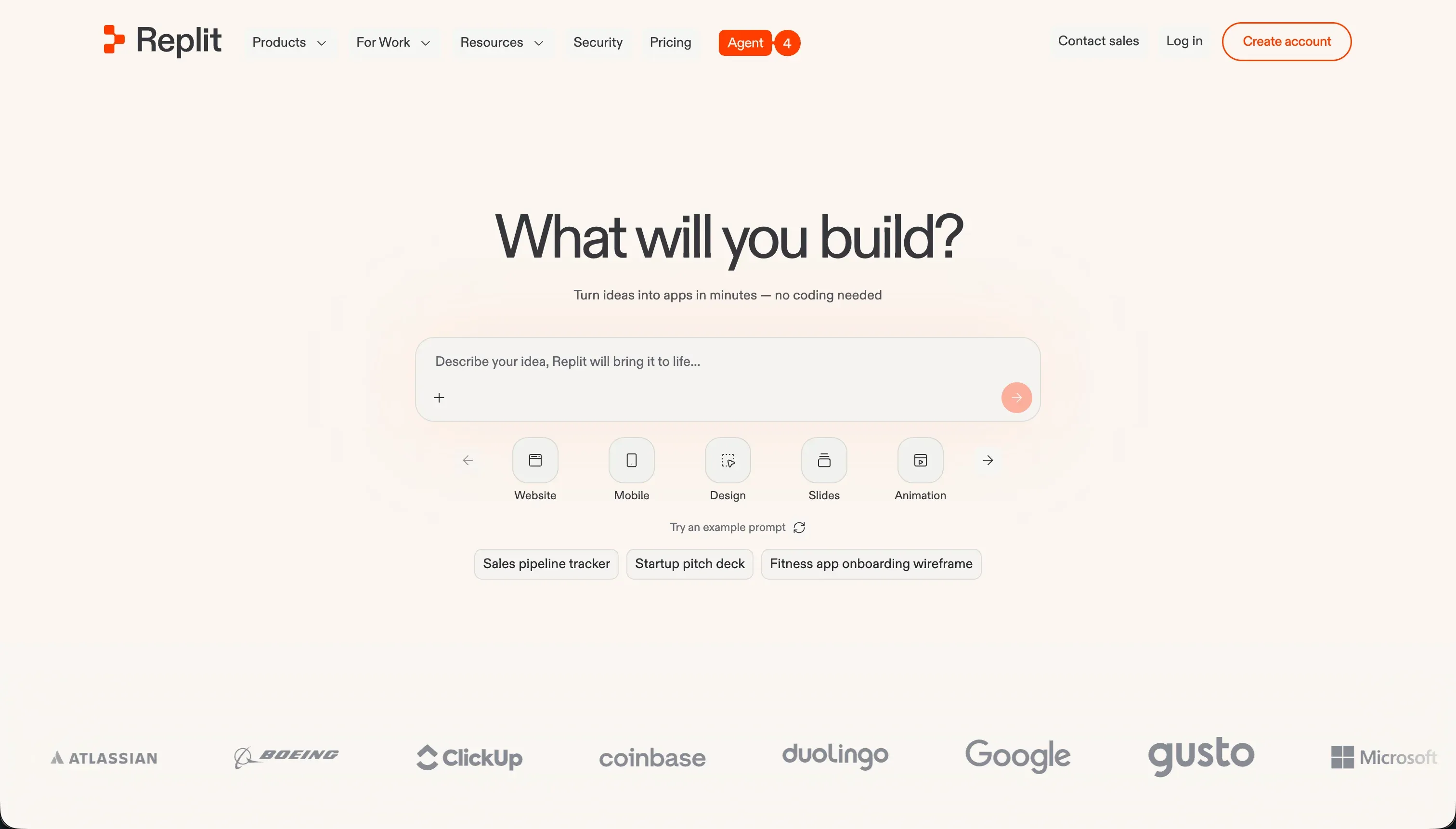

The choice between Replit and Retool represents a core trade-off between open-ended code generation and visual, data-dense layout construction. Replit operates as an AI-powered cloud-based development environment that generates and hosts raw codebases across dozens of languages.
Retool serves as a low-code IDE optimized specifically for engineering teams needing to build internal tools and administrative consoles in front of existing databases.
Replit wins the aggregate matchup with a score of 7.4/10 against Retool’s 6.8/10. For projects requiring custom frontends, unrestricted business logic, or standard app frameworks, Replit is the higher-scoring allocation. The order reverses only when a team of SQL-savvy developers needs to quickly assemble a dense dashboard over a PostgreSQL database or a GraphQL API without designing interfaces from scratch.
The decision in 30 seconds
| If your priority is… | Pick | Why |
|---|---|---|
| Client portals, customer-facing interfaces, or custom styling | Replit | Its 8.5 design flexibility score supports any custom web frontend, while Retool’s 7.0 design score is highly constrained to internal-tool aesthetics |
| Internal tools, admin panels, and direct database queries | Retool | Scores 8.5 on data and integrations with over 100 pre-built data density widgets and native SQL utilities |
| Fully visual building with flat, predictable portal pricing | Neither | Both require technical skills and carry usage-based or per-seat pricing; a platform like Softr handles this use case with no-code simplicity |
| An exportable, non-proprietary codebase with zero platform lock-in | Replit | Produces real codebases editable in any IDE, scoring 7.5 on maintainability against Retool’s proprietary saving model |
| Granular user permissions and SAML SSO out of the box | Retool | Provides robust enterprise access controls scoring 7.5, whereas Replit forces you to write custom auth check code |
What each platform is
What is Replit?
Replit is a collaborative, cloud-based development environment that natively supports over 50 programming languages. Through Replit Agent, the platform enables builders to scaffold, write, and deploy full-stack software applications entirely from conversational prompts. The system automatically provisions server containers, manages package installations, and outputs complete, standard-compliant code repos.
The workspace includes a browser-based IDE alongside tools like Ghostwriter AI, multiplayer coding cursors, and custom domain configurations. It is designed for founders, prototyping teams, and software engineers who want the speed of autonomous AI generation without losing access to the underlying code files, database rollbacks, or system terminals.
What is Retool?
Retool is a low-code programming environment designed specifically for engineering leaders to build internal administrative panels, dashboards, and operational utilities. It provides a visual canvas with over 100 pre-built UI components like data tables, charts, and input forms.
The tool connects securely to backends via SQL and REST or GraphQL APIs, utilizing inline JavaScript to orchestrate state and format data payloads.
The platform features a managed Postgres database layer, version control, and environment branching. Retool is engineered for in-house developer teams who want to eliminate the overhead of building frontend layouts for database maintenance and back-office administration manually.
The core difference
The core divergence between these environments lies in how they translate developer intention into a live app.
- Replit runs an autonomous AI agent to write standard, open-ended codebases inside a hosted cloud container.
- Retool provides a proprietary low-code visual canvas that uses SQL queries and JavaScript scripts to sync data with pre-built UI widgets.
Where the scores diverge
Ease of build: Replit 6.5, Retool 4.0. Replit scores 6.5 because Replit Agent can scaffold and deploy a complete frontend and backend in one click from simple prompts, saving massive setup time. However, it still assumes a technical baseline for secrets management, API troubleshooting, and build log reading.
Retool scores 4.0 because it is explicitly not a no-code tool; anything beyond placing a basic widget requires writing raw SQL queries, formatting data structures in JavaScript, and manually debugging API responses.
Maintainability: Replit 7.5, Retool 6.0. Replit scores 7.5 because it compiles to standard, version-controlled code, allowing developers to easily pull the files into any local IDE or hand them off to external teams without lock-in. It loses points due to agent loops that occasionally recreate bugs and waste credits.
Retool scores 6.0 as complex apps become difficult to clean and keep organized visually over time, occasionally forcing teams to keep manual external backups of all query code.
Security & access control: Replit 6.0, Retool 7.5. Retool scores 7.5 due to premium features like granular access controls on the Business plan and SAML SSO out of the box on Enterprise.
Replit scores 6.0 because, although secrets management and database security libraries are available, roles and permissions must be written directly into the code by the AI or developer, making them harder to audit visually from a central admin panel.
Design flexibility: Replit 8.5, Retool 7.0. Replit scores 8.5 by generating raw, custom code outputs, meaning builders are free to implement any custom design pattern, CSS stylesheet, or tailored API workflow. Retool scores 7.0 because its layouts are tightly restricted to a data-dense, admin-panel layout.
Customizing Retool to look like a polished, client-facing brand experience takes substantial custom JavaScript and styling effort.
Production readiness: Replit 8.0, Retool 7.5. Replit scores 8.0 by offering autoscaling containers, PostgreSQL database rollbacks, and custom domains straight to production. Deductions stem from occasional deployment-to-editor mismatches and agent-generated regressions.
Retool scores 7.5, serving as a reliable choice for internal tools with SAML SSO and environment branching. It drops points due to the lack of native external authentication flows and Capterra reports of post-update UI bugs and disappearing SQL query savings.
Data & integrations: Replit 8.0, Retool 8.5. Retool scores 8.5 because of its extensive native connector library, optimized to link straight to any standard SQL database or APIs with minimal coding. Replit scores 8.0; while it can connect to anything Python or NodeJS can reach across 50+ languages, managing table relationships and database schemas requires manual Postgres and database structural knowledge.
Cost comparison
Replit and Retool approach cost configurations through entirely different vectors. Replit Core starts at $20/mo (annual) or $25/mo (monthly), and Replit Pro runs at $95/mo (annual) or $100/mo (monthly).
These subscriptions include a credit allowance, but additional AI Agent work, intensive compute runs, or database overages are charged based on dynamic execution metrics, making billing highly variable during active iteration phases.
Retool operates on a user-seat-based pricing model, offering a limited Free plan for up to 5 users. The Team plan costs $8/user/mo (annual) or $10/user/mo (monthly), while the Business plan escalates to $40/user/mo (annual) or $50/user/mo (monthly) to access SSO and advanced permissions.
Because fees pile up for every single internal or external user, Retool becomes highly expensive for operations that involve external clients or large departments.
Lock-in and the exit path
The lock-in profile is the most distinct structural difference between these platforms. Replit outputs standard React, Node, Python, and SQL code synced directly to version control on GitHub, meaning a buyer can leave the hosting environment instantly and run the codebase anywhere with minimal friction.
Retool relies on a proprietary runtime to parse queries and render canvas widgets. Leaving Retool means rebuilding the visual frontend interface entirely from scratch, as the platform does not export portable application files.
- Standard React, Node, Python, SQL
- Synced to GitHub version control
- Leave hosting instantly, run code anywhere
- Proprietary runtime parses queries and renders widgets
- No portable application file export
- Visual frontend rebuilt entirely from scratch
Who should pick Replit
Pick Replit if:
- Founders who need an exportable React and PostgreSQL codebase that is not locked to a single proprietary builder.
- Teams seeking to deploy customer-facing web apps, APIs, or custom SaaS MVPs without layout structure limitations.
- Technical builders who want the efficiency of an autonomous AI developer agent that can self-correct codebase errors.
Do not pick Replit if nobody on your team can read or debug the generated engine code when the Agent runs into circular debugging loops.
Who should pick Retool
Pick Retool if:
- In-house engineering teams building admin panels, database managers, or internal inventory tools over existing databases.
- Organizations that rely heavily on complex SQL procedures and pre-built data tables who want to bypass frontend layout designs.
- Enterprise teams requiring secure self-hosting, SAML SSO, and source control on-premise.
Do not pick Retool if you are deploying external client portals or vendor workspaces where seat-based pricing would make scaling budgets unsustainable.
What neither platform answers
Both environments assume they are solving development environments for engineers or tech-adjacent builders. This leaves a massive procurement gap for business operations teams, COOs, and product managers.
These buyers frequently need secure, professional-grade internal tools, client portals, and CRM layouts but do not want to manage code containers, write custom SQL queries, or deal with seat-based billing for hundreds of portal users.
For this operational class of applications, Softr represents a significantly more reliable buy, scoring 8.0+ on production readiness, maintainability, and security by utilizing visual configurations over coding. Instead of generating unvetted code, Softr employs beautiful, responsive building blocks alongside a secure, native database.
Authentication is visual, custom user groups configure in a few clicks, and pricing remains predictable. For builders with complex data schemas, pairing Softr with Airtable or a relational database offers clean user control without any coding baseline required.
Analyst verdict
Replit wins on the scored aggregate scorecard, marking a 7.4/10 against Retool’s 6.8/10. It wins on ease of build (6.5 vs. 4.0), maintainability (7.5 vs. 6.0), and design flexibility (8.5 vs. 7.0), making it the superior allocation for teams building flexible external SaaS products or custom web platforms.
Retool remains the industry standard for internal-facing data consoles, maintaining its lead in data connectivity and enterprise controls. However, it requires a constant SQL baseline and charges premium per-seat pricing. Choose Replit if you need code ownership and customized client frontends. Choose Retool only if your software needs are strictly internal and your team lives in database query terminals.
Related reading: the Replit scorecard, the Retool scorecard, and our scoring methodology.