

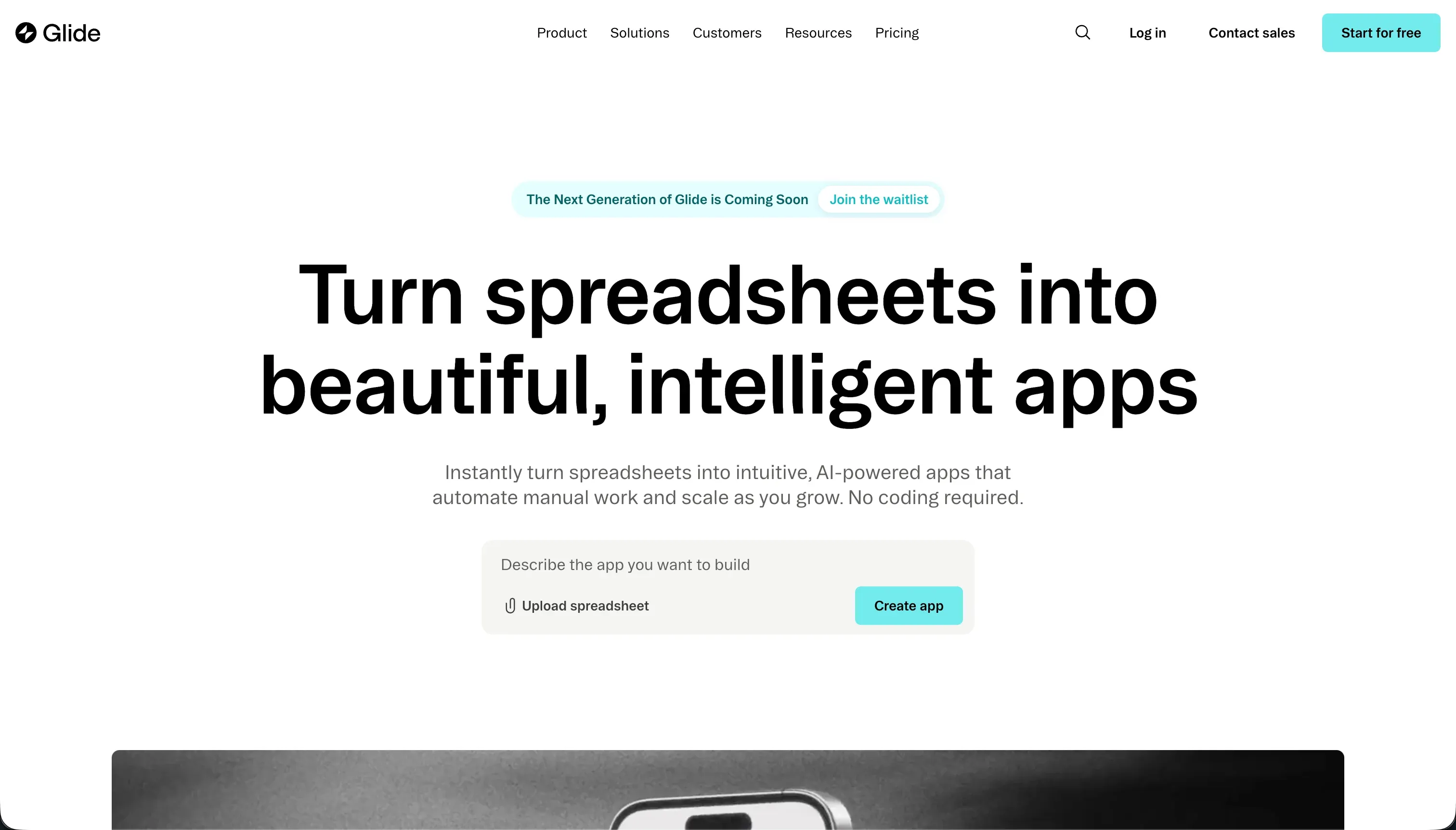

The selection between Glide and Zite represents a clear split in how business applications are architected. Glide operates within the visual low-code class, relying on structured data sources like spreadsheets to instantly generate consistent layout blocks.
Zite, which grew out of Fillout’s form builders, represents the newer class of AI-first conversational generators where prompting dictates both interface and database structures.
Glide wins this face-off on aggregate with a score of 6.3/10 compared to Zite’s 5.2/10. 1.1 points separate these platforms, with Glide offering far greater database stability and day-two maintainability. The decision only flips to Zite if a buyer requires completely raw prompt-to-app prototyping with zero user-seat pricing structures from day one.
The decision in 30 seconds
| If your priority is… | Pick | Why |
|---|---|---|
| Fast low-code setup from existing spreadsheets | Glide | Scaffolding from existing Google Sheets or Excel is incredibly fast and highly reliable |
| Building highly complex workflows in prompts | Zite | Plan Mode permits checking generated actions and relational structures safely before build |
| Scalable user counts with flat, predictable spend | Neither | Glide charges steep shared user premiums, while Zite’s page reads silently drain monthly workflow quotas |
| Granular, visual permissions for external groups | Neither | Both platform security architectures are limited and thin compared to dedicated portal engines |
| Visual editing control without prompting loops | Glide | Changes are made directly to components instead of forcing adjustments back through AI steps |
What each platform is
What is Glide?
Glide is a data-centric development utility designed to turn static spreadsheets into mobile and desktop interfaces. It operates by layering pre-configured components directly over relational files, allowing non-developers to configure standard operational software in hours.
Instead of drag-and-drop pixel adjustment, builders click to link existing database columns directly to structured display cards.
Glide features native database tables along with built-in AI column attributes that handle inline audio transcription, language translation, and summary generation. The platform is explicitly optimized for field services, inventory trackers, and internal team pipelines where layout consistency is more important than bespoke brand identity.
What is Zite?
Zite is an AI-first software generator that compiles interfaces, structural databases, and automation pipelines from conversational prose. The build model centers on prompting, where builders chat directly with an AI agent to layout custom views or adjust backend data relational links.
It inherits its core structural foundation from Fillout’s visual form building technology, translating to fast and detailed form capture.
Zite features a built-in SQL data store that manages links, bulk updates, and version history. It is engineered for operations managers and small teams looking to quickly describe a business need in natural language, review a markdown outline of the application architecture in Plan Mode, and have a prototype generated automatically.
The core difference
The primary dividing line between these systems is how modifications and structural additions are made to an application.
- Glide keeps edits deterministic and visual, letting you edit schema cells and UI components directly without relying on conversational feedback loops.
- Zite puts prompting first, routing structural database edits, CSS adjustments, and transactional webflows back through natural-language prompts.
Where the scores diverge
Maintainability: Glide 6.5, Zite 4.0. Glide scores 6.5/10 because it keeps long-term editing straightforward by exposing direct component configuration panels, but its score is reduced because users report features being moved behind higher-tier paywalls mid-project, leaving no code export path.
Zite scores 4.0/10 due to rigid layout frameworks that make visual refinements outside of prompt boundaries difficult, a complete absence of GitHub sync, and severe workspace bloat caused by the AI creating dozens of redundant backend workflows during text iterations.
Production readiness: Glide 6.5, Zite 4.5. Glide scores 6.5/10 because its pre-built interface blocks are exceptionally reliable on mobile devices, though users report systemic backend lag multiple times a year, and free tier plans get no human support channels whatsoever.
Zite drops to 4.5/10; despite offering staging environments and unlimited user allocations, scaling users is restricted by a database that lacks advanced formula expressions or SQL views, alongside an undisclosed trap where every page load runs as a workflow event that quickly drains monthly quotas.
Data & integrations: Glide 7.0, Zite 5.5. Glide scores 7.0/10 with high-speed Glide tables, robust Airtable connections, and reliable lookup columns, though it lacks direct custom SQL data endpoints.
Zite scores 5.5/10, since its SQL-lite database handles basic relations and API triggers, but the system lacks necessary advanced roll-up cells, formula fields, or complex view definitions, forcing builders to use simple direct sheets syncs.
Ease of build: Glide 8.5, Zite 7.5. Glide scores 8.5/10 by instantly scaffolding clean operational views directly on top of Airtable, Excel, or Google Sheets with smart components that adjust cleanly to mobile device footprints out of the box.
Zite scores 7.5/10; its single-prompt app generation and Plan Mode protect users from credit leaks, and its form roots make data capture highly visual, but active development requires constantly wrestling with prompting loops to refine layouts.
Security & access control: Glide 5.5, Zite 5.0. Glide scores 5.5/10 by providing row-level visibility and simple email verification settings that work well for staff directory needs, but it lacks the granular conditional permissions needed for multi-tenant customer-facing structures.
Zite scores 5.0/10, carrying over Fillout’s custom SSO foundation, but its access control is basic and relies largely on prompt-configured logical tasks instead of structured visual panels for security audits.
Design flexibility: Glide 4.0, Zite 4.5. Zite scores 4.5/10 because the AI-generated React structures allow minor variations, though users report the standard style output leans noticeably corporate and is hard to rebrand for agency-style work.
Glide scores 4.0/10; its strict component templates enforce absolute layout consistency at the expense of creative freedom, meaning you are locked into Glide’s pre-rendered design grid and custom CSS is gated strictly behind top pricing tiers.
Cost comparison
Glide bills on a shared user-seat model: its Maker plan starts at $49/mo (billed annually), but scaling to more than 25 users requires upgrading to the Team plan at $99/mo or the Business plan at $249/mo, which is limited to 100 users. Because cost scales directly with seat count, building customer-facing utilities on Glide quickly becomes financially unviable before entering expensive enterprise territory.
Zite uses a credit-and-workflow billing system starting at $15/mo for Pro (billed annually) and $55/mo for Business, offering unlimited user seats on all tiers. However, Zite’s billing model has hidden costs: it counts every data load or page refresh as a workflow execution.
This means a active team workspace can deplete the $19/mo Pro limit of 5,000 monthly workflow runs within days, forcing builders into expensive tiered credit upgrades that climb past $89/mo.
- Maker plan at $49/mo
- 25 users forces Team at $99/mo
- Business at $249/mo caps 100 users
- Cost scales with seat count
- Unviable for customer-facing apps
- Pro $15/mo, Business $55/mo
- Unlimited seats on all tiers
- Every page refresh is a workflow run
- 5,000 monthly runs burn in days
- Upgrades climb past $89/mo
Lock-in and the exit path
Both systems present significant platform lock-in. Glide offers absolutely no option to export application source code, meaning your built interface is permanently tied to Glide’s proprietary servers and database migrations require manual CSV exports.
Zite similarly lacks a GitHub sync pathway or code export mechanism, forcing a complete ground-up rebuild if you outgrow the platform’s logical constraints. Glide has a slightly cleaner data extraction path because it natively mirrors continuous changes straight to your external Airtable or Google Sheets spreadsheets.
- Data lives in Glide
- Spreadsheets keep the data
- Edits mirror to Airtable or Sheets
- External copies stay current
- No source code export
- Interface is gone, tied to Glide
- Schema changes need manual CSV
- Migrations are your job
Who should pick Glide
Pick Glide if:
- Operations teams looking to instantly transform existing team spreadsheets into polished, mobile-friendly internal tools without design configurations.
- Field engineers and site logistics staff who rely on structured card layouts, map pins, and data edits that must work reliably on mobile devices.
- Builders looking for secure native database tables that link directly to active sheets without executing workflow events on page load.
Do not pick Glide if you are deploying external client portals with hundreds of active users, as the seat-based pricing model will quickly make licensing costs prohibitively expensive.
Who should pick Zite
Pick Zite if:
- Solopreneurs wanting to rapidly build early-stage proof-of-concepts, simple web apps, or lightweight databases from simple plain-language descriptions.
- Teams that need highly customizable multi-step data entry forms, leveraging Zite’s integrated Fillout legacy tools.
- Organizations requiring unlimited shared workspaces where builders can test and preview multiple experimental apps on a single subscription.
Do not pick Zite if you fail to match the Business plan’s pricing, as standard custom login branding and automated schedule features are completely locked behind the $69 monthly subscription tier.
What neither platform answers
While both platforms attempt to construct operational software, they drop critical features when it comes to hosting customer portals or secure external applications. Glide locks custom CSS behind top pricing tiers and charges restrictive seat fees for external users, while Zite forces you into complex prompting loops for basic layout changes and silently burns monthly workflows during basic page reads.
If your project requires client portals, partner directories, or internal business trackers, Softr provides a far more complete operational solution. Connected directly to its high-performance native databases or external systems like Airtable and HubSpot, Softr scores 8.5/10 for production readiness and 9.0/10 for maintainability.
By relying on pre-built, secure blocks that can be configured visually without coding, it offers clear user-group permissions and flat pricing tiers that support hundreds of external clients without seat licensing bottlenecks.
Analyst verdict
Glide wins this comparison, scoring 6.3/10 against Zite’s 5.2/10. While Zite’s conversational AI and native SQL backend make it fast to prompt initial app shapes, its low scores on production readiness (4.5) and maintainability (4.0) make it risky for business apps meant to scale. The lack of standard database formulas and the risk of silent workflow depletion make Zite hard to support on day two.
Glide secures the higher rating due to its visual low-code editor (8.5), stable table integrations (7.0), and predictable visual editing controls. The platform enforces strict layout constraints, but this structure ensures that application logic and display layers remain clean, accessible, and maintainable over months of team use. For production business apps where reliability matters, Glide is the safer purchase.
Related reading: the Glide scorecard, the Zite scorecard, and our scoring methodology.