

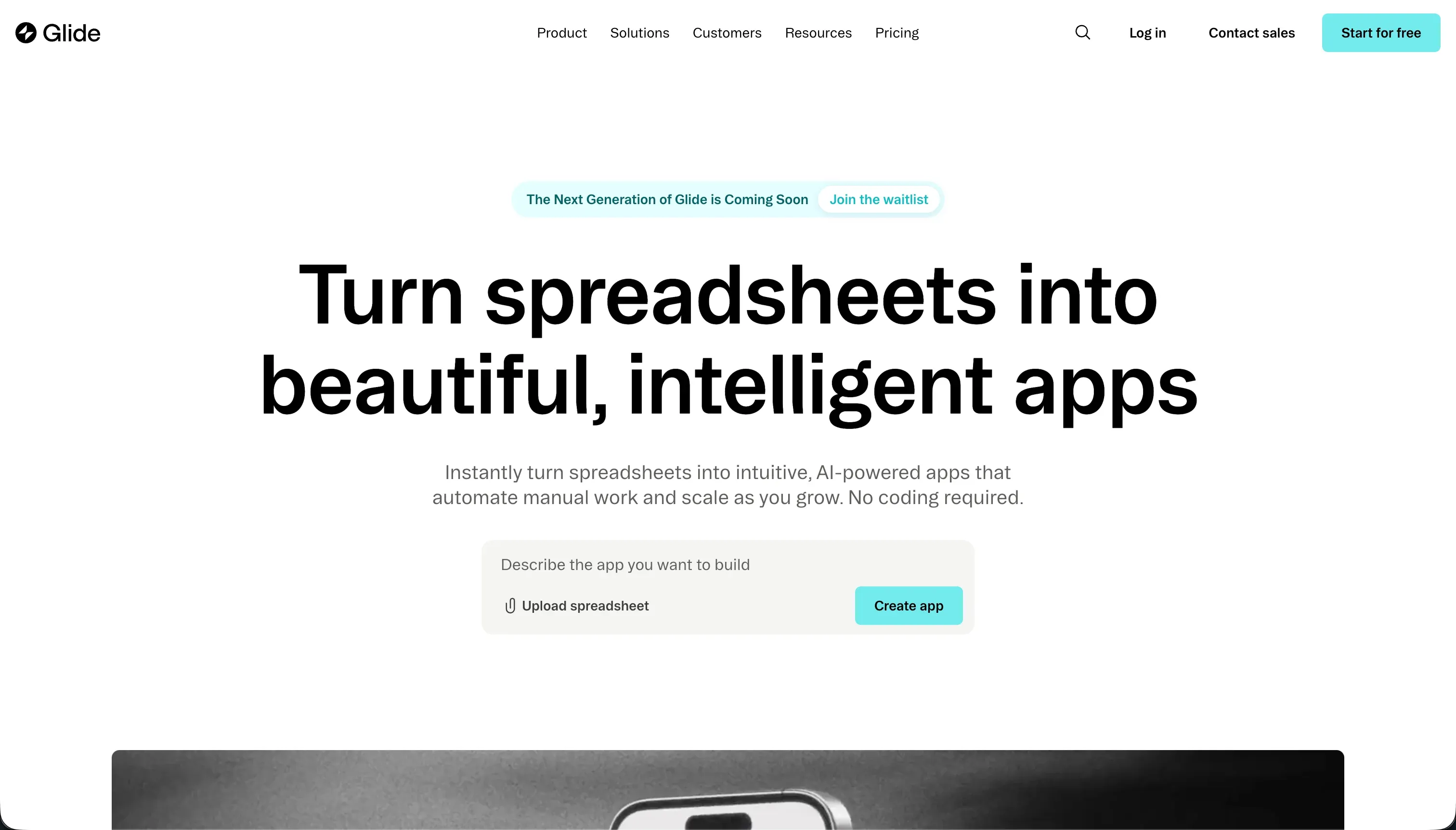
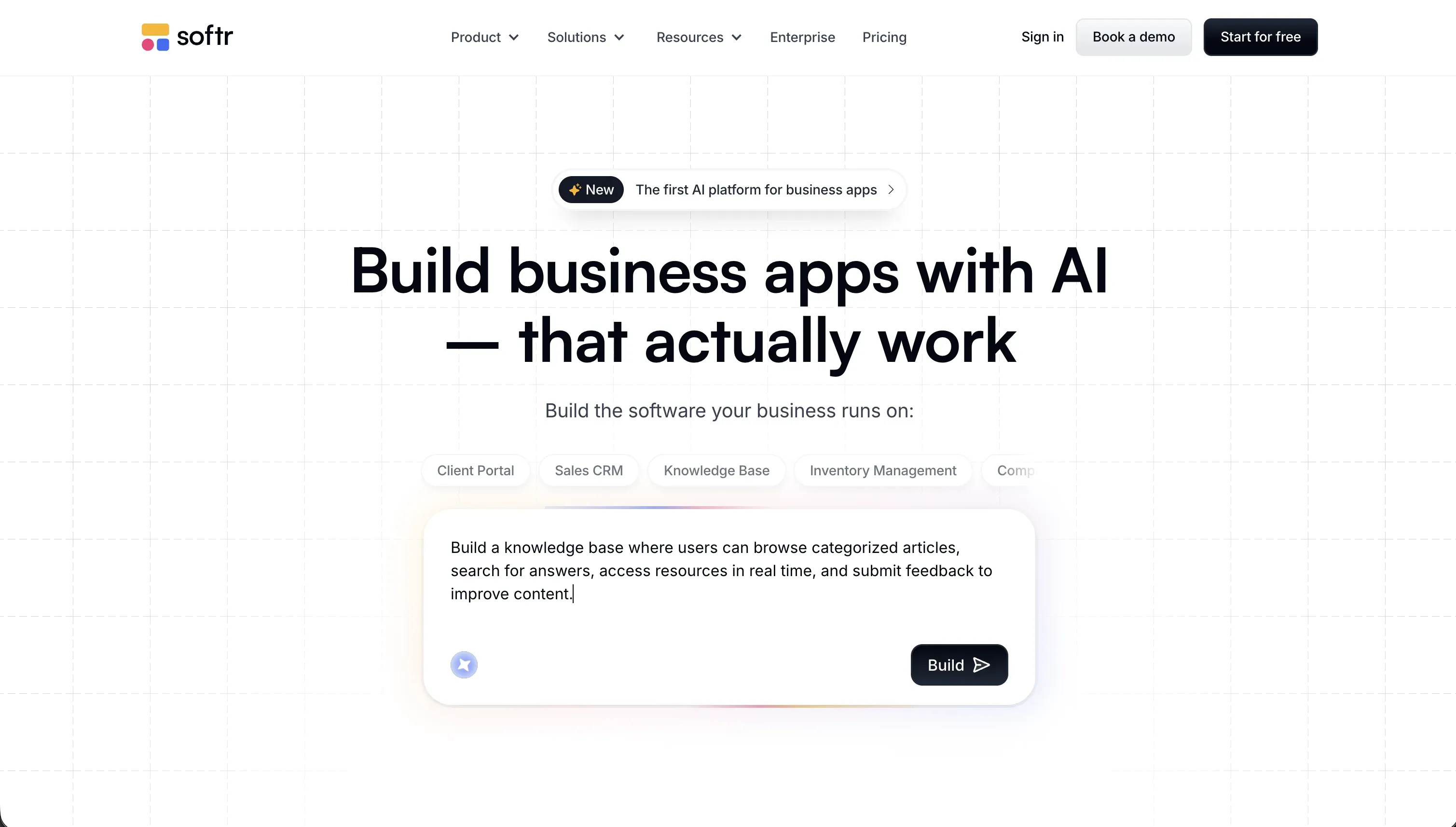
Glide and Softr solve 2 different procurement problems. Glide belongs to the spreadsheet-to-app category, built to turn structured rows into usable internal interfaces fast. Softr belongs to the business app and portal category, built for multi-user systems with permissions, workflows, and external-facing access.
Softr wins the general decision, 8.1 to 6.3. It takes the operational criteria that matter most for a real business app: ease of build, production readiness, maintainability, security, and data integrations. The decision flips only when you want a simpler spreadsheet-first tool and are happy to live inside tighter templates.
The decision in 30 seconds
| If your priority is… | Pick | Why |
|---|---|---|
| Client portals, partner apps, or vendor access | Softr | 8.5 security score with native user groups and row-level restrictions |
| Scaffolding an app straight from Google Sheets or Excel | Glide | its spreadsheet-first model is the fastest path from rows to screens |
| Predictable scaling for many external users | Softr | flat tiers are easier to forecast than tighter shared-user limits |
| Low-maintenance internal tools with future workflow growth | Softr | 9.0 maintainability score and stronger workflow headroom |
| Mobile-friendly layouts with minimal design decisions | Glide | its constrained templates produce clean responsive layouts quickly |
| An exportable, self-hosted frontend codebase | Neither | neither platform gives you full frontend code export |
What each platform is
What is Glide?
Glide is a visual low-code builder designed to turn structured spreadsheet data into working apps. Its build model starts from tables and rows rather than a blank canvas, so you connect data sources such as Google Sheets, Excel, Airtable, or Glide Tables and let the platform scaffold the interface around them.
The product ships with opinionated components such as lists, cards, maps, and detail screens, plus data helpers like lookups and rollups inside Glide Tables. Research also points to Glide AI columns for tasks like categorization, summarization, and transcription, which makes it a genuine fit for operators who want lightweight internal tools without much frontend design work.
What is Softr?
Softr is an AI app builder for portals, internal tools, and multi-user operational systems. Its build model combines visual blocks, native or connected databases, and AI-assisted setup so a team can generate pages, data structures, and access rules from prompts, then refine everything in the editor.
Research notes point to concrete capabilities including Softr Databases, integrations with Airtable, Notion, HubSpot, SQL, and REST APIs, plus Softr Workflows for automations and the Vibe Coding block for generated React components. That makes it genuinely built for teams that need secure business apps with roles, workflows, and external user access rather than a simple spreadsheet wrapper.
The core difference
These tools differ most on build philosophy: Glide scaffolds from existing tabular data, while Softr assembles a fuller business system around users, permissions, and workflows.
- Glide is a spreadsheet-first app builder that turns structured data into tightly constrained, fast-to-launch interfaces.
- Softr is a business app platform that combines visual assembly, permissions, and workflow depth into a more complete operational stack.
Where the scores diverge
Security & access control: Glide 5.5, Softr 8.5. This is one of the clearest gaps because Softr is built around user groups, restricted actions, and row-level visibility that fits external audiences better. The platform gives buyers a more auditable model for deciding who can see or do what across a portal.
Glide can handle lighter internal permissions, but research suggests the model gets harder to trust for multi-tenant or client-facing setups with stricter access needs. Softr still falls short of a perfect score because visual security models are not the same as owning a custom backend.
Maintainability: Glide 6.5, Softr 9.0. Softr scores higher because it keeps long-term app ownership simpler as requirements grow. Its native blocks, database options, and workflow model reduce the odds of hitting a structural ceiling and needing awkward workarounds.
Glide is easy to keep tidy for smaller apps, but research points to friction when logic deepens and to capability limits being pushed into higher plans, which can change the maintenance picture midstream. Softr loses points too because a managed platform still means adapting to product changes you do not control.
Production readiness: Glide 6.5, Softr 8.5. Softr separates itself with stronger operational infrastructure for real deployments, including standard auth flows, compliance coverage, and a platform shape that suits external users better. It feels more ready for a client portal or internal system that has to keep working under governance pressure.
Glide’s interfaces are polished and launch fast, but research flags reliability concerns and thinner support paths that matter once the app becomes business-critical. Softr still does not score perfectly because managed no-code platforms always trade some runtime control for convenience.
Design flexibility: Glide 4.0, Softr 5.5. Glide keeps this matchup honest because both tools are constrained, and design freedom is not the main reason to buy either one. Softr still edges it through global styling, custom CSS, and generated React blocks that allow more brand control when needed.
Glide’s template-led model is a strength for speed, but it also means builders usually accept Glide’s visual grammar rather than shaping their own. Since the gap is modest and both score low here, design flexibility does not decide the overall winner.
Data & integrations: Glide 7.0, Softr 8.0. Softr wins because it combines native relational data with broader external connectivity, including SQL, HubSpot, and REST APIs. That gives it a better path for apps that need to sit inside a wider business stack instead of only reflecting one source of truth.
Glide works well with spreadsheets, Airtable, and Glide Tables, which is enough for many operational tools, but the architecture is narrower when syncing more complex systems. Softr still takes a deduction because enterprise integration depth and backend extensibility are not unlimited in a managed builder.
Ease of build: Glide 8.5, Softr 9.0. Softr pulls ahead because its AI Co-Builder can stand up pages, data structures, and user groups in one pass, then hand the result back to a visual editor for cleanup. That makes it easier to move from idea to usable portal without manually stitching together every screen.
Glide is still quick when the job starts with a clean spreadsheet, but its speed advantage drops once the app has to move beyond the structure the source data suggests. Even Softr’s higher score gets a deduction because AI-generated starts still need review to avoid rough first drafts.
Cost comparison
The pricing models create different budgeting risks. Glide uses tiered plans with user limits that make the bill move as shared-user counts and more advanced app requirements rise, while Softr is framed more around flat tiers with included app-user allowances and optional AI credit consumption for generation features.
In practice, Glide’s spend risk shows up when a simple internal tool turns into a broader external deployment, while Softr’s spend risk is easier to forecast if your user counts fit the tier.
The hidden costs are mostly outside the sticker price: builder time spent working around product limits, maintenance when app logic outgrows the initial model, overages or plan jumps as usage expands, and migration effort if you ever leave.
Buyers should also forecast any extra spend on AI credits or add-ons, plus the cost of rebuilding the interface elsewhere because neither platform gives you a clean frontend handoff.
- Tiered plans with user limits
- Bill rises as shared users grow
- Costs climb with app requirements
- Spend risk when an internal tool goes external
- Plan jumps as usage expands
- Flat tiered pricing
- Included app-user allowances
- Optional AI credits for generation
- Forecastable if users fit the tier
- AI credits and add-ons need forecasting
Lock-in and the exit path
Neither platform gives full frontend code export, so leaving either one means rebuilding the interface elsewhere. Glide can keep your underlying rows accessible if they live in spreadsheets or Airtable, and Softr can also sit on external data sources such as Airtable, Google Sheets, or SQL, which helps preserve the data layer.
Softr has the cleaner exit overall because its external-data posture makes it easier to move your information model without untangling it from the app, even though the UI still has to be rebuilt.
Who should pick Glide
Pick Glide if:
- Operations teams that already run on Google Sheets, Excel, or Airtable and want the fastest route to a usable internal app
- Buyers who value constrained, mobile-friendly layouts more than deep customization or complex permissions
- Teams building lightweight tracking, directories, or field tools where spreadsheet structure already defines the product
- Users who want simple data helpers like lookups, rollups, and AI columns inside a low-friction app builder
Do not pick Glide if you need external client access, granular security controls, or room for the app to grow into a more complex operational system
Who should pick Softr
Pick Softr if:
- Teams building client portals, partner apps, or internal systems that need strong access control and user groups
- Operators who want AI to accelerate setup but still need a visual editor for pages, data, and workflows
- Buyers connecting a business app to SQL, Airtable, Notion, HubSpot, or REST APIs instead of relying on one spreadsheet
- Companies that care more about maintainability and production readiness than about pixel-level frontend freedom
Do not pick Softr if your project must ship as a true native mobile app or you require a fully custom consumer-grade frontend
Where neither platform fits
Neither Glide nor Softr is the right answer when the requirement is a true native mobile product with app-store distribution, deeper device APIs, or mobile-first performance expectations. In that case, use FlutterFlow because it is built for native mobile workflows and code export rather than managed web-app runtimes.
The other clean exclusion is mandatory code ownership or self-hosting. If procurement requires a codebase your team can run outside a vendor platform, use Replit because both Glide and Softr are managed environments without full frontend code export, so leaving means rebuilding the application layer.
Analyst verdict
Softr wins 8.1 to 6.3. It takes Ease of build, Production readiness, Maintainability, Security & access control, and Data & integrations, while Glide keeps only Design flexibility in a modest, low-scoring category that does not change the result.
That makes Softr the better general purchase for buyer teams choosing a business app platform rather than a simple app wrapper. Its edge comes from the criteria that matter after launch: stronger permissions, cleaner long-term maintenance, and better support for external users and broader integrations.
The decision flips only if your app is basically a polished spreadsheet front end and you want Glide’s constrained model on purpose. For lightweight internal workflows where existing rows already define the product, Glide can be the faster and simpler buy despite losing the overall score.
Related reading: the Glide scorecard, the Softr scorecard, and our scoring methodology.