

Choosing between visual mobile IDEs and prompt-driven frontend cloning tools is a procurement decision that shapes your entire technical stack.
FlutterFlow represents the mobil-first visual IDE class, designed to compile raw Dart code for the App Stores, while Same.new serves the frontend prototyping and layout replication class, pulling visual markup directly from pasted URLs.
FlutterFlow wins this comparison with an aggregate score of 6.3/10 against Same.new’s 4.1/10. The score gap reflects a fundamental difference in production survivability: FlutterFlow is built to compile compilable multi-platform code with real data backends, whereas Same.new is a pure UI staging environment that can be fragile under prompt edits.
The decision in 30 seconds
| If your priority is… | Pick | Why |
|---|---|---|
| Compiles to native iOS and Android packages | FlutterFlow | scores 7.0 on production readiness with codeless deployment to App Stores |
| Pasting a URL to copy a layout instantly | Same.new | front-end prototyping tool specialized in prompt-driven visual cloning |
| Granular user groups and permissions | Neither | both tools require manual backend setups like Supabase or Firebase to handle actual security |
| Predictable software bills without token burn | FlutterFlow | offers fixed subscription tiers instead of a variable token usage model |
| Direct drag-and-drop widget tree engineering | FlutterFlow | visual editor map directly to Flutter widget architectures |
What each platform is
What is FlutterFlow?
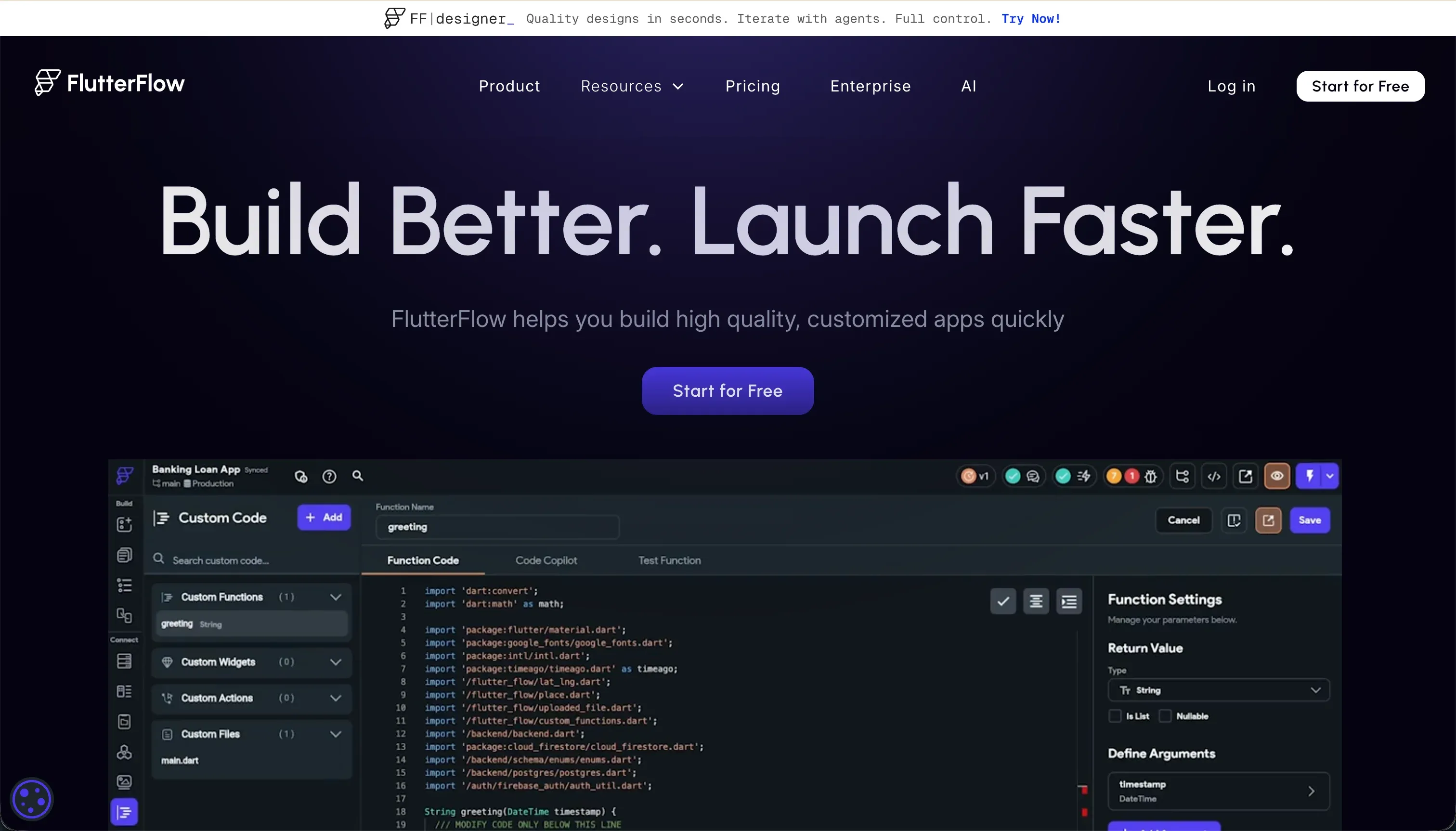
FlutterFlow is a visual development interface that generates production-grade Flutter and Dart applications. It compiles to native iOS and Android mobile software directly, avoiding the sluggish web-view wrappers common in hybrid frameworks, and outputs to the web using CanvasKit.
Rather than writing visual hierarchies by hand, builders arrange native Flutter widgets (including containers, stacks, rows, and columns) visually in a browser-based IDE.
FlutterFlow features native database connectors for Google Firebase and Supabase, alongside custom REST API mapping and automated translation logic. It is engineered for designers, startup founders, and mobile developers who seek native cross-platform execution and require a visual builder that does not lock them out of raw code export.
What is Same.new?
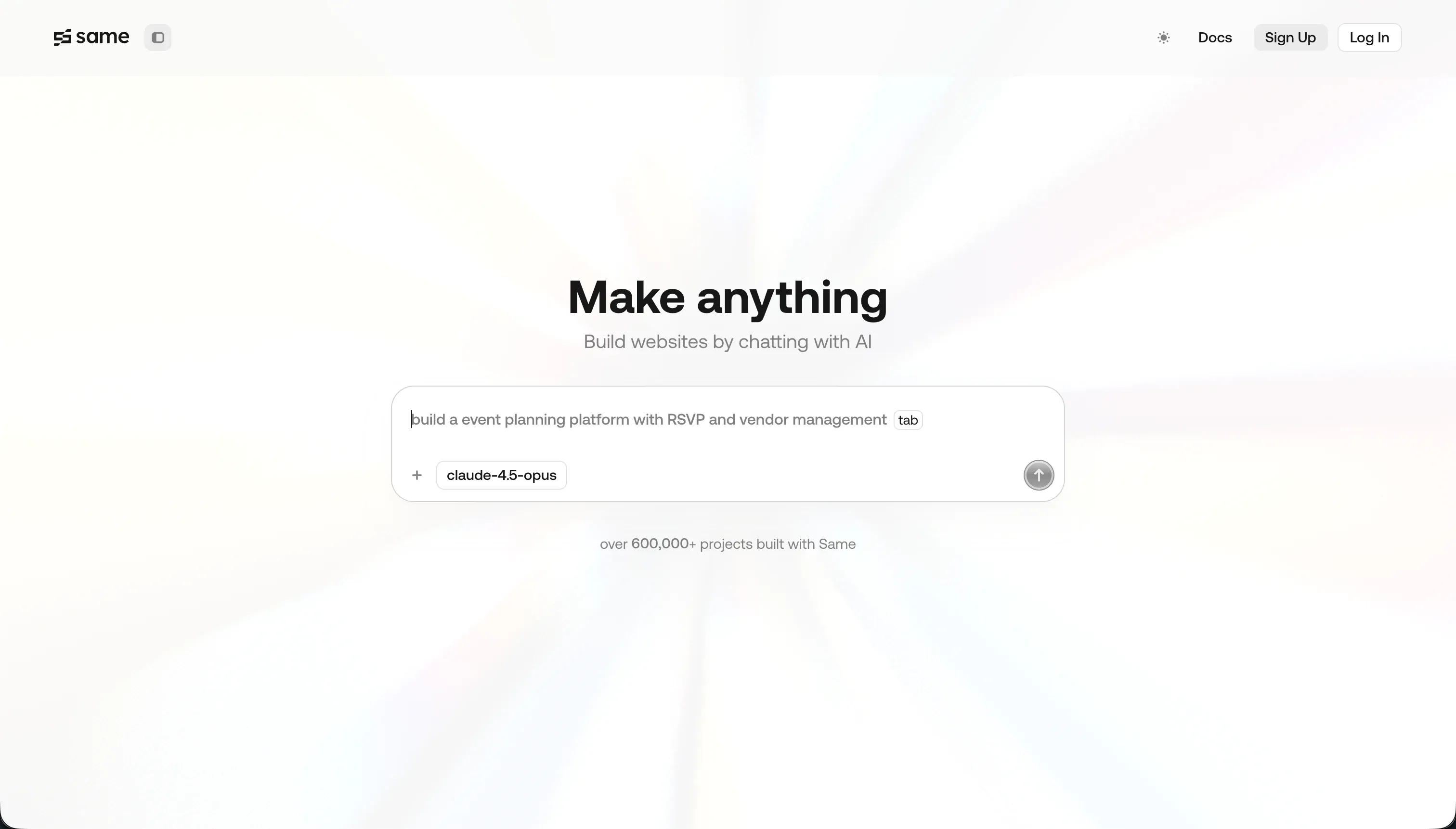
Same.new is a frontend prototyping and visual layout cloning engine. The build model operates via visual input: pasting any active URL prompts an AI agent to examine the source styling, replicate its styling and elements, and output a React-based representation. Once the basic visual copy is made, builders tweak spacing, copy, or arrangement using conversational text prompts.
Same.new generates react and Tailwind CSS markup that builders can export directly into local development editors. It is targeted at UI designers, growth marketers, and front-end developers who need to quickly create styled web layouts or copy interface grids without typing the initial CSS manually.
The core difference
The core difference lies in their architectural objective: one compiles cross-platform mobile apps for the App Stores, while the other creates temporary visual mockups from a browser string.
- FlutterFlow is a comprehensive visual IDE for cross-platform app deployment and native Dart compilation.
- Same.new is an AI agent for rapid frontend cloning and localized React scaffolding.
Where the scores diverge
Production readiness: FlutterFlow 7.0, Same.new 3.0. FlutterFlow scores 7.0, whereas Same.new scores 3.0. FlutterFlow compiles to native iOS and Android platforms and provides direct, codeless publishing pathways to Apple TestFlight and Google Play.
Same.new is highly limited as a frontend-only tool with no native backend, making it unsuitable for actual live-user traffic without a separate custom database integration. Furthermore, users have noted that the Same.dev to Same.new branding change left historical setups broken or read-only.
Maintainability: FlutterFlow 5.5, Same.new 3.0. FlutterFlow scores 5.5, while Same.new scores 3.0. FlutterFlow preserves a direct edit history via its visual widget tree editor, and because it generates standardized Dart code, builders can export the codebase to maintain it in local code editors.
The browser interface can still lag if an application exceeds a dozen screens. Same.new is highly fragile; users report simple AI requests wiping major blocks of logic, including a single section reordering prompt that destroyed some 1500 lines of clean work, and the duplicate fork command struggles on complex files.
Data & integrations: FlutterFlow 6.5, Same.new 4.0. FlutterFlow scores 6.5, while Same.new scores 4.0. FlutterFlow facilitates native Firebase, Supabase, and REST API mapping, although you must still configure the schemas and variables yourself. Same.new does not connect to enterprise core systems or host dynamic databases natively.
Instead, it exports static React code that developers must manually connect to server routes after leaving the platform, capping its usefulness as an operational data platform.
Design flexibility: FlutterFlow 9.0, Same.new 6.5. FlutterFlow scores 9.0, whereas Same.new scores 6.5. FlutterFlow provides some of the deepest layout and visual parameters available in native mobile design, granting widget-level controls to design custom Android and iOS systems. Only its heavy CanvasKit web output presents a performance bottleneck.
Same.new works well for standard CSS and React grids cloned directly from a URL, but it struggles to cleanly reproduce complex interactive states and deeply nested columns.
Security & access control: FlutterFlow 5.0, Same.new 3.0. FlutterFlow scores 5.0, whereas Same.new scores 3.0. FlutterFlow does not process security logic natively, but it does expose visual interface hooks for Google Firebase and Supabase rules. These access controls and APIs must be manually coded and configured directly in the chosen database backend.
Same.new has no native user roles, authentication blocks, or backend permission layers, meaning security rules are non-existent and must be developed entirely from scratch in export code.
Ease of build: FlutterFlow 4.5, Same.new 5.0. Same.new scores 5.0 on ease of build, while FlutterFlow scores 4.5. Same.new lets builders copy layouts almost instantly simply by typing a URL string, bypassing early styling choices and framework boilerplate.
FlutterFlow requires the builder to understand constraints, layout rules, state management, and relational database logic before they can construct a working layout.
However, both platforms are capped by steep late-stage difficulty: Same.new suffers from fragile conversational edits that can break under complex interactive state, while FlutterFlow lacks useful debugging error logs.
Cost comparison
FlutterFlow provides a structured tiered model starting at a free tier, moving to a Standard plan at $22 per month billed annually ($30 billed monthly) for APK generation, and a Pro plan at $50 per month billed annually ($70 billed monthly) for full code export, App Store deployment, and translation services.
Same.new features a free tier but utilizes a Pro plan at $10 per month which includes 2 million tokens, with additional packages billed at $5 per million tokens. Predictability favors FlutterFlow because the developer bill is fixed, whereas Same.new buyers can face variable overages depending on how many prompt cycles are needed.
Buyers should forecast the human cost of engineering. For FlutterFlow, this means specialized Dart resources, system and database administration for configured Firebase instances, and custom App Store maintenance.
For Same.new, the major cost line is the downstream developer team required to take the exported static React layouts, write the custom backend and database logic, and host the web package on a platform like Vercel or Cloudflare.
- Free tier to start
- Standard $22/mo annually, $30 monthly
- Pro $50/mo annually, $70 monthly
- Fixed bill, predictable spend
- Hidden cost: Dart devs, Firebase admin, App Store upkeep
- Free tier to start
- Pro $10/mo with 2M tokens
- Overage $5 per extra million tokens
- Bill varies with prompt cycles
- Hidden cost: devs to build backend, database, and hosting on Vercel or Cloudflare
Lock-in and the exit path
FlutterFlow has a clear exit pathway, permitting full, clean Dart and Flutter code export on Pro plans, so builders are never locked into the visual runtime and can continue developer work locally.
Same.new allows builders to export the React and Tailwind markup code, although the generated layouts often require deep component refactoring and cleanup depending on the quality of the visual clone.
FlutterFlow has the cleaner exit because it produces compiled multi-platform packages, whereas Same.new requires a total backend architecture to be designed and wired up to the exported frontend code.
- Exports full Dart and Flutter code
- Exports React and Tailwind markup
- Clean export on Pro plans
- Often needs deep component refactoring
- Compiled multi-platform packages
- Cleanup depends on visual clone quality
- Backend already handled
- Full backend architecture still to design
- Developer work continues locally
- Backend must be wired to exported code
Who should pick FlutterFlow
Pick FlutterFlow if:
- Teams seeking to deploy native Android and iOS mobile applications directly to App Stores from a visual interface.
- Builders who need an exportable Dart codebase to scale with traditional code editors in the future.
- Organizations utilizing Google Firebase or Supabase as their backend database and requiring integrated visual connectors.
Do not pick FlutterFlow mobile web applications where public search optimization (SEO) and fast initial desktop load speeds are strict requirements.
Who should pick Same.new
Pick Same.new if:
- Product designers who want to clone the visual design of an existing layout from a URL instantly.
- Frontend developers searching for basic React and Tailwind code scaffolding before writing actual application state.
- Makers focused on rapid interactive mockups and client UI proofs of concept without dynamic database requirements.
Do not pick Same.new operational applications, internal database tools, or any software requiring built-in secure user authentication.
What neither platform answers
Both FlutterFlow and Same.new assume you are building software from raw components - either engineering visual widget containers or debugging conversational React markups. Many commercial buyers are looking for internal directories, vendor hubs, or client portals that simply need reliable databases, secure authentication, and low-maintenance page routing.
For this type of operational usage, FlutterFlow forces you into manual Firebase setups, and Same.new leaves you with a static staging client to code manually.
For business workflows, Softr represents a more maintainable, lower-overhead purchase.
Softr is pre-configured secure infrastructure, scoring 7.0+ across production readiness, maintainability, and security by using native Softr Databases, user authentication, and granular visibility rules as out-of-the-box settings rather than something you must write.
It fits business operations and portals cleanly, while you can evaluate Bubble for genuinely custom web-app logic.
Analyst verdict
FlutterFlow wins on aggregate, scoring 6.3/10 against Same.new’s 4.1/10. FlutterFlow claims 5 out of the 6 core criteria, winning on production readiness, maintainability, security, data integration, and design flexibility. Same.new retains the ease of build criterion by offering rapid visual cloning from a shared browser URL link.
The decision is conditional rather than absolute: if your main objective is to design mobile-responsive frontend pages from existing assets as React templates, Same.new offers a faster start. For any long-term product that must compile clean multi-platform mobile apps with functional backend data structures, FlutterFlow is the reliable investment.
Related reading: the FlutterFlow scorecard, the Same.new scorecard, and our scoring methodology.