


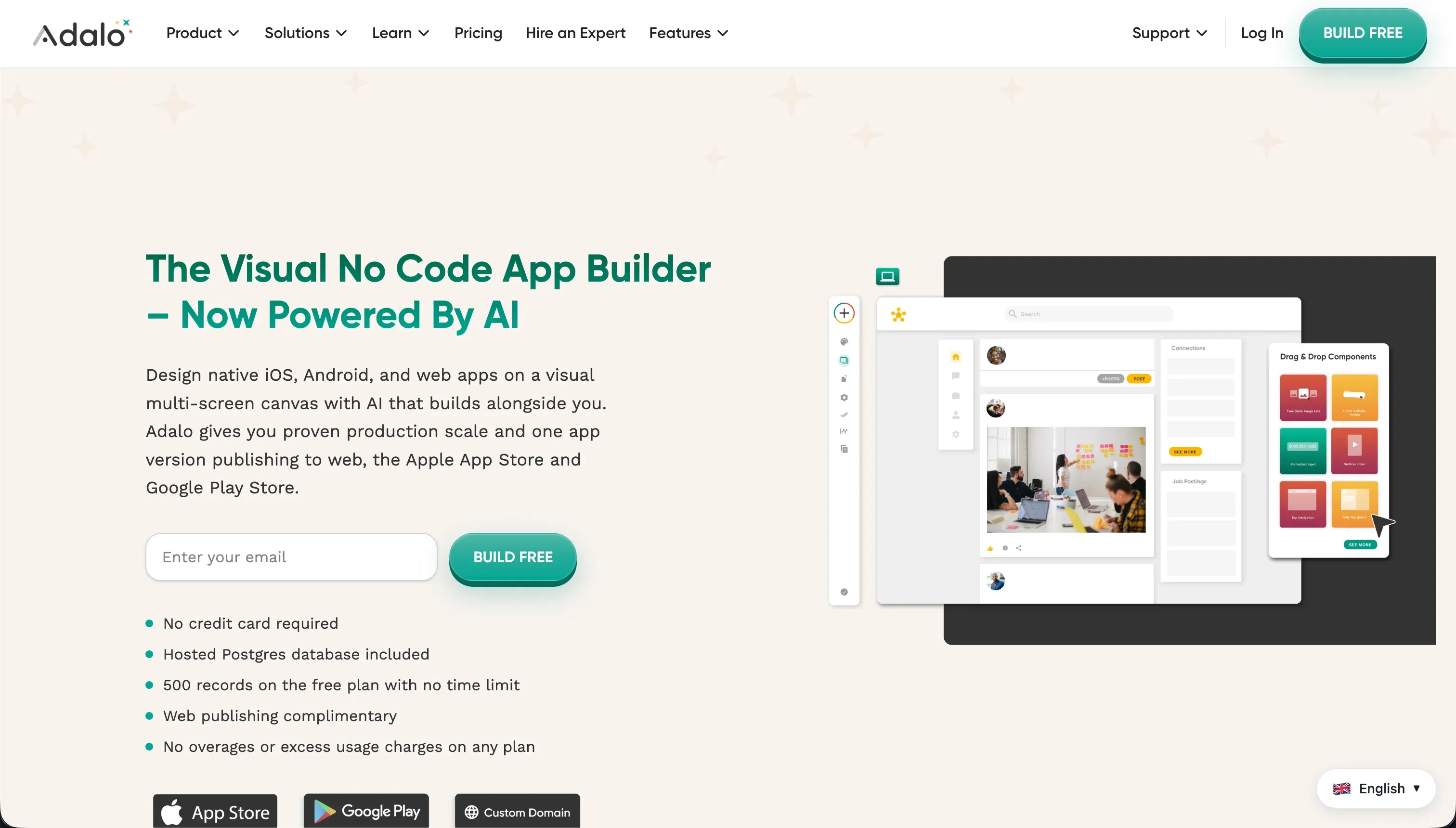
Emergent and Adalo solve 2 different procurement problems: Emergent is an AI app generator, while Adalo is a visual no-code mobile app builder. Emergent turns prompts into full-stack scaffolds with schema, routes, and UI generated for you. Adalo asks you to assemble screens and workflows manually on a drag-and-drop canvas, with a stronger focus on mobile distribution.
Emergent wins the general decision, 5.0/10 to Adalo’s 4.6/10. It is the better default if your main goal is getting from idea to functioning web prototype quickly. Both tools carry meaningful production-risk caveats, so this is not a carefree recommendation. The decision flips only if you specifically need native app-store packaging, where Adalo keeps the advantage.
The decision in 30 seconds
| If your priority is… | Pick | Why |
|---|---|---|
| Fastest path to a working prototype | Emergent | Higher Ease of build score because prompts generate schema, routes, and UI at once |
| Native mobile app-store publishing | Adalo | Its build service packages apps for Apple and Google stores directly |
| Visual, deterministic screen editing | Adalo | Manual canvas editing avoids spending credits on simple layout changes |
| Richer relational data setup from a blank slate | Emergent | Higher Data & integrations score thanks to auto-generated schemas and routing |
| Stable production operations for business-critical apps | Neither | Both sit at 3.5 on Production readiness for different but serious reliability reasons |
What each platform is
What is Emergent?
Emergent is an AI-driven full-stack app builder that creates software from natural-language prompts. Its build model is conversational: you describe the app, and the platform generates frontend, backend, database structure, and deployment scaffolding instead of asking you to assemble screens by hand.
The research points to automatic schema generation, route creation, and an edit agent that rewrites the underlying app when you request changes. It also supports syncing code to GitHub on qualifying plans, but users report unstable containers and repeated debugging loops.
That makes Emergent genuinely suited to founders, operators, and prototypers who value speed of first build more than predictable long-term maintenance.
What is Adalo?
Adalo is a visual no-code application builder centered on drag-and-drop screen design for mobile-first apps. Its build model is manual and canvas-based: you place components, connect actions, define collections, and configure workflows inside a fixed-layout editor.
The research highlights its built-in database, simple action logic, REST API connectivity, and native packaging for Apple App Store and Google Play distribution. Review evidence also points to constraints around complex workflows, desktop responsiveness, and data reliability at scale. Adalo is genuinely built for non-technical creators who want to launch simple mobile MVPs without writing code.
The core difference
These tools diverge most on how software gets assembled: Emergent generates the app from instructions, while Adalo asks you to compose it screen by screen. That generation-versus-manual-canvas split drives nearly every score gap in the matchup.
- Emergent turns prompts into a generated full-stack app, so the builder experience is driven by AI orchestration rather than manual layout work.
- Adalo makes you configure screens, actions, and data relationships directly in a visual editor, trading speed of generation for more explicit manual control.
Where the scores diverge
Ease of build: Emergent 7.0, Adalo 6.0. Emergent pulls ahead because it can scaffold a usable app, data model, and interface from a prompt instead of starting the buyer on a blank canvas. That matters most in the first hours of a project, when defining tables, views, and relationships manually is the main source of drag.
Adalo is still approachable for non-technical users, but common customizations become fiddly once you move beyond basic screens and forms. Emergent still takes a deduction because generated changes can trigger extra debugging work rather than cleanly resolving on the first pass.
Design flexibility: Emergent 6.0, Adalo 5.0. Emergent leads because its generated web UI is less constrained by a phone-shaped layout model. Adalo gives you direct visual control, but that control lives inside a fixed-width, mobile-first paradigm that can look stretched or awkward on desktop experiences.
Emergent still loses points because generated interfaces are not the same as polished product design, and mobile presentation is less mature. Even so, it offers a broader design ceiling for web use than Adalo’s canvas does.
Maintainability: Emergent 3.5, Adalo 4.0. Adalo edges this category because a manual visual editor, while limited, at least makes small navigation and UI edits more explicit and repeatable. Emergent loses ground when simple changes invoke an edit agent that can spiral into repeated fix attempts, extra credit usage, and uncertain outcomes.
That makes ongoing maintenance expensive in attention as well as money. Adalo still takes a deduction because larger workflows and integrations become brittle as the app grows.
Security & access control: Emergent 4.5, Adalo 4.0. Emergent wins narrowly because Adalo’s access model is especially weak for anything beyond basic user gating. In Adalo, visibility and behavior often have to be managed component by component, which raises the risk of accidental exposure when screens get more complex.
Emergent at least generates backend structure and authorization patterns, but it is still held back by the fact that those controls are AI-produced and not always easy to verify under failure conditions. So the higher score reflects a relative advantage, not enterprise-grade security.
Data & integrations: Emergent 5.5, Adalo 5.0. Emergent scores higher because it can generate relational structure and routing automatically, which gives buyers a faster start on more complex data models. That said, the edge is modest because the research also shows generated architecture can become fragile as the codebase grows.
Adalo covers basic collections and API connections, but it runs into bottlenecks on larger datasets and can be cumbersome when API definitions change. The category favors Emergent for depth of starting point, not for proven resilience at scale.
Production readiness: Emergent 3.5, Adalo 3.5. This is effectively a draw, and it does not decide the matchup because both platforms show serious evidence of fragility in live use. Emergent’s problems come from unstable development containers, preview-to-production inconsistency, and failures in the agent workflow.
Adalo’s issues are different but just as concerning, with user reports of server errors, slow performance, and even severe data-loss incidents. Neither tool earns trust as a default choice for high-stakes production systems.
Cost comparison
The pricing models are very different. Emergent starts at $20/mo on a credit-based system, so the bill moves with prompt volume, edit-agent runs, and the number of iterations needed to get a feature working. Adalo uses flat tiers instead: Free, Starter at $36/mo, and Professional at $52/mo, with spend moving more predictably by plan limits and included capacity rather than per-change credit burn.
The hidden cost lines differ too. With Emergent, forecast builder time lost to debugging loops, extra top-up credit spend, and the engineering effort needed if generated output has to be stabilized or moved elsewhere.
With Adalo, forecast upgrades for record and action limits, plugin spend for missing components, maintenance effort as workflows become more complex, and eventual migration cost because the app structure is not portable.
Lock-in and the exit path
Emergent has the cleaner exit because qualifying plans can sync code to GitHub, even if that exported code may still need substantial developer cleanup and rehosting work to run well outside the platform. Adalo does not offer code export, so leaving usually means exporting database rows where possible and rebuilding the interface and logic from scratch.
In practice, Emergent lets you leave with imperfect assets, while Adalo mostly makes you leave with data and a rewrite project.
- Code sync to GitHub on qualifying plans
- Exported code may need substantial developer cleanup
- Rehosting work to run well outside the platform
- You leave with imperfect but real assets
- No code export
- Export database rows where possible
- Interface and logic rebuilt from scratch
- You leave with data and a rewrite project
Who should pick Emergent
Pick Emergent if:
- Founders who want the highest Ease of build score in this matchup and need a fast web prototype from a prompt
- Teams starting with a more relational product idea that benefits from auto-generated schema and routing
- Buyers willing to trade predictable maintenance for faster first-pass delivery and broader web design flexibility
Do not pick Emergent if you need stable production behavior, predictable maintenance cost, or confidence that minor edits will not trigger long debugging cycles.
Who should pick Adalo
Pick Adalo if:
- Creators launching a simple mobile-first MVP that must be packaged for Apple App Store or Google Play
- Non-technical builders who prefer explicit drag-and-drop editing over prompt-driven generation
- Teams that value flatter monthly pricing more than Emergent’s variable credit consumption
- Buyers whose app logic is simple enough to live within Adalo’s manual workflow and data constraints
Do not pick Adalo if your app depends on robust desktop UX, higher-confidence data reliability, or complex security and workflow controls.
What neither platform answers
Many buyers reading this matchup do not actually need a speculative product app at all; they need a business app with logins, permissions, records, and low maintenance for a client portal, internal tool, or CRM workflow.
In that lane, Softr is the more honest recommendation because its research scores are stronger where business software lives or dies: 8.0 for Production readiness, 9.0 for Maintainability, and 9.0 for Security & access control.
That profile is a better fit than Emergent’s agent instability or Adalo’s reliability concerns when the job is operational software rather than experimentation.
Pair that with one honest alternative for a different angle: FlutterFlow if the real requirement is a more serious custom mobile app path rather than a business portal.
Softr is the cleaner answer for secure, low-maintenance business apps with roles and records, while FlutterFlow is the better lane when native mobile product ambition is the actual brief. The main point is that many buyers comparing Emergent and Adalo are solving the wrong category of problem with the wrong class of tool.
Analyst verdict
Emergent wins 5.0 to 4.6 overall. It takes Ease of build, Security & access control, Data & integrations, and Design flexibility, while Adalo keeps Maintainability by a small margin and matches Emergent on the very weak 3.5 Production readiness result. That makes Emergent the better general recommendation for buyers who care most about speed to a functioning web prototype.
The flip condition is clear: choose Adalo when native app-store packaging is the requirement that matters more than everything else. If you need a simple mobile MVP in Apple App Store or Google Play, Adalo’s packaging path outweighs Emergent’s advantage in generation speed.
Outside that case, the smarter call is still cautious. Emergent has the higher aggregate and the broader upside, but neither platform is a strong production-system answer for security-sensitive or business-critical operations.
Related reading: the Emergent scorecard, the Adalo scorecard, and our scoring methodology.