

Buying Cursor and Softr is really choosing between 2 different procurement problems. Cursor is an AI coding IDE in the developer-tools category, while Softr is a no-code business app platform for portals, internal tools, and CRMs. One assumes you will own and operate software as code; the other assumes you want to configure and run it as a managed product.
Softr wins the general decision 8.1 to 6.2. It is the safer default for teams that need to launch and maintain a secure business app without engineering overhead. The decision flips when you already have developers and code ownership or bespoke frontend control matters more than speed and operational simplicity.
The decision in 30 seconds
| If your priority is… | Pick | Why |
|---|---|---|
| Client portals, internal tools, or transactional CRMs | Softr | Prebuilt auth, permissions, and hosting reduce delivery risk |
| Fastest launch for a non-technical team | Softr | Ease of build is 9.0 versus 3.0 |
| Full ownership of an exportable codebase | Cursor | Works directly in your repository with standard source code |
| Pixel-level frontend control | Cursor | Design flexibility leads at 8.5 because the output is raw code |
| Predictable ongoing maintenance | Softr | Maintainability is 9.0 because there is no raw app codebase to service |
| Native mobile apps for app stores | Neither | This matchup is web-first and not the best path to packaged native mobile |
What each platform is
What is Cursor?
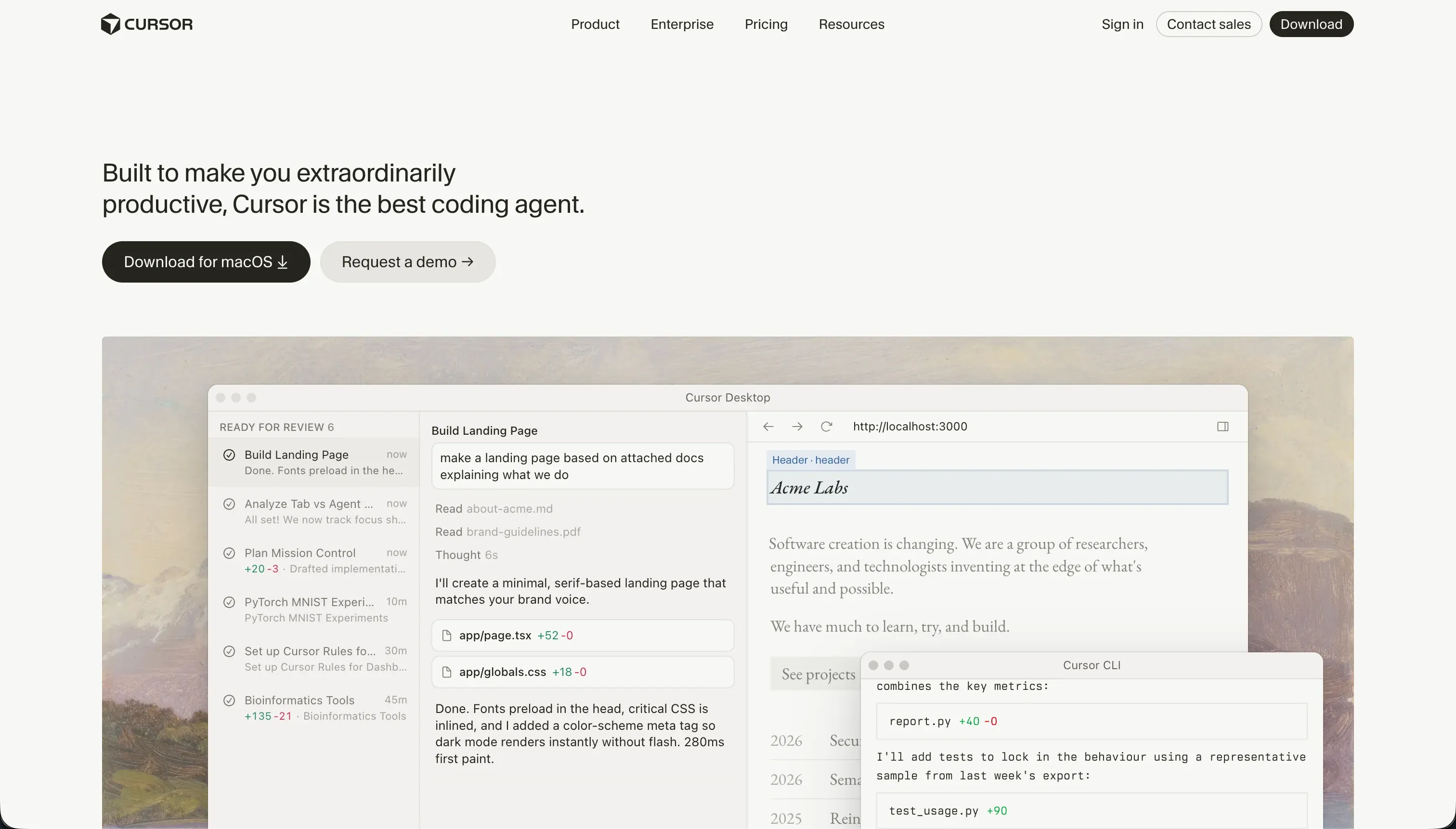
Cursor is an AI-first code editor built on a VS Code fork for developers working inside a real software repository. Its model is to accelerate coding, refactoring, and codebase navigation rather than replace the underlying stack, so your team still chooses the frameworks, database, hosting, and deployment process.
Cursor includes context-aware autocomplete, semantic codebase search, and agent-style multi-file editing that can change files across a project from natural-language prompts. It is genuinely built for software engineers and technical founders who are comfortable with terminals, package managers, debugging, and code review, not for operators looking for a managed business-app runtime.
What is Softr?
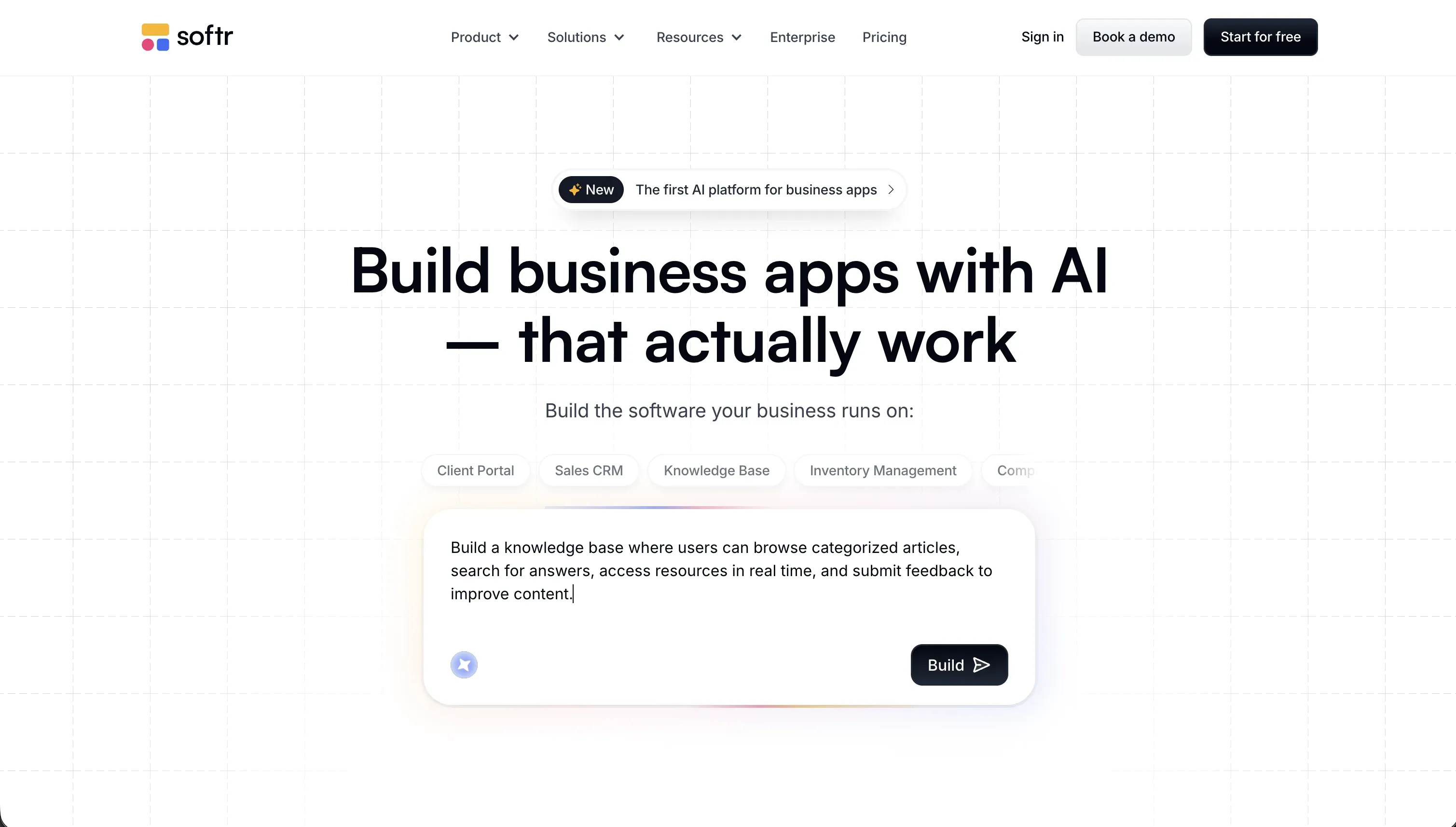
Softr is a no-code application platform for building business apps such as client portals, internal tools, and CRMs from managed building blocks. Its build model is visual and platform-led: you assemble pages, data views, permissions, and workflows inside Softr rather than writing and operating the application as code.
Softr offers an AI Co-Builder, a native relational database, and prebuilt components like tables, kanban boards, calendars, charts, and gated member experiences. It also supports concrete connectors to sources like Airtable, Google Sheets, HubSpot, SQL, and REST APIs, and it is genuinely built for business teams that need secure, maintainable software without taking on engineering infrastructure.
The core difference
These tools differ most on the build-and-run model: generate and manage custom code versus configure a managed application runtime. That single choice drives almost every score gap in the matchup.
- Cursor helps a developer produce custom software faster, but the team still owns the codebase, deployment path, and operational risk.
- Softr gives a team a managed environment for assembling business apps, with infrastructure, permissions, and runtime behavior largely handled by the platform.
Where the scores diverge
Ease of build: Cursor 3.0, Softr 9.0. Softr is built so a non-technical operator can get from prompt to working app quickly using visual blocks, generated pages, and built-in data and permissions. Cursor assumes the opposite starting point: you must initialize a project, understand the stack, run builds, and debug whatever the model changes.
That makes the gap decisive for business buyers, even though Softr still gives up some flexibility because the builder stays inside platform patterns.
Security & access control: Cursor 5.5, Softr 8.5. Softr has the stronger position because login methods, roles, and record-level access are product features rather than custom engineering work. In Cursor, security is only as good as the code and architecture your team implements, reviews, and maintains.
Softr is not flawless here either, since some enterprise identity requirements push buyers into higher plans and platform-defined controls rather than bespoke policy logic.
Design flexibility: Cursor 8.5, Softr 5.5. Cursor pulls ahead because code can express virtually any layout, interaction pattern, or frontend system a developer can build. Softr trades that freedom for consistency: its block-based canvas is faster and safer for standard business software, but it constrains page structure and pixel-level control.
Cursor still loses points overall because flexibility only matters if the team has the design and engineering capacity to use it well.
Production readiness: Cursor 6.0, Softr 8.5. Softr starts closer to deployable because hosting, authentication, and core app plumbing are already part of the product. Cursor can absolutely reach production, but only through the team’s own engineering discipline around infrastructure, testing, deployment, and rollback.
Softr does not score perfectly because its managed environment also means less architectural freedom than a custom stack.
Maintainability: Cursor 6.5, Softr 9.0. Softr removes most code-level maintenance by expressing the app as configuration inside a constrained system of proven blocks and settings.
Cursor gives you standard source code, which is an advantage for capable engineering teams, but it also means every AI-generated change can introduce dependency churn, regressions, or review overhead. Softr still takes a small deduction because platform abstraction can become limiting once the app outgrows the intended business-app shape.
Data & integrations: Cursor 7.5, Softr 8.0. This one is close because each tool is strong in a different way. Cursor can connect to almost anything a developer can code against, which gives it broad theoretical reach but also shifts implementation and maintenance onto the team.
Softr wins narrowly for many business apps because its native database and packaged connectors reduce setup time, though some deeper options sit behind higher tiers and keep it from pulling away.
Cost comparison
The pricing models are fundamentally different. Cursor is seat-based, with Pro at $20 per user per month and usage governed by AI query limits, so the bill moves with team size and how heavily developers rely on the assistant. Softr uses flat subscription tiers, including Pro at $99 per month and Business at $329 per month, with limits tied to plan entitlements rather than developer query volume.
The hidden costs are different too. With Cursor, forecast developer time, code review, infrastructure setup, maintenance, and any overages or extra tooling around the custom stack. With Softr, forecast the subscription tier you will actually need, possible AI credit consumption, and any future migration work if you eventually outgrow a managed no-code environment.
- Pro at $20 per user per month
- Usage governed by AI query limits
- Bill moves with team size and assistant reliance
- Hidden costs: dev time, review, infra, maintenance, overages
- Pro at $99 per month, Business at $329
- Flat subscription tiers
- Limits tied to plan entitlements, not query volume
- Hidden costs: tier choice, AI credits, future migration work
Lock-in and the exit path
Cursor has the cleaner exit because the core asset is standard source code in your own repository, so leaving mostly means continuing development without the Cursor assistant.
Softr does not export a full application codebase, so moving off it means rebuilding the interface and platform logic elsewhere, though your data can remain accessible through exports or the external systems you connected. In short, Cursor offers code portability; Softr offers easier operation but a heavier rebuild if you leave.
- Source code in your repo
- Code portable, still yours
- Cursor assistant on top
- Assistant dropped, no rebuild
- Interface you built
- Interface rebuilt elsewhere
- Data in your systems
- Data exported, still accessible
Who should pick Cursor
Pick Cursor if:
- Developer-led teams that need full code ownership and want AI to accelerate work inside a real repository
- Products where custom UI behavior or pixel-level frontend control matters more than turnkey delivery
- Technical founders willing to trade a 3.0 ease score for an 8.5 design flexibility score
- Teams that need integrations beyond packaged connectors and can maintain them as code
Do not pick Cursor if your team needs a non-technical builder to launch and maintain a secure business app without owning infrastructure and code review.
Who should pick Softr
Pick Softr if:
- Operations or IT teams launching portals, internal tools, or CRMs that benefit from built-in auth and permissions
- Buyers who value high production readiness and maintainability over bespoke frontend freedom
- Organizations that want non-technical staff to safely update workflows, fields, and layouts after launch
- Teams optimizing for lower operational burden across security, hosting, and ongoing maintenance
Do not pick Softr if your product requires bespoke frontend engineering, deep code-level control, or a portable source-code asset from day one.
Where neither platform fits
If your priority is shipping true native mobile apps to the App Store or Google Play, neither of these is the cleanest fit. Softr is strongest for responsive web business apps, and Cursor can get you there only if your developers build and maintain the entire mobile stack themselves. In that case, FlutterFlow is the better shortlist because it is purpose-built for native mobile delivery.
If the non-negotiable is mandatory code ownership and self-hosting, Softr is the wrong category and Cursor may still be more hands-on than some buyers want. Replit is the better alternative for teams that still want standard code and a cloud development environment without committing to a managed no-code runtime.
That makes Replit the more honest exclusion path when the real requirement is portable code plus browser-based development.
Analyst verdict
Softr wins 8.1 to 6.2, taking Ease of build, Production readiness, Maintainability, Security & access control, and a narrow edge in Data & integrations, while Cursor keeps Design flexibility. For the general business-app decision, that makes Softr the safer buy because it removes more delivery and operating risk from the team.
The flip condition is straightforward: choose Cursor when you already have developers and the asset you are buying is code itself. If bespoke UI, repository ownership, and custom engineering freedom matter more than speed to launch, Cursor’s 8.5 in design flexibility can outweigh Softr’s aggregate advantage.
For everyone else building a portal, internal tool, or CRM, Softr is the better procurement call. Its higher scores are concentrated in the criteria that most often determine whether a business app survives first contact with real users: build speed, maintainability, and security controls.
Related reading: the Cursor scorecard, the Softr scorecard, and our scoring methodology.