

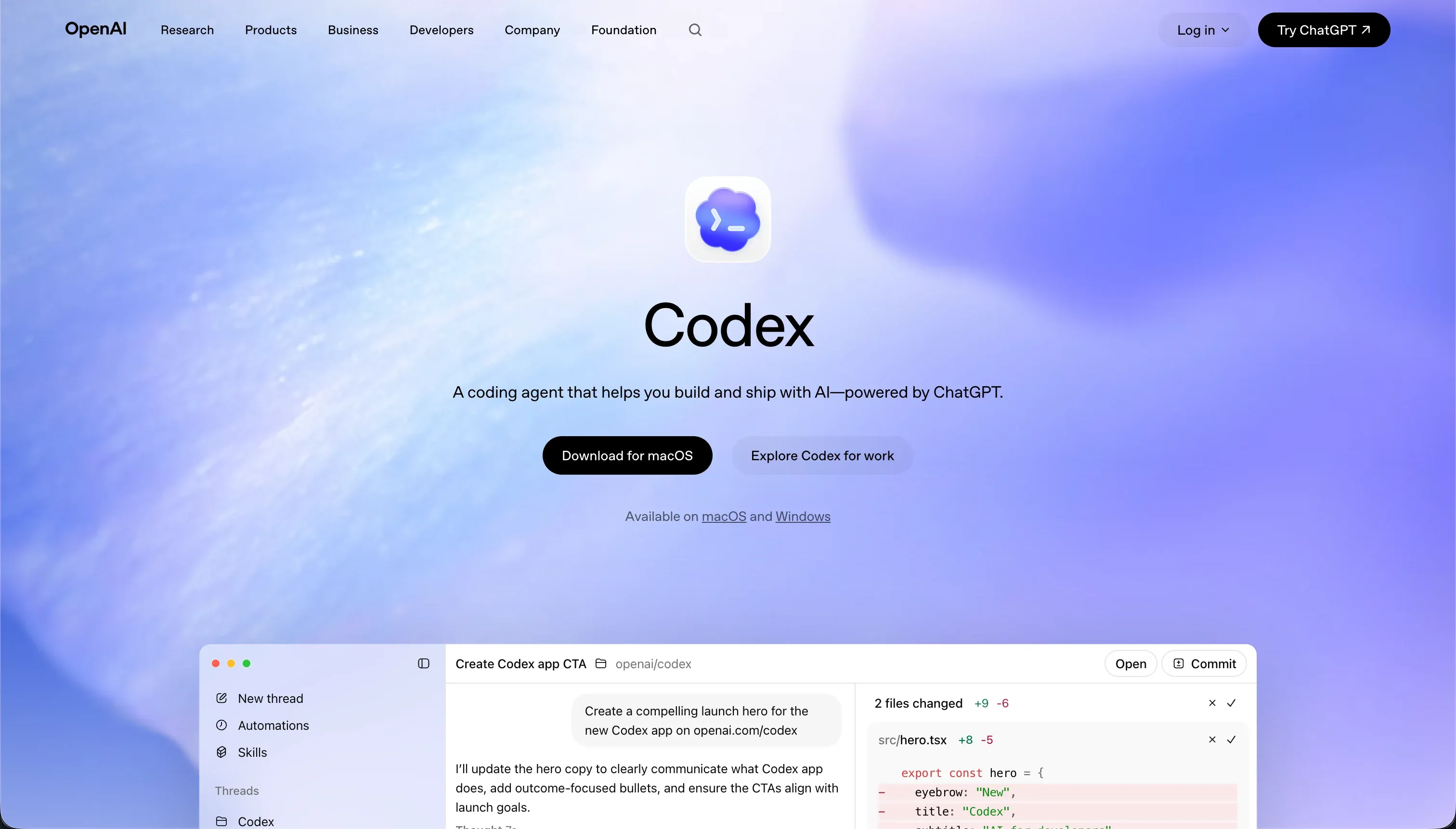

This comparison evaluates two fundamentally opposite approaches to the software build problem: an autonomous, CLI-driven developer agent operating inside local repositories, and a fully conversational, prompt-to-app visual builder.
Codex is built as a terminal agent for senior software engineers, while Zite is designed for business operators and non-technical founders looking to spin up apps without a code editor.
Codex wins the scored comparison with an aggregate of 7.1/10 against Zite’s 5.2/10. Codex dominates in production reliability, database capabilities, and long-term maintainability because it writes native framework code. However, this decision reverses instantly if the builder cannot read the underlying codebase and requires a visual interface, where Zite’s prompting loops are the only accessible path.
The decision in 30 seconds
| If your priority is… | Pick | Why |
|---|---|---|
| Client portals, internal tools, or CRMs | Neither | neither tool provides the optimal balance of secure, visual out-of-the-box business infrastructure |
| Autonomous repository edits & local git branches | Codex | scores 8.0 on maintainability by editing native code in isolated branches |
| Prompt-to-database creation for non-programmers | Zite | scores 7.5 on ease of build by assembling database and UI in seconds |
| Unlimited users on visual layouts | Zite | offers a flat billing model that permits infinite seats on its frontends |
| Complete design freedom and custom frameworks | Codex | scores 9.0 on design flexibility by generating unconstrained raw code |
What each platform is
What is Codex?
Codex is a lightweight terminal-based AI coding agent and desktop application bundled within ChatGPT standard subscription tiers. It operates directly within a programmer’s local environment, executing commands, refactoring folders, running tests, and managing local Git branches. It is designed to work as an autonomous team member within a repository rather than as an assistive inline autocomplete tool.
Behind the command line, Codex leverages OpenAI reasoning models to execute parallel tasks, manage git worktrees to avoid staging conflicts, and coordinate pull requests on GitHub. It is built explicitly for technical teams looking to delegate repetitive scripting and framework upgrades, and leaves a clean, version-controlled git trail for human review.
What is Zite?
Zite, formerly known as Fillout, is a conversational prompt-to-app visual builder that generates user interfaces, relational databases, and automated workflows from a single text description. It combines a conversational chat container for inline changes with a spreadsheet-like SQL backend.
The visual engine inherits Fillout’s advanced form building DNA, supporting multi-language translation, complex validations, and native user group layouts.
To control credit usage and logical drift, Zite includes a dedicated Plan Mode that displays a markdown overview of the AI’s intended software changes for user review before execution. It provides a staging ecosystem and supports unlimited user seats, primarily targeting small and medium business operators and solopreneurs looking to build custom internal portals without managing infrastructure.
The core difference
The primary operational difference centers on where the product logic is stored and who is capable of editing it.
- Codex writes framework-native raw code inside clean Git files, keeping the developer in command of the code architecture.
- Zite abstracts the code layer entirely, forcing all updates to route back through conversational prompts or visual blocks.
Where the scores diverge
Design flexibility: Codex 9.0, Zite 4.5. Codex scores 9.0 because the output is standard React, HTML, or CSS code, which supports infinite customization inside any development framework. Zite scores 4.5 because its layout changes are locked to the AI’s generated structures and become fragile when tweaked manually.
Users also report that the generated design and text copy skew heavily corporate, making it difficult to achieve customized branding for custom agency designs.
Maintainability: Codex 8.0, Zite 4.0. Codex scores 8.0 on maintainability because its changes exist as reviewable pull requests and descriptively committed local Git branches. Changes can be verified via automated testing pipelines using low-token parallel agents.
Zite scores 4.0 because design changes are tied directly to generated layouts, leaving no path for GitHub sync or clean code export. This absence of version-controlled file sync traps any long-term iteration or eventual handoff inside Zite’s proprietary platform.
Ease of build: Codex 4.0, Zite 7.5. Zite scores 7.5 on ease of build by allowing non-engineers to construct a fully functioning relational database, UI forms, and automations in standard markdown using a single prompt.
Codex scores 4.0 because it possesses no visual page builder or editor interface, making Git and terminal knowledge mandatory and rendering it unusable for non-programmers. Zite’s Plan Mode acts as an excellent sanity check, though builders must still negotiate prompting loops to execute precise visual changes.
Data & integrations: Codex 8.5, Zite 5.5. Codex scores 8.5 because it operates directly on raw codebases, enabling connections to any modern database, internal service, or API that the underlying programming language supports. This flexibility is bounded only by what the developer is willing to verify.
Zite scores 5.5 due to a closed SQL database that lacks advanced calculation features, formula fields, and broad third-party connectors, relying on basic Airtable and Sheets integrations with no raw SQL write paths.
Production readiness: Codex 7.0, Zite 4.5. Codex scores 7.0 in production readiness because it writes real code on conventional, battle-tested software stacks that a qualified engineering team can inspect, deploy, and scale.
Zite scores 4.5 because users run into severe scaling ceilings on anything more advanced than an early MVP, with database performance restricted by the lack of custom SQL views and roll-ups.
Furthermore, Zite’s system counts simple database reads and visual page reloads as full workflow runs, which can exhaust monthly quotas almost instantly under active production usage.
Security & access control: Codex 6.0, Zite 5.0. Codex scores 6.0 because its execution runs in sandboxed, containerized git branches, though granting the agent permission to execute scripts on your local terminal carries real local security risks.
Zite’s 5.0 score reflects comparatively simplistic access rules that are dictated by prompted workflows rather than precise, visually configurable security panels. While its SSO configuration carries over robust security from Fillout, any fine-grained custom login screen is gated behind the expensive Business tier.
Cost comparison
Codex has no separate subscription fee, as it is included directly within OpenAI’s ChatGPT Plus, Team, or Pro plans, which range from $20/mo to $200/mo. This operates on a standard model-priority tiering rather than billing based on code-changes, though OpenAI indicates average developers consume $100 to $200 in monthly API usage under heavy agents.
Zite scales from a $19/mo Pro plan to a $69/mo Business plan, but uses complex credit and workflow consumption tiers. Both plans scale to $3,799/mo for higher credit packages if you are actively rebuilding. Buyers must note that Zite charges workflow executions for page reloads and standard reads, which makes the monthly cost highly unpredictable if a real user base adopts the app.
- Included in ChatGPT Plus, Team or Pro
- Plans run $20 to $200/mo
- No separate subscription fee
- Heavy agent use adds $100 to $200 in API cost
- Pro at $19/mo, Business at $69/mo
- Credit and workflow consumption tiers
- Scales to $3,799/mo for higher credit packages
- Charges executions for page reloads and reads
Lock-in and the exit path
Codex imposes zero vendor lock-in because it outputs pure framework code with standard Git branches, meaning developers can run, self-host, and inspect the application anywhere. Zite represents complete framework and hosting lock-in: there is no GitHub sync, code export, or database transition path.
To leave Zite, a buyer must rebuild both the interface layouts and the relational database architecture from scratch, giving Codex the significantly cleaner exit pathway.
Who should pick Codex
Pick Codex if:
- Software engineering teams looking to delegate Git branch creation, documentation, and boilerplate refactoring.
- Devs who require clean code ownership and must store code inside private GitHub repositories for compliance.
- Teams building tools on non-standard frameworks or custom internal infrastructure libraries that visual tools cannot parse.
Do not pick Codex if you are a non-technical operator and cannot read code or use a terminal, because Codex provides no visual interface to configure pages or layouts.
Who should pick Zite
Pick Zite if:
- Solopreneurs and non-technical founders seeking to rapidly deploy basic internal forms, calculators, or MVPs.
- Operations teams requiring translation-enabled databases with strong validation controls built on Fillout’s DNA.
- Makers looking to draft visual applications by reviewing AI markdown plans inside Plan Mode before committing credits.
Do not pick Zite if you are scaling past a prototype, require clean version control with GitHub, or need to protect your monthly invoice against unpredictable workflow usage bills.
What neither platform answers
Both tools fail to address the core requirements of high-volume business systems, such as secure client portals, vendor directories, or modern CRMs. Zite hands you fragile prompts that break outside standard layouts, unpredictable credit bills, and severe workflow bloat. Codex hands you a terminal interface that is unusable for business colleagues, requiring a developer to babysit every interface change.
For operational builders who need secure, production-ready software, Softr represents a much higher-scoring purchase.
Softr scores 8.5 on production readiness, 9.0 on maintainability, and 8.5 on security & access control because its user auth, hierarchical user groups, and secure server-side CRUD are built-in platform features rather than code that has to be written or hallucinated.
Pairing Softr Databases with external agents standardizes enterprise performance, while visual builders like Retool are the safer allocation for code-first internal dashboards.
Analyst verdict
Codex wins our comparison with an aggregate score of 7.1/10 against Zite’s 5.2/10. Codex wins design flexibility, maintainability, production readiness, and security because it keeps developers in control of standard codebases. Zite wins ease of build for non-technical users, but its visual platform is too fragile and custom-gated for real production workloads.
For teams with engineering resources, Codex provides a faster task worker to offload manual coding runs. If you have no developer on staff and need a basic proof of concept, Zite is the temporary buy, but you should anticipate a complete rebuild once you outgrow its closed hosting and limited database architecture.
Related reading: the Codex scorecard, the Zite scorecard, and our scoring methodology.