

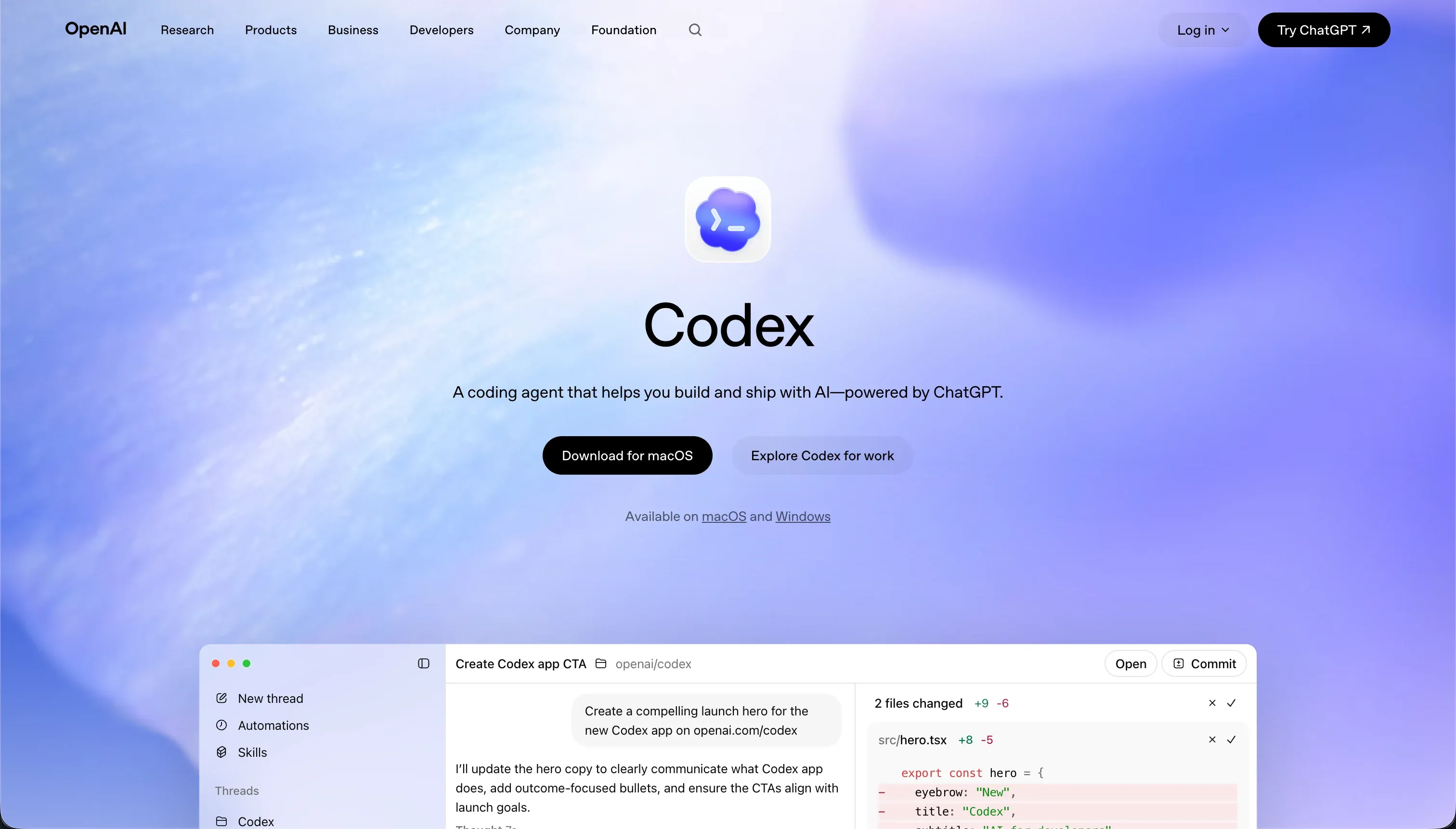

The choice between Codex and Emergent represents a fundamental procurement split between developer-centric command line tools and prompt-to-app code generation platforms. Codex is a terminal-based AI coding agent operating directly in local repository environments to write templates and automate scripts.
Emergent is an all-in-one conversational web app builder designed to scaffold complete frontends, backend databases, and hosting environments directly from chat prompts.
Codex wins this head-to-head with an aggregate score of 7.1/10 compared to Emergent’s 5.0/10. While Emergent offers a low barrier to entry for a first prototype, its high operational instability and unpredictable edit loops create a severe maintainability drain.
Codex is the clear winner for technical teams willing to trade visual editors for git-based stability, while buyers needing custom business interfaces with zero infrastructure overhead should look past both systems entirely.
The decision in 30 seconds
| If your priority is… | Pick | Why |
|---|---|---|
| Git-integrated parallel refactoring runs | Codex | It runs concurrent agent instances in containerized branches, scoring 8.0 on maintainability |
| Rapid full-stack web scaffolding from a prompt | Emergent | It scores 7.0 on ease of build by generating databases, auth, and UI in minutes |
| Predictable cloud billing and software spend | Neither | Emergent relies on variable credit burn and Codex utilizes token-based ChatGPT limits |
| Direct repository execution and test automation | Codex | It operates inside local codebases, auto-creating git branches and running terminal tests |
| Non-technical portal or internal database creation | Neither | Softr provides secure, flat-rate, visual layouts with zero risk of code regressions |
What each platform is
What is Codex?
The Codex agent is a native terminal tool and CLI application bundled with ChatGPT subscription tiers. Unlike visual platforms, it features no drag-and-drop builder, operating instead directly inside a local repository to run command line scripts, build basic code templates, and manage branches.
It is designed to extend automated, parallelized code modifications directly into an engineer’s existing local environment.
Codex uses isolated containerized branches to execute tests, write code, and open pull requests autonomously. Integrated with a desktop application to track logs and manage git worktrees, it is optimized to reduce token overhead during deep structural changes. Codex is explicitly built for senior developers who treat AI as an automated utility rather than a standalone host.
What is Emergent?
The Emergent platform is a full-stack, prompt-to-application builder designed to generate web interfaces, database tables, and routing configurations from conversational natural language. Revisions are executed through chat interfaces where users request style tweaks, workflow shifts, or schema modifications.
It handles its own cloud hosting and generates live public preview URLs immediately after build.
Emergent provides built-in user authentication scaffolds and automatic routing, attempting to abstract away the entire developer operations layer. It operates under a monthly credit budget where modifying files or invoking edit agents consumes credits from a capped plan. The system is built to lower the technical hurdle of spinning up an end-to-end cloud environment for non-technical creators.
The core difference
The primary operational difference between these systems is how they define code ownership and interface execution.
- Codex acts as an infrastructure-free local command assistant, using git-branch containment to execute changes inside a repository that you host and verify.
- Emergent acts as a unified visual runtime, orchestrating generation, hosting, and databases under a single proprietary AI-agent cloud.
Where the scores diverge
Maintainability: Codex 8.0, Emergent 3.5. Codex secures an 8.0 by keeping changes in native git branches and reviewable pull request diffs, utilizing low token overhead to keep large refactors predictable. Emergent scores a poor 3.5, driven by bugs in its underlying edit agents.
Users report that requesting even minor two-line edits can trigger full script updates, trapping builders in infinite debugging loops where the same bug is fixed five or more times, heavily consuming credits.
Production readiness: Codex 7.0, Emergent 3.5. Codex scores 7.0, producing genuine code on real infrastructure while running local testing scripts to verify code behaviors before opening pull requests. Emergent drops to 3.5 due to a persistent gap where public production does not match sandbox previews.
Additionally, development containers frequently throw waking errors such as ‘Error Waking Up Agent’, and reviewers report blocked backend environment access during deployment container failures.
Ease of build: Codex 4.0, Emergent 7.0. Emergent scores 7.0 here because a single conversation instantly scaffolds a visual web layout, database links, and routing structures with zero technical setup. Codex scores a low 4.0 because it does not have a visual interface or direct app hosting.
Non-technical users cannot run terminal agents or navigate command lines, making the entry barrier for Codex incredibly high unless you are already an engineer.
Data & integrations: Codex 8.5, Emergent 5.5. Codex scores 8.5 because it operates inside raw repositories, meaning it can reach any database, third-party API, or cloud library supported by your programming language.
Emergent scores 5.5; while full-stack data routing maps automatically during setup, users report that database schemas and integrations quickly break down once the codebase exceeds basic complexity thresholds.
Design flexibility: Codex 9.0, Emergent 6.0. Codex scores a highly flexible 9.0 since it writes raw code, leaving your app layout restricted only by your framework constraints and engineering capacity.
Emergent scores 6.0, generating responsive web layouts from prompt iterations but falling behind due to unfinished, less mature mobile configurations and limited manual styling controls once the prompt engines experience fatigue.
Security & access control: Codex 6.0, Emergent 4.5. Codex scores 6.0; its parallel branches run containerized to protect files, but granting script-execution permissions locally carries sandbox risks, and all application-level controls are code the engineer must manually write.
Emergent scores 4.5 because database permissions are generated conversationally rather than configured visually, which combined with blocked backend access is highly unreliable for strict security audits.
Cost comparison
The pricing models of these platforms diverge on the axis of subscription containment versus variable token consumption. Codex has no standalone subscription tier, bundling its CLI and agent access into standard ChatGPT plans starting at $20/month for Plus and scaling to $200/month for Pro.
It uses token-based allocation pools, making costs dependent on your base OpenAI monthlyLimits. Emergent uses a credit-based subscription ranging from a $20/month Standard plan to a $200/month Pro plan.
In Emergent, AI code generations and edit requests consume monthly credits that do not roll over, requiring builders to purchase top-up packages when thresholds are reached.
Buyers must calculate the hidden cost of credit drain during testing. Because Emergent’s edit agents repeatedly re-write scripts during debugging loops, non-technical users have reported spending close to $10,000 AUD on sudden credit overage fees.
Codex avoids these hidden billing platforms because code runs locally, meaning your only real variable is OpenAI token volume rather than premium execution markups. However, Codex requires a salaried engineer to manually read and review every code block before merging.
Lock-in and the exit path
Codex has zero platform lock-in. Because the agent writes code directly to your local file system, all logic, configuration structures, and database scripts live in native git branches that you can immediately port to standard host providers. Emergent presents a rigid lock-in scenario.
Your application database routing, layout elements, and backend schemas are tied directly to Emergent’s hosting and deployment environments, and any platform container failure can block database access entirely, making transition difficult without a complete rebuild.
Who should pick Codex
Pick Codex if:
- Engineering teams who want to automate unit tests, branch scripting, and pull requests directly in their existing local repository.
- Technical builders who require absolute code ownership and clean git-versioned changes with zero platform lock-in.
- Organizations operating on standard ChatGPT enterprise or team tiers looking to maximize current developer API-token pools.
Do not pick Codex if you are a non-technical manager who cannot run terminal commands or manually audit raw git pull request diffs.
Who should pick Emergent
Pick Emergent if:
- Non-technical founders attempting to spin up a rapid full-stack prototype or mock presentation in a few hours.
- Teams seeking basic prompt-to-app scaffolds with built-in database tables and pre-configured cloud hosting.
- Creators focused entirely on draft web mockups who do not require custom backend configurations or programmatic database migrations.
Do not pick Emergent if you require reliable production performance, predictable billing, or intend to grow your codebase beyond a simple MVP container.
What neither platform answers
Both Codex and Emergent assume that your team should build operational tools using raw, generated code. For teams seeking to build internal tools, secure client portals, or customer directories, this assumption introduces severe project risks.
You are forced to choose between a terminal agent that non-engineers cannot use, or a credit-burning AI builder that can break on every basic text edit. When authentication, page routing, and clean design tables are generated from scratch each time, maintainability suffer.
A business app creation platform like Softr solves this issue by using a secure, pre-built no-code framework. Softr scores 7.0+ across production readiness, maintainability, and security precisely because standard features like global user permissions, Google OAuth, and native database layouts are verified visual structures.
You get the creation speed of an AI Co-Builder without leaving your team dependent on generated scripts to change a user role. Teams needing custom mobile deployments can also shortlist verified visual builders like FlutterFlow to secure clean UI without credit-based debugging loops.
Analyst verdict
Codex wins on aggregate, scoring 7.1/10 to Emergent’s 5.0/10. Emergent secures a lead only on ease of build (7.0 vs. 4.0), delivering a workable full-stack skeleton in minutes. However, Codex claims the remaining five criteria by wide margins, featuring 8.0 on maintainability and 7.0 on production readiness due to stable git containment, low token costs, and raw code flexibility.
The final comparison is strictly conditional. If you are a non-technical builder who needs to spin up a fast web prototype for a pilot run, Emergent’s visual speed makes it the viable entry. But for any team building software that must live in production and scale without compounding technical debt, Codex is the highly superior and more sustainable technical asset.
Related reading: the Codex scorecard, the Emergent scorecard, and our scoring methodology.