


Codex and Claude Code solve 2 different procurement problems inside the same category: terminal-based AI coding agents. Codex is the better fit when you want an autonomous refactoring agent that can run parallel tasks across branches. Claude Code is the better fit when you want a conversational shell assistant with tighter human approval on each action.
Codex wins the general decision on this page, 7.1/10 to Claude Code’s 6.6/10. It leads on production readiness, maintainability, and data & integrations, while the matchup stays close on security and design flexibility. The decision flips only if your team wants stricter per-command permission prompts and prefers usage-based billing over a bundled subscription.
The decision in 30 seconds
| If your priority is… | Pick | Why |
|---|---|---|
| Parallel refactors across multiple branches | Codex | Containerized parallel task flow supports higher 8.0 maintainability |
| Strict manual approval before commands run | Claude Code | Granular permission prompts make its 6.0 security score more attractive in hands-on workflows |
| Client portals, internal tools, or CRMs | Neither | Both are code-first terminal agents, not low-maintenance business app platforms |
| Predictable monthly spend | Codex | Bundled ChatGPT plan pricing is easier to forecast than token-based usage |
| Large-repo maintainability | Codex | Claude Code loses points when context compaction drops rules on bigger codebases |
| Conversational shell usage on Mac or Linux | Claude Code | Its native terminal workflow is built around direct local command execution |
What each platform is
What is Codex?
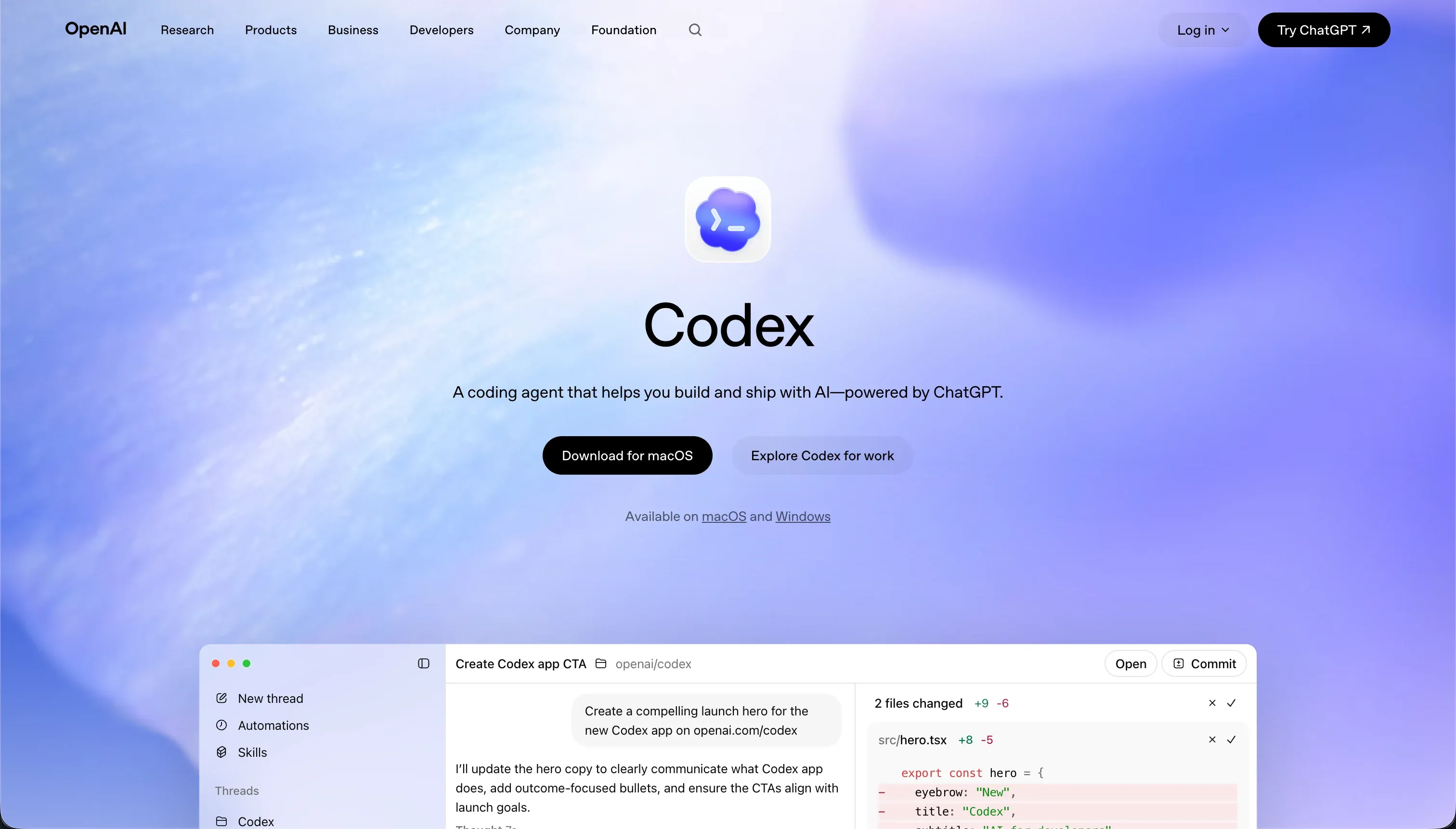
Codex is OpenAI’s terminal-based AI coding agent for working directly inside local repositories. Its build model is autonomous and branch-oriented: you hand it coding tasks, it edits files, runs tests, and works through changes in your local environment rather than inside a visual builder.
Documented capabilities include Codex CLI workflows, parallel task execution in isolated environments, and git-aware branch management tied to reviewable code changes. It is genuinely built for senior developers and technical teams that already know how to manage local tooling, review diffs, validate tests, and ship standard codebases.
What is Claude Code?
Claude Code is Anthropic’s agentic command-line coding assistant that works from inside your local shell. Its build model is conversational and tool-calling: it reads files, edits code, runs terminal commands, and helps manage commits directly in the repo you already own.
Documented features include shell execution, git commit help, and configurable guidance through files like CLAUDE.md, along with granular permission prompts before sensitive actions. It is genuinely built for engineers, technical founders, and ops-heavy teams that already have local compilers, test pipelines, and a habit of supervising code changes closely.
The core difference
These tools differ most on autonomy versus supervision. Codex is optimized to push larger parallel coding workflows forward, while Claude Code is optimized to stay closer to the developer’s hands inside the shell.
- Codex acts like an autonomous repo worker that can drive parallel branch-based changes with less day-to-day conversational overhead.
- Claude Code acts like a conversational shell partner that keeps the human closer to each command, edit, and approval step.
Where the scores diverge
Maintainability: Codex 8.0, Claude Code 6.5. Codex wins here because its branch-oriented workflow, isolated task execution, and git-friendly review model make code changes easier to inspect and integrate over time. It still is not perfect, since generated code must be reviewed closely and weak prompts can still create messy output.
Claude Code loses ground because context compaction on larger repositories can cause it to forget instructions or project rules, which adds supervision overhead. That difference matters most once the codebase is big enough that memory discipline becomes part of maintenance.
Production readiness: Codex 7.0, Claude Code 6.0. Codex pulls ahead because it is better suited to turning tasks into reviewable code changes, tests, and branch-level outputs that fit normal engineering workflows. That said, it still loses points because autonomous agents can overreach and require careful diff review before merge.
Claude Code is capable in production repos too, but latency on heavier tasks and reports of losing constraints in larger contexts make it less dependable as project complexity rises. The gap is not about raw capability; it is about how consistently each tool holds up under real team delivery conditions.
Data & integrations: Codex 8.5, Claude Code 8.0. Codex has the edge because it works naturally with standard developer ecosystems, including git-centric workflows and whatever scripts or APIs the repo already uses.
It still loses a little for requiring those integrations to be engineered and maintained in code rather than configured from a managed catalog. Claude Code is also strong because a shell-native assistant can call APIs, run scripts, and interact with databases through the local environment.
The matchup stays close because both tools are flexible, but that flexibility depends on engineering effort rather than prebuilt connectors.
Ease of build: Codex 4.0, Claude Code 4.0. Neither tool makes software easy for a non-developer because both start from the command line, not a visual builder. Codex expects you to understand local repos, tests, and review loops before you can benefit from its autonomy.
Claude Code is equally terminal-native, so the user still has to manage shell setup, package errors, and code review. The near-tie reflects that both products are powerful only if the team already knows how to build in code.
Security & access control: Codex 6.0, Claude Code 6.0. This is close because both tools run in local environments where the real risk comes from what commands you allow them to execute.
Claude Code earns credit for granular permission prompts that force explicit approval before sensitive actions, but it still remains a terminal agent with broad potential access once allowed. Codex benefits from isolated execution patterns, yet it also relies on the team to secure secrets, environments, and review practices.
Because neither product provides app-layer roles or governed end-user permissions, security is more about operator discipline than built-in control planes.
Design flexibility: Codex 9.0, Claude Code 9.0. This criterion is effectively a tie because both tools output and modify raw code, which means neither imposes a visual system on what you can build.
That freedom is real, but it comes with the same cost on both sides: layout systems, responsive behavior, and UI polish still have to be specified, implemented, and tested by the team. Codex does not win simply because it is more autonomous, and Claude Code does not win simply because it is more interactive.
The criterion stays high for both because code ownership preserves maximum frontend freedom.
Cost comparison
Codex uses bundled subscription pricing through ChatGPT plans, with cited tiers including Plus at $20/month and Pro at $200/month. Claude Code uses pay-as-you-go token billing, so the bill moves with model usage, prompt size, file reads, searches, and long-running coding sessions rather than a flat seat fee.
The hidden costs are mostly labor and usage patterns. With Codex, forecast builder review time, rework from over-scoped generations, and any migration cost if you later standardize on another agent workflow. With Claude Code, forecast token spikes from deep repo searches, long debugging sessions, ongoing supervision time, and the cost of cleaning up outputs if context compaction causes it to miss project rules.
Lock-in and the exit path
Both tools have a relatively clean exit because they work on standard local codebases rather than locking you into a proprietary app runtime. You keep the repository and its files either way, so there is no hosted database layer or generated frontend runtime you must extract first.
What you may need to rebuild is agent-specific workflow glue, prompts, and team habits, not the core application itself. On exit clarity, this is close, but Codex has the slightly cleaner path because its value is more tightly tied to ordinary branch and review workflows rather than an ongoing conversational operating pattern.
- Repository and its files
- Agent workflow glue and prompts
- Rebuild the agent glue and prompts
- Team conversational habits
- Reteach the team's habits
Who should pick Codex
Pick Codex if:
- Engineering teams that want parallel repo work and value Codex’s 8.0 maintainability score for branch-based reviewability
- Developers handling larger refactors where production packaging and test-running matter more than chat-style interaction
- Buyers who prefer predictable bundled pricing instead of usage-driven token bills
Do not pick Codex if your team lacks senior engineers who can review diffs, validate tests, and manage a fully code-first local workflow.
Who should pick Claude Code
Pick Claude Code if:
- Engineers who want a conversational shell assistant with explicit approval prompts before sensitive actions
- Mac or Linux terminal-heavy teams that already work directly from local repos and scripts
- Buyers who prefer usage-based billing because they need intermittent agent help rather than a bundled monthly seat
Do not pick Claude Code if you need the stronger long-run maintainability of Codex on larger repositories or want to avoid token-cost volatility.
What neither platform answers
Many buyers who land on a Codex versus Claude Code decision do not actually need a terminal coding agent at all. They need a business app: a client portal, internal tool, or CRM defined by logins, permissions, workflow screens, and low maintenance after launch.
In that lane, Softr is the better recommendation because it is built for secure, hosted business apps and scores 8.5 on production readiness, 9.0 on maintainability, and 8.5 on security & access control.
Pick Softr when the real job is shipping operational software for staff or customers without owning every auth, CRUD, and deployment detail in code. For a different angle, choose Replit when code ownership and a self-directed coding workflow matter more than prebuilt business-app primitives.
That split is more honest than forcing 2 terminal agents into a procurement problem centered on permissions, logins, and low ongoing admin work.
Analyst verdict
Codex wins 7.1/10 to 6.6/10. It takes Production readiness, Maintainability, and Data & integrations, while Claude Code’s best hold is Security & access control and the two tools stay essentially even on Ease of build and Design flexibility.
That makes Codex the better default recommendation for technical teams that want a more dependable branch-based agent for real repository work, especially when maintainability matters and the 8.0 score there becomes decisive.
Claude Code is the right buy only when the decision is less about repo-scale stability and more about keeping a human in the loop with granular command approvals and usage-based billing inside the terminal.
Related reading: the Codex scorecard, the Claude Code scorecard, and our scoring methodology.