




What Nonprofits and Associations Actually Need
Building software for associations and mission-driven organizations presents a unique set of constraints. Unlike commercial businesses with dedicated IT departments, nonprofits often depend on non-technical staff, volunteers, and fluctuating program managers to run day-to-day operations.
The application must serve external members securely while remaining simple to update without a developer on call. For this specific use case, our evaluation heavily weights accessibility, access governance, and predictable billing frameworks.
First, associations require reliable visual membership controls where members log in, update their profiles, access directories, or register for events. Second, database structure must handle complex relational links, such as referencing an individual donor record across multiple annual campaigns, grants, and volunteer shifts.
Third, the portal must be simple to maintain during leadership transition cycles; an administrative update or new visibility rule should take minutes visually, not hours of troubleshooting code or AI generation loops.
We map these demands directly to our six criteria. Ease of build is crucial for teams without engineering budgets. Production readiness and security & access control ensure secure donor isolation and member logins that prevent data leaks.
Data & integrations must integrate with clean tabular backends, while maintainability determines if the operational layout remains stable over years. Finally, design flexibility handles the visual brand presence and mobile layout scaling for field operations.
The use-case comparison
| Platform | Overall | Advantage | Main reason to exclude it |
|---|---|---|---|
| Softr | 8.1 | Pre-built member auth, visual user groups, secure server-side CRUD | No code export and blocks enforce a standard layout pattern |
| Glide | 6.3 | Fastest mobile-optimized view from spreadsheet data | Shared user counts cap quickly and design is restricted |
| Airtable | 6.3 | Approachably links programs, donors, and grants visually | Lacks native client login and forces paid guest seat packs |
| Bubble | 6.8 | Deep visual workflow logic and visual absolute layout styling | Unpredictable workload billing and hard lock-in to proprietary cloud |
| Replit | 7.4 | AI Agent deploys real exportable code with no standard UI limits | Requires technical skills to audit and host code safely |
| WeWeb | 6.2 | Excellent visual CSS flexbox tools and Vue code export | No built-in storage means you must pay for a separate backend |
1. Softr - best overall for member portals and directories
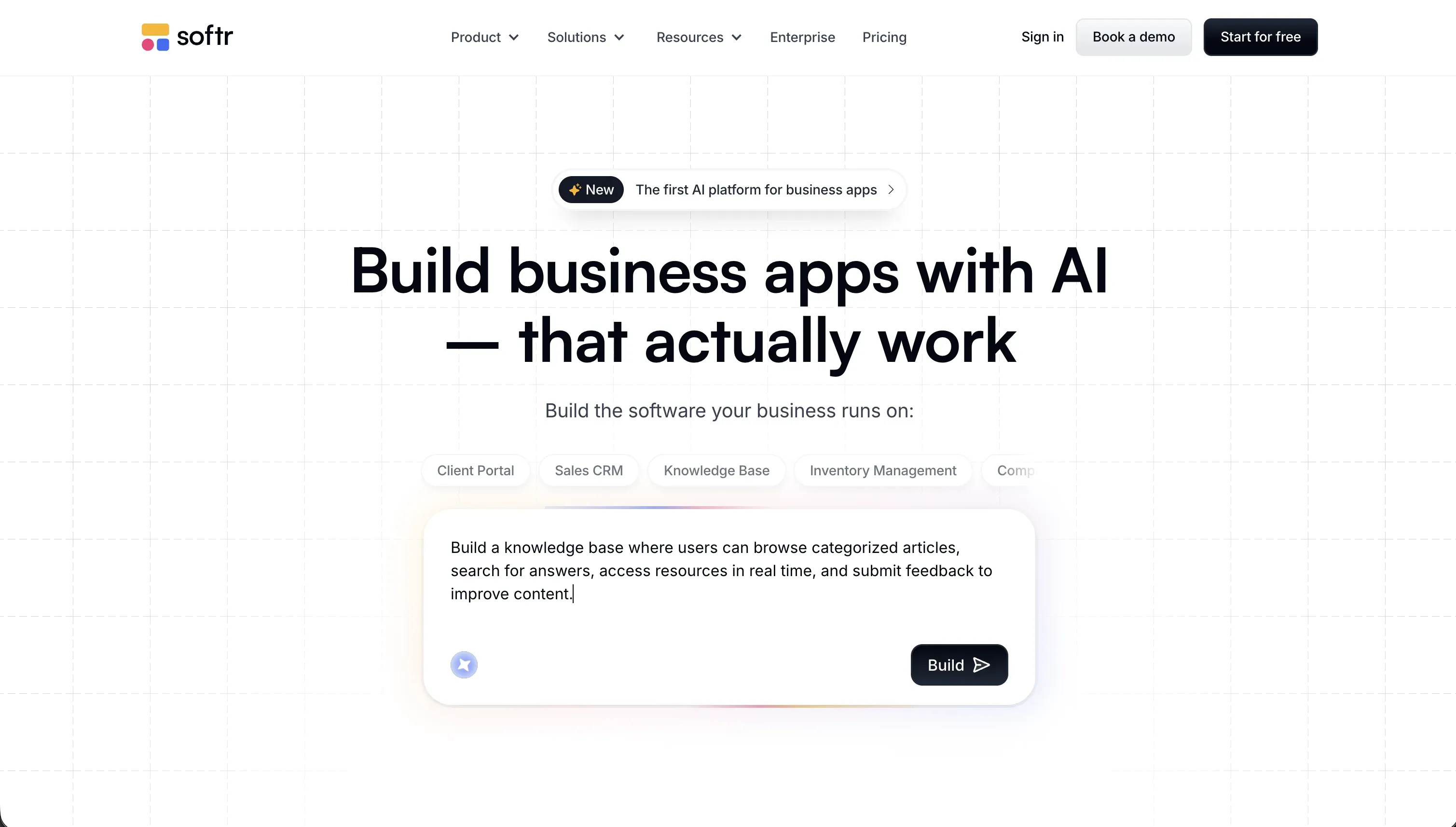 Softr homepage snapshot
For nonprofits and associations, Softr ranks first because its core architecture targets secure business portals and operational tools. The platform scores 9.0 in ease of build and 9.0 in maintainability, driven by a hybrid model where you can co-build utilizing an AI assistant or visually drag-and-drop pre-built block elements.
Crucially, authentication, profile utility routes, and visual user groups are platform-wide parameters rather than generated code blocks. This native model is essential when standing up private community spaces, organizing volunteer shifts, or implementing public directories with secure administrative update logic.
It handles the risk of client-side visibility leaks by executing CRUD database queries on the server side default. Professional costs $139 a month billed annually, supporting flat-rate scaling with 100 app users and zero per-seat friction. The honest trade is a design flexibility score of 5.5, meaning developers seeking pixel-perfect canvas control will hit a structural layout boundary.
2. Glide - best for mobile internal operations
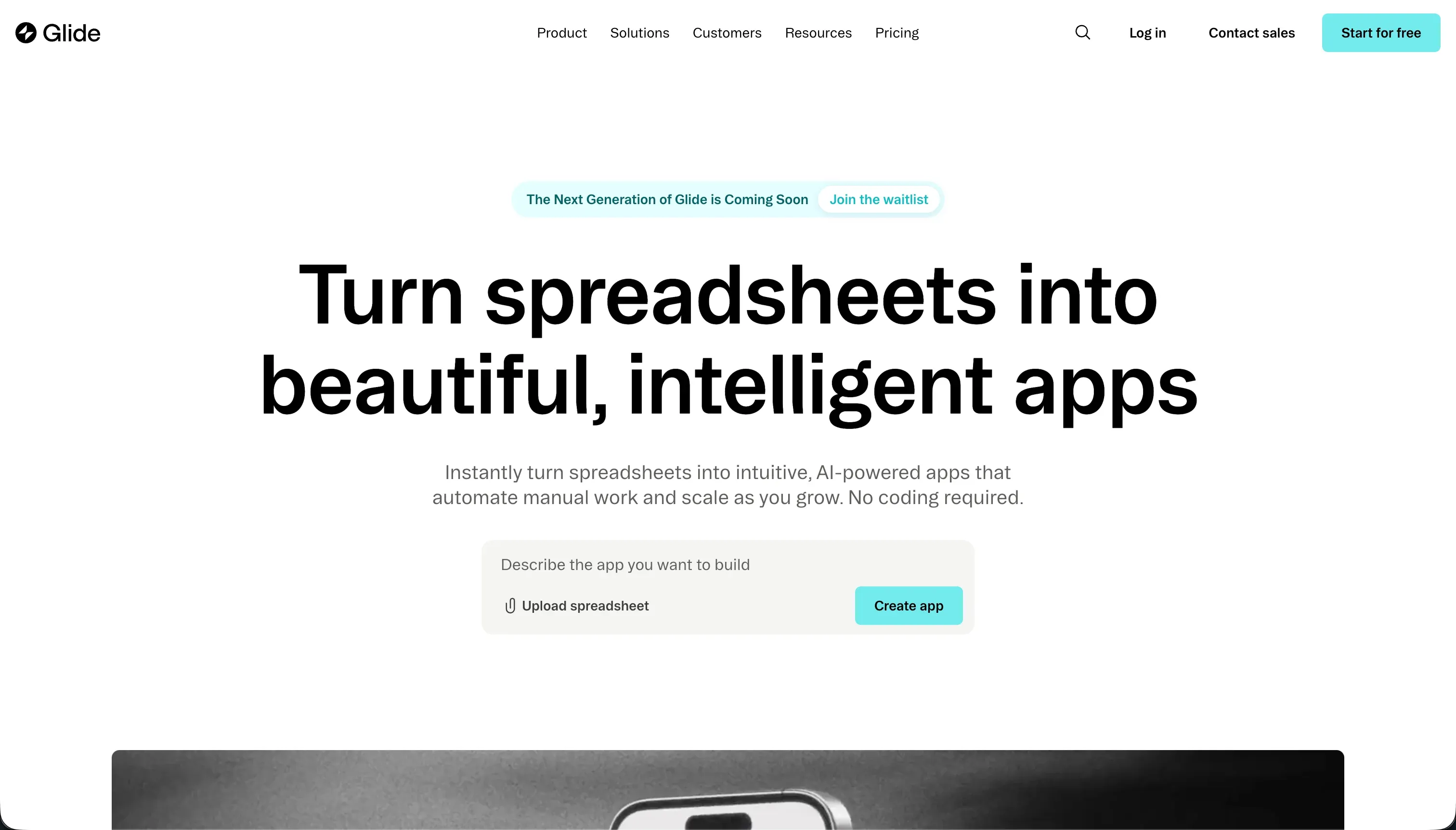 Glide homepage snapshot
For organizations seeking to bring spreadsheets into digital tools, Glide handles mobile operations with high efficiency. It scores 8.5 on ease of build by scanning a Google Sheet or Airtable base and scaffolding mobile-optimized layouts in minutes. This speed makes it highly useful for active program managers tracking equipment logs, site check-ins, or field volunteer schedules on mobile devices.
However, security & access control scores 5.5 because user group isolation rules are thinner than visual portal systems. For association membership directories where user levels dictate visibility, it becomes difficult to configure securely.
Furthermore, we exclude Glide for large platforms due to scaling prices: Business tiers cap at 100 users for $249 a month, meaning public communities can trigger costly contract upgrades quickly.
3. Airtable - best internal database for grant and program tracking
Airtable remains the gold standard database for operations tables, scoring 8.0 on data & integrations and 8.5 on ease of build. Relational links, rollups, and formulas let administrators connect donor records, grant limits, program costs, and volunteer rosters inside a highly intuitive spreadsheet interface.
However, its Interface Designer scores only 5.5 on production readiness and 5.0 on security & access control because it has no native customer login, forgot password routes, or robust client-facing layers. For external membership access, you must buy expensive guest seat packs which start at $120 a month for just 15 guests on paid plans.
To avoid per-seat fees and build a secure portal, associations typically run Airtable as a backend database beneath a dedicated frontend app builder like Softr.
4. Bubble - best for associations with custom programmatic logic
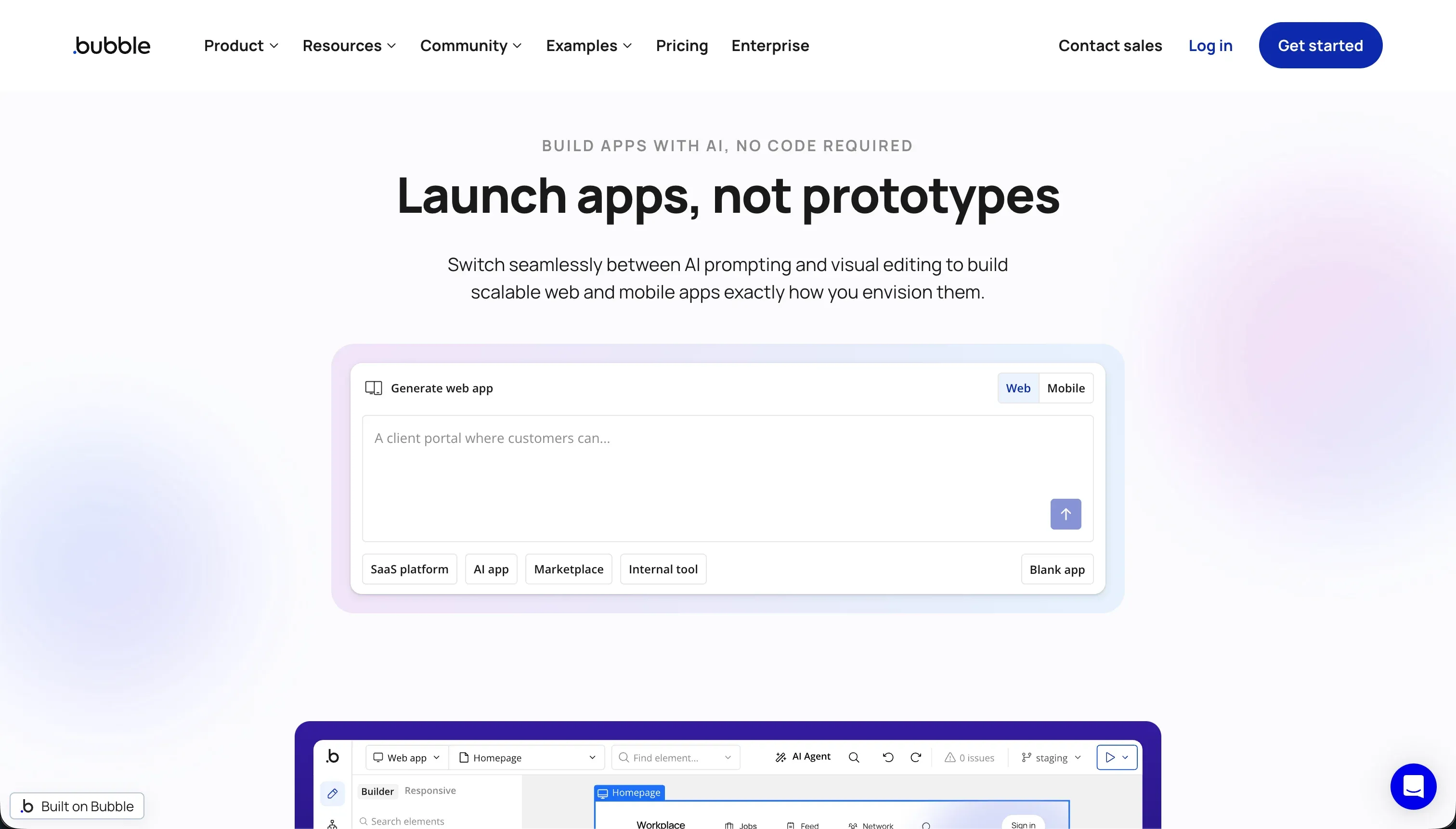 Bubble homepage snapshot
If an association runs on deeply custom operational algorithms, Bubble scores 8.5 in design flexibility and 8.0 in data & integrations. The builder gets pixel-level control and access to visual state systems. This depth allows associations to construct complex custom matching logical sequences, multi-step review workflows, or detailed programmatic filters.
However, we exclude Bubble for typical community applications due to database security and maintainability. It scores 5.0 on ease of build and 6.0 on maintainability because database privacy rules must be constructed manual, and minor logical errors will fail silently, exposing records to the browser.
Additionally, its volatile workload-unit pricing translates to unpredictable monthly bills, which is painful for non-profits managing fixed annual grants.
5. Replit - best code-first route for technical organizations
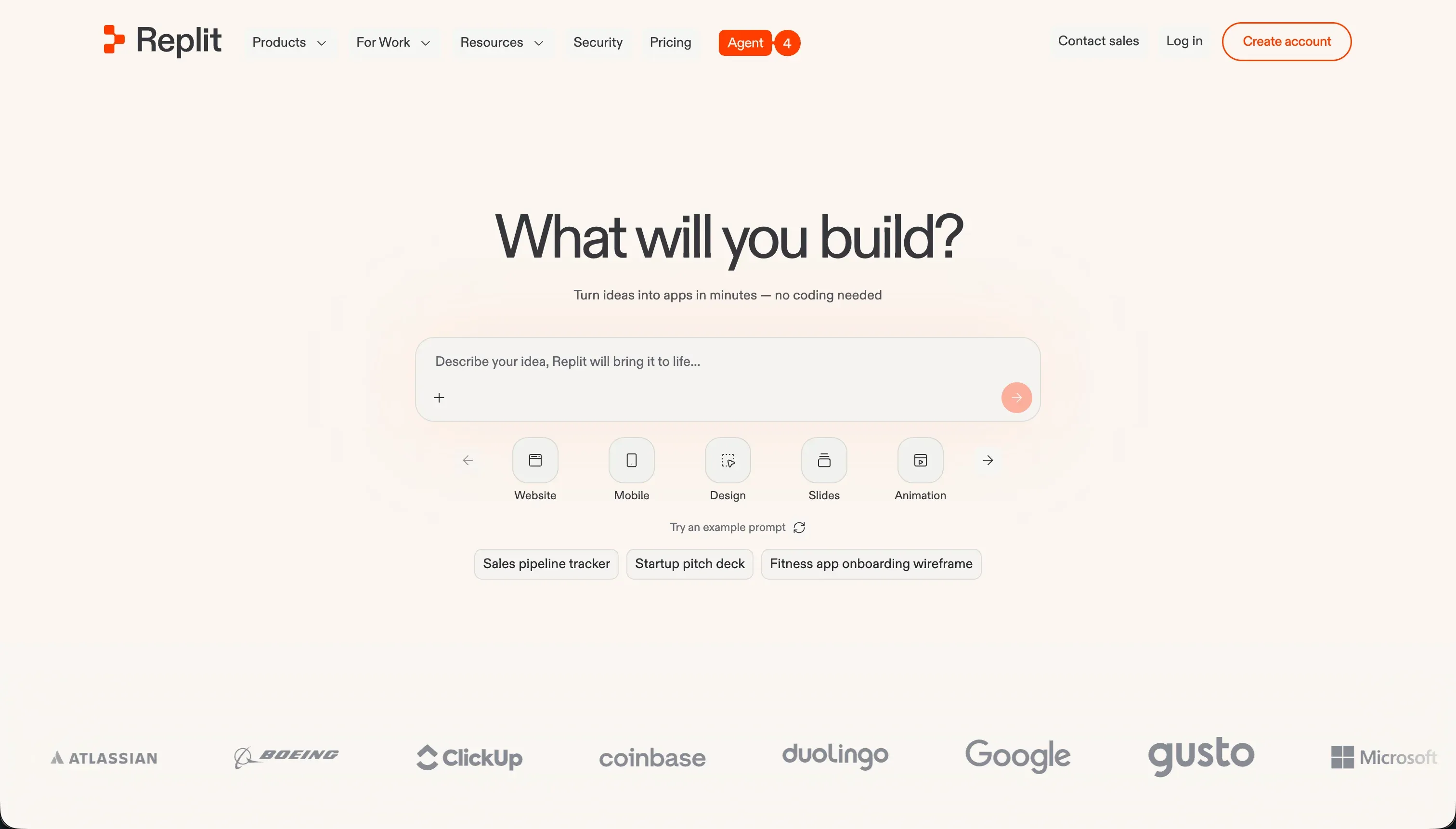 Replit homepage snapshot
Replit is a cloud-based development environment with an autonomous AI agent that builds and deploys real code. Scoring 8.0 in production readiness, managed PostgreSQL rollbacks, and custom domain deployment, it provides an exceptional exit path. Organizations that require absolute code ownership can export their codebase to any other server.
Its data score of 8.0 means anything possible in database code can be executed. However, security & access control scores 6.0 because roles and permissions live directly in custom-coded files rather than a visual administrative window. If your nonprofit does not have active internal developers to manage, inspect, and maintain standard package files, Replit is not an appropriate long-term choice.
6. WeWeb - best visual builder over custom backends
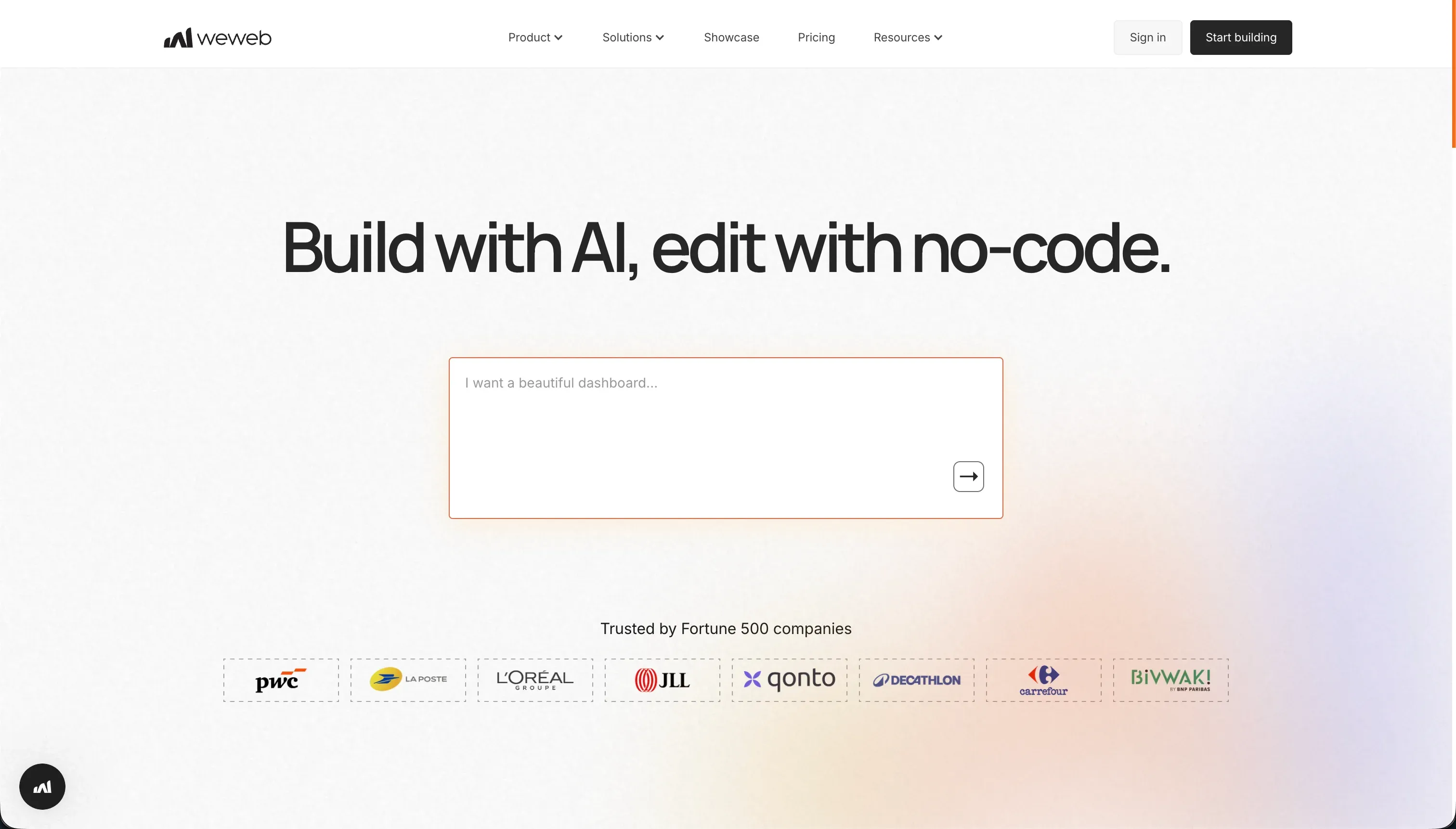 WeWeb homepage snapshot
WeWeb is a visual frontend designer built to connect to external databases, scoring 8.5 in design flexibility. It offers fine-grained layout parameters like CSS flexbox and absolute positioning, alongside Vue.js code export on staging. It is a powerful option for teams with existing IT structures. However, we exclude it for typical nonprofit builds due to its steep learning curve.
It scores 4.0 on ease of build and has a security score of 5.5 because WeWeb has no built-in database. Builders must manually configure token-based authentication and security flows against an external database like Supabase or Xano, translating to redundant multi-software subscriptions.
How to Shortlist and Evaluate Platforms
Selecting the right development platform for your nonprofit requires avoiding technical debt while matching your existing team skills. To construct a reliable shortlist, compare platforms based on the long-term cost of user expansion and visual maintenance. Our evaluated criteria details the full approach at our methodology page.
If you need custom member check-ins, class logs, or a secure public board, shortlist Softr and Glide. Softr is the best fit for scalable communities and external portals like a membership community app, while Glide serves lightweight internal operations quickly.
If your organization relies primarily on sorting relational datasets internally, shortlist Airtable as the backend engine. Review our analysis of specific workflows at our directories compilation and our event management app overview to see how components stack up.